About Paul Corney

@pauljcorney #KM4GOOD I help people and organisations to make better decisions that improve the way they work

The future for Legal KIM: An Outside/In perspective

I’ve long admired the work of Martin White on Information Governance, Intranets and Search and as Chairman of the Online Conference that used to be a must attend event at Olympia in December.  I fondly recall a Hilton Hotel, Heathrow T4 meeting at the end of the 90’s between the two of us and Gerry McGovern in which we hammered out the components of an Intranet checklist. And the horror at finding the parking bill was nearly as expensive as a tank of petrol.

We go back a long way, have worked on a number of assignments together and I once gave the Keynote Speech for Intranet Focus at the inaugural Russian Intranet Forum in Moscow where David Gurteen ran his first Russian Knowledge Cafe.

Martin and I meet regularly.  It’s one of the nicer aspects of working in alliance that you get to share ideas (within the bounds of confidentiality) with people you choose rather than those an organisation chooses for you.  In the Summer we met a couple of times to review experiences in Legal Knowledge & Information Management. I’d just given the Keynote speech at KM Legal and written a blog post while Martin was in the midst of a new assignment writing a digital workplace strategy for a prominent law firm.

Legal is changing, is KIM ready?

Martin too had noticed changes in the way law firms were working. As we compared notes we became aware that some of the knowledge management, information management and project management approaches that we had been using for many years might be unfamiliar to law firms. We decided to validate our conclusions by talking to some of our contacts in law firms and among the comments we noted were:

  • “We are great at capturing, not so great at sharing, especially when it comes to knowledge about clients”
  • “Too many people think that writing a project plan is all that is needed to make a success of Legal Project Management”

A couple of hours on 4 key topics

We have decided to set up a meeting at which we could share some of our experience with senior knowledge and information managers working in law firms. Our Breakfast Breakout will take place in the Benjamin Franklin room at the Royal Society of Arts on 9 December. Starting at 9.00am (but with breakfast at 8.30am) we will be covering (amongst other topics)

  • Knowledge Loss & Knowledge Gain,
  • Legal Project Management,
  • Getting the best from firm/client virtual teams
  • Stakeholder Engagement and Management

We will be talking about Knowledge Chameleons, the “Balloon on a Phone” and WTGTGQ – When They Go They Go Quickly. There will also be a chance to benchmark your own situation, though the Chatham House Rule will apply throughout the meeting. With just ten working days to Christmas we’ll provide a relaxed setting, no PowerPoint presentations, a good breakfast and an opportunity to support the PlanZheros charity instead of paying for a ticket. You will be able to be back at your desks by 11.00. The room will be set out cabaret-style and we’ll be moving everyone around after the mid-way break to foster networking.

How to register

Registration details will be posted here, on Twitter @pauljcorney and @intranetfocus in the next few weeks.

Donations to a charity

It being Christmas we decided instead of asking attendees to contribute to the cost of the event we’d invite them to make a donation to the Plan Zheroes charity I am a founding Trustee of. So much is happening on that front and the next three months are critical, we need all the help we can get to launch our new web/mobile presence.

How to become smarter: turning knowledge into an asset

Last week my 86 year old mother fell over an uneven paving slab on her way back from the library. Southfields Road PavementsThe swelling and bruising came out immediately and fortunately her wrist which took the impact of the fall wasn’t broken. Hand

She was badly shaken up by the event and took to her bed as a result.

Living in a location where a good number of the 100k residents are past retirement age according to a 2013 article Seaside town first place in country with average age of more than 70 and with many suffering impaired vision I decided to report the incident in the hope that the pavement might be fixed qucikly.

I was pleasantly surprised to discover a facility built on a Google Maps platform for reporting damaged pavements on the local government website (in 8 languages) and a twitter feed for instant access. So far so good.

The automatic response to my filing (and picture) was likewise encouraging and included the phrase ‘we will investigate’ along with a reference so I could track the progress.

I wondered whether in the light of mother’s predicament what the process is for making a claim – she wasn’t going to, that’s not the way her generation are wired! On the face of it everything seems well managed (except the walkway) This paragraph (also from ESCC’s website) stood out:

Thinking of making a claim

Please consider the following points before you submit a claim. Making a claim can be a lengthy process and may not result in a pay-out. Any compensation is paid from public money so we will always be robust in our investigation of claims. The decision on liability will be based on the facts of each case and the law. Because of the legal defence available, on average, 70% of claims are unsuccessful.

The last sentence (my underlining) is instructive and made me ponder whether the use of the technology is for offensive or defensive purpose? Have we become such a litigious society that every corporate body feels compelled to get their retaliation in first and use  social media as a broadcast and defensive mechanism not a collaborative platform?

I digress. Let’s be charitable and assume good intentions and applaud this as an example of good knowledge capture and retention.  What we don’t as yet know is whether this will become a good example of how knowledge can be put to good effect and improve a process (or in this case fix something that isn’t working).

The concept of Knowledge Capture & Retention seems to be much in demand: I will have run 3 Masterclasses on the subject this year alone (next London event 18th November). And having just completed a 7th visit in 12 months with Ron Young of Knowledge Associates to an industrial/engineering client in the Middle East where small changes in processes can have a material impact on performance I know how important it is to have a process that turns what you have collected into valuable Knowledge that changes the way you work or the new product development processes you follow. If not you have a set of ‘lessons identified not lessons learned’.
So what’s the secret?

When Knowledge becomes an asset

Most organisations go down the Knowledge Capture route – they create buckets (increasingly in SharePoint) to store what they have captured to make sure that the best knowledge is available when a bid, a presentation or a decision is to be made.  And that’s fine as far as it goes. Rarely do organisations add on the Knowledge Harvesting step. Here’s what that entails (drawn from Knowledge Associates’ 9 Step KM Process that acknowledges and builds on the original BP model of learning before, during & after):

  • Conduct a learning or After Action Review
  • At the end of that process ask the question does what we have discovered have the power to change/improve the way we (and those associated with us) work?
  • If the answer is yes then you have what is known as a Knowledge Nomination and these should be considered at a separate gathering.
  • Now convene, if you don’t have one as part of a Community of Practice, virtually or in person, a group of Subject Matter Experts with expertise on the process or way of working. Ask them to consider whether the Knowledge Nomination will improve our process and should be adopted.
  • If they agree then change the process. If they don’t then make sure you have captured the Knowledge Nomination and the reason for its rejection.

I have always believed that the purpose of Knowledge Management is to help organisations make better decisions and work more effectively. The simple steps I’ve outlined above should help in acheiving those objectives.

I wait now with interest to see the outcome of the saga of the loose paving slab. Will the outcome merely be a repaired section of pavement or will the team think about how this was caused and put in place measures to stop it happening next time?

A canoe, a pieris japonica and a conducive space: key ingredients for special and productive meetings

I often refer to the metaphor of: ‘Drinking from the fire hydrant ‘to describe what it feels like trying to keep up with the wave of material that hits our email in boxes.  And if like me you have 4 mail accounts (for different businesses and pro bono activities) you will know the challenge. In the past filtering of content was handled by the manual clippings service which collated material and grouped it according to a set of predefined topics.

Today much of that is automated but you still end up skimming and relying on trusted sources. I find less is more and prefer thought pieces from organisations such as the McKinsey Quarterly and Strategy & Business (formerly a Booz and Company publication now part of PWC).

meetings are the factory floor for knowledge workers

This week’s thought leadership interview by Theodore Kinni in Strategy & Business about meetings caught my eye. Based on a book Let’s Stop Meeting Like This: Tools to Save Time and Get More Done by Dick and Emily Axelrod, a couple of quotes hit home:

S+B: Why should executives be concerned about meeting effectiveness?
DICK AXELROD:
Meetings are the factory floor for knowledge workers.They are where a lot of work gets done—or should get done—these days. Organizations are getting more complex, and making them work requires people to meet. Meetings are also artifacts of the organizational culture. If you change the way you meet, you can begin to change your culture. And meetings are huge engagement opportunities. They are where people decide whether they’re going to sit on their hands or they’re going to put their wholehearted self behind whatever needs to be done.

AND

…..These five factors—purpose, challenge, autonomy, learning, and feedback—provide a way of thinking about a meeting that goes beyond the agenda and mechanics, like how you set up the room. If you can embed them in your meetings, you should have good ones.

S+B: How do you embed them?
DICK AXELROD:
We use something we call the “meeting canoe” for that. It’s a six-stage process that represents the order, shape, and flow of the meeting experience. First, you welcome people and connect them to one another and the task. Then, you help them discover the way things are, and elicit their dreams about what could be. Next, you help them come to a decision about what should be done and ensure that everyone is clear about the decisions reached and who is going to do what. Finally, you attend to the end by reviewing the decisions reached, identifying next steps, and reviewing how you worked together.

choose which meeting you attend

This all struck me as being true! We are all looking for ways of making meetings more effective and the idea of making them voluntary (you have to see value and want to attend) is one that plays very well with Open Space Meetings – A method of running meetings – the agenda is decided on the day by participants and there are five main rules during the mini-breakout sessions:

  • Whoever comes are the right people: this alerts the participants that attendees of a session class as “right” simply because they care to attend
  • Whatever happens is the only thing that could have: this tells the attendees to pay attention to events of the moment, instead of worrying about what could possibly happen
  • Whenever it starts is the right time: clarifies the lack of any given schedule or structure and emphasises creativity and innovation.
  • When it’s over, it’s over: encourages the participants not to waste time, but to move on to something else when the fruitful discussion ends.
  • Law of Two Feet” (or “The Law of Mobility”). If at any time during our time together you find yourself in any situation where you are neither learning nor contributing, use your two feet. Go to some other place where you may learn and contribute.

You need special people and a confident organisation to run Open Space Meetings.  Most people need an agenda published in advance in order to decide whether to attend. In many of the cultures I work with such a session would be viewed as frivolous at best.

What I have observed, and why I was drawn to many of the assertions made by Dick and Emily, is that set up and space are so important.  Its a core theme in Masterclasses I run.

the right space and the right culture

view of the CityA month ago I was a guest at the official opening of dotmailer‘s new Head Office concurrent with their 15th birthday.  I had the pleasure of working with them in 2005 when the founders were thinking about where to take their evolving business (then called Ellipsis Media) and Tink Taylor (Founder) has been very generous in recognising that contribution in the what others have said section of this site – I will publish a note on that in due course.

I mention the testimonial as the company I looked at then has many of the same people still working for it today. Much of that is down to the working culture and collegiate approach which their new HO building in London which overlooks the City reflects.

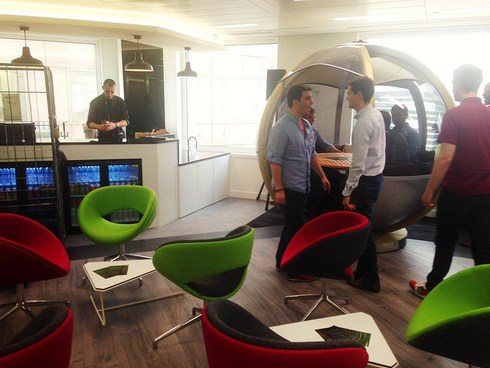
dotmailer kitchenI particularly liked the use of the English style tea house (kitchen) which houses the original table from the pub in Croydon where the 3 founders first met and discussed the business.

And the use of the bubble pods for meetings and the iPad driven coffee machine.  Make the best coffee and people will meet around it, site the meeting areas close by and people will use them. dotmailer has dotmailer podsmade meetings (and work) fun and its dramatic growth as a business would indicate its a formula that works.

and finally

My title draws on three metaphors: a canoe, a pieris japonica and a conducive space.  I’ve dealt with the space issue above. Here’s what Emily Axelrod said about the canoe:

EMILY AXELROD: Our graphic artist, Bob Von Elgg, came up with the canoe as a metaphor for meetings. We love the idea because a canoe requires direction and coordinated action to move through the water. And when you look at a canoe from the top, its shape is reminiscent of the meeting experience: A meeting is a conversation that starts out small in the welcome and connection stages, it reaches its widest point when you’re discovering the way things are and eliciting people’s dreams, and begins to narrow again as you decide what to do and attend to the end.

Plants, like humans, require the right environment to flourish: put a shade loving plant (or person) into the limelight for too long and they go off colour; give them the right nutrients and feed them and you will reap the benefits.  Below is a Pieris Japonica I have grown from a small plant.  At the start of the season I gave it too much light and put it in a draughty spot – the leaves went brown and it lost its colour. Now in a sheltered spot (out of the wind and part shade) it has had a resurgence.

Managing meetings is an art form requiring careful husbandry. Get it right and the results will be spectacular!

Pieris Japonica

Tips for working on international assignments (part I)

Thanks Frank (Gardner)

It was he who encouraged me to blog about my experiences and I have always wanted to be able to share some of the techniques I’ve come to adopt when undertaking international assignments. The offer by Sandra Ward and Val Skelton, Co-Editors of Business Information Review, to write an article for the forthcoming edition was too good to miss and so today I submitted that piece.

Here are just a few snippets from my submission (the pictures won’t be appearing):

Abstract

In today’s global village the ability to work cross border and cross culture is increasingly important. This article looks at the lifecycle of an assignment from winning and negotiating to working and collaborating concluding with reporting and getting paid. It examines what it takes to run successful international assignments while identifying a number of potential pitfalls to be avoided and issues to be considered.

Baggage trolley at El Fashar Airport DarfurI am lucky; I’ve worked across five continents and experienced many different cultures over the last 40 years. I’ve been shot at in Ireland, detained in Sudan, been part of an aid convoy in the Philippines after Typhoon Ondoy, slept in a tin shack in Darfur, shared a room with a desert rat while watching oil fields burning in Saudi Arabia in the aftermath of Desert Storm and landed in Barbados after the island’s only hurricane.

When I reflect on a few snippets from a lifetime of conducting international assignments it’s perhaps unsurprising that my daughter frequently asks the question at the top of this piece.

Winning the business

We’ve all had ‘we’d like to invite you to tender for’ requests from organizations we’ve never met. As you become more visible and published so these increase. As a rule unless you can trace a direct link to someone you know or somewhere you’ve been then you are being used as padding for a tender process. Be warned. It takes a considerable effort to respond to tender requests especially when there are procurement specialists intermediating….

Negotiating the ‘deal’

….An African friend of mine signed up for a consulting engagement with one of Africa’s major organizations. It looked great and met all of the criteria outlined above. Payment was triggered by receipt and acceptance of a set of reports and recommendations. Now 9 months later he is still waiting for formal approval for his reports. His mistake? He had no milestone payment and no upfront mobilization fee. Next time he might insist on a payment for delivery with balance on acceptance.

Travelling and staying

… Before I decide on whether to go or not to a country I check out what and whom I know who might help – I conduct my own ‘Peer Assist’ – and visit the members’ library at Chatham House.

…Accommodation can make or break an assignment! A client will often give you an allowance or have preferential rates. Expensive doesn’t always mean good; proximity to your client is vital as is the ability to work in your room. For Darfur Victoria Ward and I had to undergo UN security training. It taught me a number of things I use today when asking for a room:

  • Above tree line and below floor 7
  • Preferably not facing the street
  • Proximity to fire stairs.

Working & communicating

The Culture Map which notes that human speech varies depending on whether there is a “high” or “low” level of assumed shared cultural context. This affects vocabularies: the English use more words whereas North Europeans (and Americans) tend to be more forthright.

Why is this relevant? If you don’t adapt your style and (in my case) speak slower, write more succinctly and with less jargon, there is huge potential for miscommunication….

Importance of set up

If the way we speak, write and hold ourselves is important so are the technological underpinnings. Consider this: in many organizations the jump drive (memory stick) is banned. There is a limit on email size (try sending a video to a client), browser activity is monitored and restricted and guest access behind their firewall requires countless sign off and takes days!….

Listening ears and noticing eyes

How you are received on arrival is usually a good indicator of how important your visit is…

…I also find it pays to listen more than talk especially in the early parts of an assignment, as someone once said ‘you have two ears and one mouth and should use them in that proportion’…

Friendly ‘fire’

Assuming you are by now super observant and minding your P’s & Q’s, the next big challenge facing you is how to work with your immediate stakeholder group. You need to establish separate sounding boards not just your project sponsor…

Handling left field moments

Even the best of us can inadvertently put a metaphorical foot wrong. Our actions are magnified when we are dealing in a different environment and out of our comfort zones….

…Perhaps my most surreal experience occurred in Sudan when I was invited to visit a major company for a discussion only to find on arrival there were 200 people assembled to hear my presentation on ‘Knowledge Management in the Energy Industry’. After recovering from the shock I conducted a 45-minute Q&A session prompted by an opening, ‘What keeps you awake at night?’

Reporting and getting paid

I’ve had mainly positive experiences dealing with international clients and getting paid. Typically the more ‘developed’ the country the worse organizations (especially governments) are at making payment if you are an SME.

However I’ve found people will try and find a way to pay you if they feel you’ve done a good job. Your challenge is to manage that perception!…..

Ten tips

If I were advising someone about to undertake their first international assignment what would I tell them?

  • No credit cards in SudanClarity is key, ambiguity is the enemy of progress: be clear about the terms, what they are going to get, when and in what format and what help and assistance you need from them in order to deliver it.
  • Prepare for the unexpected: plan for disasters and have a backup (if you are on medication take that in your briefcase); save your work to the cloud (securely of course). Adopt my 50/50/50 rule and always have that amount of £, € and $ in your wallet.
  • Keep detailed field notes and conduct regular After Action Reviews or Pause & Reflect sessions as a team: It’s vital to be able to reflect on what you’ve heard and to have the ability to play that back in regular progress reports.

I will share the rest of the article and the remaining seven tips over the coming months.

Awash with Artichokes: making the most of surplus food at Borough Market – Risotto Primavera

Artichokes are aartichokes-for-good-healthn acquired taste but when you are hungry they are delicious. This is a recipe with basic ingredients: a few determined people, a dash of technology (soon to be enhanced), a sprinkling of generous traders and a huge dose of imagination from the cooks who mixed ingredients.

Week One: from small beginnings – 5 traders, 1 charity (Dragon’s Cafe)

After a little bit of encouragement from Charlotte Jarman (an Anthropolgist project manager of FoodSave project at Sustain who has helped to develop tourism projects with coffee-growing communities in Peru and Tanzania), aided and abetted by Plan Zheroes, London’s Borough Market adopted the idea of making surplus food donations.
The scheme begain in June and received good local press coverage, here’s what Sustain said: London’s Borough Market sends surplus food for use by a local charity.’

The first week’s donations got a lot of publicity including London SE1 Community Website. One of its reader’s, Abi Todd got in touch:

Hi Plan Zheroes

I read the article on SE1 about linking up food from Borough Market with the Dragon Café. Your work sounds amazing and I would love for us to get involved.

I manage a young people’s hostel for 116 vulnerable people aged 16-21 in Borough. We are making frequent use of Food Banks and I would be really interested in investigating if we can link with local food suppliers to supplement this. many of our young people are sanctioned for long periods of time, and food poverty and poor nutrition are rife.

The organisation I work for is Look Ahead Care and Support www.lookahead.org.uk , and I attach our service leaflet so you can see a little of what we do.

Do get in touch if you think we could work together on this.

So we did!  We asked Abi to create a profile on the Plan Zheroes map, sign the charity agreement and connected her with Charlotte at Sustain; one week later they were ready to collect surplus food.

Week Two: ‘exit the Dragon’ (temporarily); enter Look Ahead

With the Dragon Cafe unable to receive a donation Look Ahead steps in. By now word has spread and volunteers appear from Plan Zheroes and Sustain to help collect and distribute the surplus food. Sustain and Charlotte
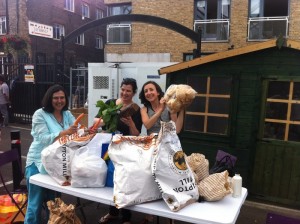
Jacopo of Plan Zheroes weighs donations and we record details, the volunteers from Look Ahead pack it and take it to the charity. Charlotte (of Sustain) registers donations week by week, so we all have an idea of what and how much is being donated.

There was much more food to take LookAheadand Jaqueline from Look Ahead, came with one young person and one (very) big bag… luckily they also had money to call a taxi!
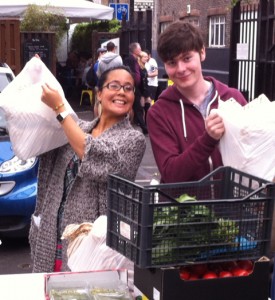
At the donation collection point, we had a surprise: an unusual donation of artichokes. Jaqueline’s face, was a picture: we wondered if she knew how to cook and eat Artichokes… and secretly Jaqueline was already wondering if the young people they help would like it!

We raised the issue her face had betrayed and Jaqueline shared they run a weekly “Masterchef’ session, wondering if we would be able to run one with them for the Artichokes?!  Abi replied again:

On Thursdays we run “masterchef” sessions where staff or young people run cooking sessions. It’s a really well established feature of our week at Gateway and your support with making use of donations would be really appreciated.

Week Three: Masterchef Ivan and the Artichokes class
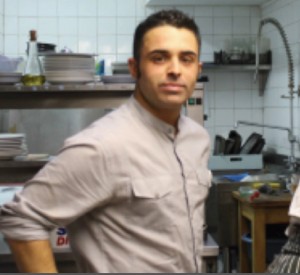
IvanOf course the next step was to engage Ivan Cubillo – a Zheroes Volunteer, who is a professional chef and just graduated as Nutritionist, here is what he said:

“Artichokes are a bit tricky but once you know what to do with them are delicious!! I know few tricks to cook them with not much hussle.”

So now everything is set up, Ivan is running a MasterChef session on Artichokes.

And the story has a happy ending:

We now have to wait and see when Ivan goes to Look Ahead – Gateway for the Masterchef. Meantime over 150kgs of food was prevented from waste, and 180 young people have access to delicious food from their very local Borough Market!

Back to Abi who confirmed inter alia that:

We can definitely commit to Saturday collections over the Summer. We could handle more – mostly so far we’ve just been giving it straight out to residents, who have been cooking it themselves, but there is a fair bit of scope for us doing communal cooking activities as well. (Ivan is coming on Friday to meet me to discuss)

The veg fits in well with our ‘Healthy Conversations’ programme which is all about encouraging better lifestyles and choices, so we are happy to facilitate as much healthy stuff coming into Gateway as possible.

I counted 7 pallets yesterday, and we also had about 4 cardboard boxes.

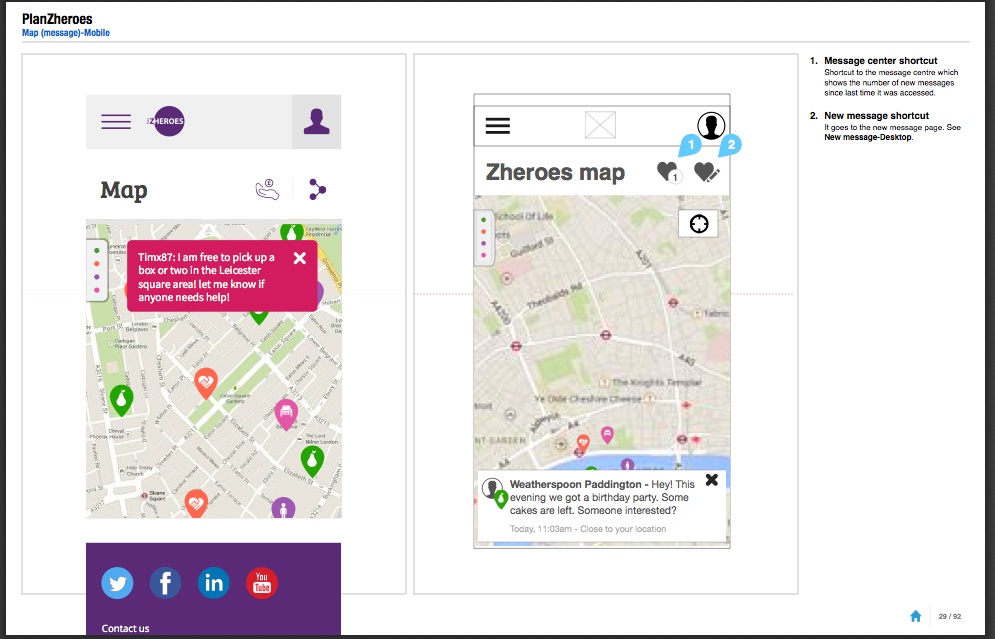
The role of a food knowledge broker is never dull and once the wonderful new mobile application is launched from next month, thanks to our friends at Keytree who have given us massive support, we at Plan Zheroes will be able to do so much more and help make much better use of surplus food. Here’s a sneak preview of how a conversation between a donor and a recipient might go:
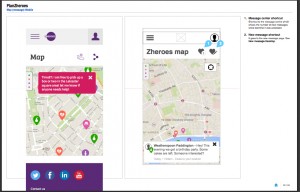
PZ Wire frames - mobile1 Jul14Even if you can’t help with effort as a volunteer or food as a donor you will be able to by making a financial contribution. Plan Zheroes is a registered charity and like all not for profit organisations we need funds to keep afloat.  Thanks for reading this and watch this space for the results of the Masterchef session.

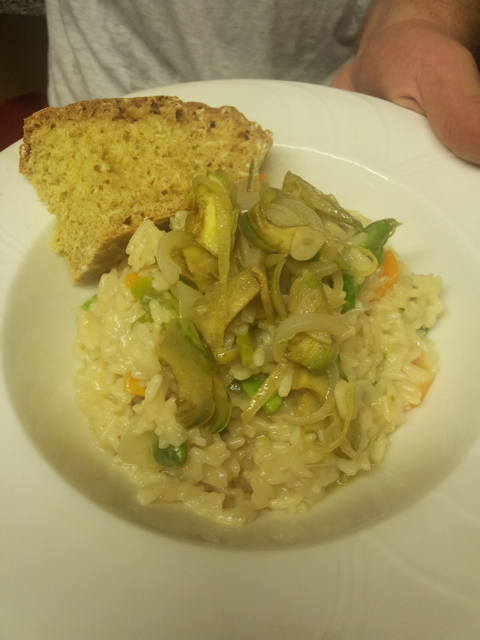
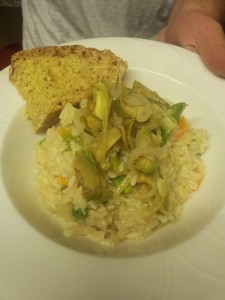
Now that’s what I call an imaginative use of Artichokes – Risotto Primavera:

Here is Ivan’s account of his MasterChef class

Today it was a good day at Look Ahead. The participants showed commitment and good attitude troughout the session. Tommy who works at Look Ahead helped wonders and it was a fun person to be around. Soda bread was a huge success and although we had to tweak the recipe a little bit, the result was amazing! On Monday, the charity received/collected asparagus, broad beans, spring onions, kale, broccoli and (as Tommy said) “lopads” of carrots. With such as a good variety of produces the choice was obvious: Risotto Primavera! After frying the onions and garlic we add some carrots chopped up nicely. Then we add our rice (no rissotto rice? No Problem!) Tesco did not have risotto rice so we end up using long grain rice (Challenged accepted!). Once we add the rice we started stirring our rice to release all the starch…adding slowly our lovely beef stock  was next (Thanks stock cubes!) and when our rice was almost done we added the broad beans and asparagus (they were previously blanched) and  finished the rissotto with butter and cheddar cheese (parmigiano a bit too expensive for our budget). And the Artichokes? Well, we almost forgot the artichokes! (Here is where the Chefs skills come in handy) Quickly we peeled a couple of them, thinly sliced them and sauteed them with garlic and onions, we add a bit of water until they were nice and soft. The par-roasted artichokes looked delicious on top of our rissotto and the guys in the workshop loved them. Overall, great experience in Borough Road, people loved me (no wonder!) and I loved them, so “this could be beginning of a beatiful friendship”.

Best,

Ivan
Rissota Primavera