“What’s in it for me”: sharing client knowledge in a workplace with 4 generations.

On March 2nd I was in Broadgate talking to the Chairman and two Managing Partners of a law firm. There, at the invitation of the Chief Operating Officer, we were discussing inter alia how to deepen relationships so that when the senior relationship manager departs, their knowledge, networks and clients don’t depart with them.

‘Why would I change, there’s nothing in it for me’

Against a backdrop of increased M&A activity and potential ‘Lift Outs’ (hiring of teams from another firm) we talked about why millionaires would share what they know for the benefit of the rest of the firm. I recalled an incident from a previous client, a federation of 13 businesses with very wealthy MD’s who had no intention of passing on what they knew about clients or cross selling for the good of the whole firm. This is what one MD said:

I wouldn’t let …. anywhere near my client;  for a start my business is unique and I don’t want them ruining a relationship which has been built up over many years.  Ours is a relationship business and I have an assistant who knows everything about the client and we store all information on the …. system.

And this from a senior banker:

I have a flat in London and a house in Umbria. I drive an Aston and the school fees are all paid. Why would I want to change?

These are not untypical responses from the upper echelons of organisations.

‘I have no assets so I go where the excitement is’

Contrast that with these factionalGeneration Rent’ (People born in the 1980s who have no hope of getting on the property ladder, a term coined by The Independent’s Tim Walker) examples arising our of conversations I had a few days ago.

Sam‘ is 30. He left college and became a talented electrical engineer.  As part of the BT’s acquistion of EE he now finds himself in demand.  His prospective boss (a newly promoted middle manager) sends him an email in which he tells him how lucky Sam will be to work on his new team – I kid you not!  So Sam retorts, ‘actually I am not going to work for you or on your team…’

Sam lives with his girlfriend, they are able to afford to rent but have little immediate prospect of owning a home. She is training to become a teacher.  Their horizons are near term and they want to work for people who share their values where they can move on when the role (or people they work with) becomes uninteresting.

Sam’s father Matt who is in his late 40’s had a mortgage at 21 fuelled by the belief that home ownership was the ultimate benchmark of a civilised society. Sam doesn’t feel the same, for him experience is more important.

Micha‘ is 23 and has been in work for 2 years since graduating from Univeristy of Southampton. She doesn’t know if she can afford to leave her parents to move in with her boyfriend. Her world is governed by whether she can service her credit card and overdraft and of getting away from a 45 year old middle manager who has read the corporate values manual but disregarded it from day one in his pursuit of a plethora of consumer durables. He speaks the talk but doesn’t walk it.

Generation Rent employees have a very different set of values and aspirations from their colleagues.  Unable (or unwilling) to join the property owning fraternity they are more transient than their predecessers and do not have the same sense of attachment. They will go where the action is unencumbered by physical assets.

They come to firms with a developed sense of online community but are less adroit at human interactions.  Engaging with these organisational foot soldiers is going to be one of the biggest challenges facing senior management over the next few years as they try to make organisations leaner and more productive. And no longer I fear can Senior Managers subcontract the task to HR, Learning, Training or indeed Knowledge Management or rely on the cascading methods of communication that have been prevelant in most organisations seeking to get changes made and messages understood.

crossing a broad chasm

The proportion of people classed as Generation Rent is predicted to expand as UK home ownership becomes a distant horizon.  This gap isn’t going to close quickly so organisations are relying on squeezed middle management to be the water carriers between the top and the bottom. For the first time ever we have 4 generations of workers all working at the same time!

In the current edition of ‘The World Today’ Chatham House’s bimonthly magazine there is piece on a recent members event during which Kevin Sutcliffe, Head of News Programming EU, Vice News had this to say:

There is a notion that television news and documentaries attract an older audience. The logic in editorial meetings at Channel 4 News and the BBC is that people aged 18-35 aren’t interested in the world.  VICE started to put out documentaries about the coup in Mali or the way Egypt and the Arab Spring was unfolding. They were very popular. They had engagement times of about 25 mnutes and they were getting hundreds of thousands of views. So there is great interest from that group in the world. The issue was the way it was being presented. Most television talks down to people, and that is not representative of 16-35 year olds.

I found this encouraging and supports a comment from Gordon Vala-Webb who Sandra Higgison interviewed a few years back when my colleagues and I at Sparknow were conducting research into the Evolvng Role of the Knowledge Manager. In response to a question that indirectly asked how his KM initiative at PWC Canada impacted all ages and levels of seniority Gordon said:

Our biggest portal users have been here less than six months

What is striking about all of these examples is the expectation and motivational gap between those at the top and those lower down the organisation which prompts this question: Is a fundamental shift needed in the so called Social Contract between employees and firms to bridge this chasm and make organisations more sustainable?

How to close the gap

Create a Corporate Social Contract (with embedded KM aspirations)

In a recent piece of work engaging with a brand new Senior Management Team I encouraged them to get their personal values and beliefs on the table and craft their own commitment to each other and the team.  It mirrors this piece extracted from Harvard Business Review For Great Teamwork, Start with a Social Contract https://hbr.org/2012/04/to-ensure-great-teamwork-start

To turn groups of employees into great teams, a powerful first step is to form a social contract — an explicit agreement that lays out the ground rules for team members’ behaviors. A contract can cover territory such as how members will work together, make decisions, communicate, share information, and support each other. Social contracts clearly outline norms for how members will and should interact with one another.

Team norms exist whether openly stated or not. A good leader should facilitate sessions with his/her team to uncover the existing norms, both positive and negative, that impact team functioning. Establishing a social contract can reinforce positive behaviors while helping teams to overcome dysfunctional ones.

I’d add one aspect here: the development of Knowledge Competencies (at a personal and corporate level) should be a thread that runs through this document.

Contemplate disintintermediatimg middle management

This will be heresy in some quarters but I generally believe we are at a tipping point when it comes to how organisations are working.  The interpretation of messages from the top and flow of ideas to the top while often seen as an important filtering process seems to me more likely to alienate Generation Rent employees who are used to collaborative not command and control environments. Dialogue has to be more transparant not more opaque.  Social media is exacerbating the naming and shaming of bad organisations who are often characterised by a broadcast rather than collaborative approach to internal and external communications.

Go 3 Levels down for an effective client relationship

When I set up a client strategy process at an investement bank the first challenge was how to widen and deepen relationships with our major fee earning clients so that we could accomodate the departure of a key Relationship Director. We only considered a relationship ‘secure’ when there were three contacts at three levels across our and their organisation. We documented what we knew and kept it current with regular contacts at all levels.

However, then, as now, successful ‘rain makers’ could demand want they want; a case of a slightly skewed symbiotic relationship, wherein Senior Management pay lip service to values statements and Corporate Social Contracts while bowing to commercial reality? The process worked primarily as I reported to the General Manager and CEO and carried ‘the pen’ with a mandate for change and the ultimate sanction of appointing a different Relationship Director if another refused to participate.

In another meeting last week in The City I was with the KIM Head of a large global law firm overseeing the process of deepening relationships with clients. He recognised the need for a meaningful client relationship to be 3 level deep and the importance of illustrating the differences in the way we all see the same event or object. His company is getting clients in at 3 levels for show and tell and share sessions as a way of cementing a relationship and getting expectations and aspirations out on the table.

Focus on Risk and Assets as a framework when thinking about what Critical Knowledge to keep

What struck a chord during last week’s meetings was the notion of risk – most organisations understand risk but few set about managing Knowledge in that context or seeing Knowledge as an asset. While a lot of work has been done on the Risk of Knowledge loss less has been done on  the value of Knowledge Assets.
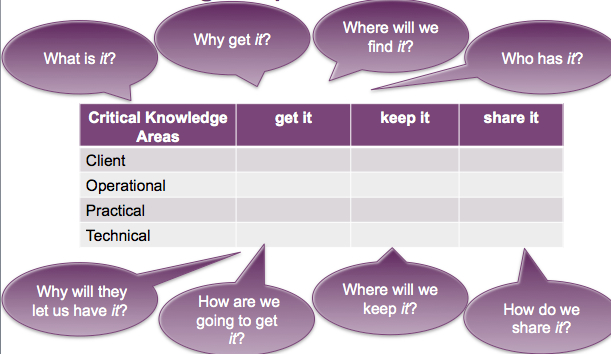
Critical Knowledge Matrix

Following a conversation between John Wade (Gill Jennings & Every) and Paul J Corney

This is how one organisation is starting to think about how to contextualise the capture and retention of its Critical Knowledge. This statemant (also from HBR – Managing your MIssion Critical Knowledge – January 2015) sums it up well:

Few companies think explicitly about what knowledge they possess, which parts of it are key to future success, how critical knowledge assets should be managed, and which spheres of knowledge can usefully be combined

Its a topic I will be picking up over the next couple of weeks at KM Middle East in Dubai where I am making a speech on Why effective knowledge capture and retention matters  then running a workshop on Unlocking the true value of Knowledge Management: identifying and assessing your organisation’s Knowledge Assets and then Singapore where I will be running Masterclasses.
 

Fired up but not yet ready to go: Legal KIM response to 2015 challenges

A month back Martin White and I ran a breakfast breakout event for professionals in Legal Knowledge & Information Management. Those who follow mine and Martin’s musings might recall the event ‘The Future for Legal KIM: an outside in perspective’. Our aim was to present our thoughts to a group of Legal KIM’ers and seek their views.

These were the topics we foresaw as being important in 2015:

  • Lawyers come and go – capturing knowledge at speed
  • Collaboration and KM beyond the firewall
  • Getting the best from virtual teams
  • Bringing it all together – legal project management

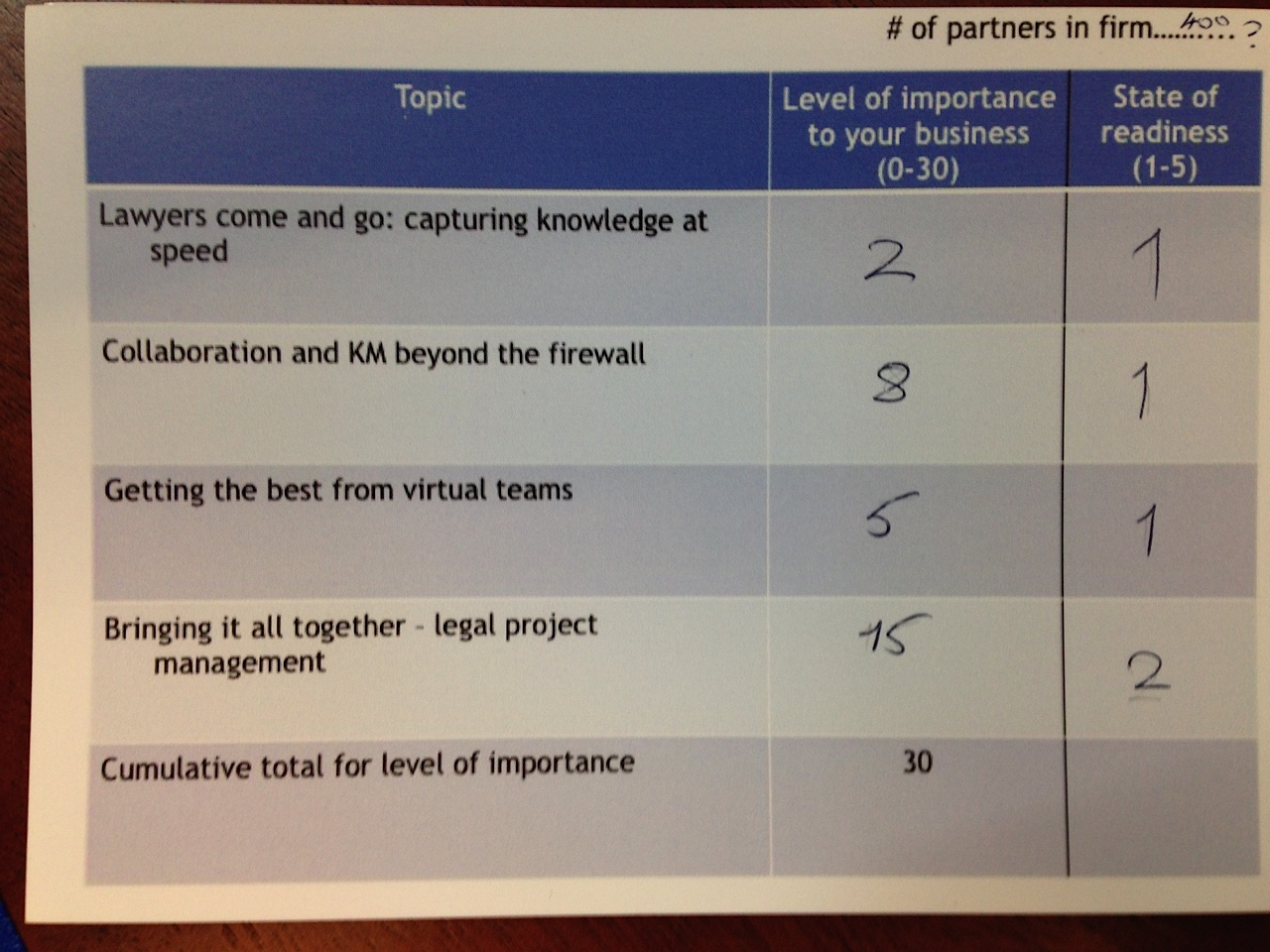
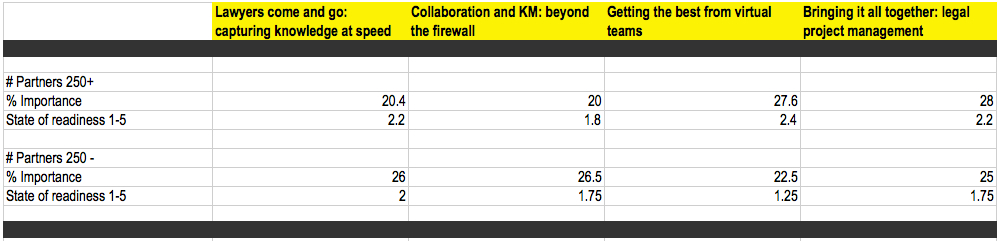
ALegal KIMs it turned out we were not far off the mark as the feedback from the postcards we invited the delegates to write on indicated.

Once we consolidated all the replies on the day an interesting picture emerged.Scores on the doors (Click on the picture below to make it more visible)

In law firms of more than 250 partners the biggest issues were around virtual teams and project management. Yet all acknowledged they were not yet in a state of readiness to tackle them. Among the smaller players the biggest worry was around loss of knowledge.

other priorities

Not unsurprisingly the comments provided a valuable insight into their thinking.  Smaller firms (at the start of their KIM journey) were looking for basic KM:

  • Basic entry level km – completely new to it / evolving information research service & integrating with K activities
  • Provision of rapid and easy access to previously captured knowledge / Technology to simplify the process of intergration

Larger firms wanted something different (note the reptition of collaboration):

  • Collaboration inside the firewall / Expertise locating
  • Combining & improving KM systems / Organising our know how in a better way across the whole organisation
  • Support dept personalities working together (Marketing collaborating with IS, KM)  / Improve collaboration generally
  • Content clutter and records management / Risk & Security / Knowledge & UT goals & Strategy

So much to ponder on – watch this space for answers!

and finally

Grateful thanks to the four people who made contributions to Plan Zheroes (the event’s nominated charity).  For those who forgot and anyone else who feels moved to contribute, they can do so here.

PZ Virtual PresenceThis Thursday the Plan Zheores team are at London’s GLA for the launch of their new virtual presence which has the potential to make PZ the ‘Uber of surplus food’. Here’s a snapshot of what it will look like and why the team is so excited.


How to begin a project in a new business: collaboration, communication and a dash of KM

A week back someone asked me for a bit of advice about getting projects off the ground so I thought I’d share this with her (and you). At the request of the Executive Chairman I’m doing a really interesting piece of work at the moment with a new management team. If we pull it off it will be a great example of how to embed Knowledge Management principles into a business with the aim of speeding up development and learning as we go.

theoretical and practical underpinnings
Successful project management is dependent in no small part on collaborative team working. Learning Before, Learning During and Learning After (core foundations of what is often called Knowledge Management) can transform the way project and management teams work and how they collaborate. Simple techniques associated with each step will ensure that what we learn as we progress is fed back into the way we work in the future. The techniques associated with each step are tried and tested across a variety of industries and cultures. We are going to begin by creating an environment and way of working that encourages collaboration and openness: where we all share in success and are able to identify and rectify potential failure.

the brief

The funding clock is ticking and ‘product’ (a prototype) has to be at an advanced
stage if not already delivered for Q3 2015.
In short, the new team has to ‘hit the ground running’ from January and rapidly
establish a modus operandi in the first 90 days to ensure:

  • all issues around obstacles to delivery are capable of being surfaced in an open
    and supportive manner;
  • a set of core behavioural norms including communication and a technical
    collaborative infrastructure are established by the team for the team;
  • everyone understands their responsibilities, role and deliverables and is aware
    of the strengths of the rest of the team; and
  • everyone celebrates successes and takes ownership of potential failure

My initial brief was along these lines:

…help create a collaborative team environment with a shared understanding of what needs to be done and by whom…

the backdrop

Without naming the client (I will call them Polyglot)) I can tell you:

  • it’s space age stuff involving energy retention (so green and renewable)
  • it’s a multicultural environment and none of the 6 ‘man’ team has English as a first language
  • none of the team have worked on a project together
  • they have ambitious targets to develop a working prototype

Each was chosen because of a specialism – PhD’s abound – and an ability to go beyond what’s conventional.  But they have different backgrounds, cultures, outlooks and personal value sets. They are hungry and excited about the prospect of creating a product that can change the way we look at energy retention.

Ahead of the meeting I sent them an outline of the session and opened as follows:

You face a tremendously exciting and challenging 2015. A
new company, a new multinational team and a project that
has the potential to change the way energy is consumed,
stored and saved. Few organizations and the people who
work for them can look forward to the coming year with
such anticipation.

Project Mobilisation Meeting #1

Its Day Four and most of the team arrived on Day One. We’ve assembled at their new offices which is appropriately housed on a reseach park. In advance I asked each of the team to be thinking about a proud moment when they had enjoyed working in a team.

The aims of the half day session were:

  1. Begin building a Polyglot culture based on collaborative team working.
  2. Understand the respective strengths of the team members and Polyglot.
  3. Help kick off the ‘project’ with a shared understanding of the obstacles, deliverables and timing.

The agenda I worked up for the half day kick off session is below. What I can share is how the opening went (taken from the write up I produced):

Introductions
Everyone had a really interesting story to tell about him or herself and an astonishing array of experiences. Perhaps the most revealing was that nobody had English as his or her first language. We adopted this mantra as a way of overcoming potential misunderstanding:
‘I heard you to say…. and I understood you to mean….’
Further we agreed that whenever anyone did not understand a phrase or word they would seek clarification and record it on a white board along with a glossary of terms.

item who comments
Introductions Ask people to introduce themselves with their name and an interesting/unusual fact. Scene setting: why are we here, what the session is all about.give some examples of good (and bad) experiences
Hopes & Fears Exercise In 2 parts. Each person to write down on Postit notes:Why I joined? To plenary and call out.Then 3 hope and 3 fears and put up on the wall.
‘when you look at things differently’ An exercise designed to get people thinking about different perspectives.Split into 3 teams and give each a paper with one of 3 ‘professions’. Ask them to jot down notes about the room through that ‘lens’. Back to plenary for call out and learning’s.
My proudest team moment PC to ask each person to tell his or her story. JM to note down words for each person that sum up emotions, skills & knowledge, outcomes, behaviours.
How can we ensure the project fails? This exercise (a Reverse Brainstorm) will surface barriers/obstacles and solutions. Split into two teams; ask them what can they do to make sure we fail to meet the deadlines and quality standards.
What would you tell your Dad? Ask each person to write down a response to this ‘over dinner question’: So tell me what is it you are doing?Then get everyone to come and put his or her ‘offerings’ onto the wall. In plenary for discussion and agreement.
And finally: ‘Homework’ set the task: present an outline project plan on Friday 16th January. NB We will decide the composition of the teams in advance. There will be no guidance.

Why what the boss says (and does) matters : 3 examples to make you weep

Its not unusual at year end to take time out to think about the year ahead and reflect on the year past. Those thoughts are often prompted by conversations with people over copious lunches and dinners about corporate goings on.

fallen-tree-One such event occurred the Saturday between Christmas and the New Year. On a very windy morning (in the dark) I hit a tree that had fallen at Friston Hill on the main South Coast road, walked away from the car unscathed (even though the car was not) and so was in reflective mood about cuts to services, tree felling and pruning.

My dinner companion that day was recounting a sorry tale from her past which can best be described as the ‘mine is bigger than yours’ syndrome. In short the CEO (whose profile was increasing to the chagrin of some of the board) departed in haste prompting a dramatic fall in the stock price and the departure of some of the core team as well while the Chairman filled the now vacant positions with his own team. I’d seen a similar occurrence at a software business I was close to. There the CEO was deemed (by the incoming Chairman) to be a technologist not a commercial man. So the Chairman who had previously run a business though crucially not in software made appointments over the CEO’s head. Unsurprisingly it ended in tears and the excursion into the US a portend of things to come where investors lose their shirts!

These discussions made me ponder the difficulty of being in a Chief People Officer, Head of Talent Management and Head of Global Communications role since they are all dependent on the machinations above them at board level. In both cases I’ve seen at first hand how people who’ve given so much to an organisation can be ‘erased’ from the payroll and while the payoffs can be significant the scars take a long while to heal.

What it says to me is that few of the value statements that organisations come up with are grounded in the way they conduct themselves internally when the going gets tough. Here’s a few more examples:

#1: ‘no publicity, not now, not ever’

Last year I was contacted by an old friend, For the sake of anonymity I will call him Mohamad. He has a long and distinguished career in finance and recently developed a wonderfully innovative financing mechanism for a blue chip organisation he was advising.

Mohamad approached me since he knew through our joint alumni network that I had helped a number of organisations to surface and then make use of knowledge that could improve the way organisations worked.  We talked a lot about the critical knowledge that he’d developed running the project and how it might be used for future financings for the good of his organisation and indeed his country (it was at that level).

Armed with a few ideas on how he might go about capturing how decisions were made and implemented and a possible mechanism for sharing what he’d learned (factional stories) he went off to meet his boss.  Imagine his (and my) disappointment when he was told: ‘no publicity (of any form)’.  While a simple Google search shows him and the name of the project financed – there was a bit of publicity – nothing at all exists in the public domain or in his organisation on the method. And it seems like it never will despite mission statements that talk about becoming a learning organisation.

#2 ‘do as I say, not as I do’

I was advising an organisation in the West Country.  The CEO (who sadly passed away in a car accident having survived a Tsunami) was about to announce a bout of pruning and cutting back.  I was gobsmacked when he turned up the day before the announcement in a new Porsche.  The point I made to him was the signal he was sending, irrespective of when he had ordered it, was the wrong one and for him to regain the trust and commitment of his team he had to be seen to be in it with them!  The Porsche made few appearances after that.

#3 ‘if we are doing so well why do we feel so bad’

A close friend was at a end of season bash/annual pep talk. Her unit had exceeded all its targets and her personal performance and that of her team was a real cause for celebration.  In fact when the Group CEO got up to speak she was actually looking forward to it. After all her unit had bucked a corporate trend and she’d worked hard (often on a Sunday) to provide clients with an exemplary service.

When the CEO sat down she was totally deflated: instead of praising he implored the business to do better and berated those who had not met targets.

What proved the final demotivator?  When some of the tickets to a show (that many would have wanted to see) were handed to members of senior management rather than ‘balloted’ for use by the staff.

It made me recall a plane conversation back from Washington where my fellow traveller told how his business (he ran a call centre operation) had achieved an unprecedented 93% approval rating yet was being pushed to go to 94%.

and finally

I am currently helping an emerging business to think through project mobilisation and team building with a multinational and multicultural team. Its an exciting challenge and I shall be drawing on experiences such as those I’ve described to help create a collaborative working environment.

I continue to believe that to have credibility, value and mission statements have to be owned and embraced at the very top and not purely the work of consultants who canvass staff opinions and produce group think outcomes for the CEO and Board to rubber stamp.

Future of Legal KIM: ‘Death of Difference’ and the need for effective legal project management

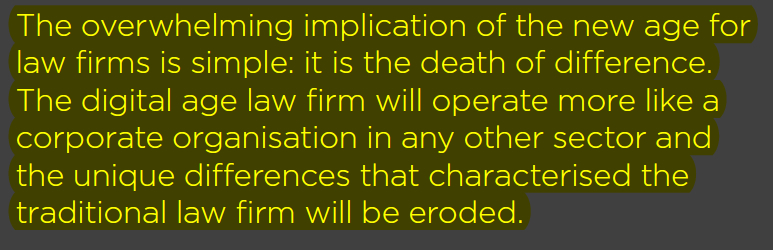
A really timely thought piece ‘Becoming the law firm clients really want’ landed on my desk this week. The future of LawBy Peppermint Technology Research, it characterised the future of law firms as being ‘the death of difference’ noting that legal will become much like other sectors. This scenario has profound implications for lawyers, professional support lawyers and legal knowledge & information management (KIM) professionals.

On December 9th Martin White and I will be hosting a breakfast breakout event at the RSA The future for Legal KIM: An Outside-In perspective.  In it we will look at some of the issues facing KIM professionals. Martin and I have worked in many industries across many countries; we’ve seen and been involved in seismic shifts in the KIM roles in engineering, energy, the 3rd sector, publishing, software and finance. Our thinking in putting this event together was to share some of our experiences in a relaxed setting with like minded legal KM’ers.

So over the past few weeks in the run up to the event we have been looking at the four big issues research had told us were near the top of the legal professions ‘must do’ list.

  • Lawyers come and go – capturing knowledge at speed
  • Getting the best from virtual teams
  • Collaboration and KM beyond the firewall
  • Bringing it all together – legal project management

I began with Going but not forgotten: knowledge capture in a hurry, Martin then wrote  The opportunities for digital workplace adoption by law firms and  Certifying virtual teams – a key skill in digital workplace implementation.

bringing it all together – legal project management

Today I am going to focus (from a KIM perspective) on the challenges of setting up a project management infrastructure that allows an organisation to learn from previous experiences and feed back learnings from the project back into the business.

There are many project management disciplines being used in industry. The Stage-Gate new product development (NPD) methodology is one example in which the veracity of new products are assessed and resources allocated according to a set of criteria for each stage of the process. Knowledge capture is built into the process.

Irrespective of the system you adopt below are a few of the questions you will need to be asking (I’ve omitted the obvious budget ones):

set up (learning before)

  • What do we know about this subject and what has been done before?
  • Who is an expert (internal and external) and can we get their input before starting the project?
  • Who should we invite to the Kick Off meeting and how do we want to structure that?
  • What structures are we going to use for management, monitoring and decision making?
  • Who is going to be on the Project Steering Group and how do we manage those stakeholders and others? How often should they meet and in what format?
  • How are we going to capture the outcomes of meetings, store the material we generate and make people aware of what’s happening?
  • How do we collaborate across teams and boundaries to ensure the best possible decisions are made based on the best?

conduct (learning during)

  • Who do we go to for answers to tricky questions that arise and how do we do that?
  • How often are we feeding learnings back into our project?
  • Who is providing updates and in what format?
  • Where are we storing progress reports?

conclusions (learning after)

  • What format will the debrief take and who will be invited?
  • When and where will you hold it?
  • Who will be tasked to action the outcomes?

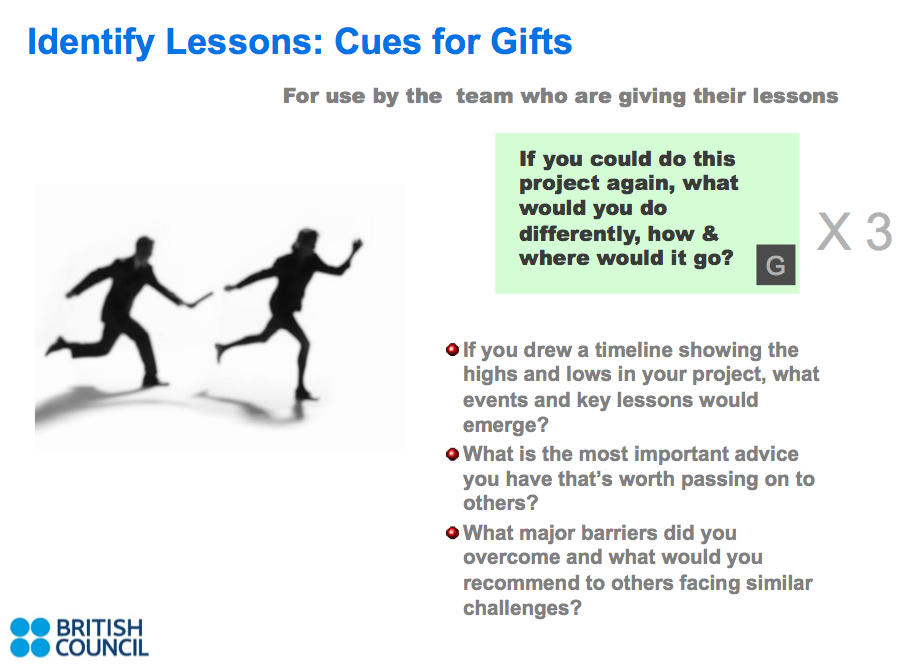
I remember a conversation once with Professor Victor Newman on his Baton Passing Technique which arose in part to ensure project knowledge is passed on.  He said:

The big problem in managing learning to have an impact is to know what knowledge is useful, to whom, the form it should take, where and when it is best applied and when best to share it

Baton PassingAlongside is an extract from the slides Victor and the British Council made available.  It works, I’ve tried it!

I have used in addition: After Action Reviews, Pause & Reflects, Retrospects to name but three.


Earlier this year APQC published an interview with me in which I described the concept of DEBRIEF as a technique for capturing learnings at the end of various stages of projects. I will talk more about that on the 9th.  It’s not too late to sign up here!

and finally

Too often the KIM team are excluded from the project management processes in favour of an accredited (Prince 2 trained) Project Manager. In my view that’s a grave mistake, there are KM techniques for each step of the process and the good KIM’er will be well versed in facilitating such interventions.

If you fail to learn from what you’ve done then you will not improve as a business and will be uncompetitive with those who do.