
Out of austerity, growth of Social and a dose of Logical Minds: insights from working in Lisboa

Royal Bullfighting Club

Real Club Tauromáquico Português, Lisboa

I’ve just spent an inspiring couple of days in Lisboa. It started well: a wonderfully productive 3 hours in the company of Ana Neves of Knowman discussing SocialNow 2015 in Amsterdam, followed by a reunion dinner at the Real Club Tauromáquico Português, (Royal Bullfighting Club of Portugal) Lisboa with a former colleague I had not seen since 1986.

The prime motivation for my visit (apart from the 25c temperature) was providing advice to a business that helps children with learning difficulties as it thinks through its future options.

economic & business backdrop

Over dinner, my former colleague, an influential banker whose ancestor discovered an island in the Atlantic now named after him, shared his perceptions of the current state of play.  Here’s my take on what he said:

…the government is doing very well but the current political structure means decisions are taken very slowly. I am an optimist by nature and see great potential in our people but our media is always looking for mistakes and bad news and never tells us about areas we are doing well.

Taken at face value this gives grounds for optimism and yet in previous conversations I discovered that the Portuguese prefer to hear ‘experts’ from overseas rather than trust their own and go overseas to make their fortunes. So for young entrepreneurs the future is bleak.

Yet Portugal is a country that ranks 25th in the World Bank’s ease of doing business ranking (ahead of Netherlands, France and Spain).
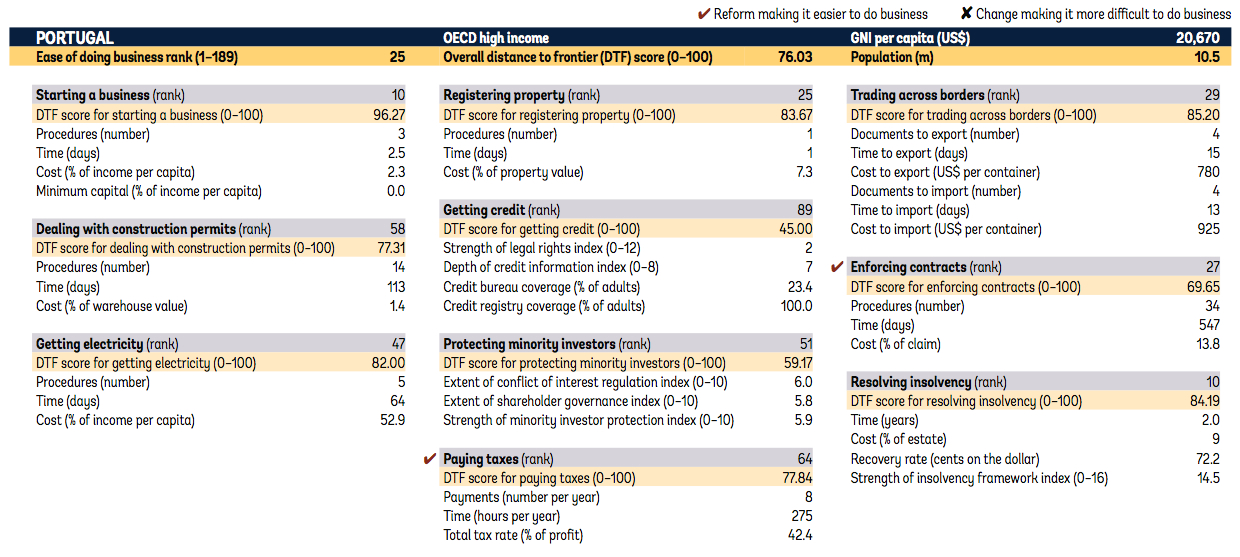
Portugal WBK ranking

Click to enlarge picture

It’s improving standing is due to a raft of measures many of which are currently subject to scrutiny and debate in parliament:

  • Portugal lowered its corporate income tax rate from 25-23% and introduced a reduced corporate tax rate for a portion of the taxable profits of qualifying small and medium-size enterprises.
  • Portugal made enforcing contracts easier by adopting a new code of civil pro-
    cedure designed to reduce court backlog, streamline court procedures, enhance
    the role of judges and speed up the resolution of standard civil and commer-
    cial disputes.

Since 2008 the government has made a number of changes to employment law. While these have resulted in increased productivity there is growing disenchantment at declining living standards and the young expect to leave when they graduate.

What does the immediate future hold?  Increased personal taxes, an increased disparity between those able to ride the continued wave of austerity and those who can’t and a desperate need for investment for young start up businesses.

Initiatives such as Cidadania, an event aimed at stimulating discussion in society around the use of new forms of communication, will help. This year’s event in Porto showcased numerous examples of how empowered citizens have interacted with NGO’s, Government and Public Administrations. Ana Neves has also been running a Community of Practice for COTEC and written a guide on helping its member organisations to choose KM Tools.   Ana would be the first to admit that Portuguese organisations are not yet big on Knowledge Sharing or Knowledge Management and that community involvement in social tools is in its infancy. But interest is growing!

LogicaMentes (Logical Minds)

Autism strikes without consideration of ethnicity, gender or financial background. It is a developmental disorder that affects the way people interact with the world and other people.

Each child or adult with autism is unique and, so, each autism intervention plan should be tailored to address specific needs.

The UK’s NHS notes:

Some types of intervention can involve hours of intensive work, and this is not always possible for many families because of the practical, emotional and financial commitments necessary.

Treatment is based on the assessment of the physician carrying out the examination and frequent case assessments with the team thereafter.  Treatments now take place in the home, at school and at clinics like LogicaMentes.

Much is written and there are countless online sites providing guidance, advice and online collaboration to parents who often find this a very difficult condition to live with.
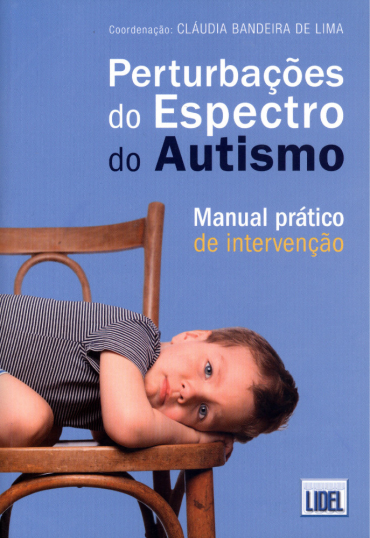
images.livrariasaraiva.com.brThere are a variety of treatment methodologies, LogicaMentes bases its on the book written by the clinic’s co-founder, Claudia Bandeira De Lima.

They also use a wonderful iPad application developed by a member of their team that enhances the learning experience for children. Already it has paid off: the app has facilitated communication between a mother and son where previously his condition has precluded any. Small but significant steps!
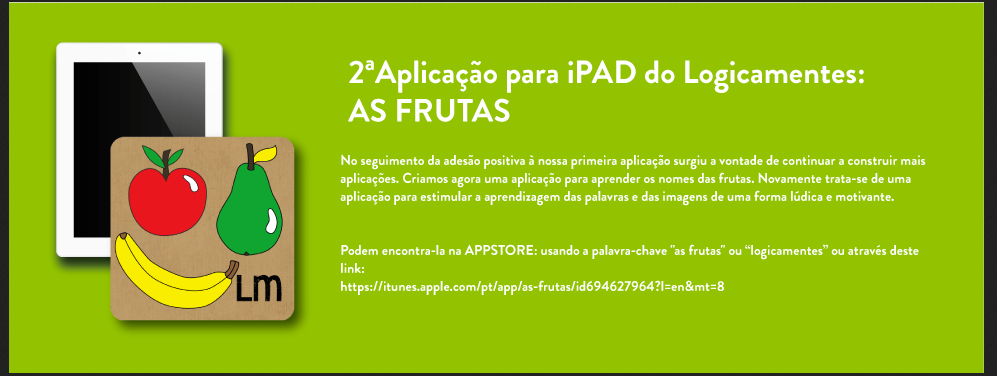
App

Resource management, records management and cash management are core competences as are the ability to share knowledge among the team and manage a diverse group of stakeholders (parents, schools, doctors).

It is a priviledge to have been invited to help the team and to be working in Portugal.

 

‘…there’s zero collaboration or institutional knowledge’: learning lessons from winning teams

So says Paul Azinger, the last US Captain to win the Ryder Cup, in the aftermath of the 2014 event and the accompanying soul searching. He implicitly acknowledges the importance of building on what ‘you’ know as an institution if you are to be successful.  This is what he said:

A big difference between us and them is that Europe always has a succession plan. McGinley was surrounded by past captains and future captains, and they all reap the benefits. We’re lone rangers as far as captains go. Nobody knows what we’ve done in the past. There’s zero collaboration or institutional knowledge.


why Team Europe’s victory is relevant to business

Why is the outcome of a biennial golf match of interest to lawyers and others who work in highly rewarded and individualistic roles? Because the players are all ‘Rock Stars’ in their own right who come together sporadically to play (and win) against their peer group.

What stands out about the European approach? Meticulous planning, attention to detail, clarity over roles before, during and after each Ryder Cup match and a willingness to acknowledge that no one player is bigger than the team.  Business is no different relying on a collaborative team approach and a set of shared values.

In October 2012 Apple CEO Tim Cook reshuffled his team, this is how it was reported in a Bloomberg Business Week interview:

“The key in the change that you’re referencing is my deep belief that collaboration in essential for innovation – and I didn’t just start believing that. I’ve always believed that,” said Cook. “It’s always been a core belief at Apple. Steve very deeply believed in this.”

Cook said that he wanted to ensure that Apple takes its already “enormous” level of collaboration even higher. “There are many things. But the one thing we do, which I think no one else does, is integrate hardware, software, and services in such a way that most consumers begin to not differentiate anymore.”

“You have to be an A-plus at collaboration,” Cook continued. “And so the changes that we made get us to a whole new level of collaboration.”

Here’s how commentator Kristine Kern (@kristinekern) of the Table Group saw this move:

Let’s be clear: Ousting a rock star from your team — or asking them to change their ways — is not always something you can do. But it’s something you should consider. “Like most things, it’s not black and white,” Kern concludes. “Organizational health requires rock stars do both stellar and healthy work. Which shouldn’t be a problem: Most true rock stars rise to a challenge. Just don’t be afraid to demand it.”

why shared values matter

Some time ago I was the Business & Strategy Advisor to an Anglo-Dutch company in the professional services / software business. It was around the dotcom boom period when investors were falling over themselves to back the next hot opportunity. Company valuations were bizarre: at one point on revenues of $20m we had a market cap that was 40 times bigger. Our AIM share price went from £1.25 to £16+. It was easy to be profligate, we weren’t and I take personal pride in having taken the lead on travel budgets and integrating the acquisitions we made.

As we grew (acquiring first a US firm, then a German one) and shifted our centre of operations (and development) from Europe to the USA the Executive Management team all recognized the importance of having a set of values and a structure that could transcend global operations while recognizing cultural nuances peculiar to the location of each office.

What might go down well as a motivational incentive in Denver would need tweaking to be embraced in Maastricht let alone in Guildford. We needed a framing device that everyone in the business could buy into and in the management’s case the cojones to ‘get with the programme’. So we organised a cross company group of all levels to work through what they wanted out of the business – how they wanted to be treated as employees and in most cases, shareholders.

To this day I can remember the constituent parts:

  • a clear vision understood by all
  • a meritocracy that rewarded success and took action on poor performance
  • inspiring and visible leadership
  • a place that was fun to work where you could pick up the phone to anyone.

We had 6 locations and office sizes ranged from 12-50.  We had a central sales/CRM system everyone used and we had quarterly conference calls with the management team where people could ask what they wanted. Board meetings rotated around the various offices, one was virtual the next in situ. When tough decisions were required we were clear about why they were being taken and communicated that.

Of course technology and process played a role, the corporate intranet was a good information source. We conducted Peer Assists, After Action Reviews; we fed our learnings back into the development process and we used what we learned to reengineer the business around the Stage-Gate New Product Development Process.

The going got tough, people got let go, yet Sopheon survived and today has an award winning software, Accolade, with embedded Knowledge deployed in the innovation and new product departments across hundreds of organisations globally.

so what

Whether business or sport, people respond to good leaders who provide guidance and clarity, hold people to account for poor performance and recognize/reward exceptional performance. They are also good at making the right decision and leading teams through implementation by inspiration, perspiration and collaboration. I’m sure those will feature prominently when Captain McGinley releases the inevitable ‘Building a winning Ryder Cup Team’, book.

Good decisions are informed by good knowledge: of clients, of markets and of resources. Knowledge Management when performed well becomes ingrained behaviour and Knowledge Sharing is a core element.

and finally

I am indebted to Euan Semple (who talks and writes common sense) for my summary. Taken from his excellent tome ‘Organisations Don’t Tweet, People Do‘ Euan argues that in today’s interconnected world it is increasingly important to be seen to add value and to be seen to be knowledgeable and willing to share that knowledge. He goes further:

In the old days ‘knowledge is power’ used to mean holding on to it and only giving it out judiciously to certain people. In an Internet world there is no point in having knowledge if people don’t know you have it, and if you are not prepared to share it. Web tools enable more knowledge to flow more readily around your organisation. Taking part in this process is going to be more obviously a part of being more productive than ever before. Being able and willing to share your knowledge will become a key business skill.

Collaboration is the mechanism by which Knowledge is often shared. It is something Apple and the US Ryder Cup designate (a forecast from me – Azinger to be the US Captain in 2016) recognise as being a core ingredient for a successful venture. So should you!

The future for Legal KIM: An Outside/In perspective

I’ve long admired the work of Martin White on Information Governance, Intranets and Search and as Chairman of the Online Conference that used to be a must attend event at Olympia in December.  I fondly recall a Hilton Hotel, Heathrow T4 meeting at the end of the 90’s between the two of us and Gerry McGovern in which we hammered out the components of an Intranet checklist. And the horror at finding the parking bill was nearly as expensive as a tank of petrol.

We go back a long way, have worked on a number of assignments together and I once gave the Keynote Speech for Intranet Focus at the inaugural Russian Intranet Forum in Moscow where David Gurteen ran his first Russian Knowledge Cafe.

Martin and I meet regularly.  It’s one of the nicer aspects of working in alliance that you get to share ideas (within the bounds of confidentiality) with people you choose rather than those an organisation chooses for you.  In the Summer we met a couple of times to review experiences in Legal Knowledge & Information Management. I’d just given the Keynote speech at KM Legal and written a blog post while Martin was in the midst of a new assignment writing a digital workplace strategy for a prominent law firm.

Legal is changing, is KIM ready?

Martin too had noticed changes in the way law firms were working. As we compared notes we became aware that some of the knowledge management, information management and project management approaches that we had been using for many years might be unfamiliar to law firms. We decided to validate our conclusions by talking to some of our contacts in law firms and among the comments we noted were:

  • “We are great at capturing, not so great at sharing, especially when it comes to knowledge about clients”
  • “Too many people think that writing a project plan is all that is needed to make a success of Legal Project Management”

A couple of hours on 4 key topics

We have decided to set up a meeting at which we could share some of our experience with senior knowledge and information managers working in law firms. Our Breakfast Breakout will take place in the Benjamin Franklin room at the Royal Society of Arts on 9 December. Starting at 9.00am (but with breakfast at 8.30am) we will be covering (amongst other topics)

  • Knowledge Loss & Knowledge Gain,
  • Legal Project Management,
  • Getting the best from firm/client virtual teams
  • Stakeholder Engagement and Management

We will be talking about Knowledge Chameleons, the “Balloon on a Phone” and WTGTGQ – When They Go They Go Quickly. There will also be a chance to benchmark your own situation, though the Chatham House Rule will apply throughout the meeting. With just ten working days to Christmas we’ll provide a relaxed setting, no PowerPoint presentations, a good breakfast and an opportunity to support the PlanZheros charity instead of paying for a ticket. You will be able to be back at your desks by 11.00. The room will be set out cabaret-style and we’ll be moving everyone around after the mid-way break to foster networking.

How to register

Registration details will be posted here, on Twitter @pauljcorney and @intranetfocus in the next few weeks.

Donations to a charity

It being Christmas we decided instead of asking attendees to contribute to the cost of the event we’d invite them to make a donation to the Plan Zheroes charity I am a founding Trustee of. So much is happening on that front and the next three months are critical, we need all the help we can get to launch our new web/mobile presence.

How to become smarter: turning knowledge into an asset

Last week my 86 year old mother fell over an uneven paving slab on her way back from the library. Southfields Road PavementsThe swelling and bruising came out immediately and fortunately her wrist which took the impact of the fall wasn’t broken. Hand

She was badly shaken up by the event and took to her bed as a result.

Living in a location where a good number of the 100k residents are past retirement age according to a 2013 article Seaside town first place in country with average age of more than 70 and with many suffering impaired vision I decided to report the incident in the hope that the pavement might be fixed qucikly.

I was pleasantly surprised to discover a facility built on a Google Maps platform for reporting damaged pavements on the local government website (in 8 languages) and a twitter feed for instant access. So far so good.

The automatic response to my filing (and picture) was likewise encouraging and included the phrase ‘we will investigate’ along with a reference so I could track the progress.

I wondered whether in the light of mother’s predicament what the process is for making a claim – she wasn’t going to, that’s not the way her generation are wired! On the face of it everything seems well managed (except the walkway) This paragraph (also from ESCC’s website) stood out:

Thinking of making a claim

Please consider the following points before you submit a claim. Making a claim can be a lengthy process and may not result in a pay-out. Any compensation is paid from public money so we will always be robust in our investigation of claims. The decision on liability will be based on the facts of each case and the law. Because of the legal defence available, on average, 70% of claims are unsuccessful.

The last sentence (my underlining) is instructive and made me ponder whether the use of the technology is for offensive or defensive purpose? Have we become such a litigious society that every corporate body feels compelled to get their retaliation in first and use  social media as a broadcast and defensive mechanism not a collaborative platform?

I digress. Let’s be charitable and assume good intentions and applaud this as an example of good knowledge capture and retention.  What we don’t as yet know is whether this will become a good example of how knowledge can be put to good effect and improve a process (or in this case fix something that isn’t working).

The concept of Knowledge Capture & Retention seems to be much in demand: I will have run 3 Masterclasses on the subject this year alone (next London event 18th November). And having just completed a 7th visit in 12 months with Ron Young of Knowledge Associates to an industrial/engineering client in the Middle East where small changes in processes can have a material impact on performance I know how important it is to have a process that turns what you have collected into valuable Knowledge that changes the way you work or the new product development processes you follow. If not you have a set of ‘lessons identified not lessons learned’.
So what’s the secret?

When Knowledge becomes an asset

Most organisations go down the Knowledge Capture route – they create buckets (increasingly in SharePoint) to store what they have captured to make sure that the best knowledge is available when a bid, a presentation or a decision is to be made.  And that’s fine as far as it goes. Rarely do organisations add on the Knowledge Harvesting step. Here’s what that entails (drawn from Knowledge Associates’ 9 Step KM Process that acknowledges and builds on the original BP model of learning before, during & after):

  • Conduct a learning or After Action Review
  • At the end of that process ask the question does what we have discovered have the power to change/improve the way we (and those associated with us) work?
  • If the answer is yes then you have what is known as a Knowledge Nomination and these should be considered at a separate gathering.
  • Now convene, if you don’t have one as part of a Community of Practice, virtually or in person, a group of Subject Matter Experts with expertise on the process or way of working. Ask them to consider whether the Knowledge Nomination will improve our process and should be adopted.
  • If they agree then change the process. If they don’t then make sure you have captured the Knowledge Nomination and the reason for its rejection.

I have always believed that the purpose of Knowledge Management is to help organisations make better decisions and work more effectively. The simple steps I’ve outlined above should help in acheiving those objectives.

I wait now with interest to see the outcome of the saga of the loose paving slab. Will the outcome merely be a repaired section of pavement or will the team think about how this was caused and put in place measures to stop it happening next time?

On Portugal’s recovery: ‘Don’t compare us to Greece’

The Portuguese media has been awash with stories about attempts to renegotiate the terms of the bailout negotiated by the government with the international community (The Troika).  After the Irish Finance Minister went public saying Portugal should honour its obligations as they had and not ‘do a Greece’ a senior  politician from Lisbon came back with the above retort. It’s a sore subject; the Portuguese are a proud people with a history of meeting their obligations yet during 2 weeks talking to people in Porto, Lisbon and Faro I’ve come to realize just how precarious the recovery is.

Food, drink and the cost of living

Eating out is a national pastime; lunches are taken seriously and out of the office. Today an average 2 course meal for 2 with wine in Lisboa will set diners back €35-40.  Sounds good?  Compare that with the average weekly wage of €200 and then consider that Portugal now ‘enjoys’ some of the highest priced utilities in Europe (among top 5) and you get some idea of the shift in habits that is occurring.

The imposition of a 23% tax on eating out, on wine and even on golf have all taken their toll. Its no wonder there is a campaign for a minimum monthly wage of €600 and a reversal of the pension decrease the ruling party introduced when the austerity budget was introduced.  For a great breakdown of the cost of living and interesting commentary see here: Cost of Living in Portugal

Wages and disposable income

In Portugal, people earn $24 384 per year on average, less than the OECD average of $34 466. Not everyone earns that amount however. Whereas the top 20% of the population earn $30 578 per year, the bottom 20% live on $13 056 per year.

Another essential factor of employment quality is job security. Employees working on temporary contracts are more vulnerable than workers with an open-ended contract. In Portugal, close to 9% of total employees have a contract of 6 months or less, slightly lower than the average of 10% for 30 OECD countries. This figure suggests Portugal has been successful in stabilising working contracts and encouraging open-ended contracts.

Stealth taxes and the road toll debacle

Hiring a car is easy, even if the companies now rival Ryanair in dreaming up additional must have extras, using the road toll system is not.  For a start the hire company will try and ‘sell’ use of a tracking device that charges the car for using any autoroute subject to a toll charge.  If you refuse their tempting offer then a labyrinthine process awaits when you come to settle your tolls involving numerous trips to the Post Office most of whom are oblivious to their new responsibilities.  And the galling thing: it is virtually impossible to turn around and leave the autoroute!

Three days on we still don’t know how much we owe for the first part of the Faro-Lisbon trip and we’ve been out of the country since Saturday!

The black economy

A friend who knows about such matters told me that up to 40% of trade is conducted outside of official channels.  Restaurants and indeed the open top bus companies are reluctant to process credit card transactions to avoid tax – many have signs that notify you in advance and those that do not are often ok with you going back to pay later. It’s a situation many travelers will find uncomfortable.

Roll back the frontiers of the state

‘It won’t work if it’s legal’ was one chilling indictment of the authorities’ efforts to promote new ideas.  Wading through treacle is how to best describe the insidious intervention of the state in an attempt to seize revenue from whichever source it can.

The most recent example is the edict by which all houses must put white posts up to signify the boundaries of their property. And of course everyone will pay for the privilege of registering his or her ‘new’ boundaries!

Barbarians at the gate

Real estate has bottomed and in Lisbon / the Lisbon coast a slight rise is being fuelled by overseas buyers from China and Russia perhaps prompted by the policy whereby rich individuals can purchase a visa permitting access to the rest of the EU.

This from CNN Money

Portugal has been offering these deals for just over a year. Foreigners receive a residency permit when they invest €500,000 in property. After five years, they can apply for permanent residency, and EU citizenship one year later. Portugal is also trading visas to those who inject capital or create jobs in the country — similar to the U.S. immigrant investor program, which requires a minimum spend of $500,000. Like those on offer in Spain, the Portuguese visas grant access to the Schengen area, which includes the bulk of the EU but not the U.K.

Official figures show more than 330 visas have been issued in the first 12 months of the program, raising €225 million.

And yet

The eternal frustration among the chattering classes I met is that the country’s promotional activities are too low key. Two examples: I had no knowledge at all about the Portuguese Army’s involvement alongside the Allies in Belgium in WW1. In reading an excellent account (balagan timeline) of their involvement I was amused to see this quote: ‘…The Portuguese soldiers hated the British rations…’ and; I was also unaware as were most I spoke to that Foreign Pensioners can reside and collect their retirement pensions in Portugal entirely tax free. Portugal has launched an aggressive measure to attract affluent worldwide pensioners to come and reside in Portugal. The lure is zero tax on such pensions.

In addition to these tax incentives Portugal has:Sao Bento Station Porto

  • great food, a great climate, wonderful architecture  and superb scenery;
  • great roads with no one on them;
  • really talented people with ideas and imagination;
  • it costs less (17% of disposable income) to keep a roof over your head there than elsewhere in the OECD (21%)

But:Dessert at Darwin

  • there is a lack of industrial manufacturing;
  • 35% of under 25’s have no job and many are leaving and perhaps most seriously;
  • there is a cadre of middle managers aged 45-60 who are in entrenched positions across the government and block ideas and the career prospects of others and;
  • there is a complete lack of trust in the political parties and politicians and a general view that the increased taxation is choking growth.

in summary:

Portugal will pull through, of that I’ve no doubt.  There are signs of recovery and despite the national mood (which a good performance by the national team at the World Cup will lift) this period of readjustment was probably needed.

Habits are changing, as an illustration the biggest growth market appears to be in building and running residential homes for the elderly something that surprised me.