It’s August in the Middle East where the temperature rarely dips below 30c at night and reaches 50c+ during the day. Contrast that with winter where snow is on mountains that trap carbon emissions severely impacting air quality.
I’ve been there 7 times in the past 12 months and seen all the seasons and how they impact people’s demeanours. How festivals such as Ramadan affects productivity (while enriching the soul of those who follow its strictures), how the New Year which occurs in the spring makes people look longingly towards the future and how April seems to be everyone’s favorite month: clear blue skies, snow capped mountains, a purity about the air and a profusion of flowers.
July and August are the hot months when recruitment people at universities globally are most busy and when many organisations in the Middle East and Asia see their talent take sabbaticals to go back to school to further career prospects.
I am with a client where 3 of the most talented minds who have been the core team on a project have been offered the chance to further their academic careers overseas. This is not unusual in a part of the world (east from Istanbul) where educational attainment is prized and the title of Dr. elevates one’s social standing. It’s their last week, in fact they’ve really already left but at my prompting our sponsor agrees that I should have a discussion with them with the aim of:
- Identifying the networks of people within… who the leavers connected with
- Getting recommendations as to how existing business processes might be enhanced based on experience gained in flagship projects
- Maintaining an ongoing connection with a view to developing an Alumni network of skilled ex …people
Importance of set up
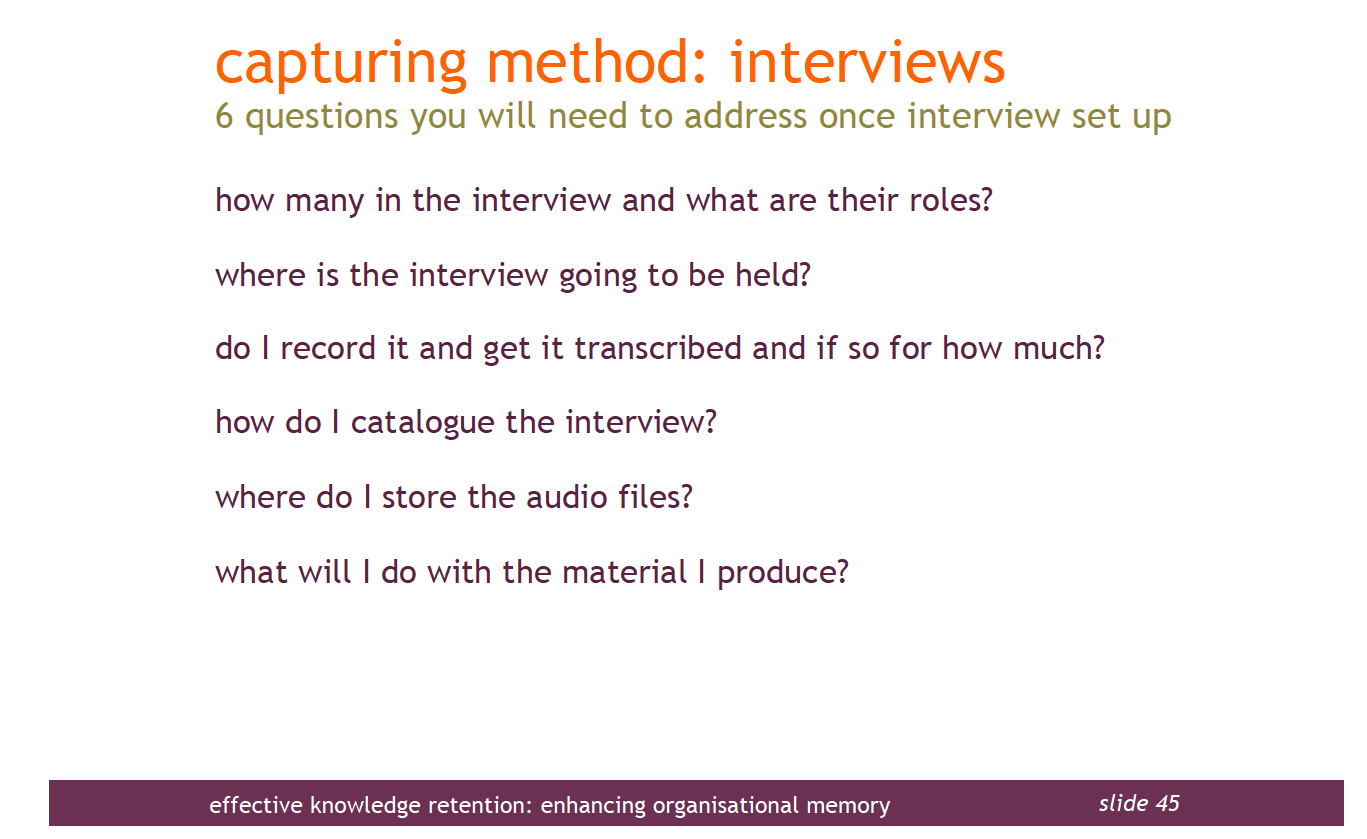
The set up is important. In an environment where conformity and learning by rote the norm everything must be done to ma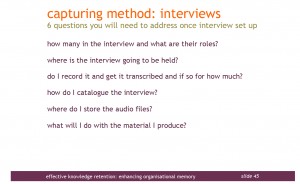 ke the participants feel at ease and willing to share. So the room had to be quiet yet not too formal and the desks set up in a way that encourages conversation not question and answer. This is what I say to people who attend my masterclasses.
For an interview such as this to really succeed the interviewee needs reflection time. Always send a briefing note, a technique I learned many years ago with Sparknow LLP while conducting an Oral History assignment with Islamic Development Bank.
The purpose of this note is to give an interviewee time to reflect on their career (highs and lows) ahead of their departure, feeling they have said what they want to, been heard and passed on enough that someone following can build on their legacy. Here’s the note:
Briefing paper sent to the participants a few days before the interview
Going but not forgotten
We would like you in advance to be thinking about your time at … from the day you joined to the day of your departure and specifically:
- Draw a timeline to cover that period with a line in the middle. Above that line (in the highlights section) think of three moments (events, projects or incidents) that you would look back on as favourably reflecting the time you have spent at …. They might be personal, team or even organizational. Having identified them see if you can think of an image or an object that reflected that moment. Then place (draw/write) or bring along those images. If you can’t then see if you can think of a title for each. We will be asking you questions about each event or project.
- Below that line (the lowlights section) repeat the exercise again over the spread of your time at …. These lowlights might include a time when you felt dispirited, confused, when something didn’t happen or there was a blockage in a project. Again the purpose is to understand what happened and how (if you did) you overcome the situation.
On the day of the interview you will be asked to reflect on your career from the day you arrived to now. With your permission we will record the interview so that we capture the real highlights and will make any transcript available to you thereafter for your own personal use.
Why should you participate? Often when people leave an organization having made a significant impact there are gaps in the knowledge of those who are left behind, what we describe as ‘organizational memory’ is not as strong as it could be. It is important to recognize your contribution and to try and capture that in a small way.
Thank you for agreeing to participate.
Notes for interviewer (based on a 90 minute window of time)
Questions to be posed during the interviews
Arriving:
- Tell me about your first day, what were you expecting, did it meet those expectations?
- How did it differ from your previous job?
Working:
- Looking back over your time, if there is one thing you wish you could have had, what would it have been?
- What surprised you about working at ….?
- Who has helped you the most at ….?
Leaving:
- What will you miss about …?
- What will you tell someone who is about to join your ?
- What advice would you give to someone about to do your job?
a few of the nuggets that surfaced
what would You tell someone…
- Don’t underestimate the challenge of changing mindsets
- Project governance needs to be clear
- Be serious about what is crucial
- Don’t just rely on consultants, go find the people who know in our organisation
- Makes sure the contract specifically covers who holds the IP rights at the end
- Helping is more important that reporting and always recognise contributions
Each had an anecdote to illustrate it and prompt a meaningful discussion.
an example from closer to home
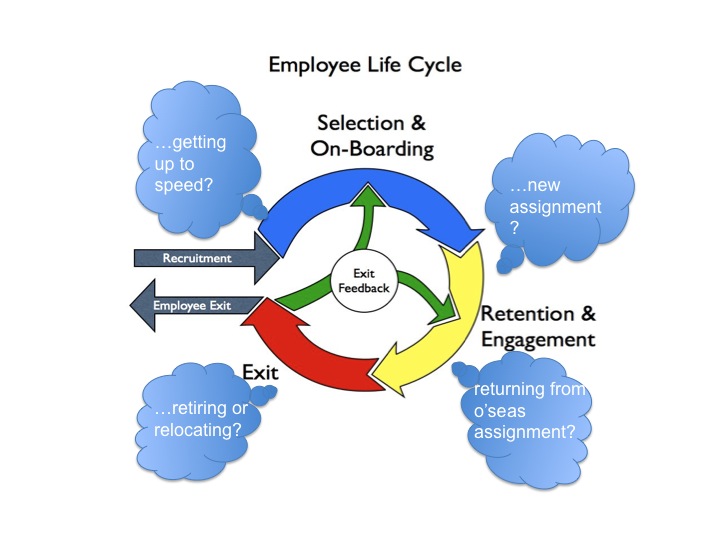
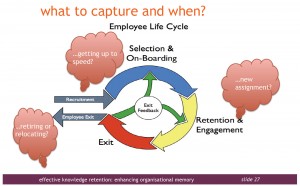
In an ideal world the sudden departure of employees with key knowledge should not be a cause for concern. Organisations that have adopted a 9 step process throughout an employee’s life cycle and fed learnings back into the processes of the business will take situations like this in their stride. I remember a quote from Barney Smith the former Head of KM & Information Services at Natural England who’d overseen the establishment of a knowledge retention (transfer) programme without realising he would be one of the main contributors. This is from an interview with him conducted by Sandra Higgison (ex Editor KM Magazine) as part of research into the ‘evolving role of the knowledge manager’ I worked on while at Sparknow:
…I love Natural England in so many ways, and partly because as soon as the general election was announced, the chief executive said, we’re going to have to make a third of our staff redundant.
So I’m part of the redundancies group – I put my name forward. And the first thing, I get this letter, and it goes to me, copied to my line manager in Natural England. Says you’ve applied for redundancy, you’ve filled out the forms, you’ve made your own calculation, we’ve considered it, we’re happy to proceed on that basis. And the next stage is two-fold: Firstly, we will be approaching the pension provider for a formal evaluation of your redundancy assuming you depart on such and such date. Secondly here’s the knowledge transfer toolkit.
I did a full knowledge transfer pack using this toolkit about a year ago. And had workshops for about 5-6 people, unpacking what it is I know about how to use it. And it actually came out as a package. I’m grateful for doing it. Didn’t quite get it back correctly, because I like mind maps. I’ve used a software package called Mind Manager...and one of my management team sat with me for a whole afternoon trying to get stuff out of my brain. And I had a knowledge management expert come in and then spent two months on the phone, do you have any questions? Do you have any documents? Do you have this all unpacked. And they’re now rolling this out again.
This time, it was absolutely brilliant that publicly and within the organization it was like, we’ve already got the plan and the tools ready, as soon as someone leaves, here’s the knowledge transfer toolkit.
a few do’s and don’ts
Sudden departures are inevitable in all organisations, those that have processes in place to mitigate such departures will undoubtedly be better off that those who have to react in a hurry. Here’s a few do’s and don’ts:
- Organisations are usually adept at capturing, don’t capture on a just in case basis otherwise you will have created a ‘bucket’ of information and anecdotes that are never accessed
- Be clear about what it is you are trying to capture and why – it should be the Critical Knowledge that makes the organisation work and it would struggle without
- Recognise that when departures do occur you offer the departee an opportunity to leave a legacy and to create an enlarged alumni network.
- Make Knowledge capture and retention part of the way we do things around here, adopting a process that includes learning before, during and after any piece of work and at all stages of the employment cycle
and finally
If this has been of interest and you’d like to know more I am going to be running a Masterclass on effective Knowledge Capture and Retention in a week’s time and with Martin White of Intranet Focus hosting a Breakfast Breakout at the RSA on the Future of Legal KIM (this topic is a big issue for them) on December 9th.