Fired up but not yet ready to go: Legal KIM response to 2015 challenges

A month back Martin White and I ran a breakfast breakout event for professionals in Legal Knowledge & Information Management. Those who follow mine and Martin’s musings might recall the event ‘The Future for Legal KIM: an outside in perspective’. Our aim was to present our thoughts to a group of Legal KIM’ers and seek their views.

These were the topics we foresaw as being important in 2015:

  • Lawyers come and go – capturing knowledge at speed
  • Collaboration and KM beyond the firewall
  • Getting the best from virtual teams
  • Bringing it all together – legal project management

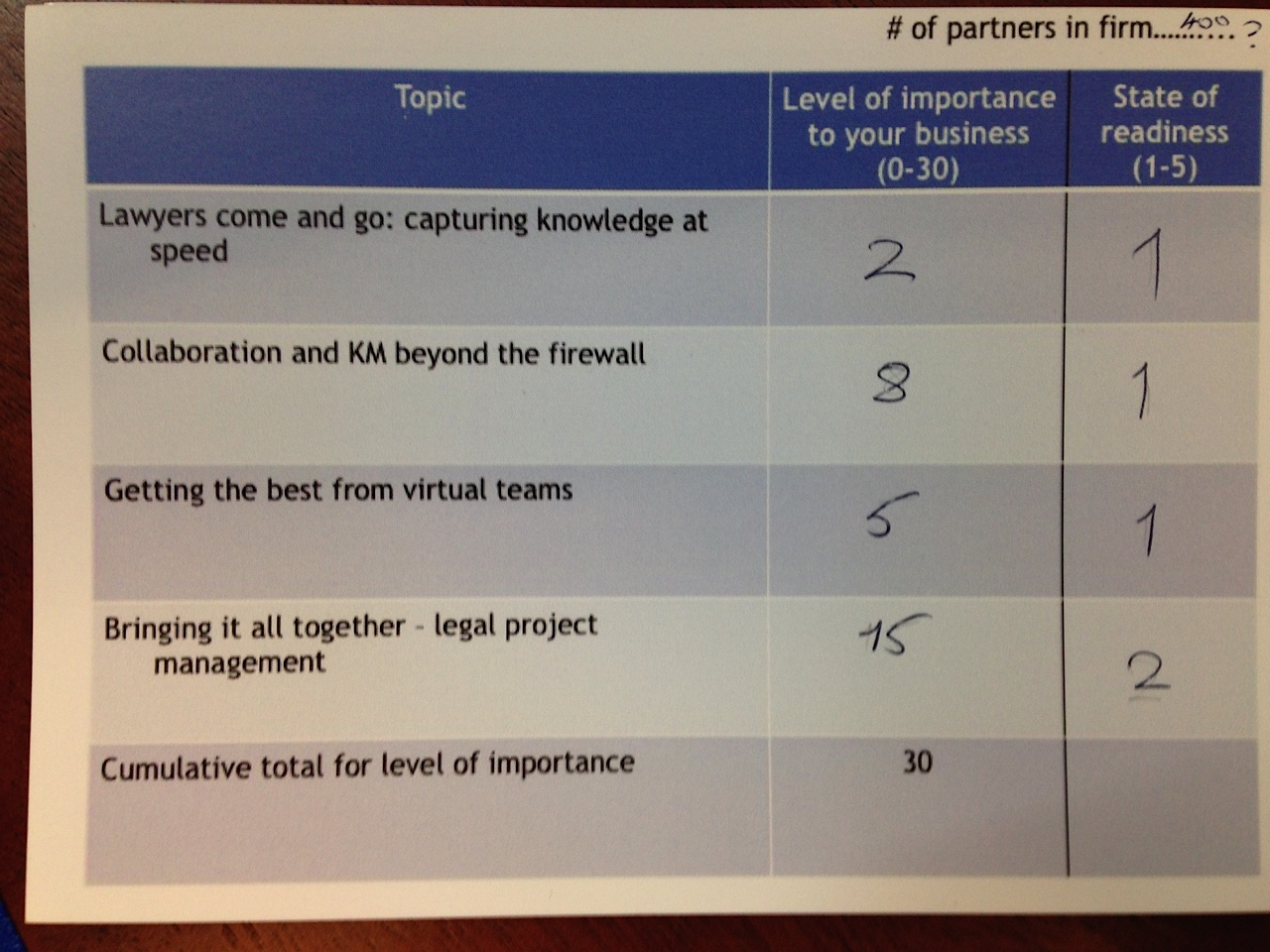
ALegal KIMs it turned out we were not far off the mark as the feedback from the postcards we invited the delegates to write on indicated.

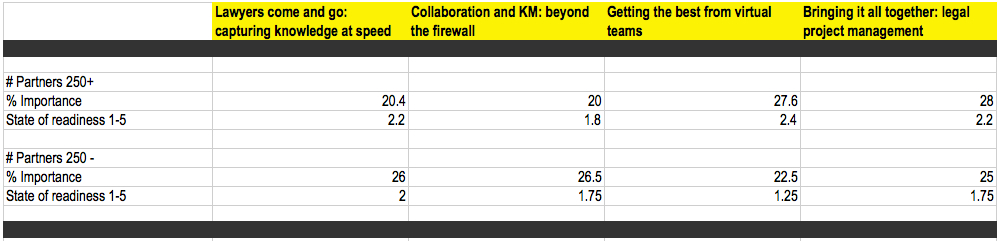
Once we consolidated all the replies on the day an interesting picture emerged.Scores on the doors (Click on the picture below to make it more visible)

In law firms of more than 250 partners the biggest issues were around virtual teams and project management. Yet all acknowledged they were not yet in a state of readiness to tackle them. Among the smaller players the biggest worry was around loss of knowledge.

other priorities

Not unsurprisingly the comments provided a valuable insight into their thinking.  Smaller firms (at the start of their KIM journey) were looking for basic KM:

  • Basic entry level km – completely new to it / evolving information research service & integrating with K activities
  • Provision of rapid and easy access to previously captured knowledge / Technology to simplify the process of intergration

Larger firms wanted something different (note the reptition of collaboration):

  • Collaboration inside the firewall / Expertise locating
  • Combining & improving KM systems / Organising our know how in a better way across the whole organisation
  • Support dept personalities working together (Marketing collaborating with IS, KM)  / Improve collaboration generally
  • Content clutter and records management / Risk & Security / Knowledge & UT goals & Strategy

So much to ponder on – watch this space for answers!

and finally

Grateful thanks to the four people who made contributions to Plan Zheroes (the event’s nominated charity).  For those who forgot and anyone else who feels moved to contribute, they can do so here.

PZ Virtual PresenceThis Thursday the Plan Zheores team are at London’s GLA for the launch of their new virtual presence which has the potential to make PZ the ‘Uber of surplus food’. Here’s a snapshot of what it will look like and why the team is so excited.


How to begin a project in a new business: collaboration, communication and a dash of KM

A week back someone asked me for a bit of advice about getting projects off the ground so I thought I’d share this with her (and you). At the request of the Executive Chairman I’m doing a really interesting piece of work at the moment with a new management team. If we pull it off it will be a great example of how to embed Knowledge Management principles into a business with the aim of speeding up development and learning as we go.

theoretical and practical underpinnings
Successful project management is dependent in no small part on collaborative team working. Learning Before, Learning During and Learning After (core foundations of what is often called Knowledge Management) can transform the way project and management teams work and how they collaborate. Simple techniques associated with each step will ensure that what we learn as we progress is fed back into the way we work in the future. The techniques associated with each step are tried and tested across a variety of industries and cultures. We are going to begin by creating an environment and way of working that encourages collaboration and openness: where we all share in success and are able to identify and rectify potential failure.

the brief

The funding clock is ticking and ‘product’ (a prototype) has to be at an advanced
stage if not already delivered for Q3 2015.
In short, the new team has to ‘hit the ground running’ from January and rapidly
establish a modus operandi in the first 90 days to ensure:

  • all issues around obstacles to delivery are capable of being surfaced in an open
    and supportive manner;
  • a set of core behavioural norms including communication and a technical
    collaborative infrastructure are established by the team for the team;
  • everyone understands their responsibilities, role and deliverables and is aware
    of the strengths of the rest of the team; and
  • everyone celebrates successes and takes ownership of potential failure

My initial brief was along these lines:

…help create a collaborative team environment with a shared understanding of what needs to be done and by whom…

the backdrop

Without naming the client (I will call them Polyglot)) I can tell you:

  • it’s space age stuff involving energy retention (so green and renewable)
  • it’s a multicultural environment and none of the 6 ‘man’ team has English as a first language
  • none of the team have worked on a project together
  • they have ambitious targets to develop a working prototype

Each was chosen because of a specialism – PhD’s abound – and an ability to go beyond what’s conventional.  But they have different backgrounds, cultures, outlooks and personal value sets. They are hungry and excited about the prospect of creating a product that can change the way we look at energy retention.

Ahead of the meeting I sent them an outline of the session and opened as follows:

You face a tremendously exciting and challenging 2015. A
new company, a new multinational team and a project that
has the potential to change the way energy is consumed,
stored and saved. Few organizations and the people who
work for them can look forward to the coming year with
such anticipation.

Project Mobilisation Meeting #1

Its Day Four and most of the team arrived on Day One. We’ve assembled at their new offices which is appropriately housed on a reseach park. In advance I asked each of the team to be thinking about a proud moment when they had enjoyed working in a team.

The aims of the half day session were:

  1. Begin building a Polyglot culture based on collaborative team working.
  2. Understand the respective strengths of the team members and Polyglot.
  3. Help kick off the ‘project’ with a shared understanding of the obstacles, deliverables and timing.

The agenda I worked up for the half day kick off session is below. What I can share is how the opening went (taken from the write up I produced):

Introductions
Everyone had a really interesting story to tell about him or herself and an astonishing array of experiences. Perhaps the most revealing was that nobody had English as his or her first language. We adopted this mantra as a way of overcoming potential misunderstanding:
‘I heard you to say…. and I understood you to mean….’
Further we agreed that whenever anyone did not understand a phrase or word they would seek clarification and record it on a white board along with a glossary of terms.

item who comments
Introductions Ask people to introduce themselves with their name and an interesting/unusual fact. Scene setting: why are we here, what the session is all about.give some examples of good (and bad) experiences
Hopes & Fears Exercise In 2 parts. Each person to write down on Postit notes:Why I joined? To plenary and call out.Then 3 hope and 3 fears and put up on the wall.
‘when you look at things differently’ An exercise designed to get people thinking about different perspectives.Split into 3 teams and give each a paper with one of 3 ‘professions’. Ask them to jot down notes about the room through that ‘lens’. Back to plenary for call out and learning’s.
My proudest team moment PC to ask each person to tell his or her story. JM to note down words for each person that sum up emotions, skills & knowledge, outcomes, behaviours.
How can we ensure the project fails? This exercise (a Reverse Brainstorm) will surface barriers/obstacles and solutions. Split into two teams; ask them what can they do to make sure we fail to meet the deadlines and quality standards.
What would you tell your Dad? Ask each person to write down a response to this ‘over dinner question’: So tell me what is it you are doing?Then get everyone to come and put his or her ‘offerings’ onto the wall. In plenary for discussion and agreement.
And finally: ‘Homework’ set the task: present an outline project plan on Friday 16th January. NB We will decide the composition of the teams in advance. There will be no guidance.

Why what the boss says (and does) matters : 3 examples to make you weep

Its not unusual at year end to take time out to think about the year ahead and reflect on the year past. Those thoughts are often prompted by conversations with people over copious lunches and dinners about corporate goings on.

fallen-tree-One such event occurred the Saturday between Christmas and the New Year. On a very windy morning (in the dark) I hit a tree that had fallen at Friston Hill on the main South Coast road, walked away from the car unscathed (even though the car was not) and so was in reflective mood about cuts to services, tree felling and pruning.

My dinner companion that day was recounting a sorry tale from her past which can best be described as the ‘mine is bigger than yours’ syndrome. In short the CEO (whose profile was increasing to the chagrin of some of the board) departed in haste prompting a dramatic fall in the stock price and the departure of some of the core team as well while the Chairman filled the now vacant positions with his own team. I’d seen a similar occurrence at a software business I was close to. There the CEO was deemed (by the incoming Chairman) to be a technologist not a commercial man. So the Chairman who had previously run a business though crucially not in software made appointments over the CEO’s head. Unsurprisingly it ended in tears and the excursion into the US a portend of things to come where investors lose their shirts!

These discussions made me ponder the difficulty of being in a Chief People Officer, Head of Talent Management and Head of Global Communications role since they are all dependent on the machinations above them at board level. In both cases I’ve seen at first hand how people who’ve given so much to an organisation can be ‘erased’ from the payroll and while the payoffs can be significant the scars take a long while to heal.

What it says to me is that few of the value statements that organisations come up with are grounded in the way they conduct themselves internally when the going gets tough. Here’s a few more examples:

#1: ‘no publicity, not now, not ever’

Last year I was contacted by an old friend, For the sake of anonymity I will call him Mohamad. He has a long and distinguished career in finance and recently developed a wonderfully innovative financing mechanism for a blue chip organisation he was advising.

Mohamad approached me since he knew through our joint alumni network that I had helped a number of organisations to surface and then make use of knowledge that could improve the way organisations worked.  We talked a lot about the critical knowledge that he’d developed running the project and how it might be used for future financings for the good of his organisation and indeed his country (it was at that level).

Armed with a few ideas on how he might go about capturing how decisions were made and implemented and a possible mechanism for sharing what he’d learned (factional stories) he went off to meet his boss.  Imagine his (and my) disappointment when he was told: ‘no publicity (of any form)’.  While a simple Google search shows him and the name of the project financed – there was a bit of publicity – nothing at all exists in the public domain or in his organisation on the method. And it seems like it never will despite mission statements that talk about becoming a learning organisation.

#2 ‘do as I say, not as I do’

I was advising an organisation in the West Country.  The CEO (who sadly passed away in a car accident having survived a Tsunami) was about to announce a bout of pruning and cutting back.  I was gobsmacked when he turned up the day before the announcement in a new Porsche.  The point I made to him was the signal he was sending, irrespective of when he had ordered it, was the wrong one and for him to regain the trust and commitment of his team he had to be seen to be in it with them!  The Porsche made few appearances after that.

#3 ‘if we are doing so well why do we feel so bad’

A close friend was at a end of season bash/annual pep talk. Her unit had exceeded all its targets and her personal performance and that of her team was a real cause for celebration.  In fact when the Group CEO got up to speak she was actually looking forward to it. After all her unit had bucked a corporate trend and she’d worked hard (often on a Sunday) to provide clients with an exemplary service.

When the CEO sat down she was totally deflated: instead of praising he implored the business to do better and berated those who had not met targets.

What proved the final demotivator?  When some of the tickets to a show (that many would have wanted to see) were handed to members of senior management rather than ‘balloted’ for use by the staff.

It made me recall a plane conversation back from Washington where my fellow traveller told how his business (he ran a call centre operation) had achieved an unprecedented 93% approval rating yet was being pushed to go to 94%.

and finally

I am currently helping an emerging business to think through project mobilisation and team building with a multinational and multicultural team. Its an exciting challenge and I shall be drawing on experiences such as those I’ve described to help create a collaborative working environment.

I continue to believe that to have credibility, value and mission statements have to be owned and embraced at the very top and not purely the work of consultants who canvass staff opinions and produce group think outcomes for the CEO and Board to rubber stamp.