About Paul Corney

@pauljcorney #KM4GOOD I help people and organisations to make better decisions that improve the way they work

“True tacit knowledge can’t be passed on when people leave”: embedding knowledge capture & retention

On Wednesday I had the pleasure of meeting and listening to Karen McFarlane who is Head of Profession, Knowledge & Information Management (KIM) for the UK Government’s Civil Service. I’d been invited as a guest by NetIKX as a precursor to a talk I am giving there early in 2014. And with due permission (Karen’s ‘day job’ is quite sensitive) I posted a few Tweets on what I heard which you can find on their twitter feed for the event #netikx63.

The Knowledge Council – setting frameworks and strategy for the KIM Profession

Karen outlined the work that has taken place over 18 months at the Knowledge Council to develop a framework and a new Government Knowledge & Information Strategy (GKIS). Her aim is to ensure people in KIM roles have KIM qualifications with good succession planning. A profession (currently 1,000 people across government are considered KIM professionals) that will attract and maintain talent and create an environment where KIM civil servants can move across roles equipped to do so.

These comments (which I am paraphrasing) stood out:

There is a real concern about loss of knowledge when people leave which is why a lot of effort has gone into building a knowledge harvesting toolkit for the KIM community….

One of the techniques is a Mastermind Chair; another, getting people to ask ‘what questions do you wish you’d asked…Try and identify the critical people… many departments use social media to share knowledge…

...True tacit knowledge can’t be passed on when people leave, you need a strategy to ensure you don’t get to that point…

Some organisations are now making use of Alumni networks to keep access to people who’ve left…

And finally… Department of Work and Pensions (DWP) and Her Majesty’s Revenue and Customs (HMRC) are now sharing stories on their intranet…

an accredited career pathway

Karen painted a backdrop wherein the topic of knowledge & information management is higher up the agenda in government than it has been for more than two decades. All of which is really positive as is the work being done with external bodies such as CILIP on accreditation and training and career pathways for KIM professionals in government.  Its impressive progress which the soon to be released GKIS will place into context.

This brings me back to the capturing and exploiting corporate knowledge’ pilot we* have been running for HMRC’s businesses under the supervision of their KIM professionals.

HMRC’s Pilot Programme: Setting Up and Capturing: Modules 2 & 3

My previous postings looked at why HMRC had set up the pilot programme, what critical knowledge is, how to identify it and why it is important.  Modules 2 & 3 of the programme focused on:

Setting up how to identify and approach the knowledge holders & networks how to design a knowledge capturing approach
Capturing develop an understanding of different capture techniques benchmark against existing approaches

‘Our’ delegates recognised:

  • not everyone who changes jobs or leaves has critical knowledge whose loss will severely damage the organisation.  Its important to be proactive to identify where it resides and with whom – the knowledge holder.
  • everyone is different. Each person who partially retires will feel differently about what they want to give back. Some people might initiate. Approach each person differently in order to find out how they feel about knowledge capture.

In Module 2 we looked at the setting, preparation and clarity of purpose which are all key to successful capturing of knowledge.  A key task is to think seriously about how a request for time with a knowledge holder is likely to be received.

A typical Knowledge Holder?

A typical Knowledge Holder?

Profiling and Archetype Mapping are used extensively in design, it is even more important when dealing with intangibles to have identified and acknowledged likely preferences of the person you are approaching?
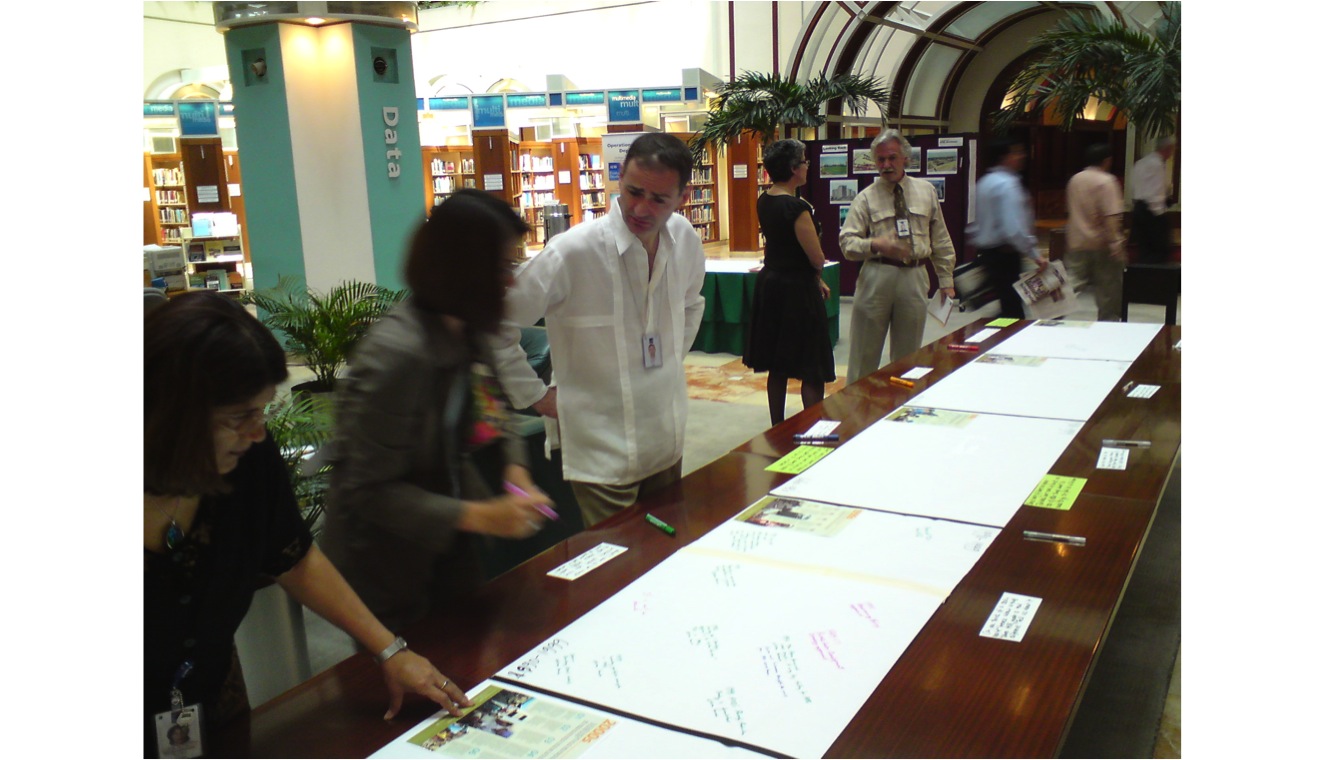
A large exhibit in Asia

A large exhibit in Asia that sought to identify major events in the life of an institution. Passers by were asked to note on a timeline events that were of interest to them.  This helped to target key players for future interviews and the subject areas to be covered.

Focusing on the individual is just one aspect of knowledge capture & retention: it’s vital to focus in addition on decisions, events and processes (documented as well as practiced) to see what knowledge is called upon in the first place and from where and then what is produced during the process.

Another key aspect is to create the right environment for the discussion/interview/observational session.  This is especially important when the intervention is to be recorded or a large response is sought.

The delegates spent time thinking about the right form of consent, how they might craft the invitation to participate and the mechanism they’d use to capture material.

Module 3 was very much about trying out. The delegates looked at:

  • Sketchbooks
  • Interviewing
  • Recording
  • Group Elicitation
  • Reverse thinking

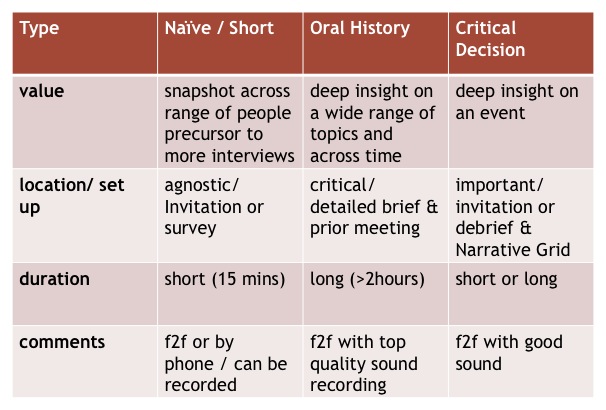
Types of interviewsThey discussed a variety of approaches to interviewing, comparing those with the checklist already developed for HMRC.

And they worked on interviewing (and listening) skills comparing and contrasting experiences.

As part of the benchmarking exercise we encouraged delegates to look at the 47 step knowledge capture process as articulated in Professor Nicholas Milton’s book Knowledge Acquisition in Practice which was very successfully adapted by John Day, at Sellafield that in itself drew on work done by Shell on its Retention of Critical Knowledge (ROCK) programme.

As in the previous modules offsite work involved listening to audios developed exclusively for this programme including a clip on Baton Passing, a technique used by the British Council adapted for their use by Professor Victor Newman.

importance and danger of Knowledge Harvesting

To return to the beginning. The Knowledge Council’s focus on equipping KIM Professionals with tools and techniques in Knowledge Harvesting is admirable. Yet I felt there is a missing skill from the training ‘suite’ shown by Karen McFarlane at the NetIKX meeting, namely that of facilitation which for me is critical.

If knowledge harvesting (what I might call knowledge capture and retention) is to become an ingrained ‘way of working’ across government then people in the business need to be equipped with those skills as well. KIM professionals must have the skills to facilitate others in Knowledge Harvesting not just conduct them.

Last minute captureThe alternative scenario is that the KIM professional gets called in to do a last minute ‘tell us what you know’ knowledge harvesting session with a prominent person and the resultant  ‘pearls of wisdom’ are placed on a database that few look at or listen to.

*Sparknow and Knowledge et al worked in partnership to deliver this programme.

‘its between me and my god…’ inside Iran

Reza (not a name I imagine used extensively today in view of it being that of the deposed Shah) is my driver as we pass a massive new mosque under construction in Teheran. We’d got onto the subject of religion as I’d seen few Iranians observe prayers while at work and asked Reza whether that was usual.  He said ‘it’s between me and my god’ adding, that the number of people who regularly attend a mosque is falling. Pressed for a number he says less than a quarter of the population!  A figure that shocked me and was contrary to the (erroneous) image I had. All is not as it seems (or is reported) in Iran.

Teheran – a walking city?

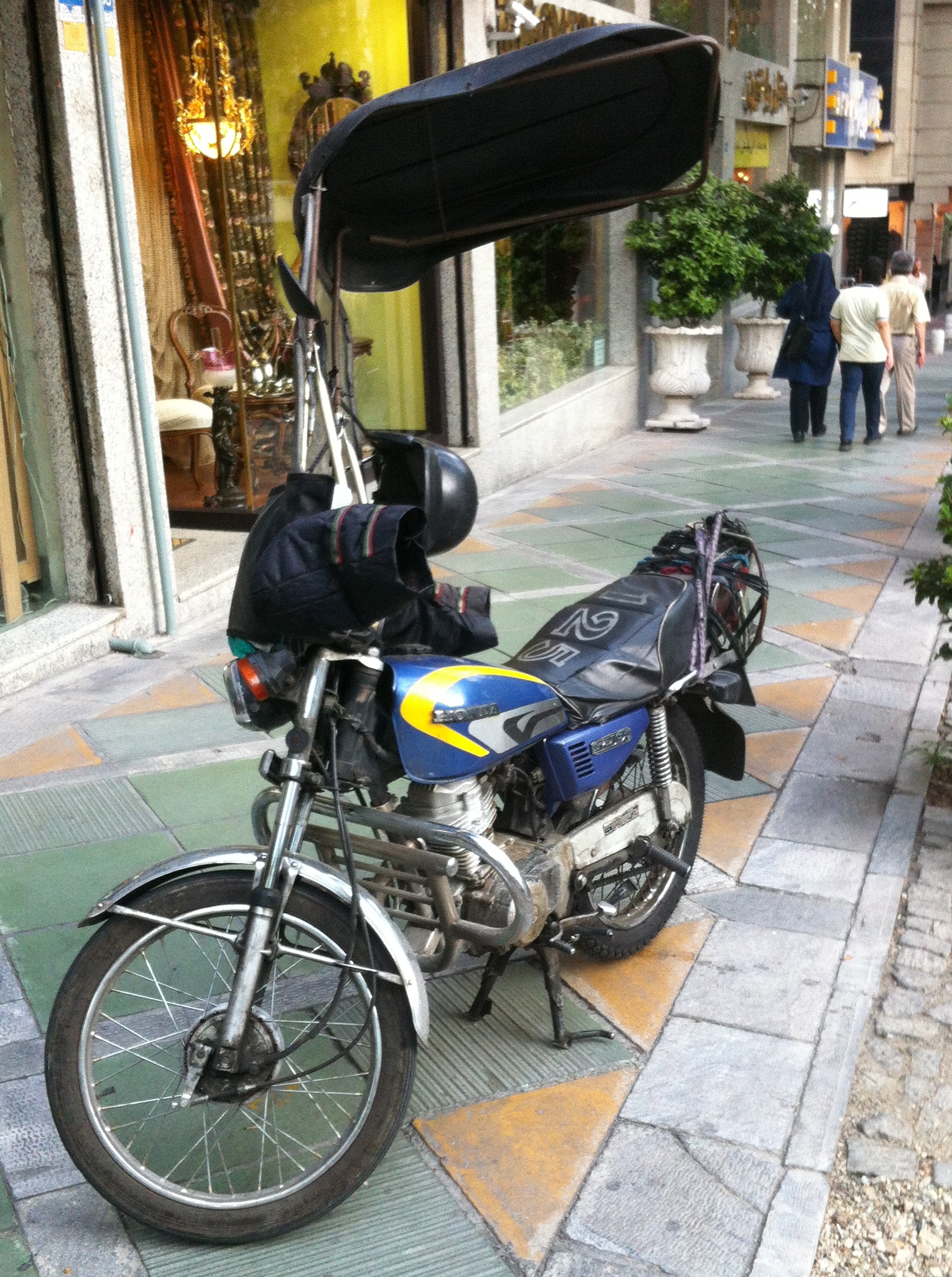
The dress code for men is Western (no ties though) and generally women are very smartly turned out.River by the roadCovered Bike  People walk or ride interestingly constructed bikes and the feel is European with tree lined boulevards and pavements.

Traffic is a nightmare and short journies can take hours. It is not uncommon for a 10 mile commute to take 90 minutes. Teheran is a sprawling city with mountains as its backdrop and smog in winter when temperatures can plumment with snow on the hills.

food, drink and cards

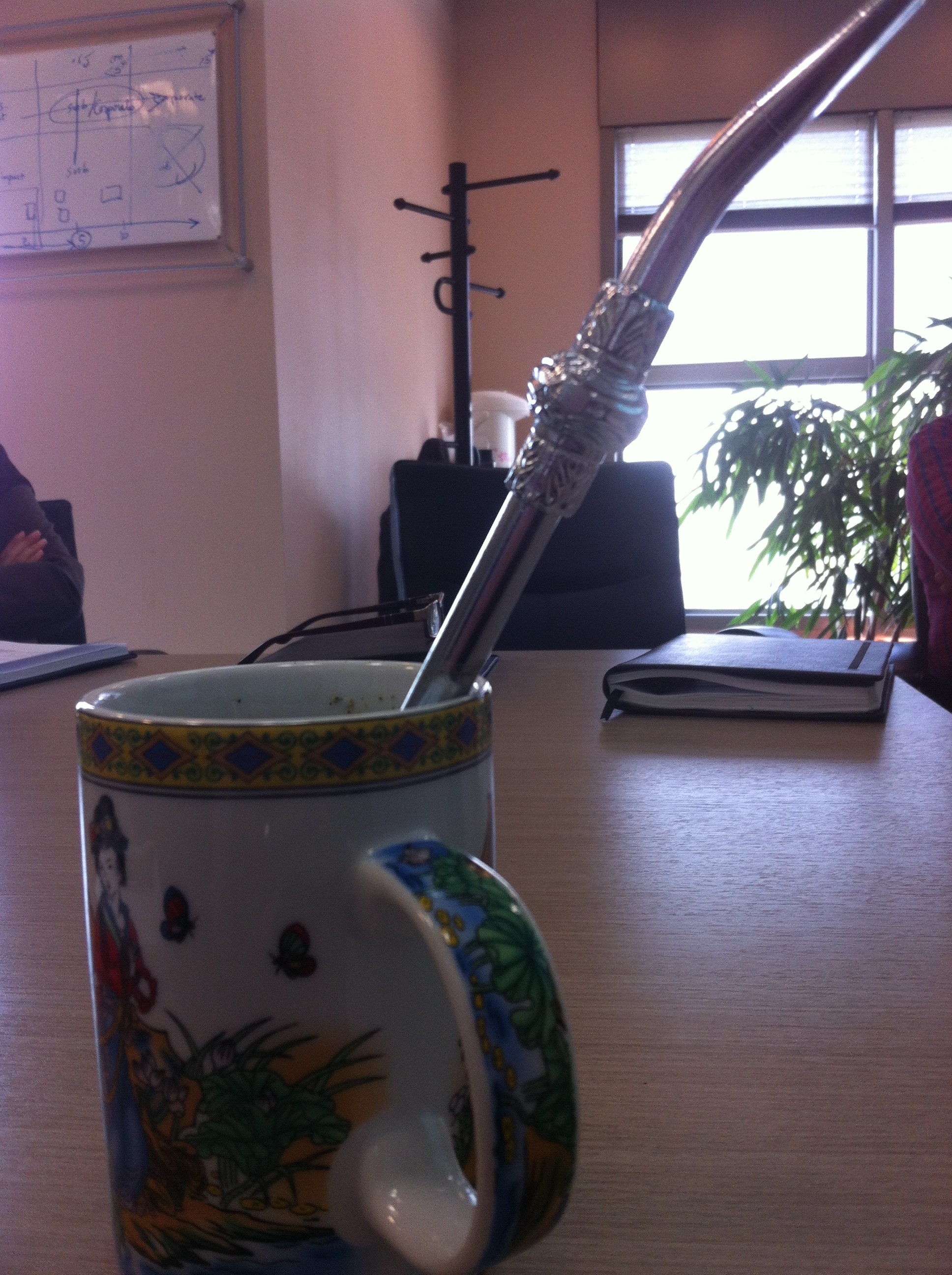
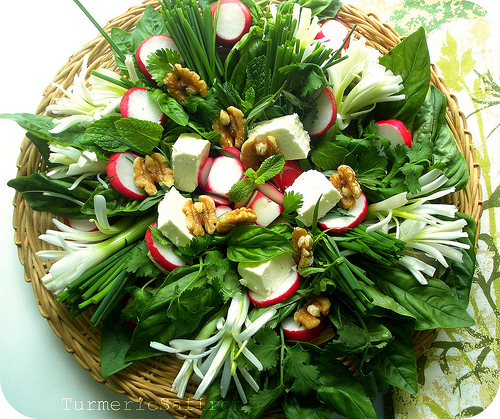
Persian cooking is among the best in the world.  We were entertained at a villa in the centre of Teheran and treated to the most astonishing meal surrounded by our host’s family. IMG_1175Another unexpected highlight was being offered Brasilian Mate by our client in his office. The slightly bitter tasting liquid is much prized so this was an honoursabzi_khordan.

Another treat was to discover how much of the Iranian diet comprises locally sourced food. The impact of sanctions means little is imported and the local goat’s cheese was among the best i’d tasted. Surprinsingly fish is not a Teheran speciality, the absence of a river means fish is farmed though it bore none of the taste associated with UK farmed salmon.

Vegetables are fresh and salads in fashion though fast food is now prevalent and cakes a prerequisite with coffee.

Flowers adorn cards which are given for eid and brithdays.

‘a country united by soccer’

In June Iran, coached by the Portuguese Carlos Queiroz, qualified for the 2014 World Cup finals in Brasil by beating the powerhouse of Asian football South Korea. It was and is a source of great joy and celebration uniting the whole country.  And yet unlike Sudan and Saudi Arabia there is no football for the fair sex as women are prohibted from attending matches which I was to discover presents a challenge to be overcome!

Iranian women are nothing if not resourceful and I was reminded of the story of Jeanne Baret reputed to be the first woman to circumnavigate the globe in 1740 dressed as a man! It appears Iranian women adopt a similar tactic to gain access to matches even though the language used by the male attendees is rudimentary.

Although the victory against South Korea was not without controversy (Queiroz was accused of inciting the crowd and making inappropriate gestures) a susbequent traiining camp to Lisboa was cancelled during to lack of funds as reported in Teheran Times.

The Iranian Football Federation (IFF) announced that the training camp which was supposed to be held in Portugal has been cancelled due to lack of funds.

“We tried to arrange the training camp but it’s impossible due to lack of money,” Mehr News Agency quoted head of IFF Ali Kaffashian as saying on Sunday.

Iran was scheduled to face Gabon in its training camp in Lisbon on September 12 as well as a friendly against Sporting Lisbon. Iran football coach Carlos Queiroz told FIFA last week his priority is a good preparation ahead of the 2014 World Cup.

“We have to make a worthy, creditable contribution, one that will honor and make all the supporters in Iran proud. How are we going to do that? With a wide-ranging, intensive preparation, as without that we won’t be able to compete against the big teams,” he said.

I found it astonishing that coach Queiroz’ planned preparation schedule is being disrupted and an illustration of the economic impact of sanctions.

news and social media

As if underscoring the not is all as it seems observation I switch on the TV in the hotel and find BBC World which is a major shock since BBC’s website is blocked along with Facebook and Twitter. Yet Google search is available even if some of its apps are not and during the elections internet line speeds slowed to a crawl.

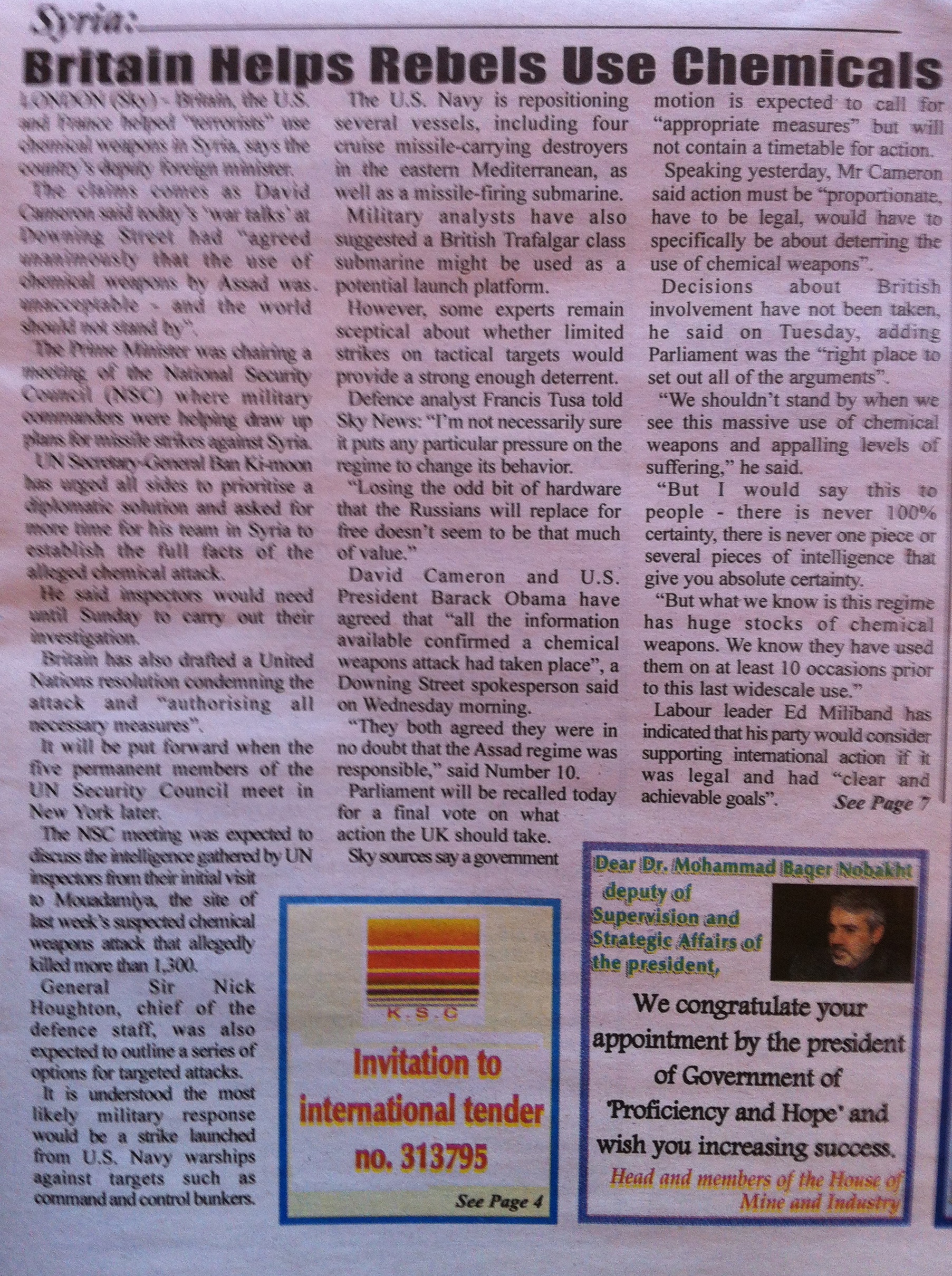
‘Britain helps rebels use chemicals…’

External news feeds are carefully scrutinised and it is difficult for a theocratically inspired regime news monitor not to be influenced by comments such as ‘nuke the bastards…’ made by a US citizen in the comments section of a online news service in response to an article on the Iranian stance on Syria.

An alternative view1It goes some  (though by no means all the) way to explaining news stories such as this which appeared in Iranian newspapers on our final day in Teheran. Iran’s people are ready for a change and the recent elections seem to have given them hope that a period of isolationism is coming to an end. Not many are aware that Iran’s current President studied at Glasgow University and that so many of its citizen’s prize a good academic career that they are willing to forego luxury items to ensure their family are well educated. Everyone seems to be a Dr. and woe betides the unsuspecting visitor who fails to address someone with a Phd by the correct title.

As we were about to depart, the UK Parliament gave a thumbs down to military intervention in Syria which as all readers will be aware is close both geographically as well as politically. The Iranian news reported this occurance positively!

A recent flurry of messages between London and Tehran and a reopening of diplomatic relations albeit through the Omani embassy in the UK, suggests a change of approach even though on departure I was grilled by the immigration official at Teheran airport about what a UK citizen had been doing there.

More importantly I sense we are at a watershed moment wherein the US is no longer seen as or indeed behaves like the ‘policeman of the world’.


Favourable first impressions of Iran despite ‘come back tomorrow with the fingerprint records…’

Our first contact with an official at the Iranian Consulate in Dubai in support of our application for a visa.

will we get in?

Nazim (aide de camp from the client’s Dubai office) has handed over our documents at 9am. A prominent Knowledge Management guru/practitioner and I (whose name I am omitting along with that of the client to protect confidentiality), have stopped there enroute to Tehran as there is no Iranian Embassy in the UK. We’ve been assured getting a visa would be straightforward and that the opening hours for visa applications of 8am to Noon would allow us enough time to get on the 18.45 Emirates flight from Dubai to Tehran.

IMG_1108

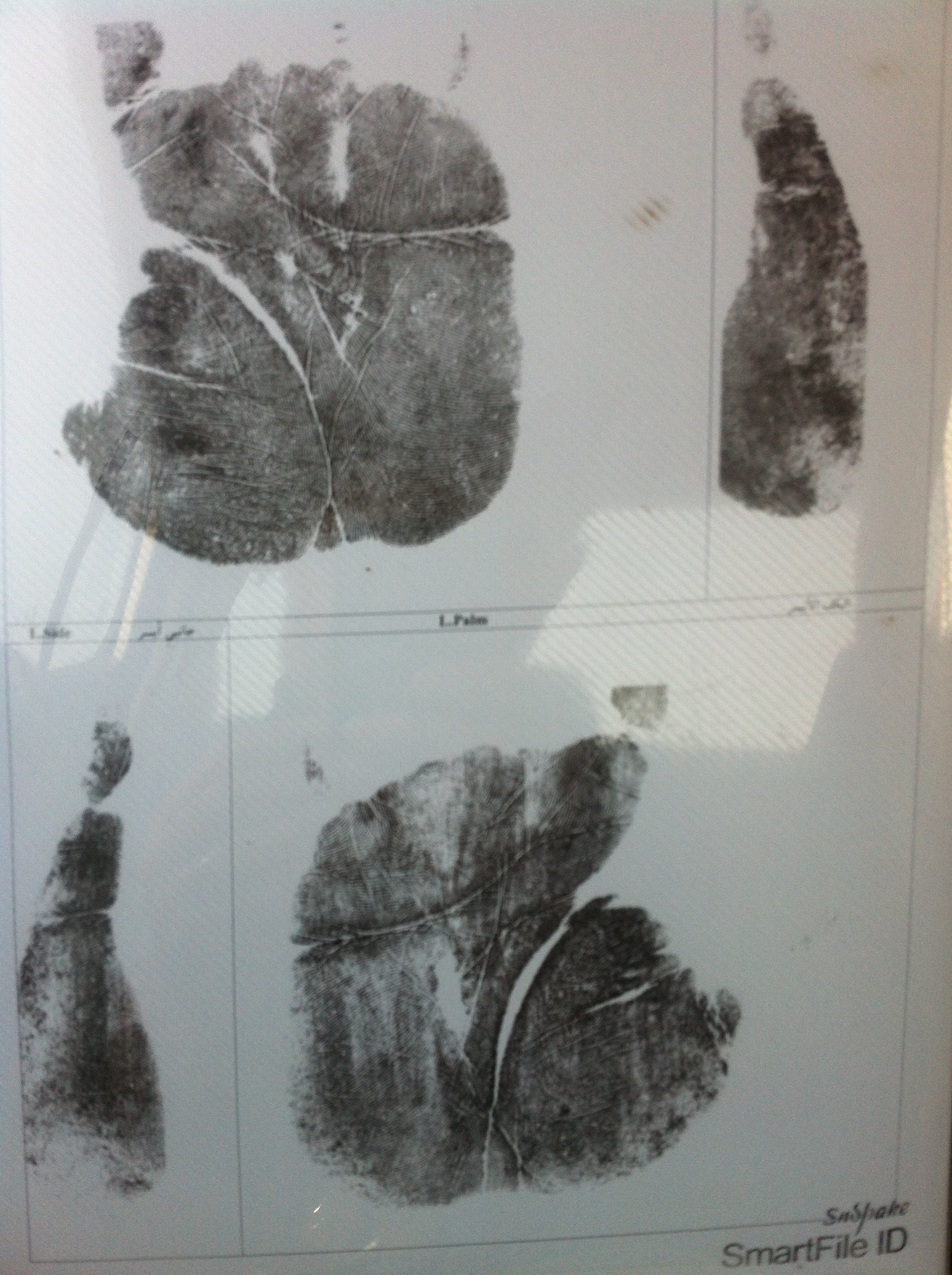
My hand /fingerprint

So at 7.30 am, having arrived barely 5 hours previously, we were collected and taken to Dubai CID for fingerprinting. This is not normal for either of us. It has been necessitated by the US’ imposition of such a policy for inbound Iranian visitors and as often happens in politics provoked a like for like response.  It proves to be a slightly amusing affair despite the officer in charge holding my hand a little too long for my liking while I am shown where to place my palms on the machine that is to record every detail of my hands not just fingerprints.

no insurance, no entry!

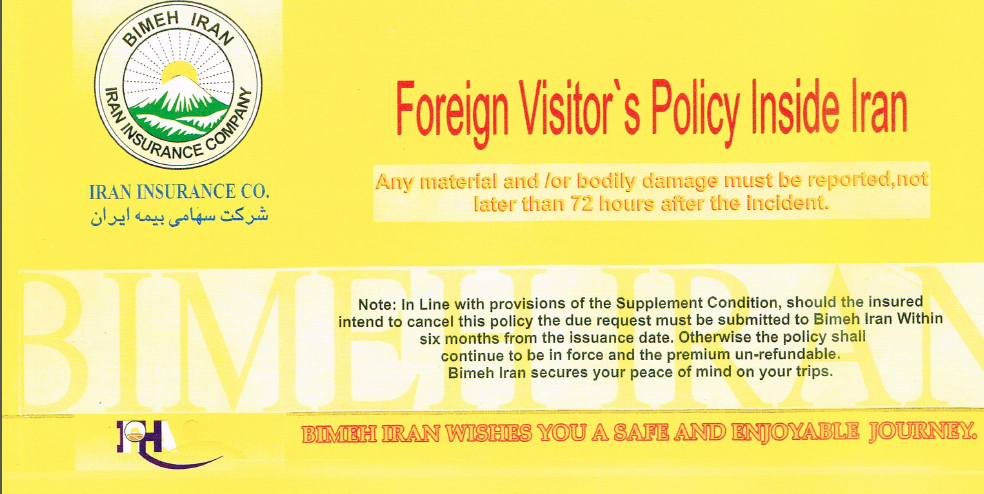
And so to the Consulate.  The official rejection is made in a manner that leaves little room for negotiation. And a new twist, we are instructed to get travel insurance.  This is in itself ironic as UK travel insurance is invalid as the UK Foreign Office issues advice warning UK citizens not to travel to Iran. So here we are being told to buy it otherwise we don’t get a visa.  Help is at hand, a colleague of Nazim’s appears from nowhere on a motor bike, collects our documents, including fingerprint records, and speeds off in the blazing sun (its by now 10.30am and 35c).

InsuranceHe returns smiling some 35 minutes later clutching a couple of policies issued by the Iran Insurance Company! Amid much backslapping off he goes having handed over our documents.  Nazim whose demeanour has changed from misery to euphoria marches up to the counter with the policy.

Come back tomorrow with the fingerprint records!

There is a problem, not all our documents were handed back. Nazim is now crestfallen. Its 11.15am, the noon deadline for visa issuance is approaching, and our records are zooming around Dubai on a motorbike. The likelihood of us getting to Tehran that evening are diminishing rapidly along with his career prospects. We have a packed four day schedule that kicks off tomorrow morning and involves many senior figures, Nazim is on the hook to deliver us to the departure gate with valid visas!

However once more ‘Insurance Man’ delivers. He is back in 15 minutes with our fingerprint documents and with much fanfare 15 minutes before cut off time all documents are submitted.  A visa is duly issued by a woman official dressed in an abaya and hijab not our first contact who is haranguing everybody attempting to submit a visa application.

Declining the tempting offer of a tour of Dubai (I put a marker down for a visit to the Burj Khalifa to watch the sunrise) we return to our temporary home the Le Meridien Hotel opposite the Dubai Creek Golf Course – its way too hot and humid to play golf – and final preparations for the packed week ahead.

Nazim tells us that they went to the Consulate to check everything the previous week and were assured all our visas were a formality. Within a week the fingerprinting and insurance requirements were added. And the official who gave the initial advice was now on holiday.

first impressions

As we begin our descent the fuselage mounted camera on the Emirates Airlines Airbus A330 shows little of the terrain but does reveal an airport some distance from the centre of Tehran, a city which we are to learn is home to some 14 million people.

Women put on cloaks and headscarfs and from now on physical contact (including the shaking of hands) in public between the opposite sexes is the exception rather than the norm.  We land in the dark at 9.50pm at Imman Khomeini International Airport, Tehran.

The airport is a solid structure; quite Easten Bloc in many respects with substantial columns and signage that pays little attention to aesthetics.The immigration hall has a low ceiling which adds to the sense of foreboding I always feel when entering a new country.

As we line up to put our luggage through a scanning machine I note the lady in front has two suitcases larger than her.  My offer to help is politely declined with a knowing look. My earlier fears prove groundless and we are out 30 minutes from touchdown having been met by a driver who instantly makes us feel welcome greeting us with ‘Asr bekheir’ (good evening).

Samand_LX_31Our’ car the Samand is ubiquitous throughout Iran and in its ‘satellite’ countries. Iran Khodro Company (IKCO) is the largest vehicle manufacturing company, having an average share of 65 percent of domestic vehicle production with annual sales in excess of 700,000 vehicles that includes a number of French names produced under licence.

As we are to discover, sanctions has served to increase the manufacturing base placing much emphasis on the need for innovation and creativity.  I am to discover that as a result the Stage-Gate Process – New Product Development methodology developed by Professor Robert Cooper is very popular (more of that in a future post) and proves an interesting touch point as I worked with them both a decade ago when helping to introduce the process into many clients.

The journey is eventful and takes 45 minutes. Driving styles mix aggression and faith. Right of way is negotiated though traffic signals are observed. The overwhelming impression is of too many vehicles: entry to the centre on certain days is dependent on your number plate.

Pedestrian right of way does not seem to exist and crossing the road is not for the faint hearted. It requires determination, cunning and luck.  Woe betide the pedestrian who deviates or stops mid way as vehicles swerve around you.

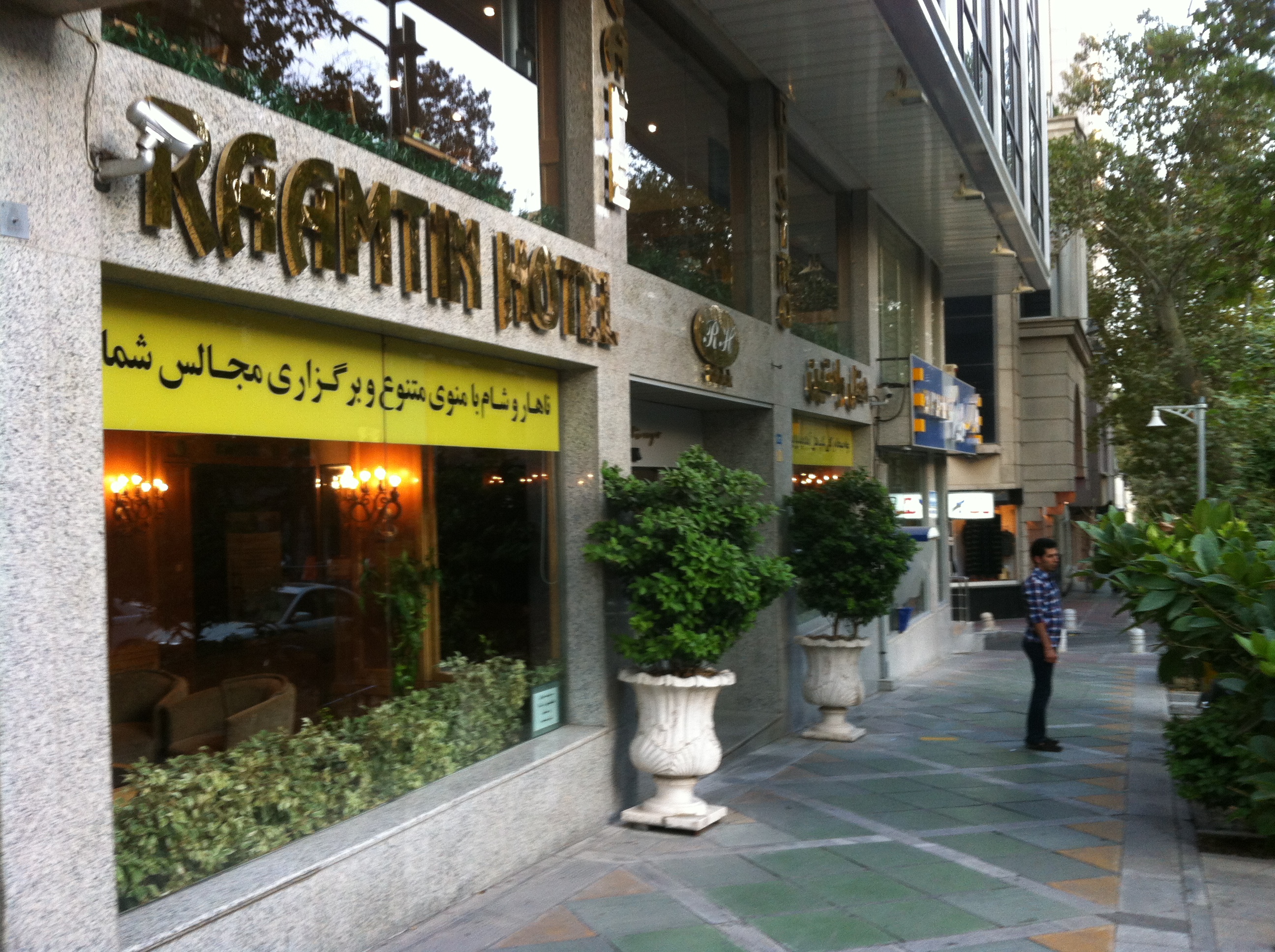
IMG_1206On arrival we receive a warm greeting from the receptionist at the Raamtin Hotel a boutique establishment with 70’s decor. The  hotel is situated on the main North – South route but is surprisingly quiet. Water runs down each side of the street from the nearby mountains that form a backdrop to the metropolis.

River by the road


Room 309 which also has a 70’s feel about it overlooks the tree lined road which has many pedestrians despite its steep incline. It feels European in many ways and first impressions are favourable.

capturing & exploiting corporate knowledge in HMRC: bombs, cakes and critical knowledge

The impending release of the UK Government’s Knowledge & Information Strategy has shone a spotlight on the need for all areas of government to capture, effectively manage and share the knowledge and information they create and receive…if they are to deliver a world class and publically accountable digital public service.

I wonder how many UK taxpayers associate HMRC with being at the leading edge of government practice? Yet a few months back 14 senior business people gathered for the first modules ran by Victoria Ward and I of a Civil Service Learning pilot programme* entitled capturing and exploiting corporate knowledge. 

The venue was Whitehall, London yet the delegates came from around the country and represented a wide variety of disciplines from across HMRC: VAT Directorate; Anti Money Laundering; Large Businesses Service; Corporation Tax, International and Anti-Avoidance (CTIAA); Specialist Investigations; Local Business Comliance: and Excise, Customs, Stamps & Money Services (ECSM).

in advance

We asked the delegates to:

…bring along an object. An image, document or small artifact that illustrates a memorable event with which you were involved during your last couple of years in the business. It might be a decision, a new piece of policy or a transaction.  We are going to ask you to talk about the object and use it during the exercises so please think carefully about what you might choose.

Here’s why: Objects stimulate conversations; people feel comfortable talking about them in environments where otherwise they might not open up. They reveal insights other techniques fail to unearth and so are effective as icebreakers and as triggers for more in-depth discussions on events and projects.

One of the core beliefs I’ve developed working with Sparknow is that, to be effective and valued, knowledge management has to be about helping to improve the decision making capacity of individuals, teams and organisations. Indeed it features in the opening sentence of the World Bank’s definition of KM:

…Knowledge provides insight for decision making…

So, much of early stage investigation into critical knowledge has to be around events and decisions and how knowledge has (or has not) informed them. Objects have proved to be a good way of facilitating those early dialogues and feature prominently in the work we do.

By combining timelines and objects to examine an event or decision in an Anecdote Circle we imagined this would act as a real stimulus in helping to place clarity around the concept of critical knowledge.

module one: Positioning

aims

  • understand the importance of critical knowledge to HMRC

objectives

  • able to identify critical knowledge
  • see how and why others identify and capture critical knowledge

Reassuringly people were prepared and had an object, an image or something in mind (this is often not the case). Here’s an extract from Victoria’s fieldnotes taken during the plenary debrief on the memorable objects session:

My object wasn’t that helpful, it was just a document…But it was a conversation starter, very simple very plain, a trigger… It brought a story to life and helped with focus

The Anecdote Circle helped the delegates identify the event or decision they wished to examine in more detail.

For that we invited them to use a tool, (worksheet) for conducting a more in depth (Deep Dive) type of discussion, Sparknow has christened the Narrative Grid.

Narrative Grid Worksheet

Narrative Grid Worksheet

Comments were broadly favourable and the Narrative Grid was to feature later in the programme by which time they were more attuned to its benefit and skilled in its application.

From looking at critical knowledge from an internal perspective we shifted to the external environment drawing on examples from the nuclear industry, the health industry and the regulatory industry to illustrate how they had set about identifying what critical knowledge was in their business and why they set about capturing it. A common theme running through each example, with which the HMRC delegates were able to empathise, was the need to mitigate risk especially around the departure of staff with considerable expertise and experience.

There was broad agreement that critical knowledge:

‘It’s the knowledge HMRC would struggle without if it lost’

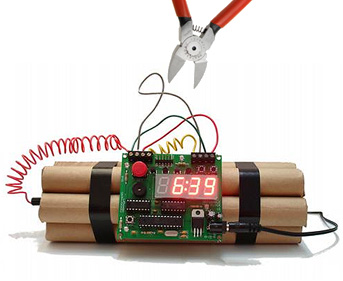
And in working through examples the delegates were able to identify two compelling metaphors: bomb defusing and cake makingcolored_wires_bomb_cutter_3268

  • In defusing bombs the precise critical knowledge is knowing what wire to cut.
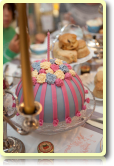
  • For recipes, it’s not just the recipe, ingredients, marinading, but how hot is my oven?

    Flower Bomb Cake by Madeline Ellis

    Flower Bomb Cake by Madeline Ellis


Module One ended with us providing the delegates with a set of references and reading. We also provided a link to an interview I’d conducted with Gordon Vala-Webb a promiment KM’er in Canada who was in charge of a project to capture and retain knowledge for a regulator at a time when many of its most experienced staff were about to retire and would impact them operationally. Gordon gives an eloquent explanation of how a large govenrment organisation tackled this and determined the knowledge they could least afford to lose. Here are a few snippets:

…we took a risk management approach and got each of the branches to fill in a risk assessment form as part of the annual business planning process… a high score would have resulted in the branch developing a risk mitigation plan… we provided guidance on different approaches which included videoing, interviewing, expanding procedure manuals…in some cases they kept the retiring staff on call…

…I believe if we had not had this program people would have been scrambling to keep operating…

More to follow on Modules 2 through 6 over the next few weeks.


*Sparknow and Knowledge et al worked in partnership to deliver this programme.
why the UK Government is seeking to capture and retain critical knowledge

As I write this an updated Government knowledge & information Strategy is being crafted.

Following the recognition of knowledge & information management (KIM) as one of the professions of government and building on Information Matters published in 2008 it represents another important milestone in the journey towards a more flexible workforce able to recognise, capture and retain that knowledge & information critical for its current and future business.

More on that in due course once the Strategy has been released.

turning the km & i vison into reality

Recently HMRC (through Civil Service Learning) commissioned Sparknow and I to run a set of pilot programmes on capturing and exploiting corporate knowledge. HMRC like all areas of governement face the threefold challenge of:

  • equipping new joiners with sufficient knowledge and information that they are able to hit the ground running (while making the most of the knowledge they are bringing to the organisation)
  • ensuring that when staff are reassigned they have sufficient time and access to the knowledge they need to transition into the new role
  • capturing the huge experience and knowledge (often tacit) from staff who are coming up for retirement, whose job may be dissapearing or who are leaving to pursue a career elsewhere.

In welcoming the participants our sponsor said:

This proposed programme…aims to make knowledge retention part of the engrained behavior and the way ‘we’ work. It should be a continuous process fuelled by the belief that everyone has something to contribute and much to learn from sharing knowledge.

Our challenge then: to develop an informative, participative and enjoyable set of interlinked modules that gives exposure to a dozen or so tools and techniques that will help to identify, capture and reuse what are often termed ‘critical knowledge assets. And find a measurement (we used Dr Donald Kirkpatrick’s Learning Evaluation Model) to assess the success of this capacity building initiative.

View from first training room

The view from the venue for modules one and two.
Picture by Victoria Ward

Over the next month I am going to be taking a more in depth look at the modules we ran and the areas that stimulated most interest among the dozen or so senior HMRC staff from different areas of the business around the UK.  So as ‘they’ say: ‘watch this space’!

when knowledge & information  flow

As part of the discussions leading up to the programme we developed a vision (a future story) of what an knowledge & information friendly environment might look like:

I’ve just returned from ‘an audience with…’ session with  John who is about to retire. It was different from the usual breakfast briefing – we got to learn about topics and events we’d identified as being of interest. Hearing those described by someone who’d been through it all was really insightful for a relative newcomer.

I relocated this year: thanks to Agnieska who’d built a bridge between my predecessor and me there were few surprises and I still see Jane for a regular catch up. I am much more aware of things that are going on, who I can go to and ask a question. Most importantly I now have a set of useful questions and the confidence to ask them in any situation.

I am keeping my Decision Journal: who’d have thought it but it’s  been immensely valuable as a prompt when having conversations.  And I am now a timeline convert and shocked my Director when I  used postcards on a timeline to share my regular update.

I do feel that should I leave it would be easier to pass on what I’ve learned in a more illuminating way. If only I’d begun it earlier – using objects as prompts has made sharing experiences intuitive.

The business has benefited: an idea brought in by a new staff member resulted in process improvements that improved collection rates; when Roger transferred to East Kilbride the transition time was much shorter as he was able to tap into the networks of his predecessor and the insights that emerged from the sessions with Priyanga prior to her departure helped shape the new set up in Southend. Whereas before we may have lost touch, now she still feels a sense of attachment and was at one of the recent breakfast events that are now open to alumni.