About Paul Corney

@pauljcorney #KM4GOOD I help people and organisations to make better decisions that improve the way they work

When someone with significant expertise joins the organisation, what happens?

Not a lot if the responses to the survey Martin White and I ran are anything to go by. With most responses acknowledging importance of expertise to their organisation, and against a backdrop of reports suggesting that 1:5 of the workforce in the US will retire within 5 years and that 77% of employees are actively looking for a new job, it seems to us a good time to be taking a deep dive into the topic of Expertise Discovery.

How would you have answered this question? Your options are:

  1. We have a policy which values expertise sharing
  2. We have a Knowledge Management policy but there is no specific reference to expertise sharing
  3. We have a KM policy and are planning to include expertise sharing
  4. We do not have a KM policy but are planning to develop one
  5. We have no plans to develop a KM policy or a ploicy that values expertise sharing.

57% of responses ticked 4 or 5. There is much to discuss and yet the claims made today are that you can buy a product that will solve the issue at the press of a button. Maybe? Is your organisation like one I worked with a few years back who told a new senior employee that the knowledge they had acquired in previous roles was irrelevant as “we are unique”?

Those who attend our event on April 26th Expertise Discovery 2018 – optimising access to corporate knowledge will be able to

  • Appreciate how expertise profiling, expertise finding, expertise ranking and expertise sharing have to be integrated into an expertise discovery strategy
  • Understand the capabilities of the increasingly wide range of expertise finding applications
  • Apply the six crucial tests for evaluating these applications
  • Consider the respective roles of IT, HR, KM and legal managers in optimising the benefits of expertise discovery
  • Share successes and challenges with delegates under the Chatham House Rule

Over the past few years I have run a number of Masterclasses on the importance of effective Knowledge Capture & Retention and it was part of the thread that ran through “Navigating the Minefield: A Practical KM Companion” I co-authored with Patricia Eng last year. At the fulcrum of any organisational effort has to be a recogition that knowledge is not a commodity acquired at the drop of a hat. As a foreward to the chapter I wrote a few months back in “Knowledge Management Matters: Words of Wisdom from Leading Practitioners” I wrote:

As I was growing up and entering the workplace it was common for new joiners to have a probationary or apprenticeship period where you learned from watching then doing under supervision.

Depending on the profession that apprenticeship period could be anything from 6 months to a year and at the end rather like a pilot you were deemed competent to fly solo.

The assumption was that you were likely to be with that organization for a long period and that when you eventually did leave (or retire) your knowledge would have been passed on to those who would replace you.

Today employees are much more transient in nature and few organizations run apprenticeship programs: the c.v. is not about who you worked for, it is more about what you worked on (and achieved). It is highly likely that during their working life someone in their 20’s today will have worked for more than 5 employers (if not going solo as part of the ‘gig’ economy).

Organizations have to plan for this increasing turnover and changing demographics. Their systems have to cater for a transient workforce.

Part of that planning includes having thought about an approach to Expertise Discovery. I am sure you will be interested to learn why we are including this in our event.
What Lisbon, Eastbourne, Neil Usher’s book and Knowledge Management have in common: Importance of environment.

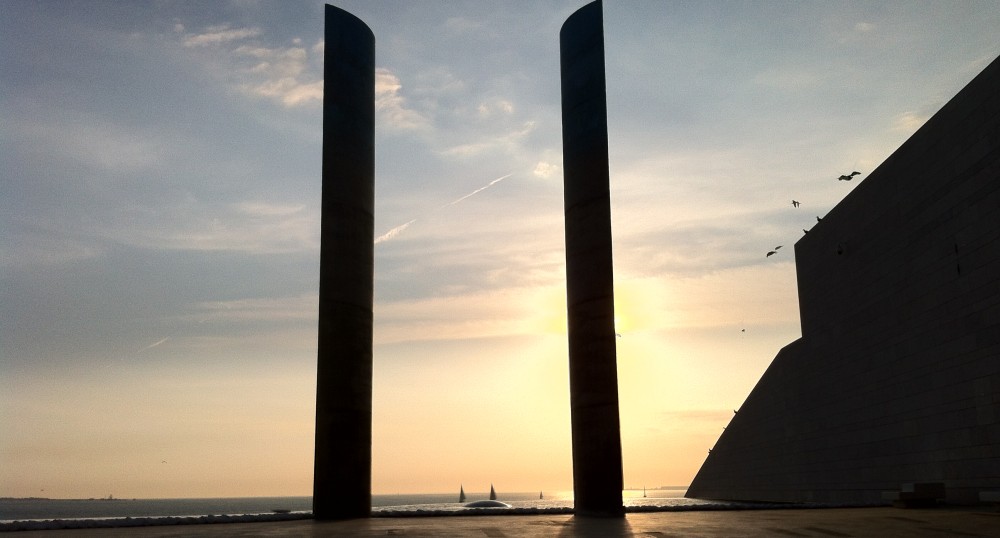
Hands up, I wimped out and decamped to Lisboa to work and write when winter (Inverno in Portuguese) hit Eastbourne last week. I had a few people I needed to catch up with, some reading I’d promised I would do as well as prepping for forthcoming masterclasses.

Since my teens I’ve found a change of scenery / the right environment often acts as a catalyst for generating ideas. Indeed one of the questions I ask when trying to determine how knowledge flows in an organisation is “where do you have your best ideas or conversations?” The venue/space is important.

Which rather nicely brings me onto one of the books I vowed to read while I was by the Tejo.

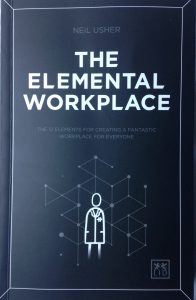
The Elemental Workplace: Everyone deserves a fantastic workplace

I first heard Neil Usher at the SocialNow Event run by Ana Neves in Lisboa in 2017. He gave an entertaining presentation in which he presented his hypothesis that there are 12 essential Elements (design principles) all good workplace designs require. Coming hard on the heels of research I’d conducted earlier that year and a Masterclass I’d run in Asia on Collaborative Knowledge Spaces this was music to my ears. I’ve always believed in the importance of planning for “Orchestrated Serendipity” when designing spaces that encourage the sharing of knowledge. Neil’s presentation struck a chord and I vowed to go and see some of his projects.

I was delighted therefore when I learned Neil had ‘put pen to paper’ and written The Elemental Workplace” an easy to read tome that I imagine will become essential reading for people looking to create a stimulating enviroment in which to work.

Already my copy has plenty of dog ears and I found myself drawn to Part One – Why, and Part Four – What could possibly go wrong?

If you take nothing more away from the book than remembering these three quotes in Part One it will have been a good investment:

An effective workplace is one that is built on the principle of simplicity, an effective workplace is one that inspires and energises and an effective workplace is one that can facilitate learning and development.

Moving onto Part Four and this paragraph under the heading “Build it and they will come” stood out for me:

On your travels and in your research, you will discover amazing physical spaces that just do not work, because the creators believed that was enough. It is never enough. Change has to be nurtured, enabled, facilitated, continued. Build it and you will have just built it, nothing more.”

Perhaps my favourite sentence in the book is on on P36 under the heading “Ether”

A fantastic workplace can make a huge contribution to the customer advocacy of an organisation by creating a natural association with admirable values and looking after its people.

This is a book those involved in Knowledge & Information Management should read a few times. The checklists are great but you will have to work out who owns the collaborative knowledge space topic and where the idea fits in your own programme (if at all).

Murals changing society

And so to Lisboa where I spent a hectic Sunday morning out and about seeking examples of Street / Urban Art. Bear with me as I tell you why. Fortunate enough to live in Lisboa as well as Eastbourne I’ve been struck by the difference in the way some of the less salubrious parts of both cities have dealt with urban deprivation.

As the Head of GAU Lisboa  Urban Art Gallery (GAU) explained:

The Galeria de Arte Urbana of the Departamento de Património Cultural (Department of Cultural Heritage), from Câmara Municipal de Lisboa (Lisbon’s City Council) has as it’s main mission the promotion of graffiti and Street Art in Lisbon, in a official and authorized scope and in a pathway of respect for the patrimonial and landscaped values, in opposition with the illegal acts of vandalism that harm the City.

The district of Padre Cruz is the largest Urban Housing development in Europe with some 8,000 homes. Violence, poverty, drugs and deprivation were rife in 2016 before the Municipality introduced the concept of Urban Art with the active engagement of the local community.  The transformation has been amazing: residents now have a pride in their community and the incidence of crime has decreased dramatically.

I am not comparing today’s businesses with Padre Cruz but I am posing the hypothesis to those who are skeptical about the importance of creating the right environment for collaboration, knowledge sharing and human interactions – Orchestrated Serendipity!

Rua da Gloria Lisboa.

Back in Lisboa I found myself surrounded by numerous visitors all marvelling at the murals that have been painted in various parts of the city at the behest of GAU.

It’s not a coincidence that the resurgance of a vibrant artistic and technologically gifted workforce has at its fulcrum a decision taken by the Municipality to set up GAU at a time of deep austerity.

That they curate the work providing a legacy for future generations is also farsighted.

And finally

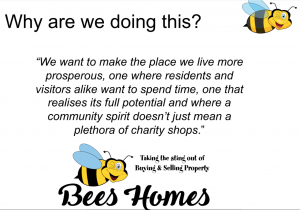
Why is this relevant? Because as part of our commitment to our community Bees Homes (the business we set up some 10 months ago) is working with the authorities in Eastbourne to try and transfer some of the knowledge gained in Lisboa and create a version of Urban Art here. We all know that a house ‘staged’ properly with good pictures will attract more buyers and achieve a better price than one that is not. The same surely applies to the environments in which we live and work?

Adapting Neil’s strapline: “Everybody deserves a fantastic environment that inspires and energises”


Next wave is where KM is not even mentioned: a dive into KM Asia 17

The view from KM Asia 17

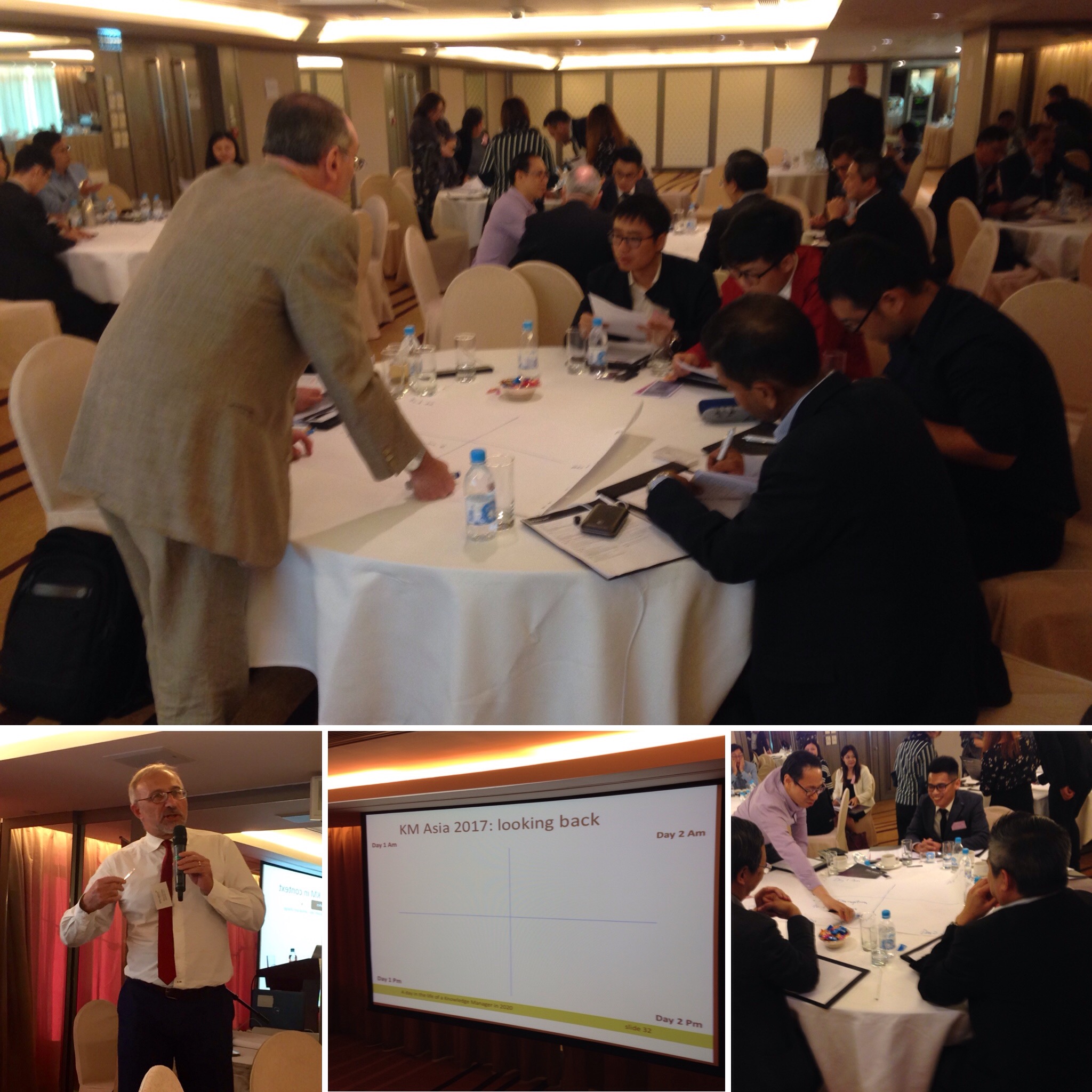
This was the first KM Asia event run by Ark Group I’ve attended in Hong Kong. Part of an Asian tour that also took in Kuala Lumpur and Singapore and comprised Masterclasses and presentations, I was there to give a talk on Collaborative Knowledge Spaces and run the hour long closing session styled thus:

KM competencies: A day in the life of a knowledge manager in 2020 “This highly interactive practical session will use a timeline technique to draw on the emerging themes of the conference. Paul will look at the skills likely to be required of a Knowledge & Information Manager in 2020. He will then invite delegates to imagine the life of a knowledge manager in 2020″

No pressure then!

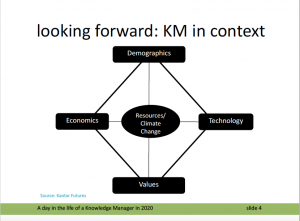
In prepping for the “future story” session I was indebted to Andrew Curry of Kantar Futures who I met to discuss one of the frameworks he uses to help clients imagine their future. Here’s how I used it in my presentation to paint a backdrop for the future.

The backdrop:

  • The world’s working age population (especially in the developed world) is shrinking
  • Big disruptive technology platforms emerge every 50-60 years or so. The current ICT (digital) wave is slowing down because the leading companies are no longer able to grow easily by adding more users; they need to find innovative ways to grow revenues per user, and this is challenging.
  • Global growth is slowing: its a combination of demographics (how many people are working) and productivity (how much they are producing). Fewer people of working age means fewer people to support an aging population.
  • Societal values are changing and the newest entrants to the workplace place less value on individual financial success and security, and more value on good work done for a good cause.
  • Climate scientists suggest that by 2050, the average global temperature will have increased by anything between 0.8 and 2.8 degrees above levels in 1990. The implications for the world’s resources are significant and will in the shift to nationalism precipitate conflict.

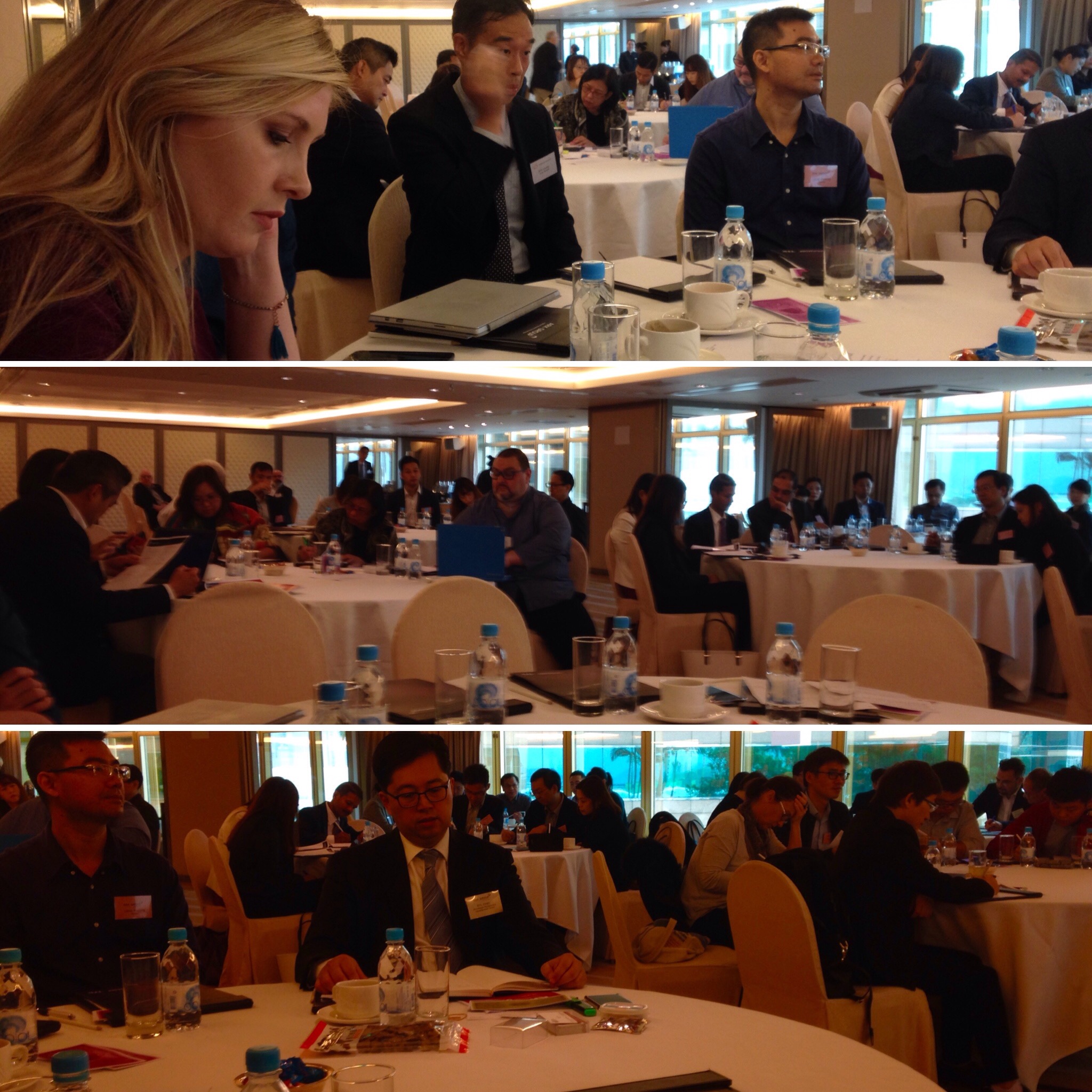
A good crowd at KM Asia on Day One

So, what emerged from 2 very full and well attended days at the Royal Pacific Hotel Hong Kong and my closing session?

what surprised me?

  • The group takeaways (3 highlights from each day) revealed how dfferently we see things and thru our own lenses.
  • How few people had focused on the idea of curation being a role that the “Knowledgeur” (Knowledge Manager of the future?) might be required to fullfill.
  • That one organisation who focuses on inspecting others did not have a process for feeding process enhancements and learnings back into their own.

what intrigued me?

  • That those who’ve offshored functions are looking to bring them back in house as they now recognise the danger of critical knowledge loss.
  • That the chat bots being used for basic ‘stuff’ cannot handle difficult complaints which are then passed over for human intervention.
  • The thirst for accreditation: people and organisations want recognition for their knowledge and a KIM career path.
  • That Hong Kong is still going through a massive building boom fuelled by demand from the mainland.

what delighted me?

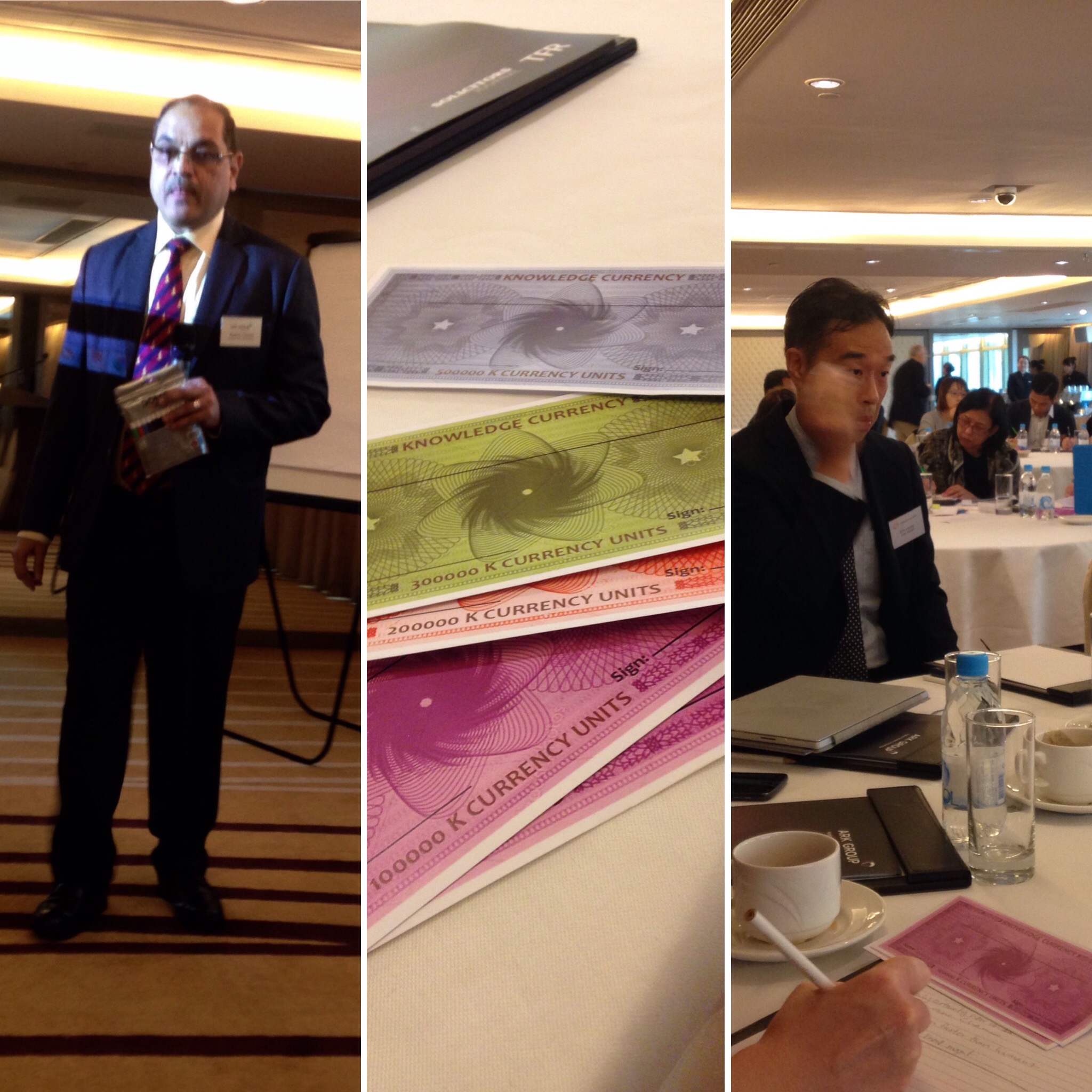
  • Rudolf D’Souza’s opening exercise with ‘Knowledge’ money
  • Three of the best presentations I’ve seen at a KM event on morning of Day Two from Eric Chan, Vincent Ribiere and Rudolf D’Souza. Set the bar high for my closing session!
  • Meeting up with a former client and friend Olivier Serrat (formerly of ADB).
  • The response to the closing session. Forget the scoring (6.4/7) and the nice feedback comments, the big plus was the enthusiastic way the delegates engaged with the exercise and were willing to ‘grab the mike’ at the end to tell the story of why their team had won a 2020 KM Award. More on that below.

what frustrated me?

  • That few knowledge partnerships deliver according to Olivier Serrat. The majority of time is spent sharing news about the partnership.
  • Jet lag: despite getting to Hong Kong early I was still tired from lack of sleep 5 days into the triip.
  • That the ‘facilities’ were on another floor accessed by stairs and quite prescriptive in their use!

what was missing?

  • Representation from the 3rd sector many of whom practice Knowledge & Information Management on a shoestring yet have developed some of the most effective tools and techniques.

quotes I took away:

Km has gone thru peak of inflated expectations which AI is now going thru (Les Hales)

Every company should have an anti strategy (Dave Aron)

Explore, Learn, Share, Ask, Incubate! (Ricky Tsui)

Technology should support not lead, it can’t understand rituals of people (Rudolf D’Souza)

and finally: what the delegates took away?

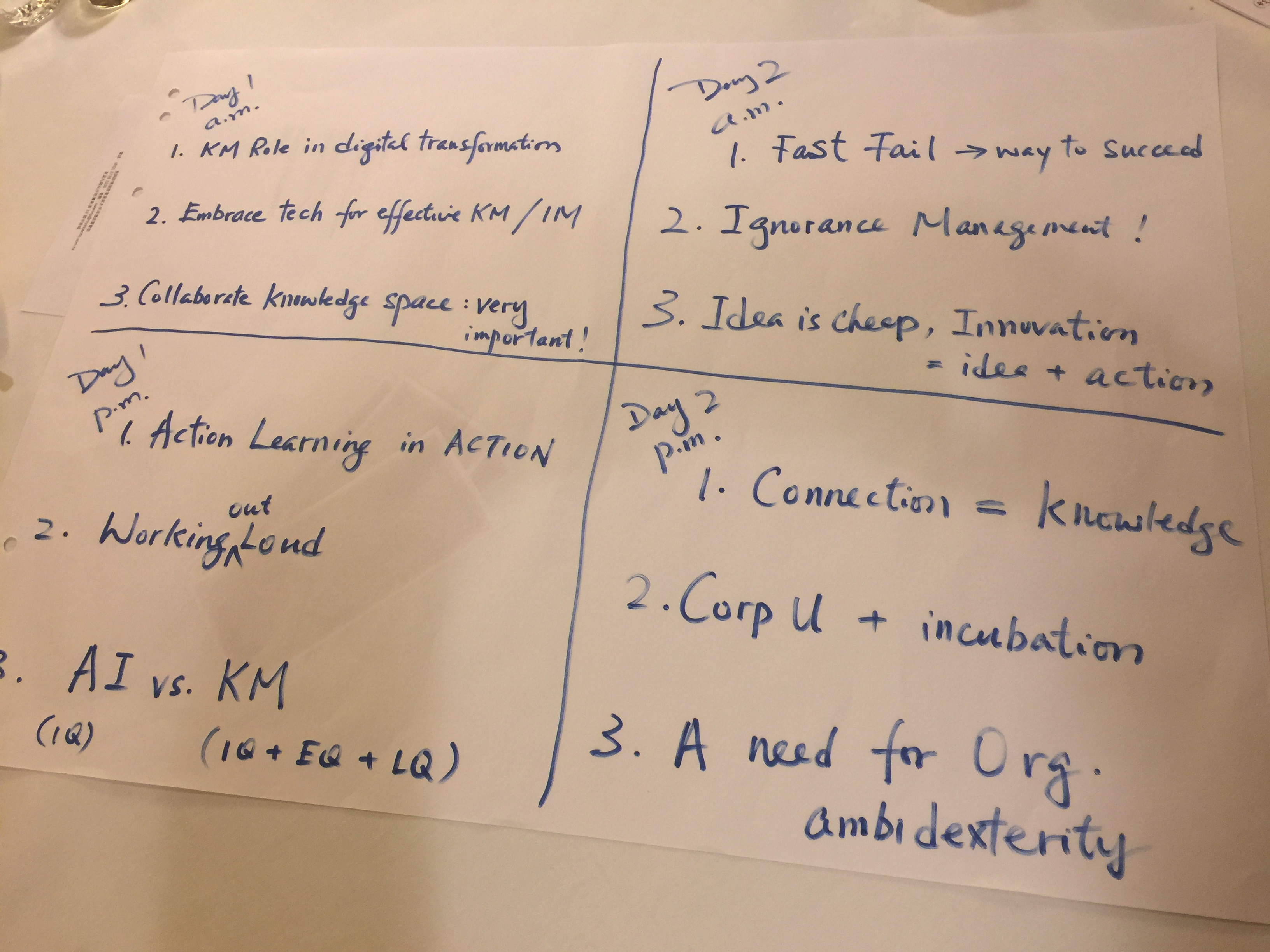
As part of the closing session I asked delegates to get into groups of 5-6 with people they had not met during the event.  I invited them to then reflect as individuals on the 3 “takeaways” they had from the morning and afternoon on both days.

Though simple it none the less brought to the surface ‘stuff’ or presentations that had made an impact. I further invited them as a group to consolidate their own findings.

And when that was complete to circle the room and see what others had noticed.

One group’s highlights from each session

It proved to be an entertaining as well as an insightful session.

Looking forward to 2020 was the last exercise of the event. Having drawn on Kantar Futures research and brought to life my thoughts on the future role of the “Knowledgeur” (KIM’er of 2020) I asked the groups to imagine they were the recipients of an award and to describe what they had done to win it!

The ‘stories’ were brilliant and this (with grateful thanks to Nick Stone who captured the recording) was one of the best: KM Asia 17: KM in 2020 Future Story

If you want more on the event I was among a number who provided regular tweets and those can be found here: KM Asia 17 Twitter Stream


How to avoid “drinking from the fire hydrant” at Arup

Taking a break can be therapeutic as well as challenging if the venue is so good it makes you reluctant to leave.

The world as viewed from within the walls of Portugal’s highest hill village Marvao seems different from the 24×7 connected envirnoment we all inhabit: Manners matter; avarice is not the driver for day to day life; food is to be savoured not devoured as a fuel between meetings; conversations are not superficial based on what each brings to the table and; the sky really is blue not pale blue impacted by pollution.

It was good to get away. These last few months have been hectic to say the least:

  • The launch of two new businesses Bees Homes and Bees Homes Financial Services
  • Arranging and planning an Asian Tour in November comprising Masterclasses, presentations and book launches – more soon!
  • Knee and dental surgery in Lisboa

As a portfolio worker you are often spinning plates and managing tight shifting schedules for clients. Yet every so often a ‘gig’ is both rewarding and stimulating as happened this week.

Knowledge in a Digital Age at Arup

A few months back the KM team at Arup asked if I’d kick off Day Two of their Global Skills Network get together. I was happy to accept. Arup get KM and do it as well as anyone being the recipient of a MAKE award. And yet working across generations and managing the risk of critical knowledge loss challenges them as it does everyone.

Like most businesses Arup has gone digital and is trying out many new technologies. It’s not a state secret, they want to be the best in the built environment. My remit was to act as a provocateur for the sessions that followed reflecting on what Knowledge in a Digital Age might look like and how they might respond to the opportunities it presents. I began as follows:

Some 20 years back Tesco Chairman Lord MacLaurin said when he saw the early results from analysis of the Clubcard holders spending patterns:

“What scares me about this is that you know more about my customers after 3 months that I know after 30 years”

Think of the modern digital economy as a massive extension of that Clubcard concept involving far more data points.

Recognising that today’s worker is deluged with ‘stuff’ and that few organisations have created an effective integrated dashboard that iincludes activities, skills, experiences, transactional data and social collaboration I addressed six basic questions:

  • Who or what should I trust? (Which sources, individual and team’s capacity to absorb and the need for trusted curated material)
  • What can I do? (To prevent Critical Knowledge loss)
  • Why should I? (Make better, more informed decisions)
  • Where do I find? (What ‘we’ know about a topic) nb Here I spoke about the recent judgement in the Trant vs Mott MacDonald case around a Common Data Environment (shared Knowledge Base)
  • When should I? (Incentivise / reward and in what format)
  • How do I go about it? (Engaging across generation and virtually)

My summary led into panel sessions whch it would be unfair to document in detail however I am sure Arup won’t mind if I paraphrase a bit since they are not uncommon:

  • People consume knowledge in different ways therefore its important to publish in a variety of forms across different platforms at different times.
  • There is a need to value team collaboration and authorship. Rewarding contributions in an environment where people believe knowledge is for everyone and not tradeable might be counterproductive.
  • There is a danger that in focusing on the digital environment and explosion of tools you lose sight of the importance of the person and networks. A way to prevent this is to develop an incubation lab to try out new technologies with beta users.
  • Knowledge bases and how to guides are important; new entrants rely on them for answers but often fail to ask “is it appropriate?”
  • Today’s youngster is comfortable with the search process having grown up immersed in technology. What can we do to bridge the gap, create effective knowledge transfer mechanisms with experienced Skill Network Leaders who struggle to articulate the question they are trying to ask of knowledge and information people and systems?
  • Knowledge informs research which drives client business.

And finally

Back to the title. It seems to me that although there are huge technological advances in the way individual, team, organisational and external knowledge, information and data is presented and we have access to, we are still struggling to absorb it all let alone keep up with the tools used. Despite technology giving us the ability to analyse data, information and knowledge to a higher level than ever before we are still hugely reliant on search to present the findings. Yet few seem to have cracked the ability to search across internal and external sources concurrently.

In a previous post I talked about the need for Assisted Search . My session this week reinforced that: A Knowledge Base is a form of curated assisted search where those responsible for it have assembled critical knowledge their organisation needs to sustain and grow its business.

The role of the knowledge professional in that remains vital and “curate” is one of the 8 ‘ates I describe in “Navigating the Minefield…” and will be going into more detail on when I visit Asia in November.


When AirAsia is not Air Asia: when you know it exists but can’t find it

I’ve always believed in the principle of “Give / Get” underpinning the basic premise that we cannot all be takers and that sharing involves two or more to engage. So back in 2005 I signed up to Trip Advisor and for the last 12 years I like millions of others have shared my observations on travel, food and accommodation. Why?

In the same way as people contribute to WikiPedia which consolidates and curates the knowledge of the many of a given topic it seemed to me only fair that if I were taking from something then I should give back. As part of this ‘social contract’ Trip Advisor regularly updates me on my standing in their community and informs me I have contributed 170 reviews and received 234 helpful votes.

So yesterday having recently confirmed my participation in KM Asia 2017 and booked a flight from Hong Kong to Kuala Lumpur on AirAsia I decided to comment on a previous flight.
KIM’ers beware

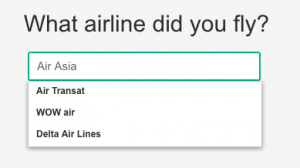
To my surprise having typed in Air Asia into Trip Advisor’s search box I got this set of drop down choices. It made no sense so I emailed them:

I cannot find Air Asia which operates from KL across Asia. Is it listed elsewhere? If not can you please show it.

Today I got this response:

We do list Air Asia, please find all airlines here www.tripadvisor.com/Airlines.

We list “AirAsia” all as one word which is consistent with their official brand; however I realize that it makes it difficult to find on our site as it is not natural to spell these two words without a space. As a result, it was not coming up in our search box. We have changed this to appear as two separate words which should allow easier access from now on. This change will take place on our live site within 24 hours.

Thanks for bringing this to our attention and do look forward to your review!

and finally

Their response was helpful but it highlights an issue that many organisations might have but not realise and why Knowledge & Information Managers should be on their guard when delivering search via drop down boxes to help people find ‘stuff’.

If the search engine is not tweaked to do what Verity’s Topic did some 20 years back namely look at all the various derivations of a name or phrase and present those in the results then the searcher has no idea if the term is correct and if he/she is getting a comprehensive results list.

Who in your organisation ‘owns’ search? I’m guessing that search is seen as technology and falls under IT’s remit.  Yet it is a vital component of the KIM’ers tool set to help people in organisations know what it knows – the ‘Navigate’ competence I’ve written about previously.