
In the past few months I’ve heard talk of a resurgence in knowledge management. km conferences are once again burgeoning; the UK’s Civil Service now has knowledge & information management as one of 22 recognised professions; last week while in Portugal I learned that the legal industry is now km aware; and many of my peers in the industry are finding themselves busier than ever providing advice to help organisations set up km initiatives across the globe.
One downside of providing external advice and assistance to organisations is that you are not always around to see the outcomes of your work especially when its knowledge and information management related. Occasionally you get the chance to get back under the covers and see how clients have implemented km style tools and techniques.
back under the covers
Such an opportunity took place at the end of December when I went back to the 7th largest global reinsurance broker (BMS) to see Phil Hill the Chief Information Officer I first worked alongside in 2001.
Reinsurance brokers are arbitrageurs: they place risk on behalf of large global organisations. They use knowledge of a client’s specific needs and apply that to find the best market to take the risk. They must know about clients and markets and manage relationships in both.
At the turn of the Millennium BMS was a top ten broker with aspirations to grow internationally and make better use of the combined knowledge of its dozen or so operating entities. It was dipping its toe into the document, records and information management waters and attempting to provide a technological backbone to support a growing demand for relevant and timely information. It had a very embryonic intranet.
Today BMS has broadened its business focus; it has expanded beyond reinsurance into underwriting working with a number of trusted partners. And it has focused much of its activity on building US based business development and transactional processing capability. Seamless connectivity and access to internal and external information on clients, markets and BMS’ own resources are support prerequisites.
So how has it managed this transition and what are the significant milestones in its journey that has seen it become one of the most admired and technologically advanced practitioners in the market? One that is:
- at the forefront of electronic placement; is regularly up for awards for innovation;
- whose CIO Phil is a frequent and sought after speaker and panellist on industry platforms?
BMS is now an institution where joiners get a preloaded iPad with 24×7 access to the latest global and internal information as well as the ‘big data’ (catastrophe modelling in BMS’ case) that has become must have software in the insurance/reinsurance industry.
a decade reviewed
In the 2001 knowledge and information audit I conducted I noted that:
- More than 60% of all items saved on the common H drive had been put in the ‘miscellaneous’ folder; there was no common terminology about how documents were to be named or catalogued; and no central place to find information on markets and clients.
- As was common around that time there was limited collaboration between the various businesses and as a result potential for pursuing the same clients.
- New joiners relied on traditional role shadowing and a tour of the building (s) to get up to speed.
- BMS was spread out across a couple of locations and on different floors in a building at Aldgate which discouraged informal interactions.
- Recognition of the concept of critical knowledge assets was a long way off and the words knowledge management dismissed as being jargon. Busy people at the business end had no real interest in filing documents let alone thinking about how they might be reused; even in 2001 everyone expected the system to do it for them and the idea of ‘drag and drop’ from one platform to another was still in its infancy.
The shocking events of 9/11 in the US provided the ‘burning platform’ moment for a change in attitudes. Everyone wanted up to date consolidated news and opinion. The Intranet, website and content management system were approved as a combined project and with my assistance the newly formed Marketing & Communications (Marcoms) Team set about creating BMS Today and building up a cadre of volunteers willing to help identify the critical knowledge and information that should be captured and stored.
A definition or aim for the system emerged:
adopting a publish once use many basis provide a one screen view of activity with clients and the markets in which they operate and a central hub for knowledge and information on the organisation and its operations.
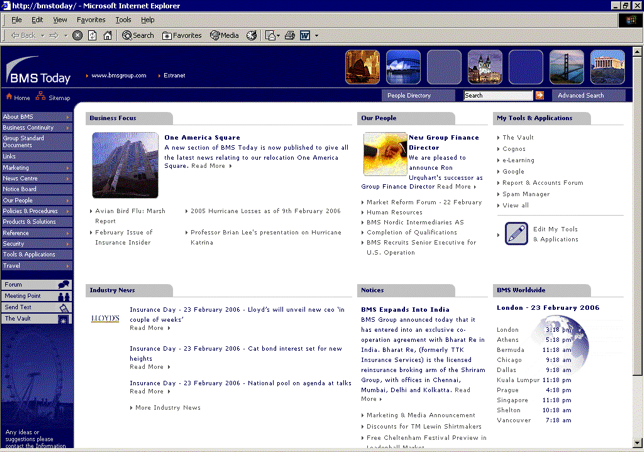
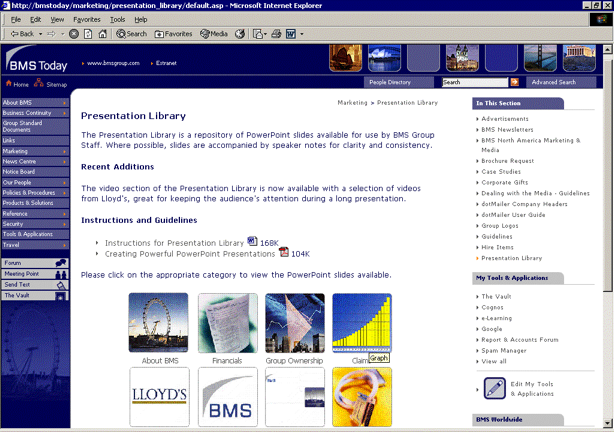
Here’s what BMS Today eventually became:

- Intranet Home Page
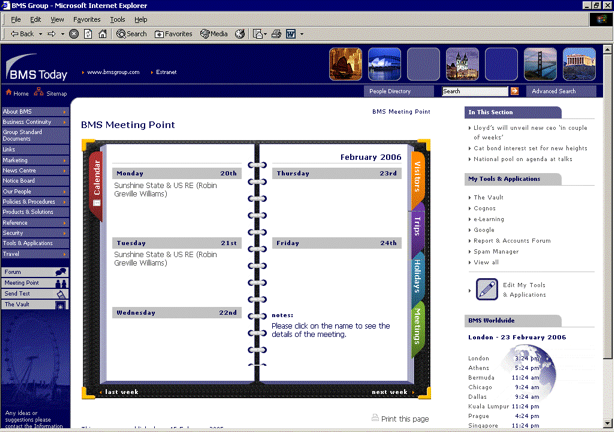 Corporate Calendar
Though at the cutting edge of intranets BMS Today was not enough. The Marcoms team needed to go further to encourage knowledge sharing so concurrent with a relocation to One America Sq they began a series of Learn@Lunch and Breakfast Briefings aimed at showcasing different aspects of the business.
Still collaboration was a distant objective though the move to One America Square in 2008 did throw up an interesting opportunity to introduce social media. One of the team (who been enrolled on a journalist programme) was deployed among the builders and fitters on site to provide a regular ‘blog from the battlements’. Widely read at the time it provided an insight into life at the soon to be occupied premises and a metaphorical bridge to help people acclimate to the new surroundings.
One America Square enabled BMS to plan collaborative physical spaces in which to hold breakfast briefings and learn@lunch sessions. There was a lot of discussion about the efficacy of such a space. ‘Connexions’ as it became known was a hub for meetings and with a business lounge in close proximity it enabled serendipitous meetings at the coffee machine (and water cooler) to continue in a relaxed but more formal setting.
And of course the best coffee, subsidized snacks and rapid internet access were made available to encourage traffic to the site and make external visitors feel welcome.
changing focus & new technologies
A change of focus combined with the arrival of disruptive technology proved a challenge and an opportunity. The broking teams needed improved access to information on the move and an easy way to demonstrate the modelling systems that enable risk to be better evaluated. But technology costs and the benefits of investment are not always easy to quantify. So CIO Phil (aided and abetted by Philip Gibson of Sparknow) used a traditional storytelling technique and the idea of developing a set of personae as a way of illustrating what BMS’ world might look like in a few years time if some technological improvements were introduced. Here’s an extract from one of the scenarios:
Jade Thompson is 35 and has worked in the London Market for 14 years. She has agreed to join BMS as a senior underwriter, moving on from one of the big managing agents. She wants to work for a company that really supports her initiative and drive – not one that swaddles her in red tape.
The week before Jade joins, she receives at home via courier a package from BMS.
Inside she finds an iPad, with a BMS logo with the slogan: “Using clever technology”. There’s also an iPhone, also with a BMS logo and her name.
She reads the attached note, welcoming her to BMS and giving her the logon and password information she needs to use the equipment. “Wow!” she says to herself, “this is great – they really know how to make you feel special.” Jade switches on the iPad and logs on as instructed. There‘s an icon on the first screen, “Welcome”. Touching the icon starts a video of the CEO welcoming her to the company. Various members of the board and HR provide insights into BMS and what she might expect in her first few days.
There is also a pointer to other information on the iPad, such as all aspects of the induction procedure including health and safety. Thrilling, she thinks to herself…
This scenario has come to fruition thanks to the investment in technology (in this case iPads) made by the BMS board which has continued to support further development on BMS Today and a decade on, this is where many of the ideas and initiatives outlined above merge.
 Soon all 9 BMS offices will be able to log into the new intranet irrespective of domicile. It will meet the original aim of providing a one screen view of all activity with a client as well as providing real time access to the latest social media applications and real time information.
Submission to the corporate document storage system is a simple drag and drop process that recognises and acknowledges peoples preference for an Outlook Mail style filing 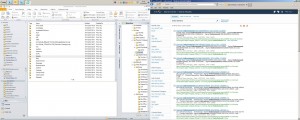 structure. ‘Stuff’ can be easily located via a search engine that accesses all operating systems via iPads which permit electronic placement.
takeaways
The team and I drew on techniques found in business development, communications, marketing, information and project management, engagement, facilitation as well as knowledge management to provide an infrastructure and ways of working that formed a backdrop to the continued expansion and development of the business.
Many who work in the knowledge & information arena would recognise most of the above activities, its what they do on a regular basis. Yet at no point during the years I worked alongside the team at BMS was km used as a phrase or established as a discipline.
That a decade on BMS is thriving is an illustration that km by any name takes time but has value.
And finally by way of acknowledgement I should mention the names of those people with whom I worked most closely during my time as Advisor. They were from BMS: Phil Hill, CIO; Roger Cooper, COO; Jeff Martin, Director; Anne-Marie Hawtin, Manager; and John Spencer Former CEO. From Intranet Focus: Martin White, CEO.