‘…maybe it’s because I’m a Londoner…’: stories from people who made London their adopted home

I’m proud to call England my home and London my birth city. It is one of (if not the) most cosmopolitan cities in the world that has welcomed and benefited from the arrival of so many different nationalities and cultures.

In 2010/11 Sara Shamsavari held an exhibition at City Hall. Entitled Britain Retold- a portrait of London it told in their own words the stories of a number of Londoners all of whom had Londoner blog 619620made London their adopted home.

This is what was written about the exhibition:

a collection of sharply empathetic portraits that explore and reinterpret the concept of British identity within London. With an aim to create a singular voice, Sara has photographed a range of culturally diverse individuals and incorporated the symbolism of the Union Jack flag into each image. She seeks to open a platform that will allow the multicultural communities of London to begin re-defining what it means to be British.

I was among the guests at the opening and remember being moved by the stories and the images Sara captured. Her motivation: to reflect the Britain she knew not that portrayed by the far right.

A couple of years on and with the impact of austerity measures across Europe starting to bite I’ve been reflecting on the tenacity of those who by force of circumstance find themselves having to work offshore to survive.

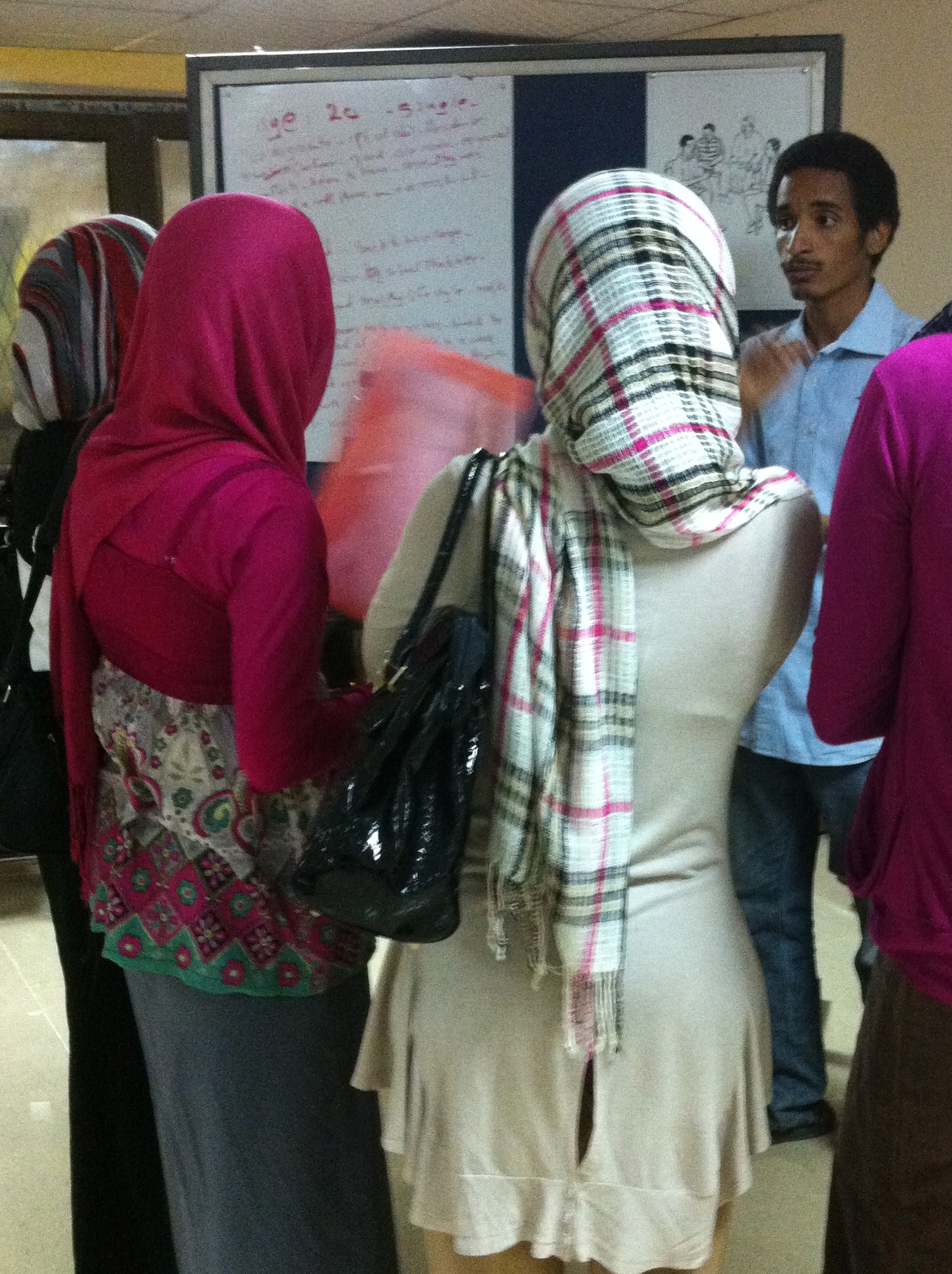
In the past month I’ve met or spoken to, Sudanese, Tanzanians, Vietnamese, Malaysians, Chinese, Saudis, Bajans, Turks and Eritreans in addition to many Europeans including Hungarians and Bulgarians.

Some were students doing MBA’s and MSc’s. Others were working in London. A fair few were in Africa. All are bound by the same desire: to find meaningful and paid employment and in some cases a home. I want to share three stories with you and in two cases I’ve changed the names to protect their identities:

Monika’s story

Monika is Hungarian, from a small village 200km south of Budapest, who is part of the team at one of London’s swankiest and new hotels.  Be-suited, blond and vivacious with a friendly smile and an easy manner she came to England a couple of years ago to find a job as there are few in accountancy back in her native country.

Monika feels a debt of honour to her parents who sold a home to fund her education. She loves London despite living in Seven Sisters some way from the centre and commented on how easy it is to get along with people here.

Ideally, she’d like to go back but in the meantime despite being overqualified for the job she is doing, like many she is grateful for the opportunity of working in London.

Samatha’s story

Sam hails from Barbados via Leeds Metropolitan University. Slight of build and pale of colour she did none the less stand out in Leeds where she spent her formative years having travelled to the UK to join her father. Having graduated she was warned don’t go to London, they are unfriendly.  Her experience is in marked contrast to the advice:

People are great here, I work with 30 nationalities and its like a big family. London is such a nice city.

Like Monika she is grateful for a job for which she is over qualified.  Also like Monika she is driven and wants to pay her way despite the cost of renting eating into much of her salary. And she can find curried goat (essential part of any Caribbean diet) without searching too far for it.

Sayid’s story

Sitting in the back of a 4×4 in Khartoum I am in conversation with Sayid (not his real name) who is one of 200,000 Eritrean refugees in Sudan. As a driver for a prominent research group Sayid has a good job (by the standards of many). His horizons though are limited: his girlfriend (who he’s not seen for 5 years) lives is Asmara; he can’t go back and she can’t leave.

Hard working he hankers after a life in Europe but recognises the challenge of trying to save the $3,000 it will cost to get him to the Sudanese/Libyan border, then on to the Libyan coast and then across the sea to Italy the obvious gateway for Eritreans seeking asylum.  Despite existing on a wage of less than $100 a month he lives in hope of one day making the hazardous and life threatening journey and of being reunited with his girlfriend in the EU.

Last Thursday evening at Brighton University I met a number of students who’ve come here to learn. Some had taken sabbatical’s from good positions. Others had exhausted savings and were eagerly seeking part time work to augment their meagre living standards.  A common theme again among those from Asia: the willingness of their families to support educational advancement even if it means working every waking moment to raise the cash to fund it.

Over dinner on Saturday night in Covent Garden with some of the speakers at the Meet The Blogger event my wife was a speaker at I was interested in the views of a lovely Frenchwoman who has been a resident here for 17 years.  She noted a change in perception among her erstwhile countrymen. No longer is London seen as a desert among the culinary oasis that is Europe; it is now the place to go for varied and good cuisine.

So what are my ‘takeaways’ from this ramble:

  • Londoner’s are lucky to live in a cosmopolitan city enriched by diverse cultures;
  • Briton’s are lucky to hold a passport that allows almost total unrestricted travel and (Heathrow’s immigration queues apart) to return without question;
  • education is seen by the citizens of many nations as their passport to a good career;
  • while London is seen as a desirable place to live and work demand for accommodation will continue to outstrip supply; and finally
  • those with less seem more inclined to share surplus food than those with plenty.
Importance of KM in Health: the story of Doctor Anwar and making use of what he and others know in Sudan

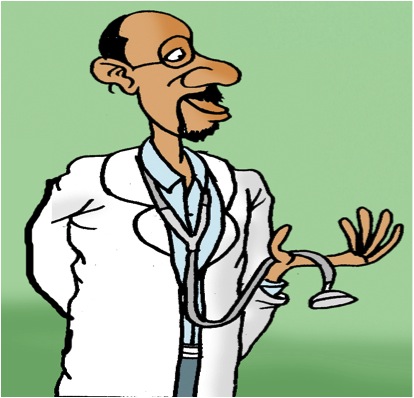
Meet Anwar, a Sudanese doctor. Just one of 5 fictional characters created by delegates at the Knowledge Management for Health in Sudan event I spoke at, helped plan and run.

Sudanese Doctor

Anwar

This exercise, Scenarios for the future, was set in 2020 and invited the 80 or so delegates drawn from across the whole of the health industry in Sudan to consider what a day in the life of each character might look like.  This was a new and warmly embraced concept in an environment where my information is my soul and much of the debate about the future takes place against a backdrop of uncertainty and increasing austerity where:

  • 2/3rds of all drugs are purchased ‘out of pocket’ not from health system
  • drugs are proportionately more expensive than in other domains
  • funds from external sources are available to assist with health informatics.

Having settled on a description of each character the delegates who were by this time in groups of 8-10 then set about imagining what their day might look like on January 1st 2020. A vivid imagination is required and was evident in the quality of the stories that were told by each group’s nominated storyteller.

The story of the Health Worker

Ismail’s story – Health Worker

I will in due course and with the organising committee’s permission publish the two ‘winning’ stories; yes we did do voting while the storytellers left the room.

One of Sudan’s leading pharmacists noted in a one:one conversation how important listening was and how difficult a technique this is for many to use when prescribing drugs.

By inviting each of the storytellers to play back the story to each of the other groups it was good to hear them say in the summing up that by the end they really felt they were the character.


The previous day I’d invited the delegates to change the way they looked and think about issues and barriers.  Using when you change the way you look at things, the things you look at change exercise conducted in the best breakout rooms I’ve ever worked with, the delegates who are naturally loquacious soon grasped the concept of seeing the room through the lens of different professions.

Breakout room

Breakout room

This change of mindset was important: it allowed the subsequent round table (well round conference room) session that discussed:

‘What are the biggest issues we face in sharing knowledge and information about the health of our nation and how can we overcome them’

I’d invited each delegate to introduce themselves to three people they didn’t know. This worked well and encouraged a very frank discussion. The main issues highlighted were:

  • no systematic collection of information and limited understanding of its value
  • transparency of process (where do the figures go) and credibility of the data
  • lack of human resources to do the collection
  • limited statistical information to undertake scientific research on
  • ownership of data and the whole process – fragmentation
  • accountability to deliver
  • communication/awareness of what each organisation is doing – lots of ‘stuff’ is happening but there is a real risk of duplication of effort e.g. many of the disease control programmes are creating their own informatized information systems

Delegates recognised the tremendous strides being made by the Public Health Institute (one of the event’s sponsors and host of the official dinner) in developing professional public health administration programmes, the creation of a Data Dictionary and the publication of the first Annual Health Performance Review though many bemoaned the lack of official  support for research projects where Sudan has a prominent global position, Mycetoma Research Centre an example.

I came away from reflecting on a discussion I had around the event:

Its all about ‘informization’ – the ability to report from a health centre level with ‘point of sale’ data collected via PDA’s / mobiles as well as computers; about logistics management as a result to ensure supplies get to where they can do the most use.

This can be monitored by the minister, routine reports can be prepared showing which centre reported, which district has complete reporting, which state has complete and timely reporting and % of stock outs of basic drugs or vaccines etc.

And inspired by many of the presentations I’d seen on the morning of the second day from University of Khartoum’s research centre and of course the Public Health Institute who are reaching out to try and create greater awareness through public forum, newsletter and other events.

Perhaps the presentation that struck the biggest chord was from EpiLab
who have achieved impressive results in helping to reduce the incidence of TB and Asthma and whose research and community communication techniques are highly innovative. I loved the cartoons they developed on how to self treat and prevent the incidence of illnesses which were drawn up BY the local communities.  Their pictures and their words are published as guides for the nation and I know they will make them available so I can share them in future blogs.

It was an honour, a challenge but nevertheless great fun enhanced by the warmth of the welcome and a genuine sense of appreciation. Sudan’s people are among the most engaging and intelligent I’ve met. One anecdote from a conversation with a young professional in the communications business illustrates their dilemma:

‘…of the 95 people who graduated in my year a few years back 90 are now working overseas, the majority in highly paid good positions…’

In my address I acknowledged the support I’d had from many people in preparing for the event. They were: Ahmed Mohammed, Dr Alim Khan, Dr Anshu Banerjee, Ana Neves, Andrew Curry, Archana Shah, Chris Collison, David Gurteen, Dr Gada Kadoda, Dr Ehsanullah Tarin, Dr Madelyn Blair, Sofia Layton, Steven Uggowitzer, Victoria Ward

why should Sudan’s health industry embrace Knowledge Management?

A few month’s back during a Skype call with Dr Gada Kadoda a Professor at University of Khartoum she told me: ‘at last year’s KMCA Sudan many of the health industry delegates who attended expressed an interest in understanding what knowledge management might do for them. How might we do that?’.

Gada is one of those special people who when they pose a question you feel compelled to answer it. Which is why in a week’s time I am going to be back in Khartoum to participate in a two day Workshop on Knowledge Management for Health Care in Sudan.

Knowledge management in health is not new. The NHS Modernisation Agency was one of the early adopters and used a lot of Chris Collison’s thinking from Learning to Fly to build a pretty effective knowledge management operation with one of the first Chief Knowledge Officers in charge of it. Sudan’s health industry does not (yet) practice km in any formal manner so as part of the research for my presentation and the sessions I am facilitating I asked some of the actors in the NHS km story to reflect on more than a decade.  Here’s what they said (names omitted):

I have said on several occasions that when you multiply the number of employees by the years of professional learning,  the NHS is the world’s most knowledgeable organisation.  Or it should be.  With better networking, more curiosity, joined-up systems, a culture of improvement and leaders who value national above parochial, it would live up to its potential.

What I have seen is wonderful pockets of excellence – hospitals with a determination to improve, a passion for learning, and a curiosity which can even transfer lessons learned from Formula One pit teams to the operating theatres of children’s hospitals.  Pockets of excellence indeed, but in threadbare trousers.

—————————————————————–

The idea of KM in that particular agency of the Department of Health was to ensure that the knowledge produced by one team (silo) would reach other teams (silos), that the whole organisation had a sense of who knew what, and that we could reuse knowledge across the Service.

We had a team of people and a CKO…a CoP with members from all different teams in the organisation; knowledge audit and SNA that involved quite a few people across the org and which changed the way they perceived the work of the KM team. Yet …our work became too focused on documents and content creation disguised as gathering of lessons learned.

——————————————————————-

In my regular interactions with physicians in the NHS, a key frustration has always been the flow of information between doctors and commissioners. Differing agendas, treating patients vs cost-effectiveness, cause breakdown in communication. The problem usually arises from the discrepancies between the notion of an ideal patient and the realities of people walking into the clinic. Pharma is not particularly helpful in addressing this through the research conducted, however the shift in emphasis to real world data by health technology bodies such as NICE is creating a cultural shift in the sector.

A great story of information exchange relates to a melanoma patient who was being treated in London. The patient was a successful business man so he continued with his work. He was treated with a very new drug and experienced severe side effects while on a business trip in Switzerland ending up at a hospital there. Mismanagement of this drug’s side-effects can result in death. The Swiss physicians had never used the drug before, and most were not even aware of its existence as it is a specialist therapy. However, there was extensive global information exchange driven by the company, which meant that as soon as they saw the patient card which all patients on the drug were advised to keep on their person, the Swiss physicians were able to access a database of information and a 24 hour network of world experts in the condition. Luckily for the patient the KM network worked thereby saving his life.

The shift towards greater use of data and increased use of technology (from other industries) is where I hope much of the Khartoum health discussion goes. One of the leaders in Health Information Systems shared this quote:

‘In the next ten years, medicine will be more affected by data science than biology.’

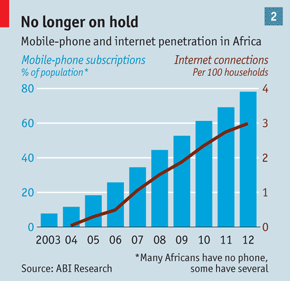
Mobile & Internet penetration in Africa

Mobile & Internet penetration in Africa

Today’s Economist article on the use of mobile technology in Africa is a timely reminder of the strides being made on that continent and how widespread adoption will present huge opportunities as well as challenges for the health industry there.

I am also  going to share this clip from Grey’s Anatomy (US TV drama) about the use of Twitter in an operating theatre. Though fictitious it gives as good an illustration as any I’ve seen about the potential benefits of using mobile technology to share knowledge and mobilise a global community in the same was as the story of the melanoma patient above does.

As the F1 season is nearly upon us I was really struck by this clip from the BBC which shows how the Maclaren F1 Team’s driver and car monitoring system is being adapted/used in a children’s hospital in Birmingham.

And yet for the Sudan health system to adopt some of these technologies (against a backdrop of isolation) there has to be a huge mindshift. I recall with chilling clarity a phrase uttered by a health professional at KMCA Khartoum last year in response to a question I posed as to the barriers to the sharing of knowledge: ‘my information is my soul’.

In an environment where:

  • sharing of information (let alone knowledge) can have serious consequences
  • admitting a lack of current knowledge can cause a loss of face and prestige
  • continuing medical education is not a core requirement for the right to practice
  • the major drug companies have no presence and sell via distribution channels
  • the physician is beyond reproach

we have our work cut out if we are to get positive outcomes from the event.  Its an exciting prospect.


knowledge management is dead but it won’t lie down: a 10 year review of a KIM initiative

In the past few months I’ve heard talk of a resurgence in knowledge management.  km conferences are once again burgeoning; the UK’s Civil Service now has knowledge & information management as one of 22 recognised professions; last week while in Portugal I learned that the legal industry is now km aware; and many of my peers in the industry are finding themselves busier than ever providing advice to help organisations set up km initiatives across the globe.

One downside of providing external advice and assistance to organisations is that you are not always around to see the outcomes of your work especially when its  knowledge and information management related.  Occasionally you get the chance to get back under the covers and see how clients have implemented km style tools and techniques.

back under the covers

Such an opportunity took place at the end of December when I went back to the 7th largest global reinsurance broker (BMS) to see Phil Hill the Chief Information Officer I first worked alongside in 2001.

Reinsurance brokers are arbitrageurs: they place risk on behalf of large global organisations. They use knowledge of a client’s specific needs and apply that to find the best market to take the risk. They must know about clients and markets and manage relationships in both.

At the turn of the Millennium BMS was a top ten broker with aspirations to grow internationally and make better use of the combined knowledge of its dozen or so operating entities. It was dipping its toe into the document, records and information management waters and attempting to provide a technological backbone to support a growing demand for relevant and timely information. It had a very embryonic intranet.

Today BMS has broadened its business focus; it has expanded beyond reinsurance into underwriting working with a number of trusted partners. And it has focused much of its activity on building US based business development and transactional processing capability.  Seamless connectivity and access to internal and external information on clients, markets and BMS’ own resources are support prerequisites.

So how has it managed this transition and what are the significant milestones in its journey that has seen it become one of the most admired and technologically advanced practitioners in the market? One that is:

  • at the forefront of electronic placement; is regularly up for awards for innovation;
  • whose CIO Phil is a frequent and sought after speaker and panellist on industry platforms?

BMS is now an institution where joiners get a preloaded iPad with 24×7 access to the latest global and internal information as well as the ‘big data’ (catastrophe modelling in BMS’ case) that has become must have software in the insurance/reinsurance industry.

a decade reviewed

In the 2001 knowledge and information audit I conducted I noted that:

  • More than 60% of all items saved on the common H drive had been put in the ‘miscellaneous’ folder; there was no common terminology about how documents were to be named or catalogued; and no central place to find information on markets and clients.
  • As was common around that time there was limited collaboration between the various businesses and as a result potential for pursuing the same clients.
  • New joiners relied on traditional role shadowing and a tour of the building (s) to get up to speed.
  • BMS was spread out across a couple of locations and on different floors in a building at Aldgate which discouraged informal interactions.
  • Recognition of the concept of critical knowledge assets was a long way off and the words knowledge management dismissed as being jargon.  Busy people at the business end had no real interest in filing documents let alone thinking about how they might be reused; even in 2001 everyone expected the system to do it for them and the idea of ‘drag and drop’ from one platform to another was still in its infancy.

The shocking events of 9/11 in the US provided the ‘burning platform’ moment for a change in attitudes. Everyone wanted up to date consolidated news and opinion. The Intranet, website and content management system were approved as a combined project and with my assistance the newly formed Marketing & Communications (Marcoms) Team set about creating BMS Today and building up a cadre of volunteers willing to help identify the critical knowledge and information that should be captured and stored.

A definition or aim for the system emerged:

adopting a publish once use many basis provide a one screen view of activity with clients and the markets in which they operate and a central hub for knowledge and information on the organisation and its operations.

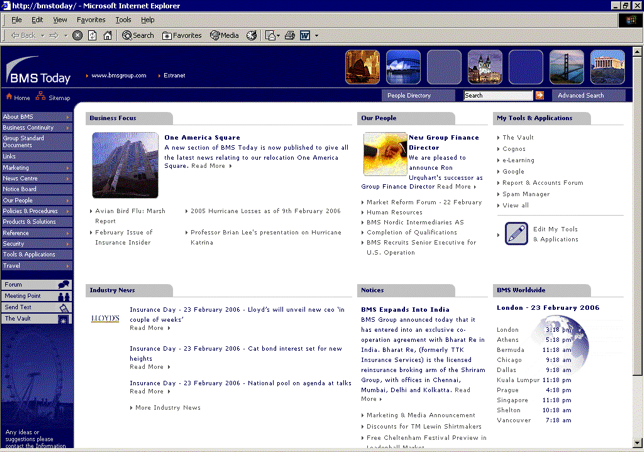
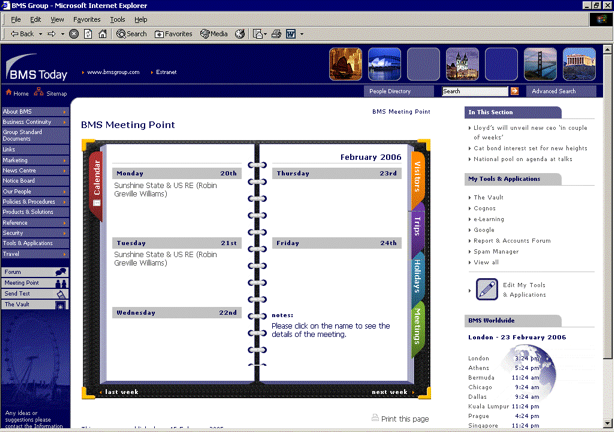
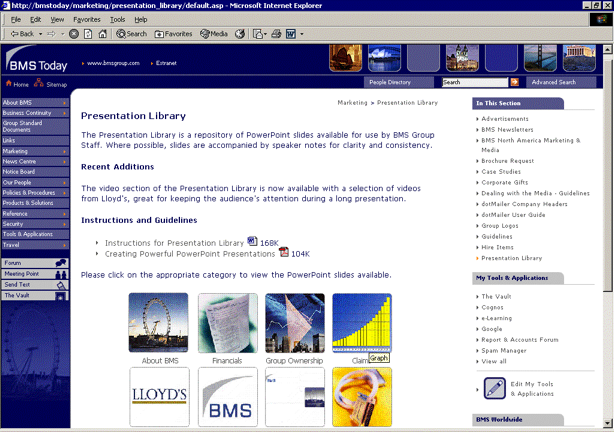
Here’s what BMS Today eventually became:

Intranet Home Page

Corporate Calendar

Though at the cutting edge of intranets BMS Today was not enough. The Marcoms team needed to go further to encourage knowledge sharing so concurrent with a relocation to One America Sq they began a series of Learn@Lunch and Breakfast Briefings aimed at showcasing different aspects of the business.

Still collaboration was a distant objective though the move to One America Square in 2008 did throw up an interesting opportunity to introduce social media.  One of the team (who been enrolled on a journalist programme) was deployed among the builders and fitters on site to provide a regular ‘blog from the battlements’.  Widely read at the time it provided an insight into life at the soon to be occupied premises and a metaphorical bridge to help people acclimate to the new surroundings.

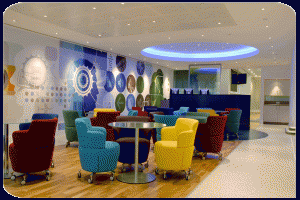
One America Square enabled BMS to plan collaborative physical spaces in which to hold breakfast briefings and learn@lunch sessions. There was a lot of discussion about the efficacy of such a space.  ‘Connexions’ as it became known was a hub for meetings and with a business lounge in close proximity it enabled serendipitous meetings at the coffee machine (and water cooler) to continue in a relaxed but more formal setting.Connexions 600x400

And of course the best coffee, subsidized snacks and rapid internet access were made available to encourage traffic to the site and make external visitors feel welcome.

changing focus & new technologies

A change of focus combined with the arrival of disruptive technology proved a challenge and an opportunity. The broking teams needed improved access to information on the move and an easy way to demonstrate the modelling systems that enable risk to be better evaluated. But technology costs and the benefits of investment are not always easy to quantify. So CIO Phil (aided and abetted by Philip Gibson of Sparknow) used a traditional storytelling technique and the idea of developing a set of personae as a way of illustrating what BMS’ world might look like in a few years time if some technological improvements were introduced. Here’s an extract from one of the scenarios:

Jade Thompson is 35 and has worked in the London Market for 14 years. She has agreed to join BMS as a senior underwriter, moving on from one of the big managing agents. She wants to work for a company that really supports her initiative and drive – not one that swaddles her in red tape.

The week before Jade joins, she receives at home via courier a package from BMS.

Inside she finds an iPad, with a BMS logo with the slogan: “Using clever technology”. There’s also an iPhone, also with a BMS logo and her name.

She reads the attached note, welcoming her to BMS and giving her the logon and password information she needs to use the equipment. “Wow!” she says to herself, “this is great – they really know how to make you feel special.” Jade switches on the iPad and logs on as instructed. There‘s an icon on the first screen, “Welcome”. Touching the icon starts a video of the CEO welcoming her to the company. Various members of the board and HR provide insights into BMS and what she might expect in her first few days.

There is also a pointer to other information on the iPad, such as all aspects of the induction procedure including health and safety. Thrilling, she thinks to herself…

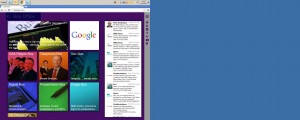
This scenario has come to fruition thanks to the investment in technology (in this case iPads) made by the BMS board which has continued to support further development on BMS Today and a decade on, this is where many of the ideas and initiatives outlined above merge.

BMS Box Office Soon all 9 BMS offices will be able to log into the new intranet irrespective of domicile. It will meet the original aim of providing a one screen view of all activity with a client as well as providing real time access to the latest social media applications and real time information.
Submission to the corporate document storage system is a simple drag and drop process that recognises and acknowledges peoples preference for an Outlook Mail style filing BMS Searchstructure. ‘Stuff’ can be easily located via a search engine that accesses all operating systems via iPads which permit electronic placement.


takeaways

The team and I drew on techniques found in business development, communications, marketing, information and project management, engagement, facilitation as well as knowledge management to provide an infrastructure and ways of working that formed a backdrop to the continued expansion and development of the business.

Many who work in the knowledge & information arena would recognise most of the above activities, its what they do on a regular basis.  Yet at no point during the years I worked alongside the team at BMS was km used as a phrase or established as a discipline.

That a decade on BMS is thriving is an illustration that km by any name takes time but has value.

And finally by way of acknowledgement I should mention the names of those people with whom I worked most closely during my time as Advisor.  They were from BMS: Phil Hill, CIO; Roger Cooper, COO; Jeff Martin, Director; Anne-Marie Hawtin, Manager; and John Spencer Former CEO. From Intranet Focus: Martin White, CEO.

“four legs bad two legs better”: when people leave they take their knowledge with them…

One of the big topics that comes up time and again in conversations with businesses is how to handle the loss of knowledge when people leave or get relocated. I took these notes during an interview a couple of months back with a former CEO about how he felt having exited the business after 8 years at the helm:

Too often an outgoing official feels let down by the process: using an analogy from Animal Farm, he described the environment in the aftermath of his departure as being ‘four legs bad two legs better’. The new team had little interest in understanding how decisions had been reached and maintaining the networks he considered it vital to maintain.

I remember reading Animal Farm a couple of times: the pigs take control and the mantra changes from ‘four legs good, two legs bad’ to ‘four legs good, two legs better’ as they adopt the practices of the old regime they’d previously rubbished.  It was a vivid illustration of how damaging a process leaving a business can be.

It’s not just about suddenly making provision to capture knowledge for people about to leave. Effective knowledge retention starts when a new member of staff joins: they bring fresh ideas and in many cases experiences that can be valuable additions to an organization’s corporate memory. It continues throughout their tenure (when they are involved in projects, have to make decisions, handle difficult situations, engage with stakeholders, develop policy, etc) and beyond – when they leave to become part of the alumni network.

As part of my ongoing association with Sparknow we are going to be running a knowledge retention masterclass in Singapore. To find out more about that and look at the latest blog on this subject posted today on Sparknow’s site please go to ‘knowledge retention in Asia’

It promises to be an exciting few months.