Quality, Standards & Risk: emerging KM drivers from Dubai

It was great to be back in Dubai last month for KM Middle East 2015 where I was running a Masterclass on Day One and giving the Keynote closing address on Day Two.

Chicago Beach HotelWhen I went there in 1984 the only hotel in Jumeirah was the Chicago Beach Hotel and that was an isolated spot some 30 minutes drive from Deira on empty roads and across desert. You went there for a bit of R & R after a tour of duty in Saudi Arabia.

Today the emirate is home to hundreds of thousands of jumeirah_beach_resort-485x325expats and foreign workers all of whom are bringing knowledge to help Dubai develop into one the world’s premier tourist destinations.  Here’s how the same piece of coastline looks 30 years on and you can get there today via a metro system!

Few in 1984 predicted Dubai would grow to be such a diversified economy: limited dependency on oil, increasingly reliant on the knowledge and competencies of its expanding (predominantly foreign) workforce and having the world’s busiest airport.

The underpinnings of such progress are people, process (and of course) technology. The disparity in numbers of indigenous Emirati to Expatriates (who are transient by nature) means that there is greater relience on process and technology to ensure continuity.  It is no surprise that the Knowledge Management activity in the region should be more of an operational/tactical nature rather than strategic.  This was evident for me at KM Mid East.

 The Event – Day One

Held over two days at the very luxurious Park Hyatt Dubai the event comprised a series of workshops on Day One and a Plenary Conference on Day Two.  My workshop Unlocking the true value of Knowledge Management: identifying and assessing your organisation’s Knowledge Assets took place in the afternoon from 2pm-6pm.
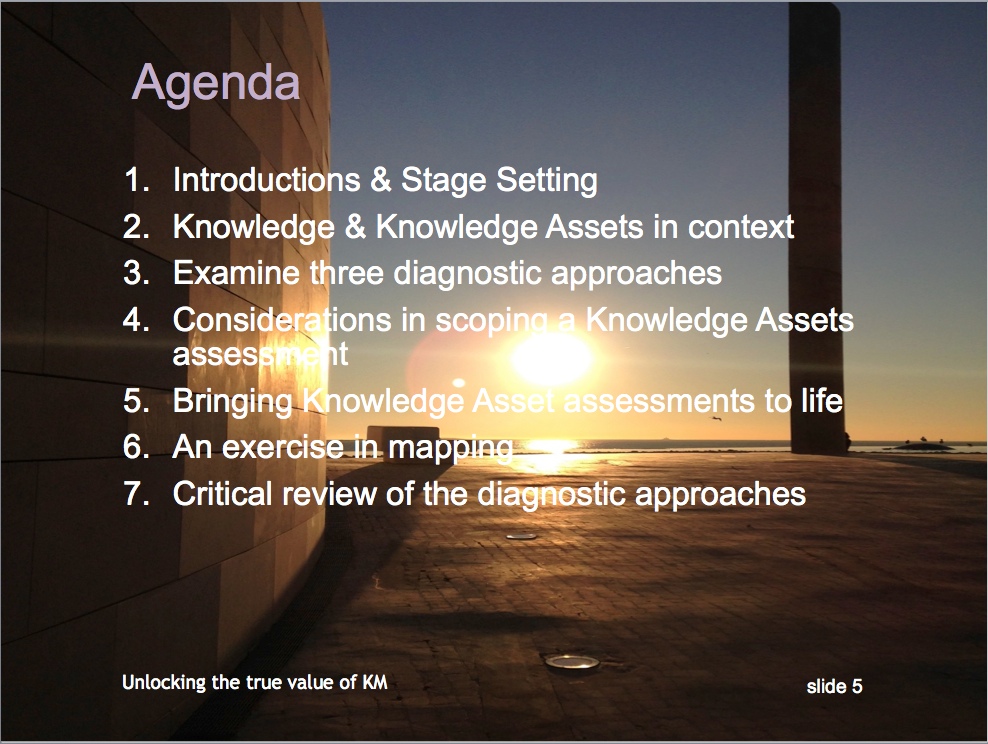
AgendaThere were 20 people, a nice mix of gender, age and experience.  This was the agenda for the afternoon:

My aim was to get the participants to think about why KM mattered and to begin to develop an understanding of the Knowledge Assets they had in their business.

I was also keen to look at a few different ways to identify and assess their value and what might they then do to mitigate potential loss.
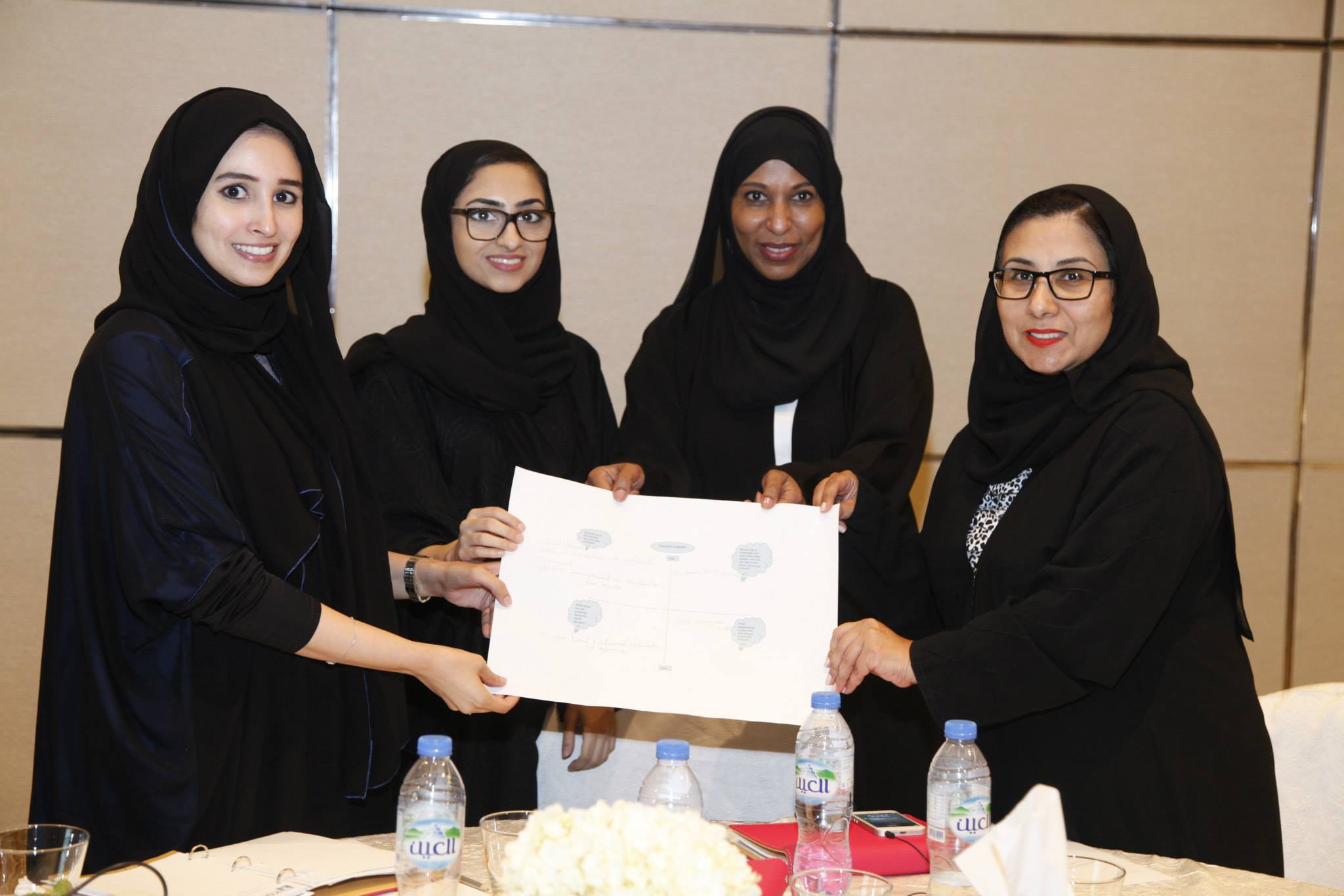
Team A at KMME Workshop

Team A at KMME Workshop displaying their ccompleted Analyser.

Session 6 An exercise in mapping was particularly revealing.

Focusing on a recent decision ‘Team A’ used the Event Analyser to describe how they had saved a substantial amount by drawing on the internal knowledge of their organisation which they were then able to pass on for others to use.

It was an enjoyable afternoon (the opening Ice Breaker helped to
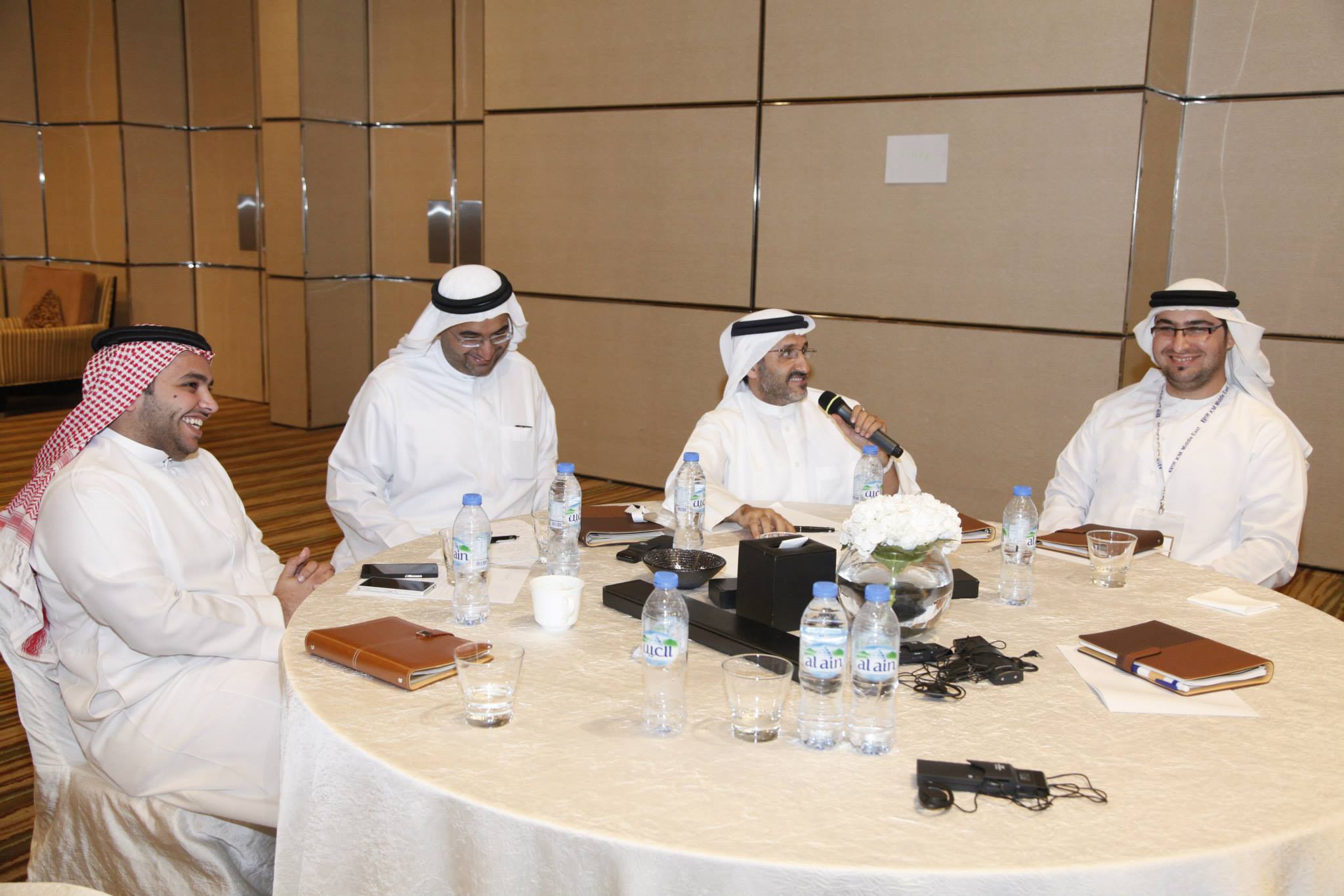
Everyone got involved

Everyone got involved

lower barriers) and I made sure each session had a mix of informing and doing with plenty of interaction, stories (and humour). And we finished at 6pm with a full contingent!

The Event – Day Two
IMG_3109_2

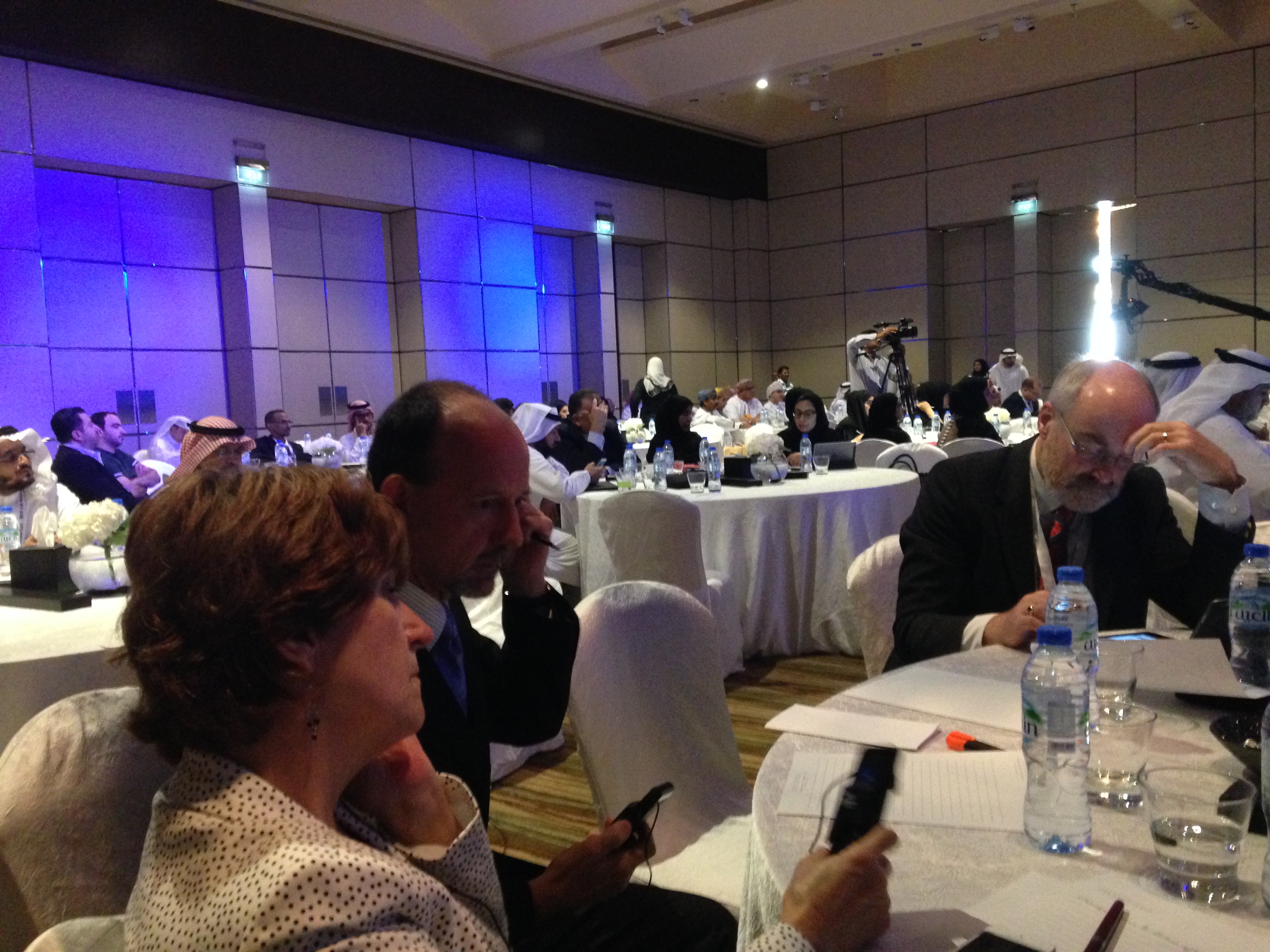
John Girard and Dave Snowden in the foreground

The slide deck has been made available for each presentation by the organisers and can be found here. There was also a twitter feed #kmme with a few interesting comments thrown in as the day proceeded.

The event was well attended and the presentations informative. Being at the end of the day I had the opportunity to hear everyone.  My attention was stimulated by some of the local presentations especially since so many focused on measurement and frameworks.
IMG_3113

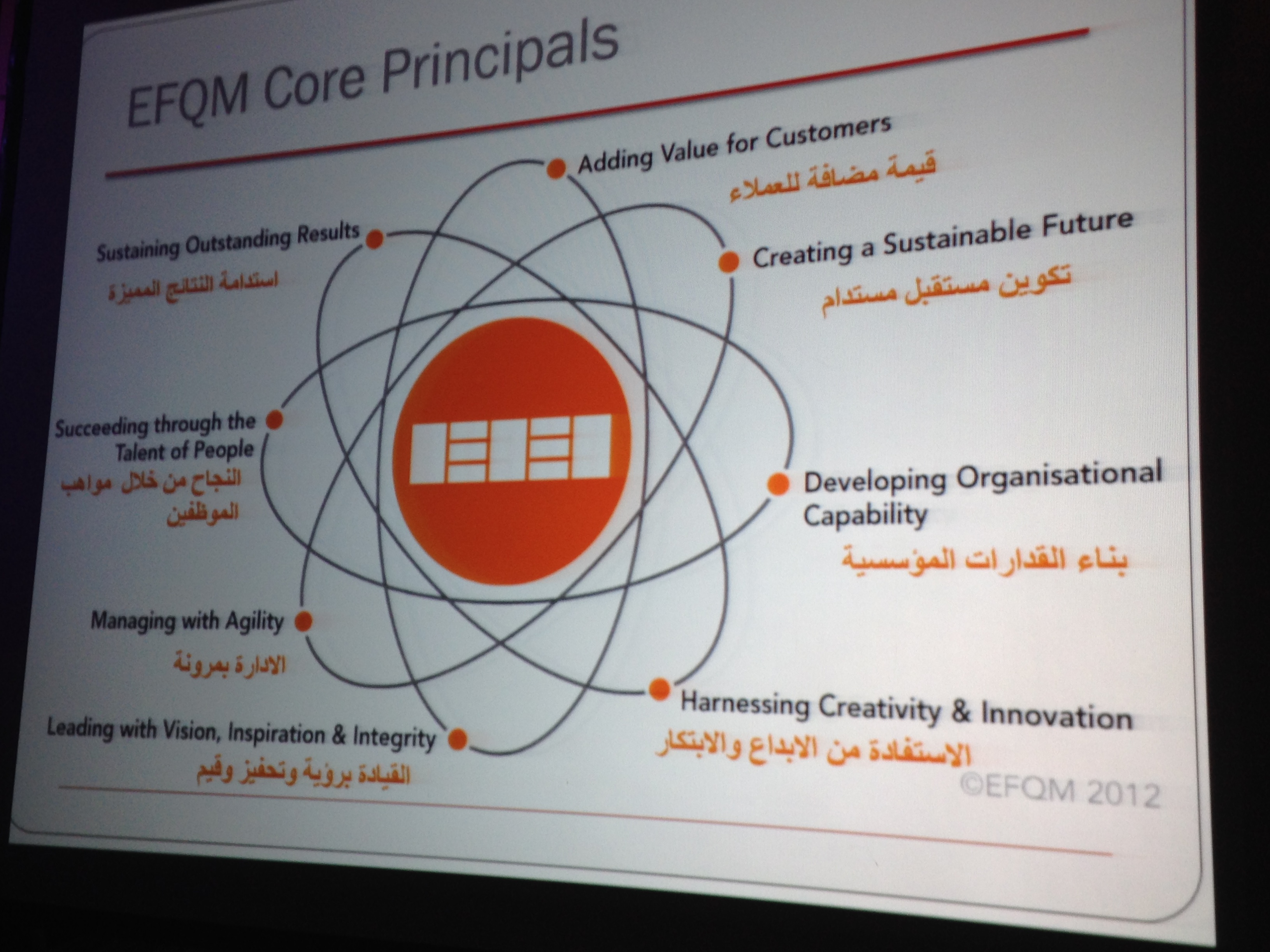
EFQM Model adopted in Dubai

One which caught my eye which was how Quality Standards such as EFQM are becoming the drivers and measurement yardsticks for KM implementations.

This adherence to standards of excellence fits with the way Dubai and the UAE are measuring progress across a wide spectrum of activities. It was even evident in the surplus food discussions I had while I was there.
IMG_3123

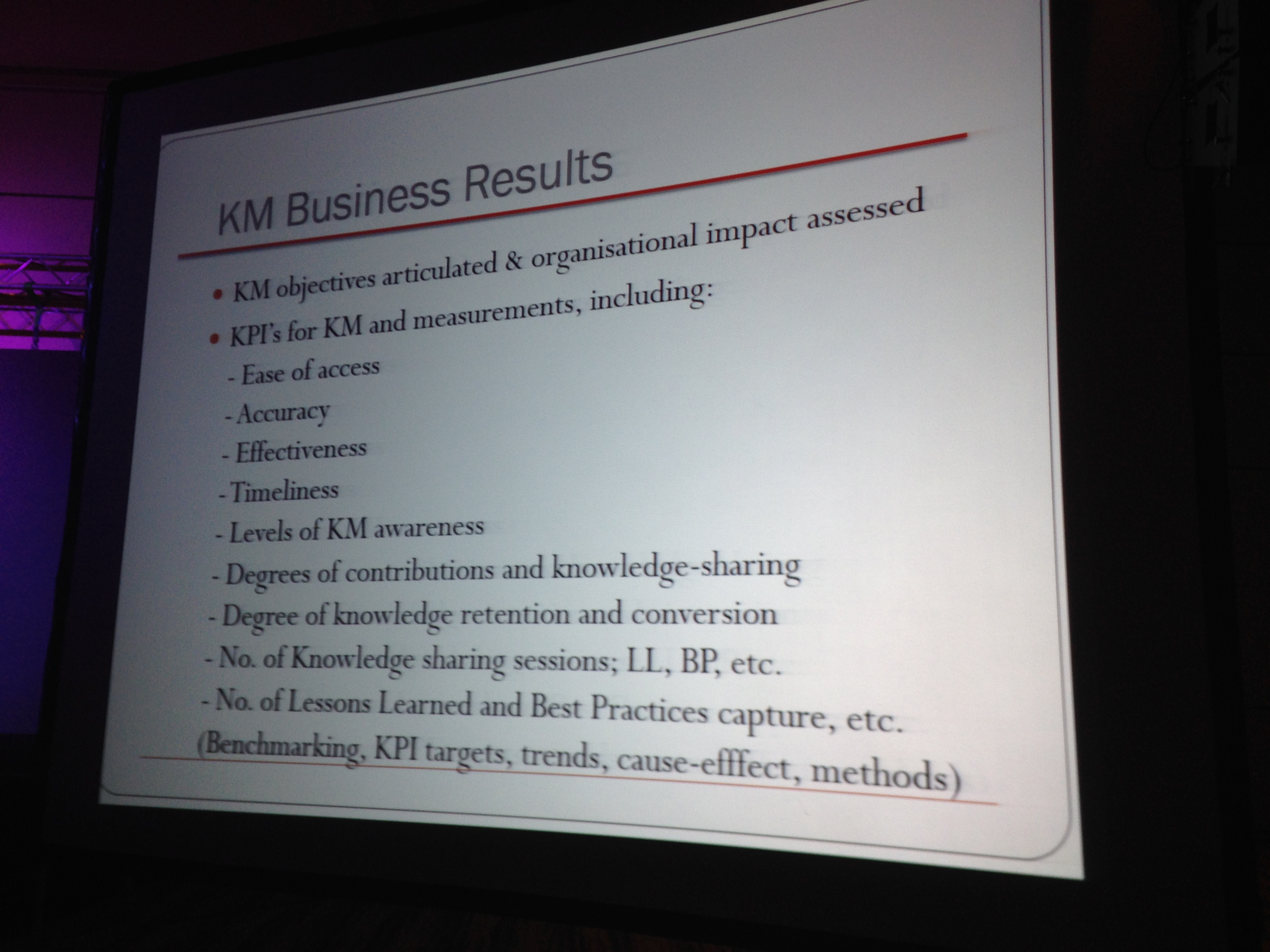
Cascading the EFQM model – KM Business Results

People understand that to win environmental and sustainability awards you have to be able to demonstrate effective reuse so the measure is based on sustainability and environmental impact not on the social impact.

Here’s just one of the slides by way of an example of how the framework is being cascaded down in KM.

While entirely logical It poses a number questions for me:

  • are the evaluators experenced KM Practitioners?
  • the start point would seem to be critical – yes an organisation might make great progress but where is the benchmarking element?
  • where do the frameworks cater for increasing the value of an organisation’s Knowledge Assets?
  • is there a danger of being in love with the process rather than the results of the process?

It’s a great start though and similar to work done in Singapore where EFQM and ASQ measures have been combined in some organisations as a way of cascading down operating values and standards (SOP’s). Where organisations start to make progress is when competencies are built into the framework.

My Takeaways

So apart from a number of very interesting discussions with the other speakers over dinner and with the delegates at the event what else did I takeaway?

  1. KM is increasingly being driven by issues of Quality, Standards & Risk.  These are operationally focused but provide tangible measures that organisations can point to as a way of demonstrating value. EFQM is the predominent standard in UAE and KM programmes need to align with it.
  2. Standards organisations are introducing criteria that include being able to demonstrate technical competence in KM including the provision of a KM strategy.  If you want the award (and often you need it to sell what you produce) then KM is a must do.*
  3. Risk (of individual and collective Knowledge loss) in a society that is still essentially transient places great importance on ‘knowing what we know’ and so Knowledge Assets Audting (identifying and assessing) is likely to grow in importance.
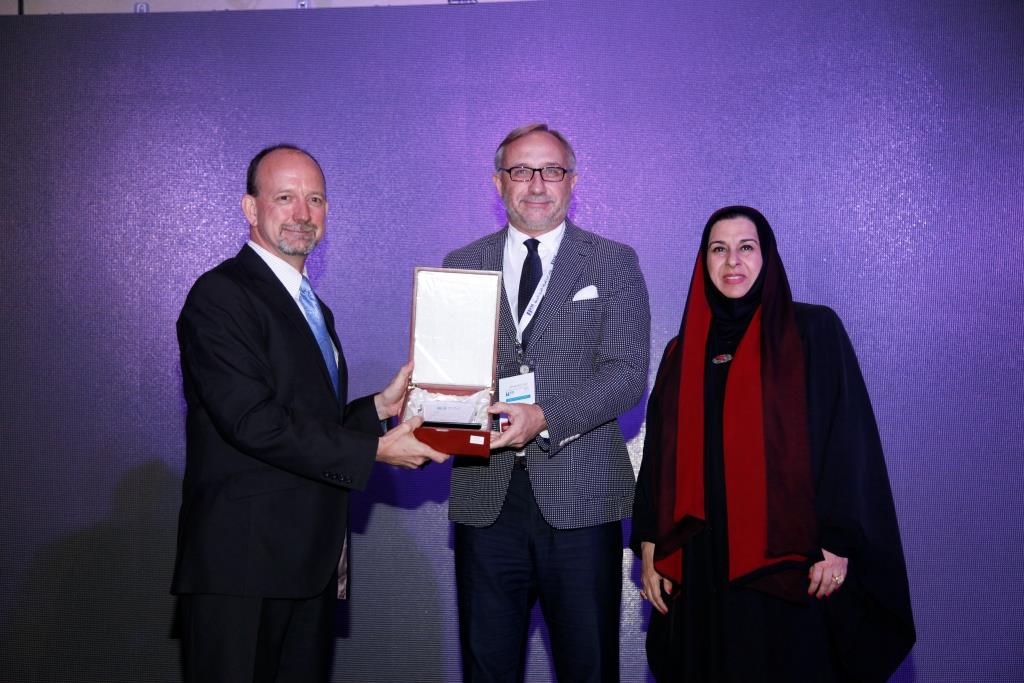
IMG_3344The final takeaway: my speaker ‘award’ (presented by John Girard along with the Deputy Director, Dubai Chambers of Commerce)


* as a footnote to this I came across this:

The Standards Institution of Israel (SII), Israel’s member body to the International Organization for Standardization (ISO), has submitted a proposal for a new international standard focusing on requirements for knowledge management systems. As the U.S. member body to ISO, the American National Standards Institute (ANSI) invites all interested stakeholders to submit comments on the proposal by Friday, February 14, 2014.

The proposed International Standard would set down requirements for organizational knowledge management systems, including the creation and maintenance of such systems, the nurturing of a knowledge management culture, measurement of organizations’ knowledge, and approaches to sharing knowledge management solutions. The standard would cover businesses, nonprofits, government organizations, and other groups of any size and in any field.
Fired up but not yet ready to go: Legal KIM response to 2015 challenges

A month back Martin White and I ran a breakfast breakout event for professionals in Legal Knowledge & Information Management. Those who follow mine and Martin’s musings might recall the event ‘The Future for Legal KIM: an outside in perspective’. Our aim was to present our thoughts to a group of Legal KIM’ers and seek their views.

These were the topics we foresaw as being important in 2015:

  • Lawyers come and go – capturing knowledge at speed
  • Collaboration and KM beyond the firewall
  • Getting the best from virtual teams
  • Bringing it all together – legal project management

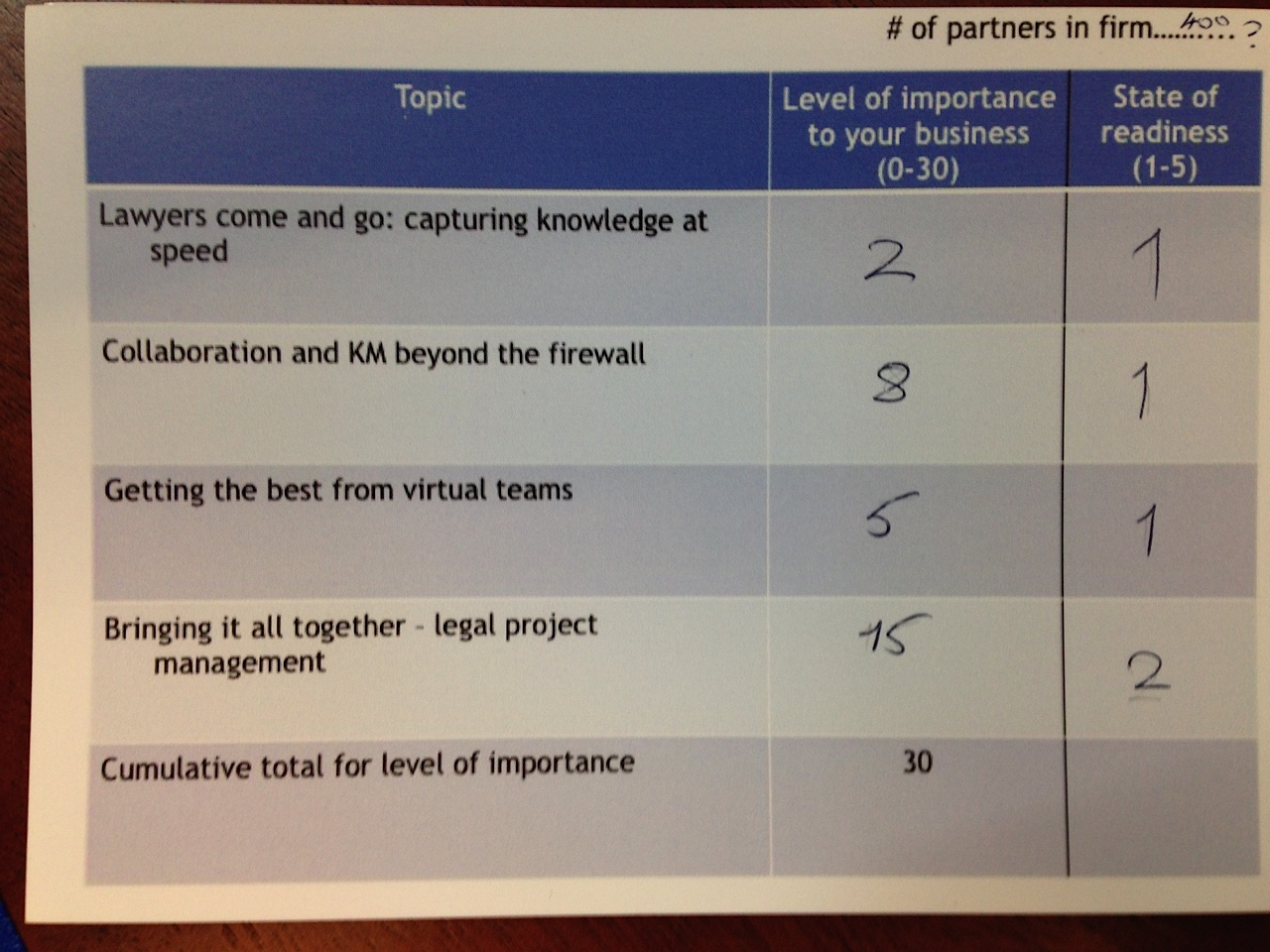
ALegal KIMs it turned out we were not far off the mark as the feedback from the postcards we invited the delegates to write on indicated.

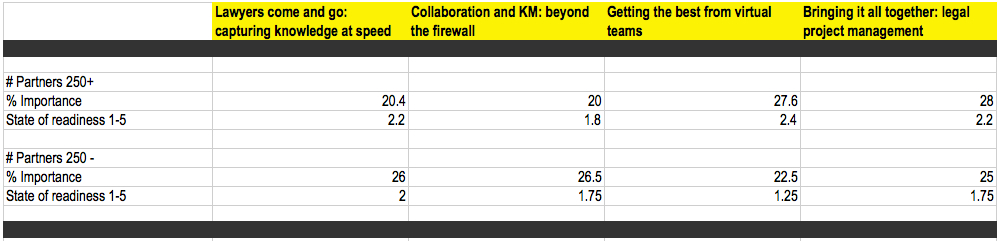
Once we consolidated all the replies on the day an interesting picture emerged.Scores on the doors (Click on the picture below to make it more visible)

In law firms of more than 250 partners the biggest issues were around virtual teams and project management. Yet all acknowledged they were not yet in a state of readiness to tackle them. Among the smaller players the biggest worry was around loss of knowledge.

other priorities

Not unsurprisingly the comments provided a valuable insight into their thinking.  Smaller firms (at the start of their KIM journey) were looking for basic KM:

  • Basic entry level km – completely new to it / evolving information research service & integrating with K activities
  • Provision of rapid and easy access to previously captured knowledge / Technology to simplify the process of intergration

Larger firms wanted something different (note the reptition of collaboration):

  • Collaboration inside the firewall / Expertise locating
  • Combining & improving KM systems / Organising our know how in a better way across the whole organisation
  • Support dept personalities working together (Marketing collaborating with IS, KM)  / Improve collaboration generally
  • Content clutter and records management / Risk & Security / Knowledge & UT goals & Strategy

So much to ponder on – watch this space for answers!

and finally

Grateful thanks to the four people who made contributions to Plan Zheroes (the event’s nominated charity).  For those who forgot and anyone else who feels moved to contribute, they can do so here.

PZ Virtual PresenceThis Thursday the Plan Zheores team are at London’s GLA for the launch of their new virtual presence which has the potential to make PZ the ‘Uber of surplus food’. Here’s a snapshot of what it will look like and why the team is so excited.


The future for Legal KIM: An Outside/In perspective

I’ve long admired the work of Martin White on Information Governance, Intranets and Search and as Chairman of the Online Conference that used to be a must attend event at Olympia in December.  I fondly recall a Hilton Hotel, Heathrow T4 meeting at the end of the 90’s between the two of us and Gerry McGovern in which we hammered out the components of an Intranet checklist. And the horror at finding the parking bill was nearly as expensive as a tank of petrol.

We go back a long way, have worked on a number of assignments together and I once gave the Keynote Speech for Intranet Focus at the inaugural Russian Intranet Forum in Moscow where David Gurteen ran his first Russian Knowledge Cafe.

Martin and I meet regularly.  It’s one of the nicer aspects of working in alliance that you get to share ideas (within the bounds of confidentiality) with people you choose rather than those an organisation chooses for you.  In the Summer we met a couple of times to review experiences in Legal Knowledge & Information Management. I’d just given the Keynote speech at KM Legal and written a blog post while Martin was in the midst of a new assignment writing a digital workplace strategy for a prominent law firm.

Legal is changing, is KIM ready?

Martin too had noticed changes in the way law firms were working. As we compared notes we became aware that some of the knowledge management, information management and project management approaches that we had been using for many years might be unfamiliar to law firms. We decided to validate our conclusions by talking to some of our contacts in law firms and among the comments we noted were:

  • “We are great at capturing, not so great at sharing, especially when it comes to knowledge about clients”
  • “Too many people think that writing a project plan is all that is needed to make a success of Legal Project Management”

A couple of hours on 4 key topics

We have decided to set up a meeting at which we could share some of our experience with senior knowledge and information managers working in law firms. Our Breakfast Breakout will take place in the Benjamin Franklin room at the Royal Society of Arts on 9 December. Starting at 9.00am (but with breakfast at 8.30am) we will be covering (amongst other topics)

  • Knowledge Loss & Knowledge Gain,
  • Legal Project Management,
  • Getting the best from firm/client virtual teams
  • Stakeholder Engagement and Management

We will be talking about Knowledge Chameleons, the “Balloon on a Phone” and WTGTGQ – When They Go They Go Quickly. There will also be a chance to benchmark your own situation, though the Chatham House Rule will apply throughout the meeting. With just ten working days to Christmas we’ll provide a relaxed setting, no PowerPoint presentations, a good breakfast and an opportunity to support the PlanZheros charity instead of paying for a ticket. You will be able to be back at your desks by 11.00. The room will be set out cabaret-style and we’ll be moving everyone around after the mid-way break to foster networking.

How to register

Registration details will be posted here, on Twitter @pauljcorney and @intranetfocus in the next few weeks.

Donations to a charity

It being Christmas we decided instead of asking attendees to contribute to the cost of the event we’d invite them to make a donation to the Plan Zheroes charity I am a founding Trustee of. So much is happening on that front and the next three months are critical, we need all the help we can get to launch our new web/mobile presence.

Pattern language writeshops, gamification and the importance of passion: a chairman’s perspective of KMUK

“Very stimulating couple of days at – insights into gamification, perspectives on engagement & mulling over global individual concept”

This quote from one of the presenters was a great way to end what was a really enjoyable and rewarding couple of days at the 11th KMUK held a few weeks back.  Despite sharing chairing duties with David Gurteen I managed to capture much of the social media activity on Day One and publish a series of Storify accounts.  On Day Two I upped the informality and attempted to broaden the gamification debate with Andrzej Marzcewski.

A lot of ‘Operational KM’ activities emerged but I will focus on presentations from Alim Khan who outlined a very interesting technique in co-creating a report (writeshops), gamification session with Andrzej and an energetic performance from Patricia Eng on the US Nuclear industry’s knowledge capture and retention programme.

Knowledge Capture & Retention in the US Nuclear Industry – a story of passion!

So Ladies first, here’s a few of the comments Patricia made:Bp1_bVNIgAAwPu-

You have to make the exec management think you are serving them but you are serving the workforce

Don’t worry if you don’t have much money, what you need is PASSION, hang about the cafe. Replaces the old smokers room.

KM metrics? Ask the problem owner, help them develop the tools, go back and see if things are better

IMG_2171The slide that caught my eye though was this one. Apart from the fact that Patricia’s efforts save $37m she rightly focused on the pain points one of which was around departing knowledge. It was a theme that came back a number of times and Patricia’s work inspired a similar exercise at Lloyds Register.

Patricia believes people who leave have different motivations for sharing what they know before the leave even if their departure is involuntary.  I would group them into the following categories:

  • Legacy/Notoriety: I want what I’ve done in the organisation to be remembered and passed on;
  • Avarice: I want my cv to reflect what I’ve done and I see this process and the stories it generates helping me as a freelancer.

In fact this ‘What’s in it for me’ motivational issue is often overlooked by many KM’ers and is one of the core foundations of the work I am doing in Iran with Ron Young. And here’s where I disagree with many in the KM community who are convinced that if you get the culture right then knowledge sharing naturally occurs: There has to be something in it for people to be willing to share what they know.

A study in collaboration at the World Health Organisation

Dr Alim Khan is an incredibly well educated individual who thrives on complexity and with whom I had the good fortune of spending two weeks in Darfur as part of a mission to see how KM might be grounded in a humanitarian crisis. It was therefore not a surprise to see him presenting on the topic of how to accelerate completion of a project report and findings using a wiki based on Christopher Alexander’s Pattern Language work.

The idea of a pattern language appears to apply to any complex engineering task, and has been applied to some of them. It has been especially influential in software engineering where patterns have been used to document collective knowledge in the field.

This was a great example of non routine content aggregation via the coordinating mechanism of a wiki -from workshop to writeshop. ‘Building a collaborative knowledge product at the WHO’ was a session that showcased new thinking.

It’s only a game!

The previous week Andrzej led a Knowledge Cafe session on Gamification in a KM Environment. Once again this was an entertaining talk focusing on the psychology behind the use of games and especially the variety of user types (stakeholders) an organisation needs to consider and their motivations (the ‘\what”s in it for me’ again) for participating.

IMG_2185Andrzej and I then led a working session where the delegates were asked this question:
what role (if any) do you see for gamification in KM?

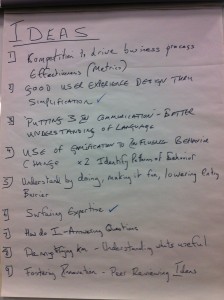
The discussions were wide ranging: many were sceptical; some were Gamification Ideas KMUK 2014converts; others saw no role.  But when asked to note down their top  ideas this is what emerged:
I was particularly drawn to the idea of surfacing expertise (which is how CapGemini where Andrzej is the Intranet supremo uses the technique) and the idea of using Gamification to demystify KM.

My take: Gamification is a big leap to make for senior executives who have not grown up in an online interactive environment. As Andrzej points out each one of us who uses LinkedIn is engaged in Gamification; ditto those of us with loyalty point cards. Its about how the technique is introduced that matters and where it is targeted.

A word or two from Dave Snowden

A few quotes from Dave’s opening address which I thought were spot on:

Danger of Community of Practice – correlation doesn’t give rise to causation.

@snowded prefers to talk about ‘decision support’ rather than ‘knowledge management’ – it describes what it does

Understanding the history of the organisation is a key to understanding its culture.

The idea of creating a big database of lessons (identified) only works if those are then fed back into the workings of the organisation – then they can be described as ‘Lessons Learned’! Most aren’t which is why the idea of a pool of case studies is often also a waste of time.  Its rare for two cases in one organisation to be the same so why would you expect something that happens someone else to be a perfect fit for your own organisation.

And finally

Future of KM is facilitation, not management. Needs to be part of the how we natively work & relate.
The new world of the Knowledge Managers- moving from managing knowledge repositories to facilitating communities #kmuk

Exactly!


A KM Definition that isn’t: KM Legal 2014 examined

This extract from today’s twitter stream on KM Legal 2014 is telling:

Just been asked why we’re not at in London – “because we went to the one in 2004” was the answer.

I was there to deliver the opening address to this year’s KM Legal event.  It was very well attended with 80% of the audience being qualified lawyers.

In truth I left feeling disappointed. Apart from an interesting perspective on the future role of predictive data delivered by Eric Hunter, Director of Knowledge, Bradford & Barthell in California much of the remainder focused on providing information rather than applying knowledge and the discussion was about Intranet implementations on SharePoint. I should point out that my impressions are based only on Day One.

In my presentation (publically available on SlideShare) I began by describing how 20 years ago I’d helped build a one screen view of all our activity and created what was effectively one of the first Intranets in the process.  Yes the solutions and reach are greater today but the questions being addressed are the same.

Its significant how many people have knowledge in their titles however almost all are involved in Operational Knowledge Management and many in Information Management.  Very few appeared to be involved in Strategic Knowledge Management which for me is surprising given that the legal profession more than many others has to be knowledge driven relying on precedent and changing judgements in order to make recommendations (legal arguments) based on personal and team knowledge and experience.

Information Management is not Knowledge Management!

Mark Gould (who was suitably voluble) summed it up thus:

Information management is important, and often needs to be better. Helping information flow is not knowledge management.

I noted the Knowledge Management definition delivered by Zurich which might work for them and meet their specific criteria but for me misses by a mile the real meaning of Knowledge Management:

Knowledge Management: ‘The efficient and effective use of information to meet the objectives of the team and businesses we support’

Where is the key bit about learning from what you’ve done before, capturing, storing and reusing the knowledge of people? What happens when people leave and new lawyers join?  Yes Knowledge Management requires good information systems to support it but there is no mention of building knowledge into the processes of the business.  Its quite ironic as in 1998 Zurich Re London hired me to help embed knowledge into their Lotus Notes systems for underwriting and decision making.

We want value add from our legal parners!

This was a cry from a few of the presenters and the logic is powerful.  If their lawyers have expertise in managing knowledge then why not tap into it and ask them to share it with the clients as part of an overall package. But that’s a narrow perspective as the conference demonstrated.  The essence of KM tools like Peer Assists is that you are bringing expertise from outside of your own industry when launching a new project. Organisations that just hire the same character types and draw from the same talent pool end up being clones! The same applies to advice.

Transparency and co-creation

Eric’s presentation struck a chord.  His premise: that the future is about opening up and co-creating with clients is spot on.  Clients at the event were complaining about opaque charging structures and archaic processes.  Eric (who is ex Oracle) noted that:

Real-time data analytics is changing business models

I buy into that argument and can see a world where more generic aspects of law are consolidated (perhaps in the cloud) and the superior knowledge hence value is priced differently. Surely the value of great legal minds is in the analysis and delivery not the curation and storage?

Comments I liked:

  • On Intranets: Bird&Bird-content facilitation role vital to look at what was best version and then use that. LinklatersWhen search works you are on your way to a winning Intranet!
  • On how to sell: White&Case- Demands for collaboration coming from clients is a common theme. Love analogy of selling processing and successful completion.
  • On the creation of  embedding knowledge into ‘Pathways’ (processes): White&CaseSubject matter pathways (a set of navigable PowerPoints) that help lawyers go thru a workflow. simplicity thru PowerPoint with embedded live links. Real business efficiency tool. pathway dependent on effective curation next step is to add on time recording and budgeting. Good for showing clients Gr8 for onboarding.
  • On what’s in it for me: White&Casepeople will only contribute if they know who is going to see information. Simplicity is best, fewer options better.
  • On what people are called: ZurichExpertise Enablement Officer, (Learning Officer, Knowledge Manager, Information Manager rolled into one).
  • On organisational values and change: Berwin LeightonPaisnerDownside of giving people ability to customise their personal home pages is that the core message / values of the firm get lost.Lewis SilkenPowerful group needed to bring about change in a legal firm? Secretaries! Administrative initiatives will fail if not involved.
  • On the future: Variousrevolution in way of working is coming with a need for a virtual digital workspace across the industry that all firms contribute to. Increasingly clients will put together teams based on the best practitioners drawn from different firms.

What I missed?

  • Any discussion around communities and talk of knowledge sharing policies.
  • A discussion on risk – none seemed to follow the example of Nuclear who have identified what critical knowledge is and tried to plan accordingly for its loss?
  • And a wide ranging debate on Twitter that brought those outside the room into it.  How can we as a KM Community preach knowledge sharing if when we are at events like this we don’t practice it?

And finally:

I left feeling that the huge challenge of breaking down silos across specialist practices in law firms has yet to be tackled effectively.  Yes the idea of common platforms is a good one but each practice area is a federated business and lawyers probably have more allegiance to their specialism than a firm.

‘What you bill is who you are’ came across as a strong undercurrent that can only be overcome by the sort of technological changes that impacted the Reinsurance Industry when Catastrophe Modelling Analytics went from being nice to haves to must haves in order to stay in the game.

If you accept the premise that the future is about co-creation and collaboration then the centralised firm structure is in danger as technology aids disintermediation.  This suggests Legal Knowledge Management’s future focus should be on competencies, skills and network management.

And just to prove that the legal profession has embraced ‘Gamification’

From Penny Newman's session on change and managing resources

From Penny Newman’s session on change and managing resources