In a recent discussion about how to surface issues that need addressing as part of a km strategy the subject of timelines and objects came up. Here’s a post I wrote for Sparknow at the end of a working session:
At the back end of 2010 Victoria, Carol and I were in Barbados helping to develop a knowledge management strategy.
The strategy needed to be reflective of the institution yet grounded in the reality of the changing nature of the economic marketplace in the Caribbean where the alleviation of poverty remains a core objective of most developmental efforts.
People have become dismissive of the value of km after years of failed attempts to institutionalize it in organizations. Yet the principles of working towards a knowledge sharing/transferring culture remain valid especially in development. And the potential for improvement in operational efficiency cannot be underestimated even if at times is not easily quantifiable.
We began by looking for good examples of knowledge sharing; using a structured framework for the initial assessment has benefited the client (as well as us) and provided an organizing mechanism for reporting. Adopting a critical decision interviewing approach has also made it much easier to unearth some of the stories that illustrate how knowledge flows. Perhaps our biggest (re) learning is the value of a neutral object in acting as a catalyst for conversations around the working practices of organizations.
Most people feel uncomfortable talking about something intangible, they need a hook to hang their conversations on. In much of our work we’ve asked people we are interviewing to draw a time line to help ground them in chronological events; that tended to be a good launching point for dialogue and stories. It was especially effective in our mission to Darfur back in March where the enormity of the problem tended to obscure people’s specific recollections unless they had just occurred.
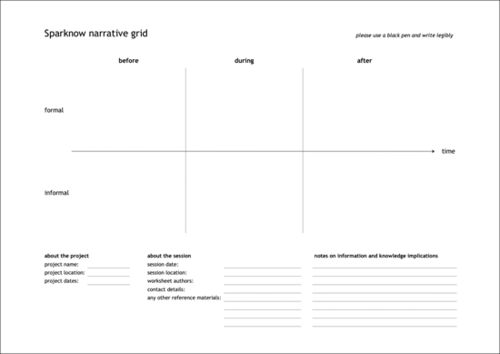
In Barbados though we were looking for evidence of how knowledge and information flows across an organization and how it is used to inform decisions. Drawing on the excellent tome Working Minds by Gary Klein et al we combined a critical decision interviewing approach with a timeline approach to create a Narrative Grid.
Perhaps most importantly we built on previous work with Royal Mail and others to ask our interviewees to describe what was going on in the formal and informal channels (“above and below the line”) while a decision was being made.
Did it work?
- As a conversation piece and in a 1:1 situation it was extremely effective and moreover became the neutral object that the interviewee was happy to channel their thoughts into. We learned a lot about the use of the right pen and of the value of the subtle prompt. It was also very effective as a way of assessing different cultural types; there were those who instantly took the pen and began writing; those who would take the pen after we had begun writing; and those who were happy to have us do the writing while they “dictated”.
- In a group session the Narrative Grid shone. Teams would gather round correcting each other and while the outputs were often anything but neat the results of a genuinely collaborative effort were not purely visual. Getting each group to summarize was especially useful since it often revealed similar patterns of behaviors, good examples/stories of knowledge sharing and areas ripe for process improvement.
Over the last decade Sparknow has experimented with many techniques to capture organizational stories. For helping to identify organizational knowledge and information flows around events and decisions the Narrative Grid has proved among the most effective.