
an Austrian war hero, surplus food and corporate social responsibility

Lotti Henley is remarkable. She was described earlier this year by the London Sustainable Development Commission as:

‘…an 86 year old war hero; an Austrian aristocrat who was forced to eat scraps of food from bins to survive during the Second World War...She says her lasting memory of hunger is the motivation behind her new campaign, Plan Zheroes, which aims to link up hundreds of shops, supermarkets and other food outlets across the capital with local charities in need of free food.’

I met Lotti on Thursday when she hosted the Plan Zheroes weekly team meeting. Articulate, witty and sharp she is an inspiration exuding the passion common in the volunteers who make up the PZ network.  And she makes a great soup!

Other than describing to the group the process by which I set up and run the Lewes Knowledge Cafe (encouragingly they’ve turned it into a blueprint for future sessions) I was there to hear about PZ’s continued progress in the area of Corporate Social Responsibility.  And its impressive.

Plan Zheroes have developed and run programmes for organisations who invest in corporate social responsibility. In short, organisations who care: about the environment in which they work; their staff; and their impact on the local community. And the programmes tick many of the boxes CSR/HR/Marketing professionals look for in running an event:

The formats are brilliantly simple:

  • One off team building events for 150 or so wherein teams compete to see who can sign up the most food outlets and charities to the Plan Zheroes map.
  • Incremental competitive volunteering wherein staff use ‘CSR’ time to sign up outlets over an extended period with progress measured on the PZ food map.

A recent event conducted for 130 graduate trainees of a construction group generated:

  • Visits to 20 charities, all of who are now registered as recipients of food.
  • Contact with over 150 food outlets, of which 80 have now signed up to the map and are committed to giving surplus food on a regular basis.

It’s a great way for organisations to make a tangible difference and bring a CSR initiative to life and one of PZ’s biggest supporters Paul UK has just won the 2012 Springboard Award for Excellence for Corporate Social Responsibility.

Back in Sussex, I am about to meet a local volunteer organisation who are keen to be the first to sign up to the PZ map and donate surplus food. Expect an announcement shortly. I’m told it takes time to get early adopters willing to donate surplus food, charities willing to accept the food and intermediaries willing to bridge the logistics gap.
Food Banks: from Chicago to Coventry

On Tuesday night the BBC ran a programme about a food bank in Coventry. Last night I attended a thought provoking lecture at Chatham House on the future prospects for the US economy. I intend to show you why I think the two are connected.

Dr DeAnne Julius the speaker at Chatham House is an influential economist on both sides of ‘The Pond’ and was a founding member of the UK’s Monetary Policy Committee.  Her assessment of what the incoming President will face over the next four years is chilling:

  • Continued low growth of 2% p.a. and high unemployment of above 8%;
  • Increased inequality between haves and have nots resulting in children being tied to the social class of their parents, signalling in effect the death of the American dream – no longer will the next generation be better off than the last;
  • Deadlocked legislature placing a constraint on the President resulting in increased State level involvement who will implement experimental local policies and taxes; and
  • Continued growth of voluntary sector (church groups and baby boomers with time on their hands) as middle and low income jobs are replaced by technology and, with increased globalisation, outsourced to lower cost markets.

The demographic similarities with the UK are striking: fewer young people going to University; a growth in the number of single parent families; a rise in short term and part time contracts; graduates doing unpaid internships (where they can get them) as a precursor to employment; and a declining population supporting an aging population with unsustainable pensions and benefits.  One in six Americans are on food stamps and US debt is at historically high levels being 7% of GDP (remember those aspirational times in Europe when country debt was not supposed to exceed 3% of GDP).

You get the picture: the recovery in the US will be long and painful for an increasing number; more and more people will end up relying on food handouts and support; and it is less likely that any recovery in the UK will be fuelled by one from the US.

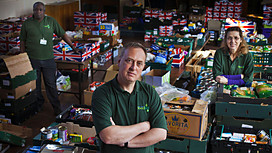
Britain’s Hidden Hungry broadcast on Tuesday night investigated the growing importance of charity foodbanks to thousands of hungry people across the UK by following the stories of three users of a foodbank in Coventry. Here’s a taster:

Care-leaver Charlotte eats just one meal a day. It’s all she can afford, so she starves herself till evening. Sandra, middle class mother of five, is embarrassed that all she can give her son for his school packed lunch is bread and butter. Middle manager Kelly, mother of two, hasn’t eaten for two days. Meet Britain’s hidden hungry – and they’re not what you’d expect.

As of 2012, more than 170,000 people are believed to be dependent on a chain of 300 foodbanks run by a Christian charity, the Trussell Trust.


Coventry food bank volunteeers (courtesy of BBC)


A month ago I ran a Knowledge Cafe in Lewes that looked at the potential to make better use of surplus food using a model developed by Plan Zheroes in London. Among those attending were volunteers from church groups, councils and local interest groups. There was broad agreement that with next April’s changes to housing and benefit entitlement there would be an increase in the number of people torn between food and heating or children’s clothing. As the write up said quoting local councillor Ruth O’Keeffe, ‘this is a theme which has reached its moment… there is definitely a need for this’. 

Just down the road Newhaven shoppers have been doing their bit to help (mirroring one approach shown on the BBC programme). ‘Generous shoppers in Newhaven help to donate 6,000 meals to needy’ was the headline in the local Sussex Express applauding the joint efforts of Sainsbury’s and FareShare in giving food for onward distribution to those who need it.

Next week I will be attending my first PlanZheroes meeting in London.  My aim is to see how (having established there is an issue to be addressed in Sussex and beyond) the PZ Map can augment the excellent efforts already in place and mobilise additional surplus food.  Watch this space and please if you are interested in helping get in touch.