‘…if we want to give our customers choice we will produce surplus food.’

Recent tabloid headlines about how much food is thrown away provided a timely backdrop to a meeting held last Wednesday at City Hall by Plan Zheroes. In attendance were charities, soup kitchen, faith groups, donors (including Paul UK, Pret a Manger, ‘Corporate Catering’) and logistics organisations (including FareShare and Best Before) all keen to make use of surplus food to ensure as much as possible goes to those who could use it and not to landfill or as a component in the production of energy.

We were there to discuss the technological requirements for a new application that will radically improve communications between surplus food donors and recipients which is in development by an expert team from Ricardo-AEA, supported by WRAP. I was there on behalf of those organisations who’ve committed to being part of the Plan Zheroes movement in Sussex.

It was such a cosmoplolitan gathering with significant Gallic representation I thought I’d share a factional story from South West France to illustrate how technology can enhance the logistics chain for even the smallest of donations.

un petite Restos du Cœur?

In a small rural community near Toulouse its nearly closing time at the local supermarche. Mme St Arroman gets the sms message she’s been waiting for from the manager: today’s surplus food is 7 pains, 3 poulet rotis, a selection of legumes, some packed boeuf and 5 jambon fromage pizzas.

Enough she thinks to meet the requirements of the local sanctuary for the homeless who have grown in number since the austerity measures have started to bite. At least they’ll get a good meal tonight!

She makes her by now regular call to Yvette one of the dozen or so volunteers who collect the food and deliver it to the sanctuary and the other self help groups and charities supplied by those local food stores and restaurants who’ve agreed to donate surplus food.

While Yvette is enroute Mme St Arroman has been receiving messages requesting deliveries. She never imagined when she and a group of local women started this initiative a few years back that it would have taken off in this way and now she has the difficult decision of apportioning the food that has been gifted.

Early on they signed up many charities and faith groups keen to have supplies to augment other food donations. It worked well to start and the charities collected the food directly; then as they failed to show up the surpermarche and the bistro cafe (who’d also been a supplier) had staff waiting after hours facing a disposal problem.  Mme St Arroman and her team solved this by engaging with the local community and finding a number of volunteers willing to do the transportation. The locale municipality did its bit too gifting storage equipment such as a refrigerated van so the food was not degraded in transit.

They learned a great deal about human nature: one of the core prinicples of the using surplus food programme; that all gifted food must not be used for profitable activities was being flouted on a regular basis.  The offenders were removed from the programme. Another principle, that wherever possible all donations would be applied to charities and groups that aspired to get people back on their feet and not become dependent is being carefully monitored and progress being made.

On a wider scale in France the national Restos du Cœur movement comprises more than 40,000 of all backgrounds with one point in common: generosity devoid of political or religious points of view. Their actions are based on the Volunteers’ Charter, whose 6 guiding points guarantee the good working order of the organisation.

The Restaurants du Cœur (literally Restaurants of the Heart but meaning Restaurants of Love), commonly and familiarly known as the Restos du Cœur, is a French charity, the main activity of which is to distribute food packages and hot meals to the needy. It was founded by the comedian Coluche in 1985.

‘fog in the Channel, Europe cut off’

Back in blighty with the chattering classes debating the sanity of Prime Minister Cameron’s EU referendum speech it became clear to the assembled gathering that the ability to provide real time alerts (similar to the French ‘story’) is a critical requirement for the new application. The core functionality included:

  • measurement of the social and environmental impact
  • a mechanism for rating
  • a way of active virtual engagement and
  • alerts

Back in the summer the then Environment Minister Caroline Spelman convened a summit in London of interested parties in the food retailing and distribution chains aimed at creating among other things a food-share database. The event was duly recorded in The Daily Mail with the charities are supporting the introduction of a so-called Good Samaritan law which exists in the US, to ensure firms that donate food in good faith are exempt from legal action arising from any adverse consequences.

I note it here since some of the comments on the article were very revealing and with due acknowledgment to the Daily Mail I’ll quote an extract from one written by an ex employee of four of the supermarkets:

Contrary to popular opinion, supermarkets do NOT throw away decent food unless they have a bad store manager- why would a business want to damage their profit margins?- it’s rotten food being left ON SALE that’s the biggest problem!!

plus ca change plus c’est la meme chose

While last July’s developments seemed promising at the time its difficult to discern real action and for some reason I cannot shake off an image of the ‘clunking fist’ that is governmental bureaucracy preventing action. Yet back across the channel I discover French Law actually prohibits the donation of food to its employees on taxable benefit grounds which you would have thought plays into the hands of surplus food donations to charity.

and finally

Wednesday’s meeting revealed a host of people passionate about making a difference: Church groups who need another tea urn but who have an ingenious and simple measurement device to see how many people they are serving (count the cups!); mobile soup kitchens whose volunteers don’t have cars and who would love to do more if only they knew where demand is not being met; and food donors who hate any waste and will provide food that meets dietary and religious sensitivities.

What struck me is the level of commitment and ingenuity. The Plan Zheroes and Ricardo-AEA team who are going to be creating the application have a tough challenge ahead to match the aspirations of those who assembled at City Hall.

And in case you are wondering ‘…if we want to give our customers choice we will produce surplus food’ is a direct but unattributable quote from one of the delegates in response to a question as to why surplus food production occurs in the first place. The ‘fog in the Channel: Europe cut off’, is a play on the headline ‘fog in the Channel: continent cut off’ that appeared in the Dally Mirror in 1930.

Scoping recipient requirements
Scoping recipient requirements

knowledge management is dead but it won’t lie down: a 10 year review of a KIM initiative

In the past few months I’ve heard talk of a resurgence in knowledge management.  km conferences are once again burgeoning; the UK’s Civil Service now has knowledge & information management as one of 22 recognised professions; last week while in Portugal I learned that the legal industry is now km aware; and many of my peers in the industry are finding themselves busier than ever providing advice to help organisations set up km initiatives across the globe.

One downside of providing external advice and assistance to organisations is that you are not always around to see the outcomes of your work especially when its  knowledge and information management related.  Occasionally you get the chance to get back under the covers and see how clients have implemented km style tools and techniques.

back under the covers

Such an opportunity took place at the end of December when I went back to the 7th largest global reinsurance broker (BMS) to see Phil Hill the Chief Information Officer I first worked alongside in 2001.

Reinsurance brokers are arbitrageurs: they place risk on behalf of large global organisations. They use knowledge of a client’s specific needs and apply that to find the best market to take the risk. They must know about clients and markets and manage relationships in both.

At the turn of the Millennium BMS was a top ten broker with aspirations to grow internationally and make better use of the combined knowledge of its dozen or so operating entities. It was dipping its toe into the document, records and information management waters and attempting to provide a technological backbone to support a growing demand for relevant and timely information. It had a very embryonic intranet.

Today BMS has broadened its business focus; it has expanded beyond reinsurance into underwriting working with a number of trusted partners. And it has focused much of its activity on building US based business development and transactional processing capability.  Seamless connectivity and access to internal and external information on clients, markets and BMS’ own resources are support prerequisites.

So how has it managed this transition and what are the significant milestones in its journey that has seen it become one of the most admired and technologically advanced practitioners in the market? One that is:

  • at the forefront of electronic placement; is regularly up for awards for innovation;
  • whose CIO Phil is a frequent and sought after speaker and panellist on industry platforms?

BMS is now an institution where joiners get a preloaded iPad with 24×7 access to the latest global and internal information as well as the ‘big data’ (catastrophe modelling in BMS’ case) that has become must have software in the insurance/reinsurance industry.

a decade reviewed

In the 2001 knowledge and information audit I conducted I noted that:

  • More than 60% of all items saved on the common H drive had been put in the ‘miscellaneous’ folder; there was no common terminology about how documents were to be named or catalogued; and no central place to find information on markets and clients.
  • As was common around that time there was limited collaboration between the various businesses and as a result potential for pursuing the same clients.
  • New joiners relied on traditional role shadowing and a tour of the building (s) to get up to speed.
  • BMS was spread out across a couple of locations and on different floors in a building at Aldgate which discouraged informal interactions.
  • Recognition of the concept of critical knowledge assets was a long way off and the words knowledge management dismissed as being jargon.  Busy people at the business end had no real interest in filing documents let alone thinking about how they might be reused; even in 2001 everyone expected the system to do it for them and the idea of ‘drag and drop’ from one platform to another was still in its infancy.

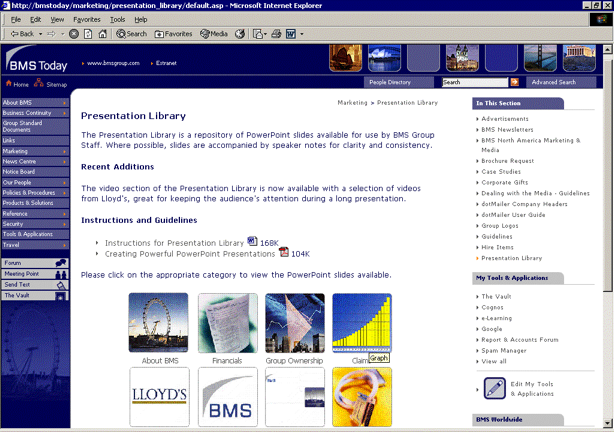
The shocking events of 9/11 in the US provided the ‘burning platform’ moment for a change in attitudes. Everyone wanted up to date consolidated news and opinion. The Intranet, website and content management system were approved as a combined project and with my assistance the newly formed Marketing & Communications (Marcoms) Team set about creating BMS Today and building up a cadre of volunteers willing to help identify the critical knowledge and information that should be captured and stored.

A definition or aim for the system emerged:

adopting a publish once use many basis provide a one screen view of activity with clients and the markets in which they operate and a central hub for knowledge and information on the organisation and its operations.

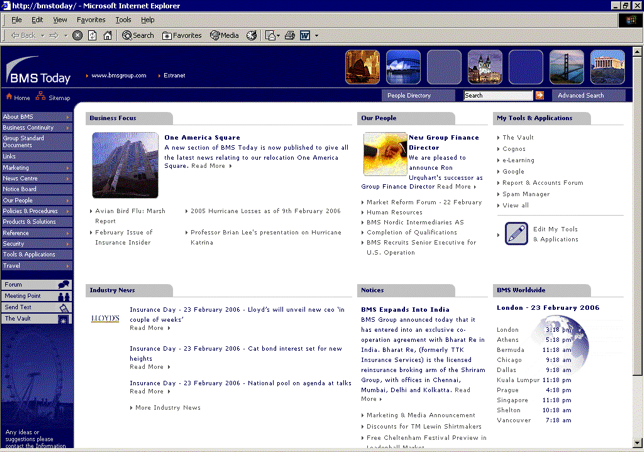
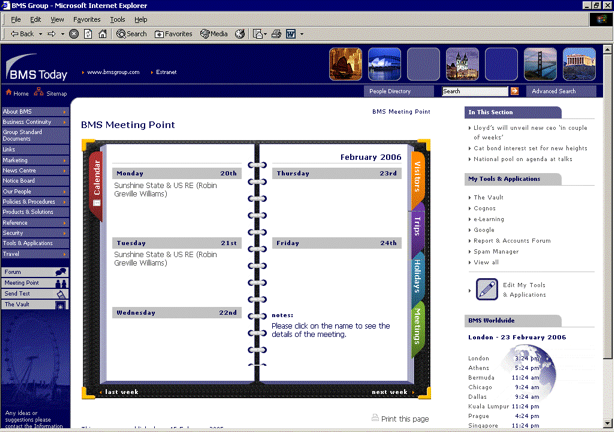
Here’s what BMS Today eventually became:

Intranet Home Page

Corporate Calendar

Though at the cutting edge of intranets BMS Today was not enough. The Marcoms team needed to go further to encourage knowledge sharing so concurrent with a relocation to One America Sq they began a series of Learn@Lunch and Breakfast Briefings aimed at showcasing different aspects of the business.

Still collaboration was a distant objective though the move to One America Square in 2008 did throw up an interesting opportunity to introduce social media.  One of the team (who been enrolled on a journalist programme) was deployed among the builders and fitters on site to provide a regular ‘blog from the battlements’.  Widely read at the time it provided an insight into life at the soon to be occupied premises and a metaphorical bridge to help people acclimate to the new surroundings.

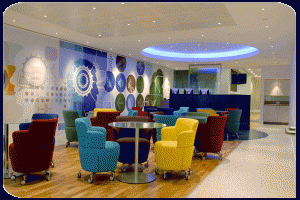
One America Square enabled BMS to plan collaborative physical spaces in which to hold breakfast briefings and learn@lunch sessions. There was a lot of discussion about the efficacy of such a space.  ‘Connexions’ as it became known was a hub for meetings and with a business lounge in close proximity it enabled serendipitous meetings at the coffee machine (and water cooler) to continue in a relaxed but more formal setting.Connexions 600x400

And of course the best coffee, subsidized snacks and rapid internet access were made available to encourage traffic to the site and make external visitors feel welcome.

changing focus & new technologies

A change of focus combined with the arrival of disruptive technology proved a challenge and an opportunity. The broking teams needed improved access to information on the move and an easy way to demonstrate the modelling systems that enable risk to be better evaluated. But technology costs and the benefits of investment are not always easy to quantify. So CIO Phil (aided and abetted by Philip Gibson of Sparknow) used a traditional storytelling technique and the idea of developing a set of personae as a way of illustrating what BMS’ world might look like in a few years time if some technological improvements were introduced. Here’s an extract from one of the scenarios:

Jade Thompson is 35 and has worked in the London Market for 14 years. She has agreed to join BMS as a senior underwriter, moving on from one of the big managing agents. She wants to work for a company that really supports her initiative and drive – not one that swaddles her in red tape.

The week before Jade joins, she receives at home via courier a package from BMS.

Inside she finds an iPad, with a BMS logo with the slogan: “Using clever technology”. There’s also an iPhone, also with a BMS logo and her name.

She reads the attached note, welcoming her to BMS and giving her the logon and password information she needs to use the equipment. “Wow!” she says to herself, “this is great – they really know how to make you feel special.” Jade switches on the iPad and logs on as instructed. There‘s an icon on the first screen, “Welcome”. Touching the icon starts a video of the CEO welcoming her to the company. Various members of the board and HR provide insights into BMS and what she might expect in her first few days.

There is also a pointer to other information on the iPad, such as all aspects of the induction procedure including health and safety. Thrilling, she thinks to herself…

This scenario has come to fruition thanks to the investment in technology (in this case iPads) made by the BMS board which has continued to support further development on BMS Today and a decade on, this is where many of the ideas and initiatives outlined above merge.

BMS Box Office Soon all 9 BMS offices will be able to log into the new intranet irrespective of domicile. It will meet the original aim of providing a one screen view of all activity with a client as well as providing real time access to the latest social media applications and real time information.

Submission to the corporate document storage system is a simple drag and drop process that recognises and acknowledges peoples preference for an Outlook Mail style filing BMS Searchstructure. ‘Stuff’ can be easily located via a search engine that accesses all operating systems via iPads which permit electronic placement.
 

takeaways

The team and I drew on techniques found in business development, communications, marketing, information and project management, engagement, facilitation as well as knowledge management to provide an infrastructure and ways of working that formed a backdrop to the continued expansion and development of the business.

Many who work in the knowledge & information arena would recognise most of the above activities, its what they do on a regular basis.  Yet at no point during the years I worked alongside the team at BMS was km used as a phrase or established as a discipline.

That a decade on BMS is thriving is an illustration that km by any name takes time but has value.

And finally by way of acknowledgement I should mention the names of those people with whom I worked most closely during my time as Advisor.  They were from BMS: Phil Hill, CIO; Roger Cooper, COO; Jeff Martin, Director; Anne-Marie Hawtin, Manager; and John Spencer Former CEO. From Intranet Focus: Martin White, CEO.

eat or heat: making the most of surplus food in 2013

A perfect food storm in 2013?

The rising cost of energy, food and transport combined with an effective reduction in disposable incomes meant many people went without this Christmas. Add in the Government’s drive for savings in the benefits budget, the cap on housing benefit and insufficient social housing and there are all the ingredients for the perfect food storm in 2013.  For the first time food is being delivered to centres in Lewes and there is talk of a Food Bank being set up mirroring initiatives in Uckfield, Heathfield, Hailsham and across the South. Many are now making eat or heat decisions and the growth in the incidence of food shoplifting bears witness to an increasing sense of desperation.

FareShare, Foodbanks and Plan Zheroes

Schemes such as FareShare (surplus food logistics) and Tressell Trust (Food Banks) tackle this need by redistributing surplus packaged food and tinned goods donated by supermarkets, food outlets and faith centres that would otherwise have gone straight to landfill.  Despite this the UK Food industry still sends millions of tonnes of prepared and cooked food to waste each year.  A group of London citizens believed it didn’t have to be this way and set up Plan Zheroes a charitable organisation that helps redistribute surplus food from restaurants,  food retailers, cafes and supermarkets to charities who then use it to feed those who are struggling to feed themselves.

Its so simple: the donor registers as a regular or occasional donor and indicates what surplus they are likely to have and when; the recipient registers to receive food specifying the type and quantity they are likely to require and how they’d like to pick it up or receive it.

Plan Zheroes in Sussex

Now this scheme is operating in Sussex and this Monday the V-Project set up in Lewes by a group of youngsters keen to provide a space for peer mentoring became the first recipient charity to sign up to take surplus food from Lewes based donors, East Sussex County Council, The Pelham Arms and Le Magasin.

In partnership with FareShare, Brighton, PlanZheroes is working on setting up new supply chains in Newhaven with NCDA and The Foyer (Salvation Army Housing Association residence for young people) and Uckfield.  More charity recipients and food donors are needed in Brighton, Lewes, Newhaven and Uckfield; all it takes is a couple of minutes to register on the PlanZheroes food map which you can find via their website.

One of our strongest supporters has been Councillor Ruth O’Keeffe who apart from promoting the Plan Zheroes initiative via her Radio Lewes programme has set up a meeting early in 2013 to try and consolidate all the various actitivities around making use of surplus food: Ruth helped launch the FareShare deliveries to Lewes and works tirelessly to ensure the less fortunate members of her consituencies have food on their tables.

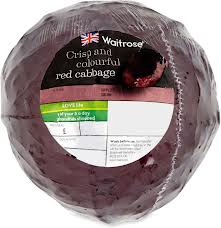
And finally during a visit to Waitrose Lewes on Sunday afternoon I came across dozens of ‘unwanted’ red cabbages that were marked down in price.  Thanks to one of the partners Nikki we are now in dialogue with their local management about enrolling them as an occasional donor working alongside their other surplus food distribution channels.