‘…education, education, education…’ and the role of critical knowledge in government as seen from Whitehall

Our top priority was, is and always will be education, education, education. To overcome decades of neglect and make Britain a learning society, developing the talents and raising the ambitions of all our young people.

Prime Minister Blair, ahead of the 2001 General Election
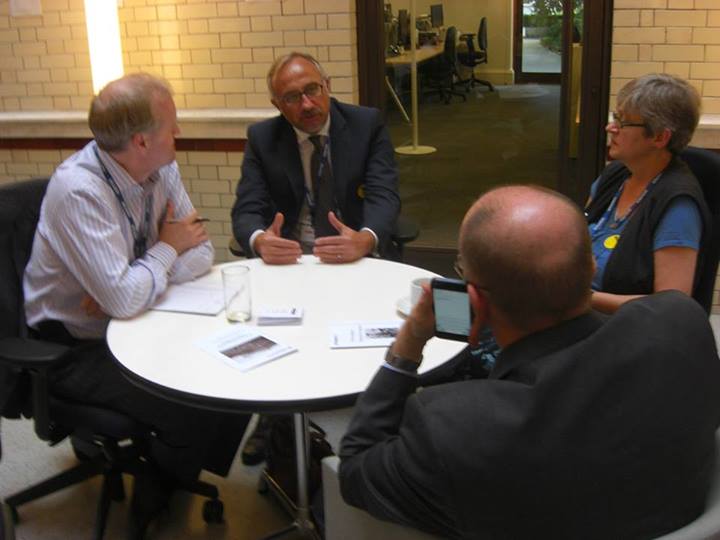
Paul at Cabinet Office 1It was an interesting and Westminster focused week. A chance to see first hand whether more than a decade on the aspiration of making Britain a learning society had been realised.

Monday, I was a guest at a Cabinet Office Knowledge Cafe facilitated by David Gurteen; Thursday, I ran a workshop* at the Department for Education on knowledge capture and retention.

At the Knowledge Cafe there was a nice mix of people from across the Civil Service. The 40 or so, assembled by Susan Chan of The Cabinet Office and hosted by Roger Smethurst, Deputy Director and Head of Knowledge and Information Management at the Cabinet Office were discussing:

How can we more actively share knowledge in the workplace?

The Knowledge Cafe format encourages conversation (it’s David Gurteen’s mantra) asking as it does for three rounds of conversation after an opening round of 2 minute introductions. For some the lack of any obvious outcomes is a source of frustration, for others its a liberating way of discussing a topic of interest and testing your own hypotheses.

I found myself in conversation about the diametrically opposed tasks of promoting voluntary transparency across government while protecting the exemptions of the Freedom of Information Act.

We discussed the difficulties of establishing Twitter dialogue and of being tied to SharePoint.   Everyone had a tale to tell about lack of handover time when being faced with a new assignment. Few seemed to have heard of Collaborate the internal government social media/chatline.  To a man (and woman) there was disquiet over the abandonment of the Local Government Agencies Community Network.

Yet the vast majority had concerns about potential loss of knowledge when organisations downsize and move to more flexible and generalist working.  This was a theme that was to resurface on Thursday.

‘I spent the morning waiting for a login…’

The dozen or so people who attended the 2nd of 3 knowledge management expert sessions held at the Department for Education were drawn from Policy, Administration and Delivery. My topic:

capturing and exploiting critical knowledge in Department for Education

An exercise I’ve found works really well when trying to get to the bottom of what critical knowledge looks and feels like is to ask people to think about a time when they needed to know…. Often mundane administrative issues (a good handover/briefing pack being rendered ineffective by lack of access to a system) get in the way!

Introductions SlideThis slide gives you the narrative.

A variety of frustrations were aired as well as great examples of good knowledge sharing practices. And yet so much revolved around the need for signposts and people acting as knowledge hubs – knowing who to go to being as important as knowing where to look.
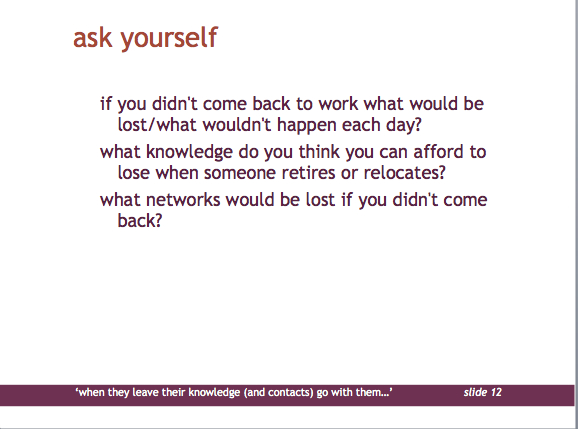
If I didn't come back tomorrow                                                           The discussion really came alive when the delegates split into three groups to work through one of these questions.  Some of the learnings:

  • Critical knowledge is often held at Grade 6 & 7 and these are neglected when it comes to knowledge capture. While Directors and Deputy Directors are adroit at managing, their domain knowledge is unlikely to be as detailed.
  • The narrative (context) surrounding critical knowledge is hugely important. By focusing on events and decisions it’s easier for this to emerge.
  • As the propensity for greater disclosure (authorised and unauthorised) increases so does the need for informal discussion – ‘An audience with..‘ sessions increases.
  • Reputation risk (from not drawing on previous experience) is viewed as a core issue.

takeaways from Westminster

Revision of the Government Knowledge & Information Strategy has sharpened the focus on the need for effective knowledge capture and retention.  That needs the active support and participation in the business areas (not just in the Knowledge and Information Management Professionals across government) for this to happen and for continuous knowledge harvesting to become ingrained behaviour.

There is still some way to go before Tony Blair’s vision is realised!

* informed by a programme run by knowledge et al and Sparknow for HMRC

 

“True tacit knowledge can’t be passed on when people leave”: embedding knowledge capture & retention

On Wednesday I had the pleasure of meeting and listening to Karen McFarlane who is Head of Profession, Knowledge & Information Management (KIM) for the UK Government’s Civil Service. I’d been invited as a guest by NetIKX as a precursor to a talk I am giving there early in 2014. And with due permission (Karen’s ‘day job’ is quite sensitive) I posted a few Tweets on what I heard which you can find on their twitter feed for the event #netikx63.

The Knowledge Council – setting frameworks and strategy for the KIM Profession

Karen outlined the work that has taken place over 18 months at the Knowledge Council to develop a framework and a new Government Knowledge & Information Strategy (GKIS). Her aim is to ensure people in KIM roles have KIM qualifications with good succession planning. A profession (currently 1,000 people across government are considered KIM professionals) that will attract and maintain talent and create an environment where KIM civil servants can move across roles equipped to do so.

These comments (which I am paraphrasing) stood out:

There is a real concern about loss of knowledge when people leave which is why a lot of effort has gone into building a knowledge harvesting toolkit for the KIM community….

One of the techniques is a Mastermind Chair; another, getting people to ask ‘what questions do you wish you’d asked…Try and identify the critical people… many departments use social media to share knowledge…

...True tacit knowledge can’t be passed on when people leave, you need a strategy to ensure you don’t get to that point…

Some organisations are now making use of Alumni networks to keep access to people who’ve left…

And finally… Department of Work and Pensions (DWP) and Her Majesty’s Revenue and Customs (HMRC) are now sharing stories on their intranet…

an accredited career pathway

Karen painted a backdrop wherein the topic of knowledge & information management is higher up the agenda in government than it has been for more than two decades. All of which is really positive as is the work being done with external bodies such as CILIP on accreditation and training and career pathways for KIM professionals in government.  Its impressive progress which the soon to be released GKIS will place into context.

This brings me back to the capturing and exploiting corporate knowledge’ pilot we* have been running for HMRC’s businesses under the supervision of their KIM professionals.

HMRC’s Pilot Programme: Setting Up and Capturing: Modules 2 & 3

My previous postings looked at why HMRC had set up the pilot programme, what critical knowledge is, how to identify it and why it is important.  Modules 2 & 3 of the programme focused on:

Setting up how to identify and approach the knowledge holders & networks how to design a knowledge capturing approach
Capturing develop an understanding of different capture techniques benchmark against existing approaches

‘Our’ delegates recognised:

  • not everyone who changes jobs or leaves has critical knowledge whose loss will severely damage the organisation.  Its important to be proactive to identify where it resides and with whom – the knowledge holder.
  • everyone is different. Each person who partially retires will feel differently about what they want to give back. Some people might initiate. Approach each person differently in order to find out how they feel about knowledge capture.

In Module 2 we looked at the setting, preparation and clarity of purpose which are all key to successful capturing of knowledge.  A key task is to think seriously about how a request for time with a knowledge holder is likely to be received.

A typical Knowledge Holder?

A typical Knowledge Holder?

Profiling and Archetype Mapping are used extensively in design, it is even more important when dealing with intangibles to have identified and acknowledged likely preferences of the person you are approaching?

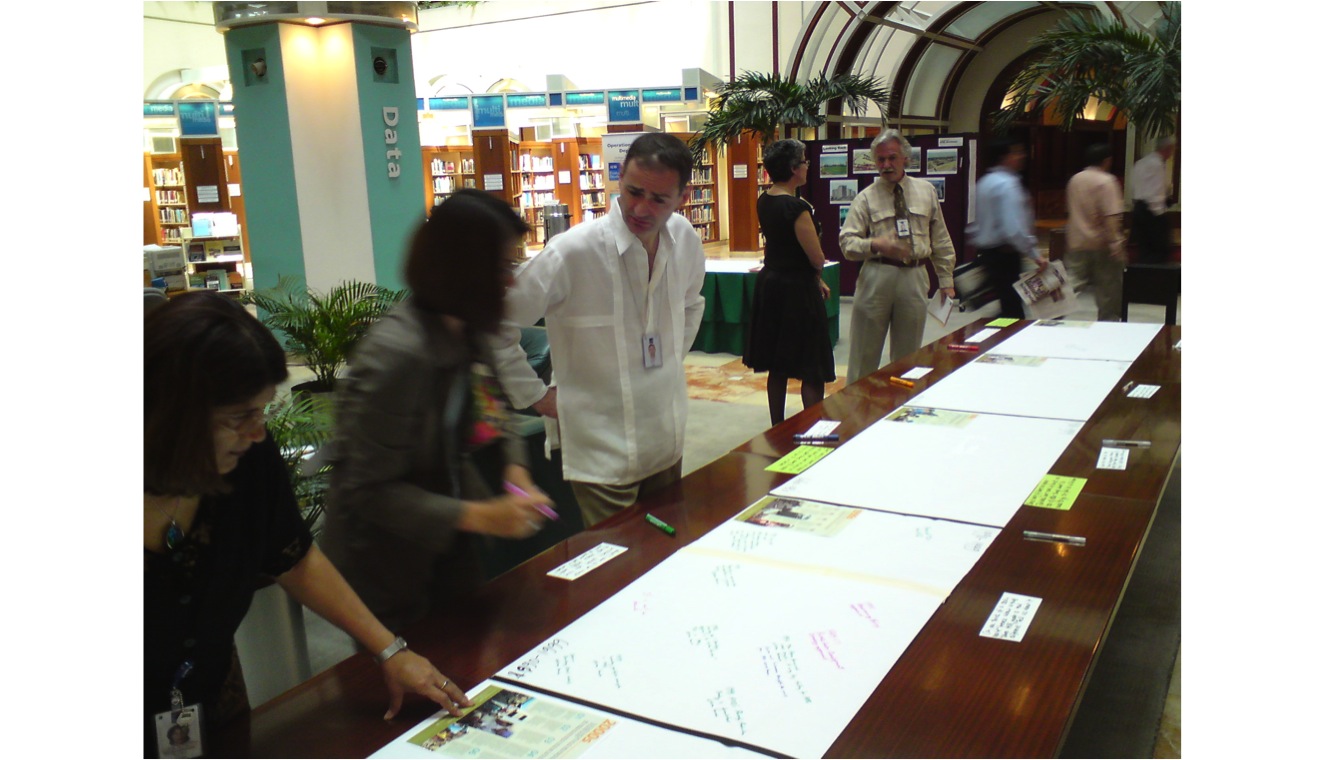
A large exhibit in Asia

A large exhibit in Asia that sought to identify major events in the life of an institution. Passers by were asked to note on a timeline events that were of interest to them.  This helped to target key players for future interviews and the subject areas to be covered.

Focusing on the individual is just one aspect of knowledge capture & retention: it’s vital to focus in addition on decisions, events and processes (documented as well as practiced) to see what knowledge is called upon in the first place and from where and then what is produced during the process.

Another key aspect is to create the right environment for the discussion/interview/observational session.  This is especially important when the intervention is to be recorded or a large response is sought.

The delegates spent time thinking about the right form of consent, how they might craft the invitation to participate and the mechanism they’d use to capture material.

Module 3 was very much about trying out. The delegates looked at:

  • Sketchbooks
  • Interviewing
  • Recording
  • Group Elicitation
  • Reverse thinking

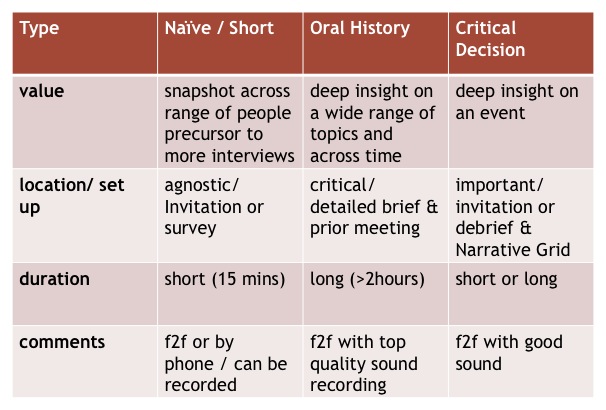
Types of interviewsThey discussed a variety of approaches to interviewing, comparing those with the checklist already developed for HMRC.

And they worked on interviewing (and listening) skills comparing and contrasting experiences.

As part of the benchmarking exercise we encouraged delegates to look at the 47 step knowledge capture process as articulated in Professor Nicholas Milton’s book Knowledge Acquisition in Practice which was very successfully adapted by John Day, at Sellafield that in itself drew on work done by Shell on its Retention of Critical Knowledge (ROCK) programme.

As in the previous modules offsite work involved listening to audios developed exclusively for this programme including a clip on Baton Passing, a technique used by the British Council adapted for their use by Professor Victor Newman.

importance and danger of Knowledge Harvesting

To return to the beginning. The Knowledge Council’s focus on equipping KIM Professionals with tools and techniques in Knowledge Harvesting is admirable. Yet I felt there is a missing skill from the training ‘suite’ shown by Karen McFarlane at the NetIKX meeting, namely that of facilitation which for me is critical.

If knowledge harvesting (what I might call knowledge capture and retention) is to become an ingrained ‘way of working’ across government then people in the business need to be equipped with those skills as well. KIM professionals must have the skills to facilitate others in Knowledge Harvesting not just conduct them.

Last minute captureThe alternative scenario is that the KIM professional gets called in to do a last minute ‘tell us what you know’ knowledge harvesting session with a prominent person and the resultant  ‘pearls of wisdom’ are placed on a database that few look at or listen to.

*Sparknow and Knowledge et al worked in partnership to deliver this programme.

‘its between me and my god…’ inside Iran

Reza (not a name I imagine used extensively today in view of it being that of the deposed Shah) is my driver as we pass a massive new mosque under construction in Teheran. We’d got onto the subject of religion as I’d seen few Iranians observe prayers while at work and asked Reza whether that was usual.  He said ‘it’s between me and my god’ adding, that the number of people who regularly attend a mosque is falling. Pressed for a number he says less than a quarter of the population!  A figure that shocked me and was contrary to the (erroneous) image I had. All is not as it seems (or is reported) in Iran.

Teheran – a walking city?

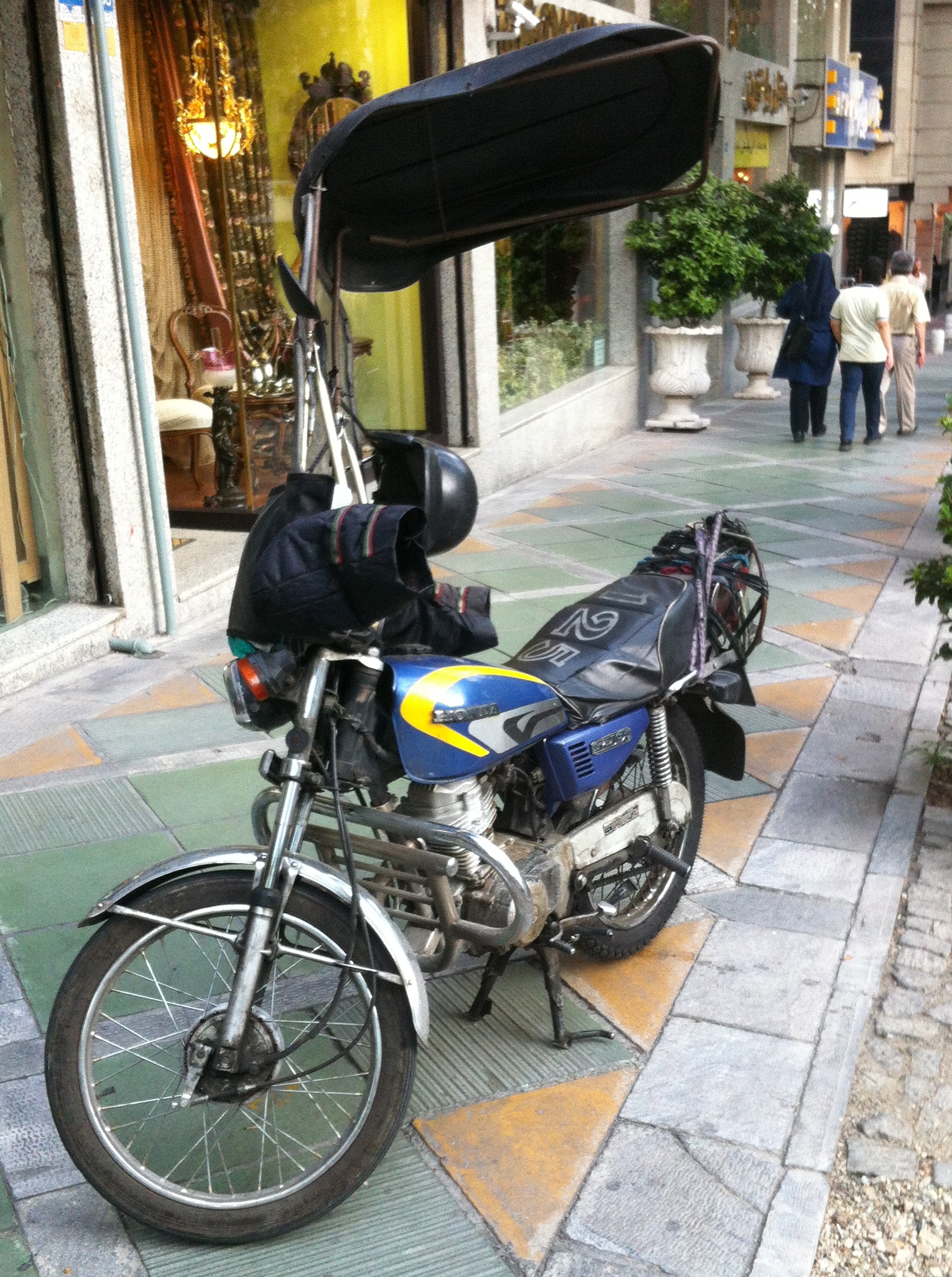
The dress code for men is Western (no ties though) and generally women are very smartly turned out.River by the roadCovered Bike  People walk or ride interestingly constructed bikes and the feel is European with tree lined boulevards and pavements.

Traffic is a nightmare and short journies can take hours. It is not uncommon for a 10 mile commute to take 90 minutes. Teheran is a sprawling city with mountains as its backdrop and smog in winter when temperatures can plumment with snow on the hills.

food, drink and cards

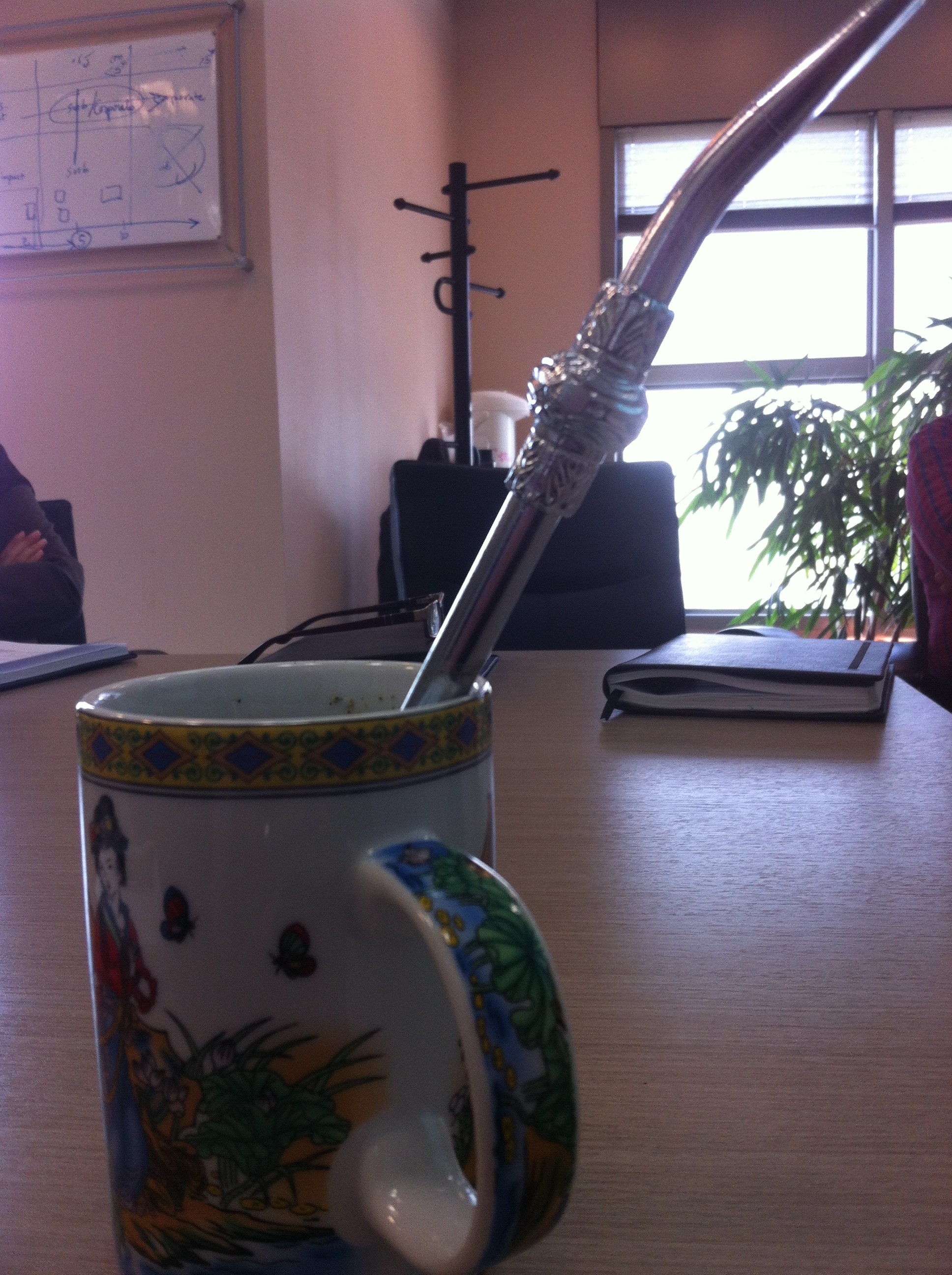
Persian cooking is among the best in the world.  We were entertained at a villa in the centre of Teheran and treated to the most astonishing meal surrounded by our host’s family. IMG_1175Another unexpected highlight was being offered Brasilian Mate by our client in his office. The slightly bitter tasting liquid is much prized so this was an honoursabzi_khordan.

Another treat was to discover how much of the Iranian diet comprises locally sourced food. The impact of sanctions means little is imported and the local goat’s cheese was among the best i’d tasted. Surprinsingly fish is not a Teheran speciality, the absence of a river means fish is farmed though it bore none of the taste associated with UK farmed salmon.

Vegetables are fresh and salads in fashion though fast food is now prevalent and cakes a prerequisite with coffee.

Flowers adorn cards which are given for eid and brithdays.

‘a country united by soccer’

In June Iran, coached by the Portuguese Carlos Queiroz, qualified for the 2014 World Cup finals in Brasil by beating the powerhouse of Asian football South Korea. It was and is a source of great joy and celebration uniting the whole country.  And yet unlike Sudan and Saudi Arabia there is no football for the fair sex as women are prohibted from attending matches which I was to discover presents a challenge to be overcome!

Iranian women are nothing if not resourceful and I was reminded of the story of Jeanne Baret reputed to be the first woman to circumnavigate the globe in 1740 dressed as a man! It appears Iranian women adopt a similar tactic to gain access to matches even though the language used by the male attendees is rudimentary.

Although the victory against South Korea was not without controversy (Queiroz was accused of inciting the crowd and making inappropriate gestures) a susbequent traiining camp to Lisboa was cancelled during to lack of funds as reported in Teheran Times.

The Iranian Football Federation (IFF) announced that the training camp which was supposed to be held in Portugal has been cancelled due to lack of funds.

“We tried to arrange the training camp but it’s impossible due to lack of money,” Mehr News Agency quoted head of IFF Ali Kaffashian as saying on Sunday.

Iran was scheduled to face Gabon in its training camp in Lisbon on September 12 as well as a friendly against Sporting Lisbon. Iran football coach Carlos Queiroz told FIFA last week his priority is a good preparation ahead of the 2014 World Cup.

“We have to make a worthy, creditable contribution, one that will honor and make all the supporters in Iran proud. How are we going to do that? With a wide-ranging, intensive preparation, as without that we won’t be able to compete against the big teams,” he said.

I found it astonishing that coach Queiroz’ planned preparation schedule is being disrupted and an illustration of the economic impact of sanctions.

news and social media

As if underscoring the not is all as it seems observation I switch on the TV in the hotel and find BBC World which is a major shock since BBC’s website is blocked along with Facebook and Twitter. Yet Google search is available even if some of its apps are not and during the elections internet line speeds slowed to a crawl.

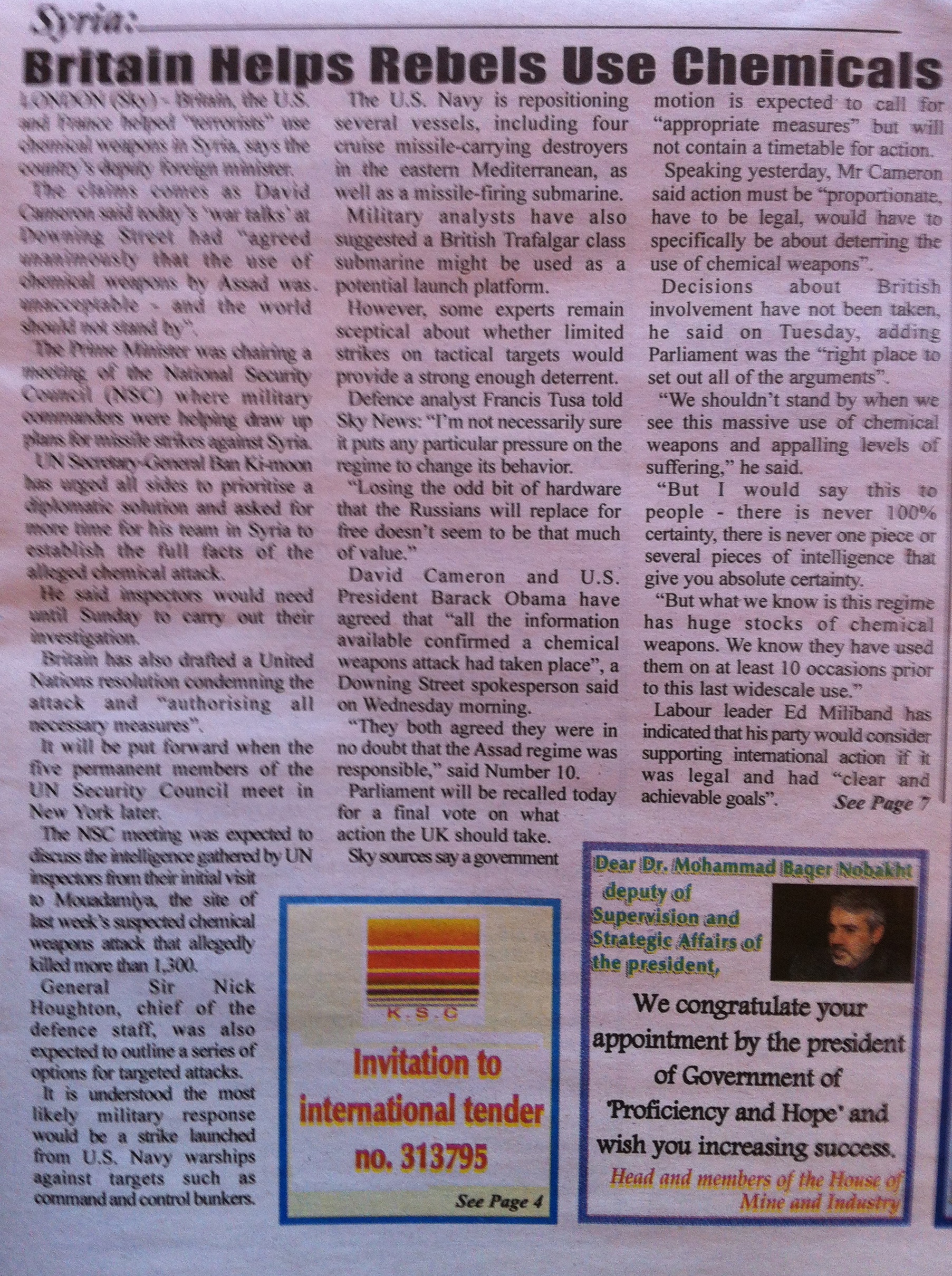
‘Britain helps rebels use chemicals…’

External news feeds are carefully scrutinised and it is difficult for a theocratically inspired regime news monitor not to be influenced by comments such as ‘nuke the bastards…’ made by a US citizen in the comments section of a online news service in response to an article on the Iranian stance on Syria.

An alternative view1It goes some  (though by no means all the) way to explaining news stories such as this which appeared in Iranian newspapers on our final day in Teheran. Iran’s people are ready for a change and the recent elections seem to have given them hope that a period of isolationism is coming to an end. Not many are aware that Iran’s current President studied at Glasgow University and that so many of its citizen’s prize a good academic career that they are willing to forego luxury items to ensure their family are well educated. Everyone seems to be a Dr. and woe betides the unsuspecting visitor who fails to address someone with a Phd by the correct title.

As we were about to depart, the UK Parliament gave a thumbs down to military intervention in Syria which as all readers will be aware is close both geographically as well as politically. The Iranian news reported this occurance positively!

A recent flurry of messages between London and Tehran and a reopening of diplomatic relations albeit through the Omani embassy in the UK, suggests a change of approach even though on departure I was grilled by the immigration official at Teheran airport about what a UK citizen had been doing there.

More importantly I sense we are at a watershed moment wherein the US is no longer seen as or indeed behaves like the ‘policeman of the world’.