10 tips for running a successful Pause & Reflect debrief

David Gurteen rang me just before Christmas.  He’d read my recent blog post about the  Pause & Reflect (P&R) debrief session I was running for the Brighton Food Waste Colllective and wanted to understand how it differed from an After Action Review (AAR).

Here’s what I told him and via this link his observations on the technique:

In a P&R debrief the team (with the help of the Facilitator) is attempting to go beyond the questions posed by an AAR: what was supposed to happen; what did actually happen; what went well; and what might we do differently next time?

While these are valid areas of investigation they tend not to address the how or why an event succeeded or failed and overlook aspects of behaviour, space and culture.

P&R sessions look at all of these through the use of timelines and objects by recreating what happened formally and informally, before the event, during the event and after the event.

The technique I like to use is an A3 version of the Narrative Grid about which I’ve written before.

By way of an example (and with the kind permission of Vera, Mei-Weh and Saskia) I’d like to draw on the recent P&R session in Brighton.

Food Waste Collective Pause & Reflect:

We met informally at a quirky venue (Blue Man Bar) in Brighton. Despite background noise the team were able to raise and openly discuss the event. Here’s what I asked them to think about in advance:

The aim is to identify learning’s from the recent Food Collective Event that you might apply to current and future events. This session is best done with a timeline /narrative grid and I will ask these questions for each stage (Before/During/After):

*     What was expected to happen?

*     What actually occurred?

*     What went well and why?

*     What can be improved and how? And finally,

*     What behaviours in others did you most admire / find most useful?

I will take notes so you just need to bring along your keen minds, memories, observations and most importantly a photo or object from the event.

some key outcomes:

The session designed primarily as a capacity building/knowledge transfer session lasted but an hour.  In that time a couple of key outcomes emerged and each of the team was able to highlight behaviours in others that made a real difference.  It underpinned my belief that by being appreciative in the approach to debriefs and focusing on events a lot more emerges.

Here’s an extract from the notes I took:
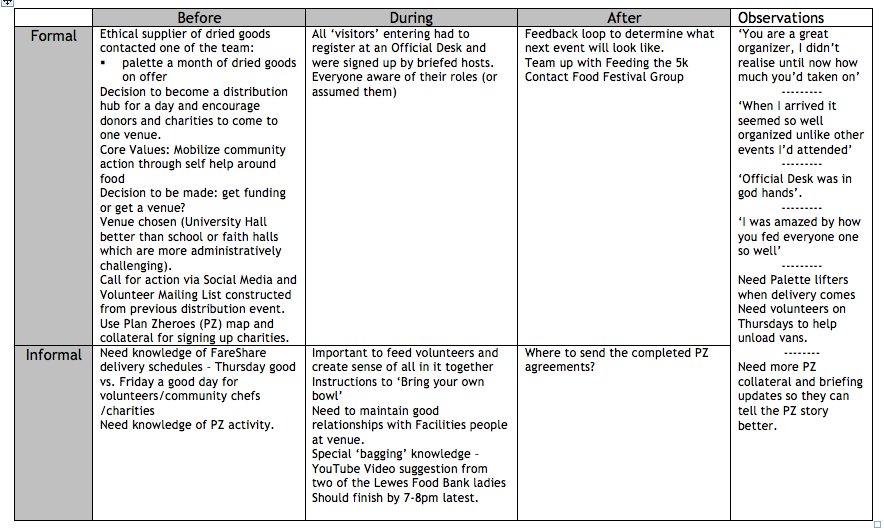
P&R Outcomes Dec13

when, where and how to use a Pause & Reflect?

Here are 10 suggestions on how to make it work:

  1. use it to conduct a debrief on an event or decision that has taken place in the last month
  2. use pictures and objects from the event or decision to amplify key moments and trigger memories – brief them about the need to bring something along
  3. get people to fill in the narrative grid / timeline as they go and if you have different cultures involved ask different groups to fill in their own timelines – in the process of comparing you will discover much
  4. probe by asking for examples – in the above case the need to get volunteers on a Thursday to help unload FareShare vans emerged only by going through the event step by step
  5. when someone makes a comment such as ‘it was so organised when I arrived’ get them to elaborate and contrast – it will generate a story that becomes an important narrative of the event
  6. make the session informal (and reflective of the organisational culture) but do have an agenda and stick to it – be clear about the roles each one is playing at the P&R
  7. get participants to talk about the environment and location where the event or decision you are holding a P&R about took place
  8. don’t be afraid to let the silence hang in sticky moments – behaviours (most admired which might have made an event successful) often emerge slowly
  9. ensure (with permissions) that you take photos of the P&R and include them in the write up
  10. finally, don’t be too ambitious: 3 hours is the maximum I’ve found works and look at 1 event or decision not a whole project.
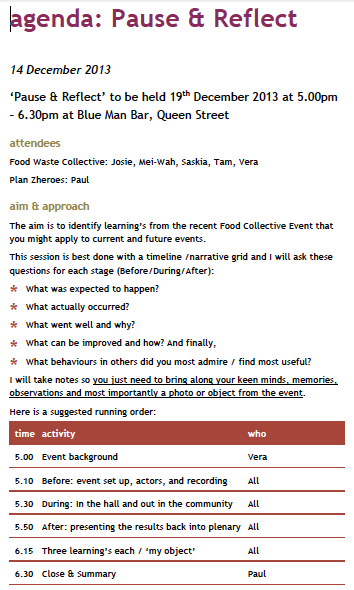


‘Pause & Reflect’ session vs. an ‘After Action Review’

Pause & Reflect AgendaTonight (Thursday) I will be in Brighton on behalf of Plan Zheroes running a Pause & Reflect session with the Food Waste Collective. We are going to be taking a look at the recent event they held at Brighton University and which I wrote about a few weeks back – when a good deed is lentil shaped: why a group of Brighton based women deserve our support.

Since a previous posting about a Plan Zheroes Pause & Reflect session on a CSR Day we ran attracted some interest I decided to share with a wider audience how I go about setting them up

The agenda is time specific and requires the attendees to have thought in advance about an object or image that sums up the event for them. The other departure from the more traditional After Action Review process is that I try to get people to focus on the behaviours in others that really helped make the event work.  This appreciative inquiry technique is one I’ve found to be highly effective reflecting as it does on behaviours in a group environment.

the power of 3

I’ve always been a great believer in the principle that less is more especially when looking back at an event or decision. And I tried to get everyone I’ve mentored or coached to focus on ‘the power of 3’. Most people can remember 3 things and act on them.

Professor Victor Newman often tells a story about one of his early experiences going into an organisation and finding a lessons learned exercise came up with more than 200 ‘lessons’ which were noted down and taken away never to be acted upon.

3 ‘things’ is also a theme I apply in reverse brainstorming when getting people to consider how they can tackle ‘stuff’ that is broken.

capacity building and knowledge transfer

Tonight’s event is part of Plan Zheroes ongoing commitment to support volunteers outside of its core market. If we can equip others with basic skills and tools to improve the way they run events and interact with food donors and recipients fewer people will be facing food poverty and we will all be making better use of surplus food.

I am looking forward to the session.

‘your entire career is your exit interview’: embedding knowledge capture & retention techniques

This tweet, from this year’s KM Russia event, reminded me of an interview I had with a senior Asian banker a few years back.  Retiring, after three decades during which time he’d been pivotal in the regeneration of Asia after the crisis of 1997,  he was asked at his exit interview, ‘have you returned the stapler?‘ The sense of disappointment in his voice was palpable as he told me (I paraphrase), ‘you devote your life to an organisation and then puff, you are gone along with your sense of identity’.

It echoed a similar conversation with the former CEO of a major reinsurance group whose departure remains a source of unhappiness because his experience and network of contacts were not considered important enough to devote time and resource to by his successors who were taking the company in a new direction.

Fortunately many organisations are now making knowledge capture and retention part of the ‘way we do things around here’, recognising the need for effective processes throughout the life cycle of employees and projects. One such organisation is Her Majesty’s Revenue & Customs who employed us* to run a pilot programme capturing and exploiting corporate knowledge’ to equip senior business heads with tools and techniques they might use to capture and retain critical knowledge.

In previous posts I described the programme modules 1-3. Here I’d like to share with you modules 4 and 5.

HMRC’s Pilot Programme: : Modules 4 & 5 Analysing & Sharing

Analysing how to analyse and organise the material that has been captured
Sharing how to share the knowledge that’s been captured how to engage with your audience

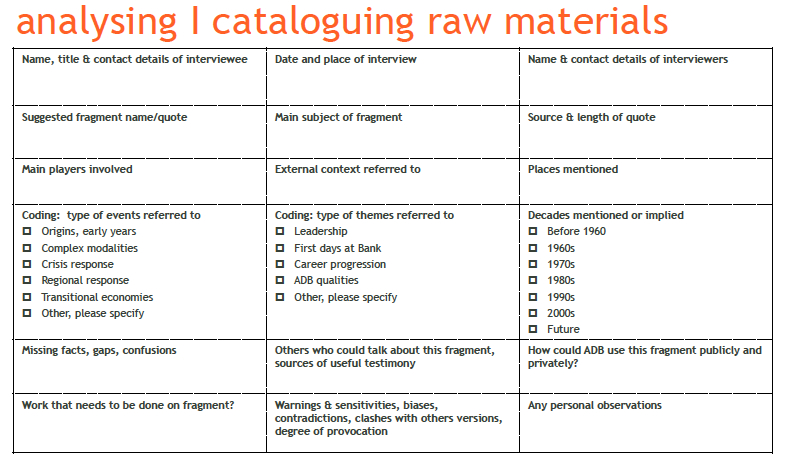
Analysing (cataloguing and curating) the material captured is often overlooked, the assumption being that search will reveal all. The delegates were invited to listen to a couple of recorded interviews and consider how they might catalogue the material.

We accepted that not every piece of critical knowledge (defined previously as the knowledge HMRC would struggle without if it lost’) is likely to be recorded on voice or camera. However the process of thinking about how to catalogue material does provide a steer on the importance of structuring what you are capturing. We spend money on creating taxonomies which is another form of categorisation and cataloguing.

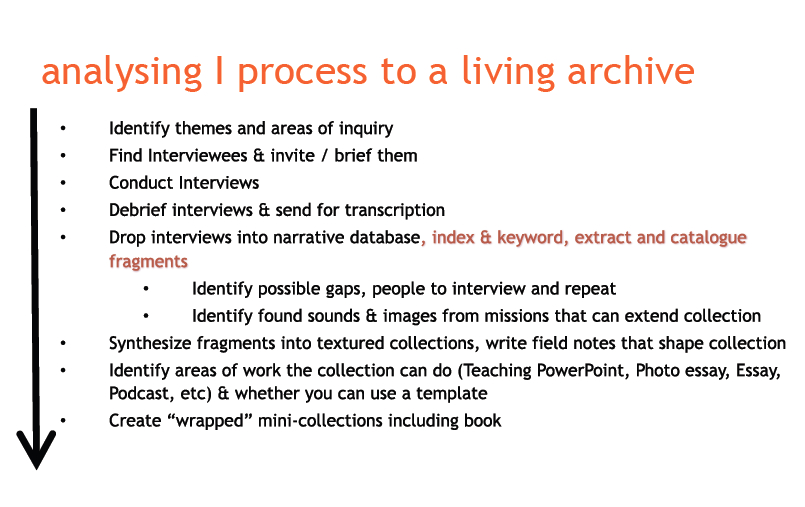
Here’s one example tablog 2ken from a piece of work featured in ‘making Knowledge Management work in your organisation’ (an Ark Group publication). It shows the process adopted for the creation of a Living Archive. Note the importance of the indexing or cataloguing process (in red).

blog 3And here’s the cataloguing process that is referred to above and was shared in HMRC module 4.

In Sharing (Module 5)  we looked at numerous ways of engaging with the stakeholder community previously discussed and identified in Module 2. Our aim here was to illustrate that no one size fits all and that each person or group might respond differently.

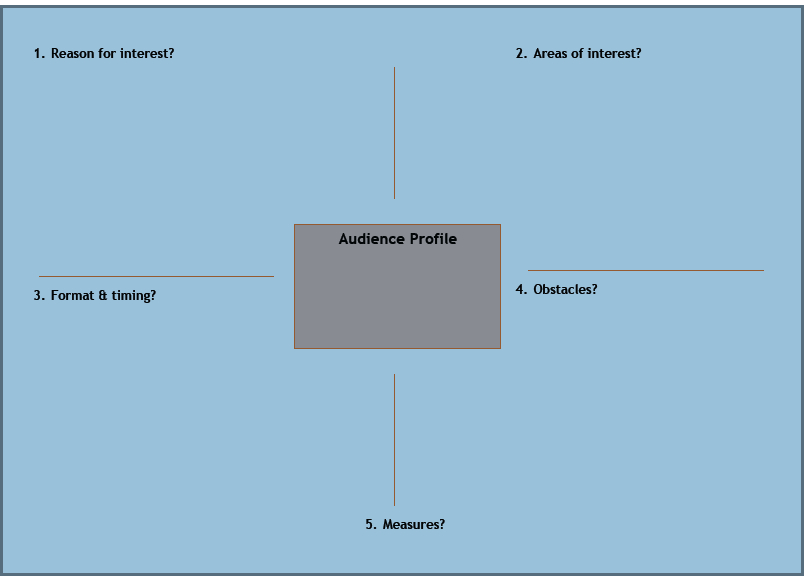
The delegates had to map the profile of the audience and then think about what might be the best method of engaging.

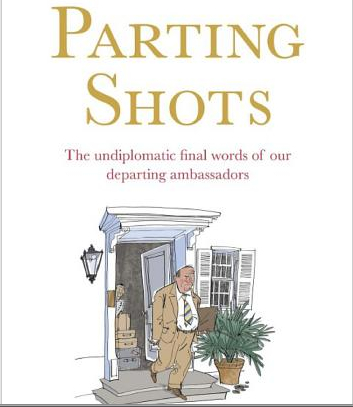
Blog 1Aside from examples of companies who have successfully use: Baton Passing, an Audience With, Fellows, Knowledge Markets, Dare 2 Share Fairs and Memoirs on Camera we discussed the (now discontinued) practice wherein a returning diplomat would complete a Valedictory Despatch after his or her tour of duty overseas ended.

Parting ShotsAs in previous modules the delegates were asked to consolidate their learning ‘off line’ and as a way of consolidating all the exercises were given an assignment to be working on before we reassembled for the final session.  I will conclude this series of blog posts next time and look at how we evaluated the programme.

Parting Shots by Matthew Parris

*Sparknow and Knowledge et al worked in partnership to deliver this programme.