Last week I attended the 12th annual Knowledge Management UK event in London.
The format has changed little over the years: predominantly show and tell for 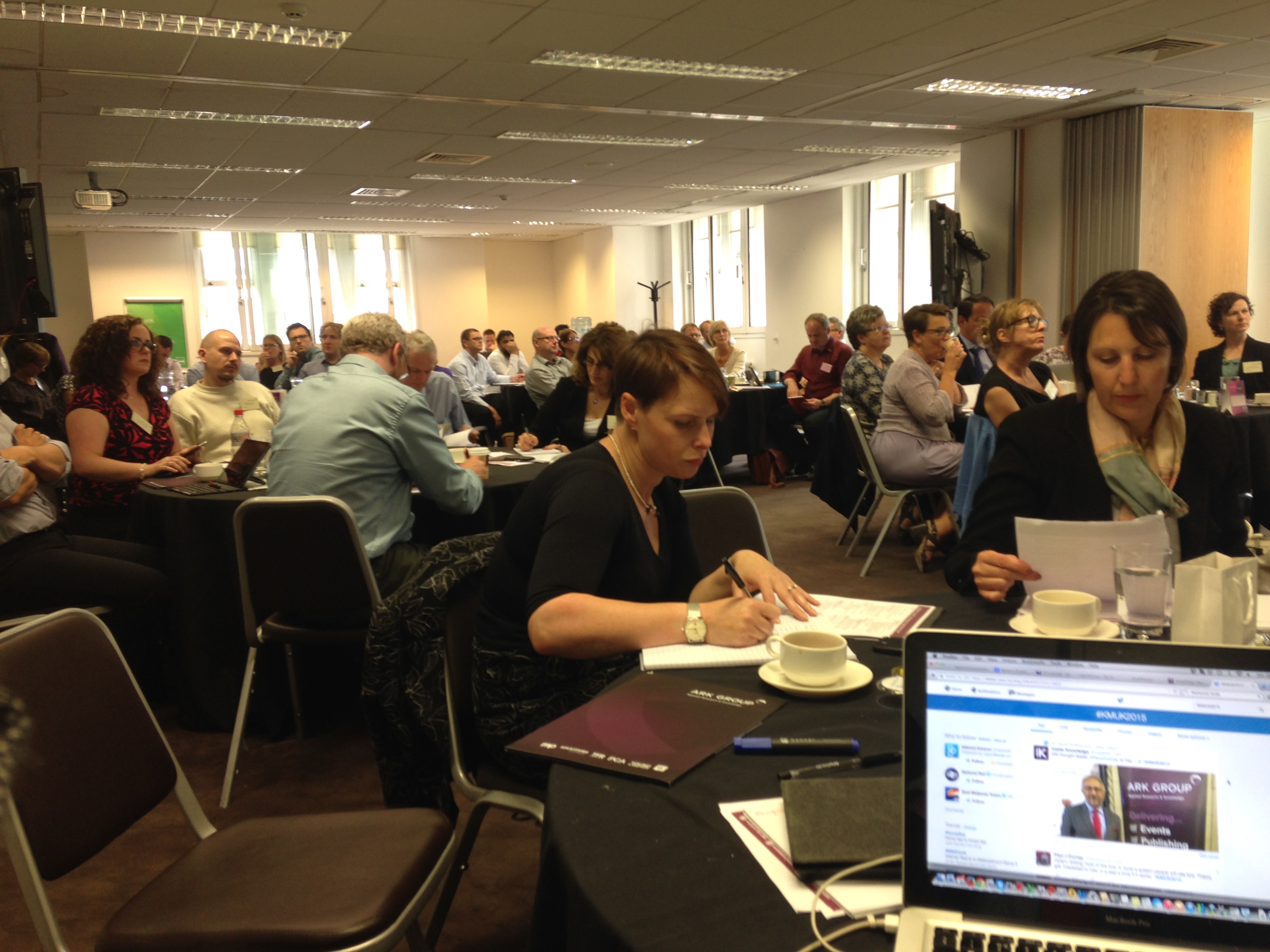 an audience that is a mix of new in post and established mid level practitioners all looking for something to take back into their business.
This year I noted an increase in the average age of the delegates and more from Small and Medium Enterprise (SME) sector perhaps reflecting how KM has become an accepted discipline across many organisations. I am particularly looking forward to seeing the feedback comments this year.
I only attended Day One, my colleague Martin White was presenting on Knowledge Collaboration in Virtual Teams on Day Two (I know he will have a few comments to add). Suffice here to give a shout for a couple of the presentations which struck a chord:
Culture Change in bentley motors to facilitate information sharing
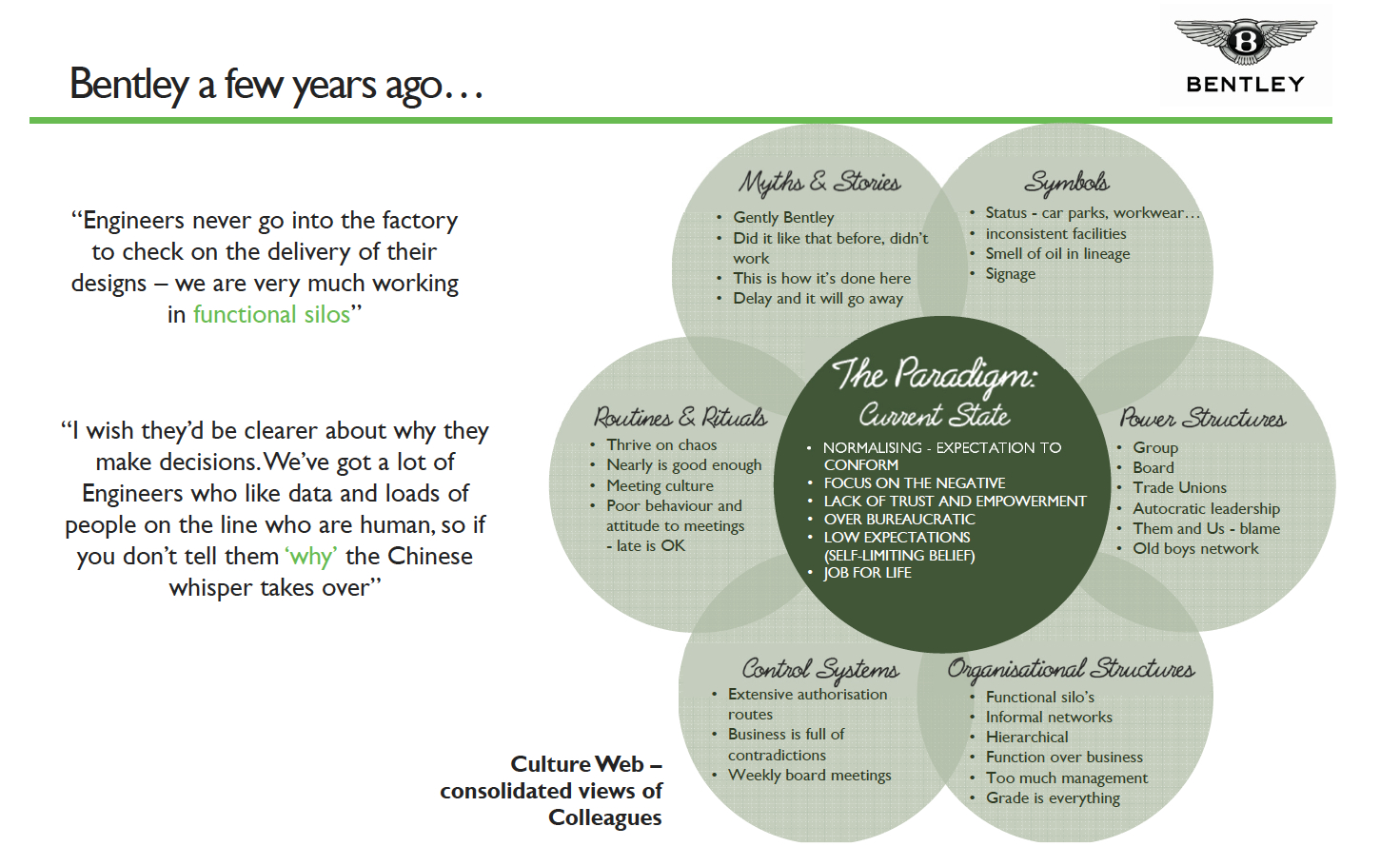 I particularly liked this Bentley Motors presentation as it mirrored my experience helping to intergrate a group of Anglo / Dutch / German / US businesses a decade ago. Now part of VAG group it has embarked on a medium term programme to align itself with their aspirations and working practices without a loss of the perception of quality.
The Hofstede findings when looking at German and UK characteristics pick up nicely where the potential  areas of conflict were likely to be.
The premise behind the programme: information sharing requires the right cultural environment not a set of slloed business units.
building a minimum viable product: Oxfam
This session provided a great illustration of the importance of working to an agreed vision for a KM programme.
 The slide I’ve picked here makes explicit the concept of get/give – if you benefit from something you have a responsibility to contribute something back in return.
Its a great example of what being a knowledge driven business is truly about.
The second slide provides an image of what collaboration will look like in  the future at Oxfam. What’s really interesting is the explicit acknowledgement of the need for information underpinnings (including Search) to provide KM benefits.
There were a couple of others and if anyone wants a truncated account follow this hashtag #KMUK2015.
OpenSpace Peer Assist
My brief was to run an interactive closing session (lasting 1 hour) that enabled the delegates to answer:
- What problems are you facing?
- In what areas would you like to share your experience with others?
- What are others doing that you would like to find out more about?
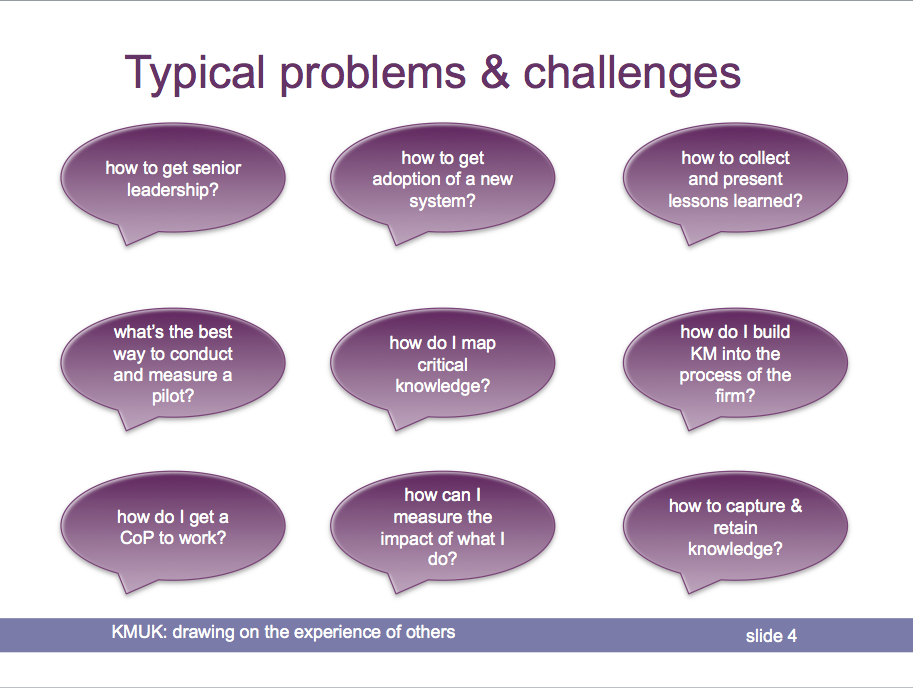 As a backdrop I shared this list to stimulate discussion.
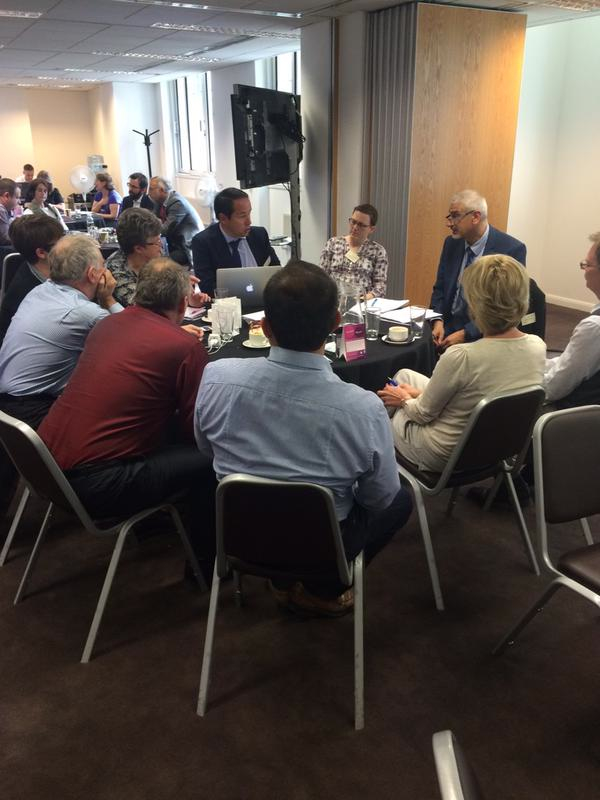
It wasn’t needed as many of the delegates were keen to have their challenge discussed and half a dozen volunteers came forward offering to act as the Assistee (host the discussion around their challenge).
Having decided which challenge each delegate wanted to discuss, these guidelines were put up: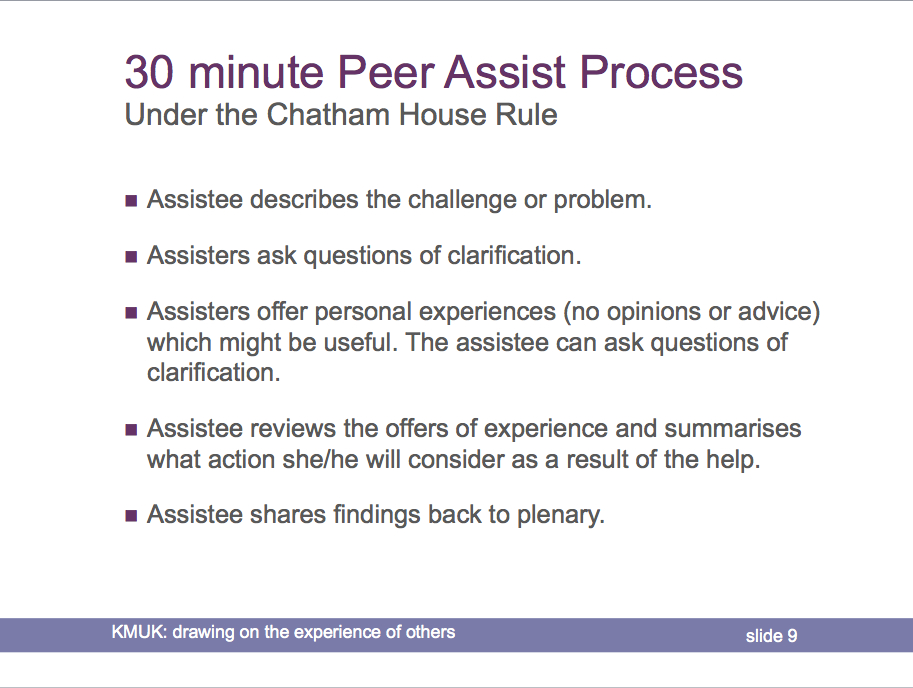
Below is a snapshot of the discussions taken from summaries which Laura Brooke of Ark Group captured on her smart phone.
The idea of getting the Assistee to summarise is to consolidate the discussions and reflect back in plenary. I’ve shared them in case some of these might help you to overcome a challenge.
Knowledge Capture In a Legal environment
- On getting people to talk about experiences: Documents don’t work, stories of events do!
- On conducting After Action Reviews and getting people to acknowledge when things go wrong: often spoken about in meetings but minutes are not always taken and when they are they are not interactive so need a better way to record.
- Asking someone to tell you what they know won’t work, instead ask them: What questions do you get asked all the time? If you don’t know what people know at least you should know who to go and ask?
- Challenge of self perceptions: Some people think they know a lot others don’t think they know anything important which is where a 3rd party might come in to tease out the valuable stuff.
- Where to store: If you put everything into a site it would be too much. SharePoint to apply an automatic taxonomy.
how to measure real value on km and learning from experience
- Saving time: at the beginning of the journey take an estimate of time to be saved and
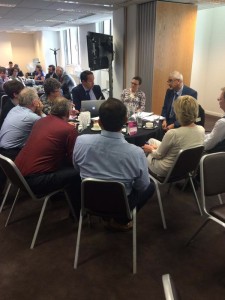 measure throughout. Help to develop people faster. If KM is making a contribution on a project that should be recorded.
 - Improving the onboarding process so that new hires do not lose interest and leave.
- Idea box (self funding): adopted by an expert, any returns should be applied back to KM.
- Managing records: looking at information that has gone past sell by date and not legally required.
- Why are we asked about KM value: should be a given that its needed.
system adoption
- Practical examples of what’s in it for me tailored for each office.
- Huge challenge getting people to fill in profiles on a people finder: need to show good examples with leaders to the fore.
- Collaborative groups: form a community among the leaders of each.
- Contributions to the system: change appraisal process to recognise the contributions.
- Steering Group: make better use of it as system advocate.
- Metrics: really good internal measures should be used for advertising.
- When all else fails shut down the other systems!
How to get leaders to take km more seriously
- While senior people understand the value they don’t back it financially.
- Siloed approach to communications: – a set of inconsistent messages even from KM champions.
- While KM is part of a strategy its often seen as a tick box exercise.
- Accountability: make objectives more transparent.
- Business Case: more analysis on where we are starting from and show tangible stuff.
- Reporting lines: KM should be an agenda item on senior level meetings just like risk!
Engaging with it
- Make them heroes part of the vision for future which they jointly own and where their role is clear.
- Recognise their workload and surface their inability to deal with multiple objectives with current resources.
- Reaffirm the importance of the KM development strategy and its priority.
- Look at success in other organisations: take IT ‘guys’ along to other organisations who have made it work.
what the participants said
Here’s a few of the comments from the Assistees and Assistors (names removed to preserve anonymity):
“Peer assist is a very powerful tool to deliver”
“I very much enjoyed being able to discuss a particular challenges with a group of peers.Interesting to hear others’ view points and ideas and the types of challenges they face”
“Very good speaker – Style of session was very useful and interesting, more like this please!”
“Engaging, fun, informative – learned a lot from the session”
“Very good peer assist. I got a few ideas generated by the group for my situation”
and finally
Perhaps what surprised me the most was the show of hands I got to the question:
A Peer assist is a process that enables the gathering of knowledge drawn from the experiences of colleagues before embarking on a project or piece of work, or when facing a specific problem or challenge within a piece of work – How many of you have used Peer Assists in your business?
Less than 10% put up their hands. Even with a modesty factor it still means less that 25% of Knowledge Management professionals at the event had used one of the most basic and valuable tools to draw on the experiences of others. I’m glad I gave people the chance to try it out and learn from each other in so doing to solve real problems they are facing.