About Paul Corney

@pauljcorney #KM4GOOD I help people and organisations to make better decisions that improve the way they work

The elephant fable: a Chinese reflection on KM, innovation and knowledge capture techniques

Introduction

To set the following discussion into context, my name is ‘Jonny’ Jiang, I am a PhD candidate on service design and service innovation at a design school in London.Jonny I am working part time with Paul at a start-up charity Plan Zheroes to deliver services to make better use of surplus food and help people in food poverty.
Thanks to Paul, I have been given opportunities to learn from his expertise in knowledge management and practice some of his methods to capture knowledge and insights in that charity.

As result, I am able to reflect upon my journey of knowledge management at the charity and my research in service design.

Interestingly, by comparing these two distinctive fields of practices, it gives me some thoughts around the importance of how we can generate new knowledge and insight around innovation.

KM tools for learning during and after

Let’s talk about some of the knowledge management methods I learnt in this process. Before jumping into these practices, I should tell you I had very little understanding of knowledge management apart from my general reading around business journals.

Paul sat down and demonstrated to me one of the previous knowledge capture sessions he ran with one of employees at the charity. He explained the rationale of capturing and sharing knowledge among staff through interviews with employees before their leaving and during their life cycle with us.

As I understood, it is very important to understand each individual’s experience and perspectives on his or her journey here and on specific events in particular in order to spot and improve the internal and external operation.

One of the other rationales I understood very well at the end is Paul’s point on the element of constructively building a better relationship with interviewees even after their leaving to help them reflect upon the personal growth and learning during the period of working inside the organisation, which I realise is very important to each party and helps nurture Alumni Networks.

Later on, I have been given an exercise to listen to Paul’s recording on his interview and using his knowledge management toolset (e.g. brief, time map, experience circle, questions) and conclude my findings based on those.

Then a few days after, we sat down again to compare our capture of knowledge based on the same interview and reflected together on some of my questions and learning’s. This was an incredibly effective session with Paul because I am able to learn by practice from Paul’s expertise to help equip a newbie in knowledge management with knowledge, practical tools and confidence.

I took the lessons and tools from this exercise and conducted an interview with employee who was about move to another city and leave the charity. Once the interview has done, I sat down with Paul again to reflect on my interview and report of this knowledge capturing practice.

Most of Paul’s methods have been already described and explained very well in this blog, so if you want to figure out what tools and methods I have used, please click on this post ‘Going not forgotten: knowledge capture in a hurry’.

Check out the timeline tool as a way to effectively reflect the knowledge and insights accumulated along the journey. It is a powerful tool because

  • It gives a common language that visually displays our thinking’s and provokes thoughts around the highlights and lowlights of the journey. In my interview it helped us to reflect on interviewee’s expectations at the start of job, which gives us lots of insights on how we manage the expectation during staff induction.
  • Mutually, it also gives an opportunity to help the interviewee consolidate the learning from the job that can be transferred to future careers.

My elephant and the correlation between design and knowledge management

As Paul invited me to write down my reflections after this exercise, I was fascinated by how similar and powerful the practices around knowledge management and design as a source for organisational innovation can be. As many of us  interpret the word ‘knowledge’ with a connection to ‘science’ ‘scientific’ and ‘objective’, there seems to be a misunderstanding of the value in ‘subjectivity’ and ‘social artefacts’.

As we all come from different experiences in life and become who we are because of those experiences, we all develop very distinctive perspective on the world based on the things we learnt and have done in the past.

It is like one of fables I learnt as a child which described four blind people who gave a very different description of the elephant by touching it from their own positions.
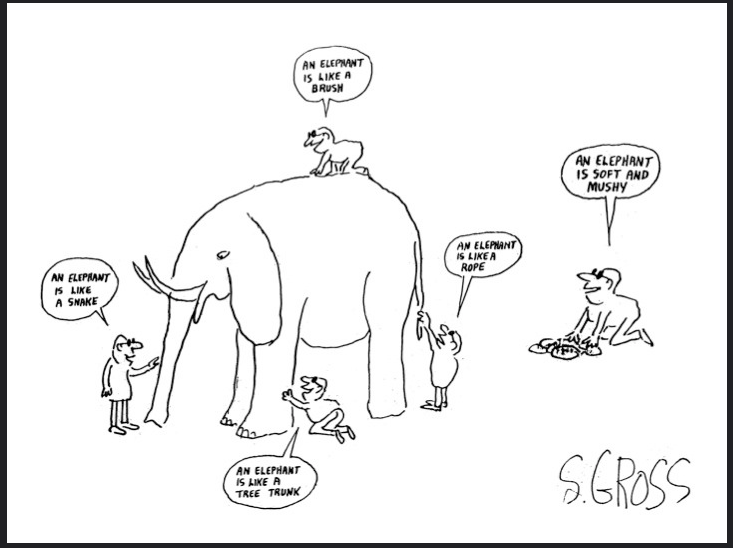
https://www.flickr.com/photos/climateinteractive/13944682478Each seems to be fully convinced by their ‘objective’ interpretation and deny others’ views of what the elephant ‘truly’ is. It is obvious, in the fable, that each of them only ‘sees’ their part of reality.

The elephant and social facts. source: https://www.flickr.com/photos/climateinteractive/13944682478

In real life, this fable maintains a sense of inspiration too. We all experience a building differently from where we look at it. It can look small from a bird’s eye view or intimidating if standing alongside it.

In organisational management nowadays, particularly large organisations, operations can be highly siloed and lacks ways of detecting those subtleties in perspectives. It means each department may have their very own budget and competing agenda and develop their very own ways of understanding and doing things under the cover of ‘specialisation’.

Those silo operations based on ‘the only one way’ present danger of neglecting the values in perceiving or doing something differently that is at the core of innovation.

As such, knowledge management is becoming increasingly critical to recognise subtlety in each individual’s interpretation and map them in order to spot opportunities in the gap of our personal knowledge and experience.
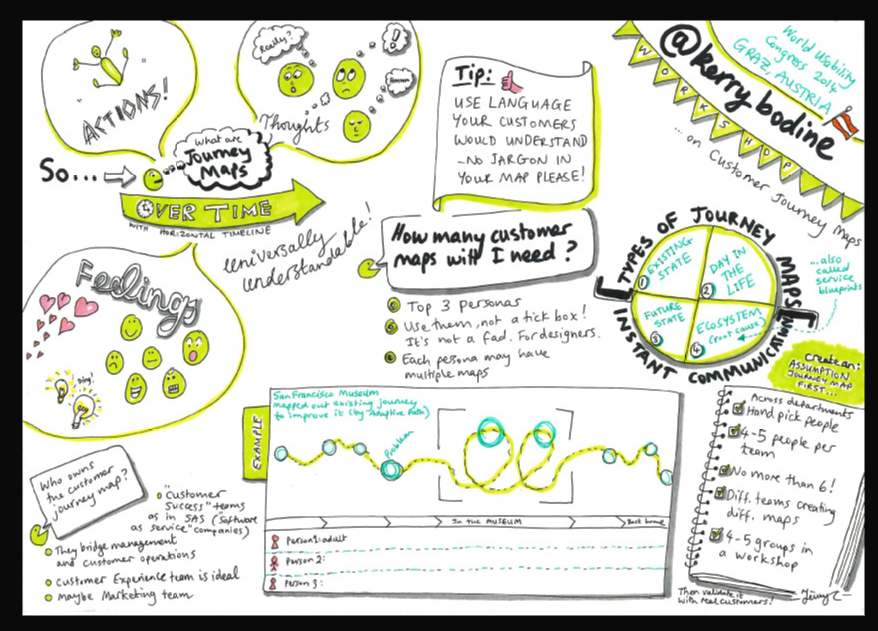
Screen Shot 2015-10-26 at 14.46.57In service design, this idea of interpretation has been very important in user research.

By mapping extensively, designers can understand better the users’ perceptions and behaviours and gather deep insights on where the opportunities can be for designing better customer experience and services.

One example of customer journey mapping. Source: (https://www.flickr.com/photos/97823772@N02/15410073995)

In Knowledge Management these interpretations can often reveal opportunities and strengths as well as failures and weaknesses.

And finally

The advice I can give to someone who is about to do the same exercise and interview a colleague who is about to leave is to take the default position of ‘he-or-she-knows-much-more-than-me’ rather than being judgemental on what you believe as the ‘truth’ or ‘reality’.

As many as we are coming from this global village, there is a great value in the diversity of perspectives and this is where I believe is the infinite source of innovation.

And of course, definitely check out those knowledge management tools on Paul’s shelf. They are really effective and surprisingly practical.

A comment from Paul

I have had the pleasure of mentoring ‘Jonny’ for the last couple of years during which time he has participated in board meetings, helped select a project management tool to act as store for the knowledge and documents on the various projects we’ve undertaken and conducted knowledge capture sessions. He is also the curator of our digital library.

I invted Jonny to be a guest contributor as I felt his experiences might be of value to others. Indeed his comments about the ‘give, get’ component of a knowledge capture process is particularly perceptive as often the drivers for such programmes are downsizing and layoffs where there is little positive feeling.

I am delighted he has contributed and would encourage you to join in with your comments.

In a world of High Value Work the case for informed and empowered Knowledge Workers is becoming stronger

Whether Lisboa, London or Tehran the pace of change is gathering apace with increased pressure for improved performance, greater efficiency and reduced risk.

Over the last couple of months I have been working in all three of the above capitals. It has been a priviledge and an eye opener: Iran is eagerly awaiting ratification of the Geneva deal and Tehran is awash with foreign companies looking to position themselves post sanctions; in Lisboa they are feeling the effects of a ‘drawn’ election and in unchartered territory over the formation of a new government and whether to continue with a programme of austerity and; in London there is considerable angst about the impact of cheap Chinese steel on an already depressed commodity market and on local communities.

In each of these capitals the role and standing of the ‘Knowledge Worker‘ is different:

  • In Lisboa, many young innovative Knowledge Workers have felt the full force of the austerity programme and fled the country rather than face an uncertain future while the cadre of secure middle managers hang onto their jobs.
  • In London, consolidation (especially in the legal sector) is growing and the push to outsource a core part of the UK Government’s drive to reduce the role of the state. Further afield UK Manufacturing continues to be battered by cheaper cost centre imports with inevitable plant closures.
  • In Tehran, as they face an openiing up of their market place and an influx of of overseas competition, local knowledge is becoming much in demand and creating a sense of eager anticipation in a workforce that has traditionally sought overseas postings as a way of enhancing their knowledge and careers.

What are the implications? 

The role of the informed knowledge worker is going to become more critical and they will need to move up the value chain in order to do so!

If you have not already done so I’d encourage you to look at a recent blog post by Andrew Curry of the Futures Company. The Futures Company has been collaborating with the Association of Finnish Work for more than eighteen months on the idea of “High Value Work”. They define this as work that is productive (it creates new value); that is durable (it creates value over time); and work that is inclusive (it spreads value beyond the business — or the C-suite. This combination, based on the emerging post-crisis literature, also creates work that is meaningful, for employees and customers. They identify four routes to acheiving it:

These are service innovation, based on a full understanding of the customer and their needs; value in authenticity, based on on a full understanding of cultural context; resource innovation, based on a full understanding of material flows; and rich knowledge, based on a full understanding of the technical knowledge held inside the organisation and a method to capture and codify it.

High value businesses combine these; for example, mastery of resource innovation often creates new technical capabilities that lead to new forms of rich knowledge.

Finland is a great example of a country that is highly technological, expensive with a great education system. That it commissioned the work is unsurprising and the findings underpin the growing realisation across many organisations that people matter, are transient in nature and that processes need to be in place to recognise that.

The future role of the Knowledge Worker?

Much of my recent work has been about helping organisations to recognise that if Knowledge Management is to have value above its traditional tactical operational bias there has to be a way of measuring the output (the Intellectual Property ‘IP’ or Knowledge Assets) that is created as a result of the activity.  And generating Knowledge Assets is reliant on empowered and stimulated people. As Andrew’s findings suggest ‘Increasingly business research is finding that people drive value.’

Last Friday I hosted a Peer Assist with a group of senior HR thought leaders on People Stimulation an idea being promulgated by Dr Abdelaziz Mustafa of the Islamic Development Bank Group. A very experienced HR Director and core member of the Association of Development Agencies HR Forum he argues the need of a work enviornment that recognises and stimulates:

  • Human Imagination
  • Individual Discretionary Behavior
  • Deeply Embedded Interests
  • Self-Knowledge, Self-Accountability and Self-Development
  • The One Person Difference
  • T.E.A.M Culture
  • Happiness at Work

While to many this may seem axiomatic it is indicative of the shifting thinking around the way organisations manage and nurture today’s and tomorrow’s Knowledge Workers.

And finally

On Monday I was at Chiswick for the first meeting of the reconstituted BSI KM Standards Committee established to provide inter alia the UK’s input into the global ISO debate on the need for standards for Knowledge Management. While hugely encouraging that KM is now being more formally recognised it was instructive to see how slowly the wheel of change turns.

Finally if I needed validation of the value of embedding effective Knowledge Management techniques I got it last night in an exchange with a Chinese mentee. In discussion over the knowledge capture interviews I’d helped him to conduct for the charity I am involved with. He said:

‘It is interesting how much good ‘after taste’ after the previous interview techniques and knowlege managemnet toolsconducted a few interviews for my research using the time line map, very effective tool!’

I have asked him to write a guest blog to reflect on some of the knowledge capture techniques we used. Watch this space!

In recognition of my Dad “a lovely man”: when knowledge capture becomes personal

John Corney, my Dad, died in August a month shy of his 87th birthday. Though not unexpected the timing of it was.  I was lucky in the sense I got to say goodbye and to reflect while he was still with us on his amazing contribution to and guidance for my own life.

Dad was a ‘lovely man’ a phrase / tribute we oft heard from those who knew him and a private man. I realised as he neared the end of his life that though we were close there were so many aspects of his background that were opaque to me.

He was of the ‘old school’ a meticulous senior banker involved in international trade who passionately believed ‘my word is my bond’ and that debt is a commitment to be honoured.  He was not loquacious or a natural storyteller; instead he eschewed the limelight though he was well read, capable of deep insight and eager to debate topics he found stimulating.

For him ‘social’ was a word associated with a gathering of people not an online activity.  Though he recognised the value of the internet, Apps, Smartphones and Tablets were alien concepts to him.

What you might ask has this personal story got to do with business? Here’s how:

  • As Executor of his estate charged with carrying out his wishes I wanted to understand the thinking behind his approach to investment.
  • I also wanted to understand more about his early life and how he made decisions.
  • Dad was similar to many senior executives who are often reluctant to acknowledge that their contribution has been significant.

Perhaps subliminally I drew on many of the techniques I encourage others to adopt when trying to capture critical knowledge from people about to retire or relocate:

  • I used a timeline to look at significant milestones in his life with photos as a prompt.
  • We talked about books he had read that had helped shaped his thinking.
  • We talked about people he most admired.
  • We went through his ‘blue book’: a transactional history and ledger of all assets.
  • We sat and watched something and used that as a neutral space for a conversation.
  • I spent days ploughing through his archives.

A big regret is that I didn’t record any of these discussions but the stories and artefacts remain and I am now their custodian with a duty to pass them onto his great grandchildren so that they too can appreciate John’s legacy.

And finally

When people leave organisations after a long period legacy is a word often cited as the justification for a knowledge capture interview. What many overlook is the step of thinking up front what is the critical knowledge they are looking to surface during the process.

This mirrors many of the stories emerging from the interviews my co-author Patricia Eng is undertaking for “Navigating the Minefield: A Practical KM Companion” book which we are aiming to publish next year. Often the driver for these initiatives has been a reorganisation, takeover or downsizing; in effect a firefighting exercise.

Setting up a programme to consciously capture knowledge is expensive and time consuming: it needs a clear rationale/driver and a set of measurements to track its efficacy and value.

Knowledge Capture EventI am looking forward to evolving my own thinking when I am in Lisboa next month running this masterclass with Ana Neves. It aims to raise awareness of the importance of critical knowledge: how to identify it, how to go about capturing it and how to go about making it available for reuse.


Good Knowledge Drives Good Business

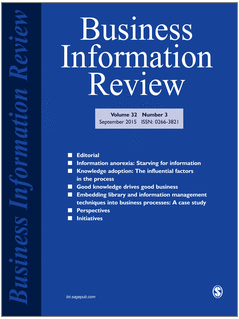
This is an article inspired by a session I ran with new businesses as part of Surrey University’s Investor Readiness Programme and my work with Plan Zheroes, It sets out to illustrate why good knowledge and information management matters to a new business.

A business is the sum total of its intellectual capital/property (‘knowledge assets’).  Drawing on examples from hospitality, renewable energy storage and third sectors, it will demonstrate the value of checklists, a technical backbone, the right cultural environment and feedback loops in identifying, nurturing and exploiting knowledge assets.

Here’s what Claire & Luke (Editors of Business Information Review) had to say about it in their Editorial:

Good knowledge drives good business

Another regular contributor to Business Information Review, Paul Corney shares his experiences of working with emerging enterprises and business start-ups in developing good knowledge and information management practices. Reflecting Screen Shot 2015-09-02 at 09.16.05on the experiences of small and medium-sized enterprises in the business and third sector, Paul illustrates in his article why information and knowledge management matter to new businesses. As Paul notes, ‘ultimately a business is worth the value of its intellectual capital/intellectual property. These “Knowledge Assets” might take the form of patented products, an efficient process, a unique piece of software or brand and reputation built over time’. The lessons here for directors of start-up are obvious, but there are lessons also for those who work with information on a day-to-day basis within larger or more established organizations.

I’m glad Claire & Luke ‘got it’.  Well run and profitable business is about making effective use of knowledge and creating and enhancing its Knowledge Assets. So it follows that:

Putting in place effective measurement is key in order to demonstrate value. As KM standards get integrated into global quality and manufacturing standards so the drive for better KM will be felt. Young organizations can get ahead of that curve by putting some of these simple techniques in place today.
As a footnote I am particularly delighted to have been asked to serve on the BSI KM Standards Committee that is going to input into the to be publsihed ISO Quality Standards.

And finally

You can get the full article from here: Business Information Review Q3 2015

From the ‘outside’: tips for running virtual meetings

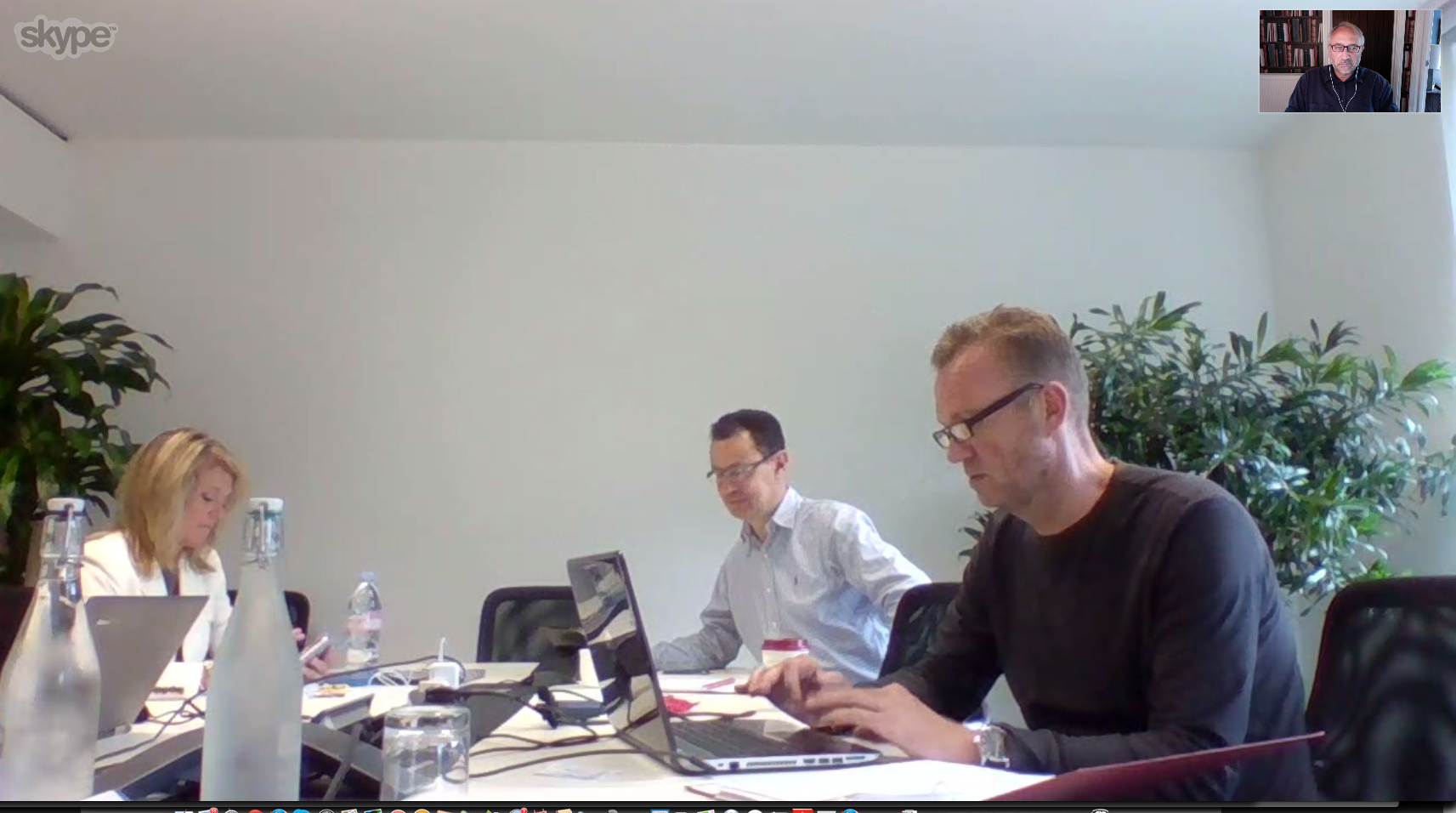
Yesterday Plan Zheroes, the charity I am proud to be the Knowledge Trustee of, held a board meeting. Unablle at the last minute to get to the venue I participated virtually. Here are a few learnings I’d like to share from the ‘Outside’ of the meeting.

Visibility

Screen Shot 2015-08-19 at 12.01.30All people in the room should be visible to the virtual attendee (s). If impractical then make sure the key players are.

As you can see we started with an empty space next to the Chairman where the CEO should have sat.

Connectivity

Unless you are in two specially built VC facilities the chances are you will be reliant on Skype or an equivalent VOIP connection.  To improve reception make sure all other programmes (especially email) are switched off on the host and virtual machines.

Scheduling

Build in breaks and make no session last for more than an hour.

Summarising

SInce conversations can often be distorted and difficult to follow from a distance (especially if there is interference on the line) make sure whomever is chairing the meeting summarises what was agreed at the end of each section of the agenda.

And finally

Don’t assume every word spoken in the room can be heard outside of it and be patient. I’ve seen virtual meetings fail because of an irritation with the technology +/or connection – why is it we always blame the other end for the poor connection – don’t apportion blame, apportion ownership of the task to get it right next time and have a back up system in place such as Facetime, ooVoo or Viber.

If you want more on this subject follow this link to a piece I wrote with Martin White of Intranet Focus for KM Legal 2015: 10 tips for effective virtual teams.