About Paul Corney

@pauljcorney #KM4GOOD I help people and organisations to make better decisions that improve the way they work

Pattern language writeshops, gamification and the importance of passion: a chairman’s perspective of KMUK

“Very stimulating couple of days at – insights into gamification, perspectives on engagement & mulling over global individual concept”

This quote from one of the presenters was a great way to end what was a really enjoyable and rewarding couple of days at the 11th KMUK held a few weeks back.  Despite sharing chairing duties with David Gurteen I managed to capture much of the social media activity on Day One and publish a series of Storify accounts.  On Day Two I upped the informality and attempted to broaden the gamification debate with Andrzej Marzcewski.

A lot of ‘Operational KM’ activities emerged but I will focus on presentations from Alim Khan who outlined a very interesting technique in co-creating a report (writeshops), gamification session with Andrzej and an energetic performance from Patricia Eng on the US Nuclear industry’s knowledge capture and retention programme.

Knowledge Capture & Retention in the US Nuclear Industry – a story of passion!

So Ladies first, here’s a few of the comments Patricia made:Bp1_bVNIgAAwPu-

You have to make the exec management think you are serving them but you are serving the workforce

Don’t worry if you don’t have much money, what you need is PASSION, hang about the cafe. Replaces the old smokers room.

KM metrics? Ask the problem owner, help them develop the tools, go back and see if things are better

IMG_2171The slide that caught my eye though was this one. Apart from the fact that Patricia’s efforts save $37m she rightly focused on the pain points one of which was around departing knowledge. It was a theme that came back a number of times and Patricia’s work inspired a similar exercise at Lloyds Register.

Patricia believes people who leave have different motivations for sharing what they know before the leave even if their departure is involuntary.  I would group them into the following categories:

  • Legacy/Notoriety: I want what I’ve done in the organisation to be remembered and passed on;
  • Avarice: I want my cv to reflect what I’ve done and I see this process and the stories it generates helping me as a freelancer.

In fact this ‘What’s in it for me’ motivational issue is often overlooked by many KM’ers and is one of the core foundations of the work I am doing in Iran with Ron Young. And here’s where I disagree with many in the KM community who are convinced that if you get the culture right then knowledge sharing naturally occurs: There has to be something in it for people to be willing to share what they know.

A study in collaboration at the World Health Organisation

Dr Alim Khan is an incredibly well educated individual who thrives on complexity and with whom I had the good fortune of spending two weeks in Darfur as part of a mission to see how KM might be grounded in a humanitarian crisis. It was therefore not a surprise to see him presenting on the topic of how to accelerate completion of a project report and findings using a wiki based on Christopher Alexander’s Pattern Language work.

The idea of a pattern language appears to apply to any complex engineering task, and has been applied to some of them. It has been especially influential in software engineering where patterns have been used to document collective knowledge in the field.

This was a great example of non routine content aggregation via the coordinating mechanism of a wiki -from workshop to writeshop. ‘Building a collaborative knowledge product at the WHO’ was a session that showcased new thinking.

It’s only a game!

The previous week Andrzej led a Knowledge Cafe session on Gamification in a KM Environment. Once again this was an entertaining talk focusing on the psychology behind the use of games and especially the variety of user types (stakeholders) an organisation needs to consider and their motivations (the ‘\what”s in it for me’ again) for participating.
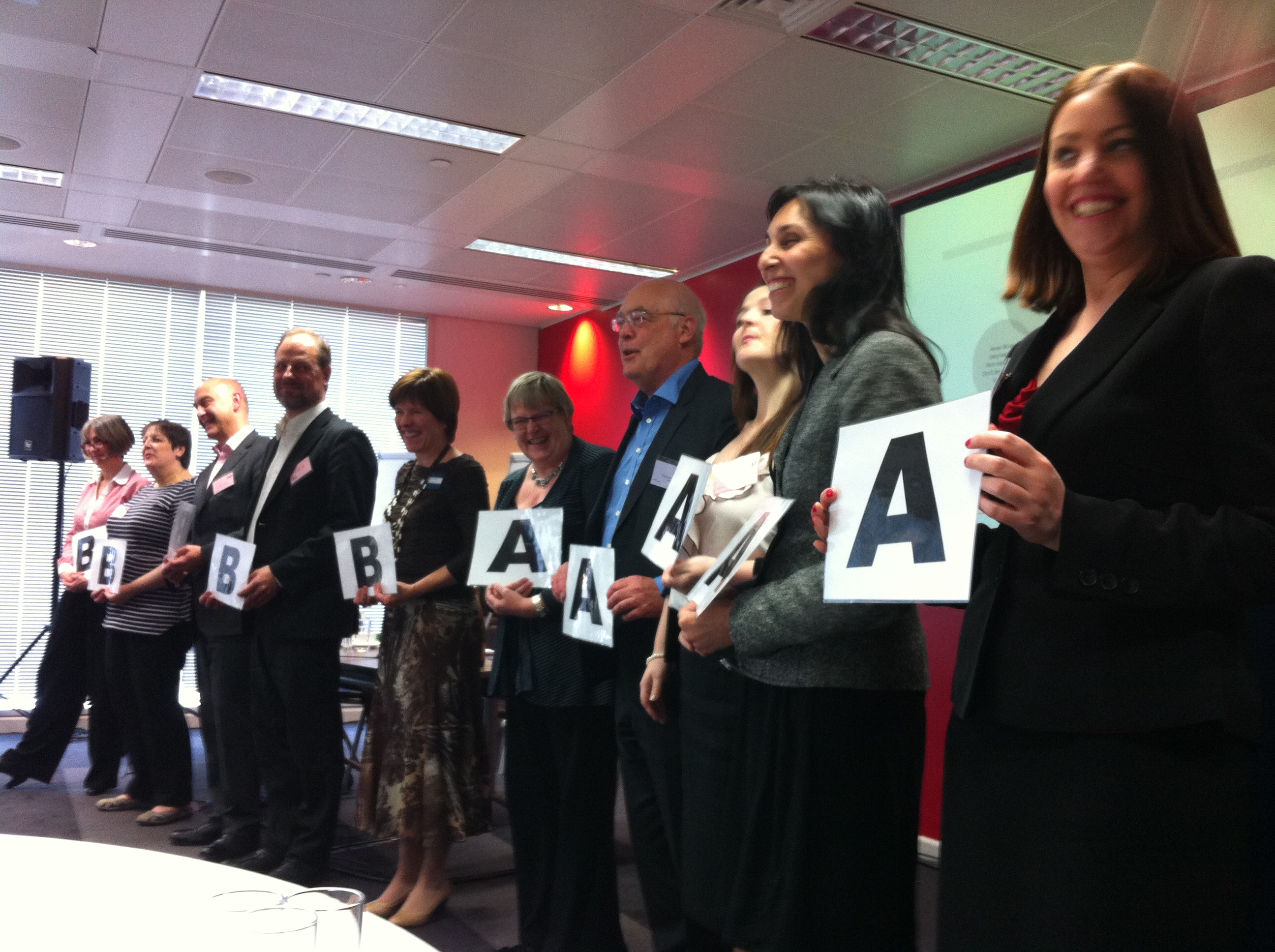
IMG_2185Andrzej and I then led a working session where the delegates were asked this question:

what role (if any) do you see for gamification in KM?

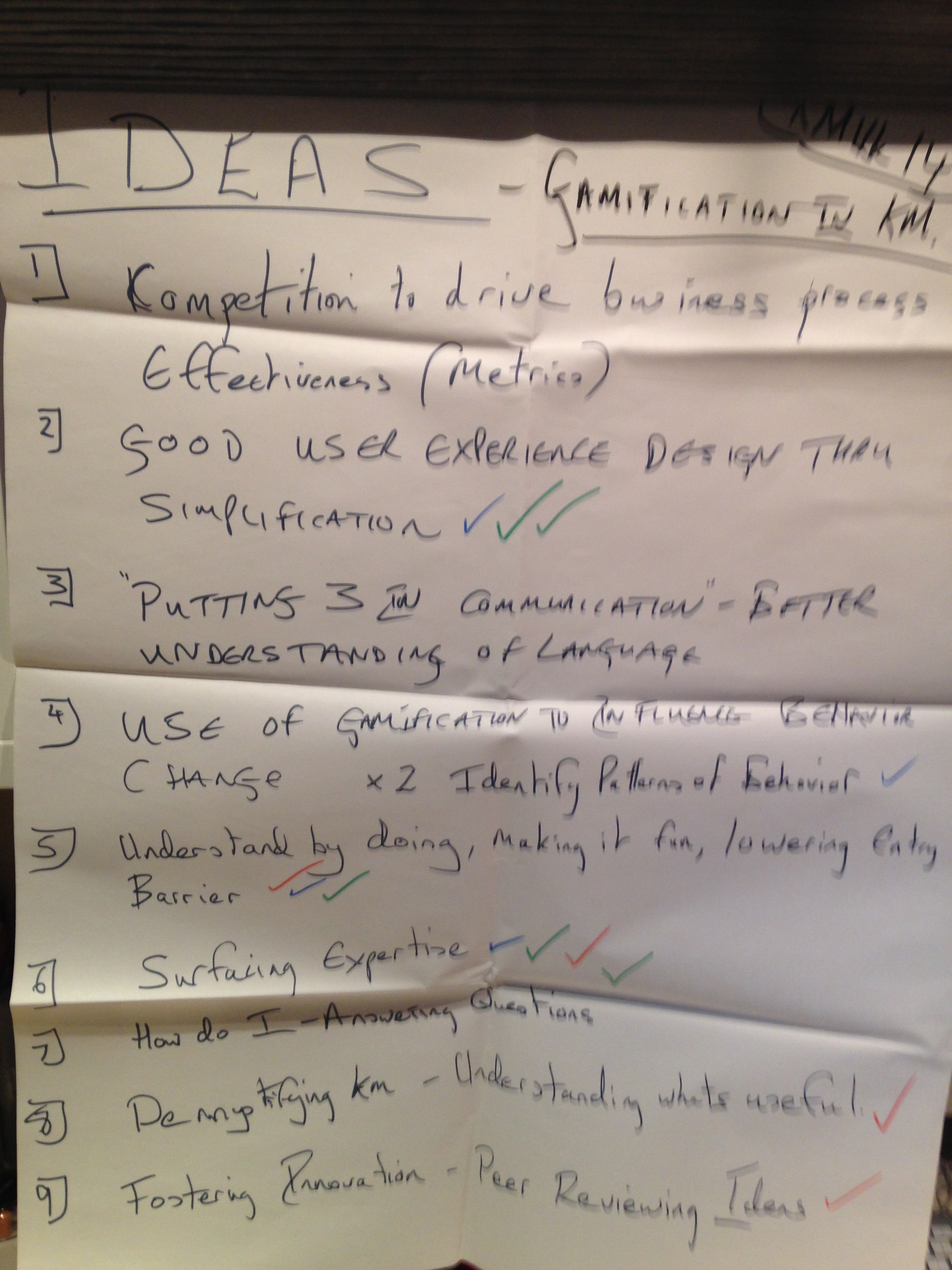
The discussions were wide ranging: many were sceptical; some were Gamification Ideas KMUK 2014converts; others saw no role.  But when asked to note down their top  ideas this is what emerged:
I was particularly drawn to the idea of surfacing expertise (which is how CapGemini where Andrzej is the Intranet supremo uses the technique) and the idea of using Gamification to demystify KM.

My take: Gamification is a big leap to make for senior executives who have not grown up in an online interactive environment. As Andrzej points out each one of us who uses LinkedIn is engaged in Gamification; ditto those of us with loyalty point cards. Its about how the technique is introduced that matters and where it is targeted.

A word or two from Dave Snowden

A few quotes from Dave’s opening address which I thought were spot on:

Danger of Community of Practice – correlation doesn’t give rise to causation.

@snowded prefers to talk about ‘decision support’ rather than ‘knowledge management’ – it describes what it does

Understanding the history of the organisation is a key to understanding its culture.

The idea of creating a big database of lessons (identified) only works if those are then fed back into the workings of the organisation – then they can be described as ‘Lessons Learned’! Most aren’t which is why the idea of a pool of case studies is often also a waste of time.  Its rare for two cases in one organisation to be the same so why would you expect something that happens someone else to be a perfect fit for your own organisation.

And finally

Future of KM is facilitation, not management. Needs to be part of the how we natively work & relate.
The new world of the Knowledge Managers- moving from managing knowledge repositories to facilitating communities #kmuk

Exactly!


What Knowledge Management is and why some people don’t ‘get it’

I was in virtual conversation today with Professor Fernando Sousa, President of APGICO, the Portuguese Association for Creativity & Innovation whose aims are to:

  • develop, disseminate and promote knowledge and experience in the management of organizational creativity and innovation;
  • establish international contacts with similar organizations;
  • create forums for dialogue between businesses, academic institutions, government agencies and other stakeholders in the management of creativity and innovation.

APGICO has all the right characteristics to become a Knowledge driven organisation where collaboration and co-creation are at the heart of everything they do!

Fernando and I first met 5 years ago when we were part of an Advisory Board assembled to look at future business options for a traditional hand weaving business based in the Alentejo region of Portugal. Fernando subsequently invited me to be a guest speaker at an EU Creativity & Innovation event Portugal hosted during which he used stories to develop themes and we’ve shared ideas ever since and recently met for tea in Faro.

I mention this since despite a number of conversations Fernando, like many, struggles to ‘get’ Knowledge Management though he appreciates the ideas behind it, the techniques that underpin it and the value of stories to unearth new meaning. In his own words:

Although I have some difficulty in entering your field of expertise, I always find your texts and slides quite interesting; in fact, I find some of them are true mind breakthroughs

While generous (thank you Fernando) it means I haven’t expressed the message clearly enough in language that he understands or in context which goes to the heart of a conversation I’ve been following this week on KM4Dev started by the World Bank entitled ‘PDFs that nobody reads’.

KM – the dangers of a supply led model

Here’s an extract from one of the many excellent contributions to the KM4Dev discussion, this by Lata Narayanaswamy, Honourary Research Fellow at University of Sheffield:

It is this question of what people actually do with all the reports and newsletters and information packs that we as development professionals produce, and I absolutely include myself here. My own research in this area would suggest that, in contrast to so many members in this forum in particular, who work to promote KM as an interactive, engaged, two-way, back and forth communications process, a large proportion of what passes for KM is the production of a PDF that gets posted on a website. It is a supply-led model that reflects what both Philipp and Magdaline have identified as the lack of reflection on what people actually want to know, and instead focuses on what organisations either want to share or what they think people should want or need to know and ‘how’ to know those issues. ……
Given the diffuse nature of what we call ‘development’, it is not therefore surprising to find that the World Bank, despite their powerful financial and discursive position, is experiencing a ‘no one is really reading our stuff’ problem, because broadcast mode has always been an essential part of their KM framework and the way in which so much of civil society has understood what is means to ‘do’ knowledge.
And whilst I believe that engaging with and articulating the demand for knowledge is hugely important, I am under no illusion that engaging with demand alone is going to address this issue. I myself as a practitioner have been in plenty of situations where someone has requested information (presumably this counts as engaging with demand!) and I subsequently learn that they didn’t use it. I think Peter’s example of ‘information that might be useful if only we had a budget to engage people with it’ really highlights that KM is not only about demand or supply but a continuous process of recognising the value of information to the knowledge creation process.

My own observations on that discussion were:

I’ve been working a fair bit recently with and in Middle East and Africa and very aware of the challenges of publishing dry English reports to audiences where English is a subsidiary tongue. I’ve tried using the power of 3 (3 bullets, 3 themes), stories and postcards to bring ’stuff’ to life.  But ultimately it takes a seismic shift for people to change ingrained habits.

One of my early corporate assignments was to set in place a business intelligence function which collated and summarised salient content for senior officers.  Later, technology sought to replicate this but was never quite able to replicate the knowledge of an individual who knew the business inside out.  In a way this was how the Knowledge Manager in that business emerged – a person who knew and understood the business providing the right content (with opinion) to those who were best able to use it.

I’ve been working with one of the leading Gamification experts and will be facilitating a debate on the subject at KMUK and with David Gurteen at a Knowledge Cafe in a few weeks time.  Its a similar issue – how to get engagement with an audience, a problem increasingly exacerbated by the behaviours of Generations X, Y & ‘Rent’ whose learning and reading styles are driven more by social than traditional push technologies.

identifying the value of Knowledge Management

So I was delighted when Nick Milton published the extract from a presentation to financial analysts made by ConocoPhillips last month in which one of their Vice Presidents described the value of Knowledge Management to that organisation – take a look at Nick’s blog. The comment that really hit me was:

The knowledge sharing group that we have that drives all of this is embedded in our IT organization, which is embedded in our technology and projects organization.
So it’s well integrated with all our other functional groups and we look at maps of how knowledge is being shared from one part of the world to the other and across different functions and can actually track how well that is working and it’s been pretty impressive what it has done for us.

“It is actually one of the key tools that we are using today to combat the great crew changes, we call it in our industry, where we have so many people with so much knowledge who are retiring and we’ve hired all of these younger people. A big part of how we do that knowledge transfer from the experienced folks to the less experienced folks is using these tools.

Value creation is at the heart of the Knowledge Asset Management Methodology, Ron Young has helped many organisations adopt. It is based on a concept of frequent value assessments with measurements (Change Readiness / Stakeholder Analysis / KM Maturity Models as examples) and the idea of embedding a 9 step Knowledge Management process into the day to day workings of an organisation.  It further calls for the identification of an organisation’s Knowledge Assets, a serious attempt to measure the intrinsic value of processes, communities and individual, team and organisational knowledge and networks.

For many years Ron, along with others in the KM arena, has been calling for a mechanism that places a value on these Knowledge Assets and while the ConocoPhillips briefing is some way off that it is a move towards that goal. Lest we should forget, a few years back a correlation was made between the winners of MAKE awards and their outperformance on the US stock market.

I believe Risk Management is also of huge significance and why the Nuclear Industry pay attention to the capture of Critical Knowledge identifying who has it and what they could least afford to lose through natural wastage or downsizing. As yet, factoring in the value of a loss of Critical Knowledge as a potential risk does not feature in the Audit and Compliance reports of most organisations and I for one believe it should.

and finally

So what do I take from this?

  • Knowledge Management needs a foundation of good Information Management;
  • To be effective (and sustainable) Knowledge Management must be embedded in the processes of an organisation and focus on business issues;
  • While stories bring experiences to life, you can’t assess what you don’t measure and if you don’t map and measure (frequently) you are reliant on anecdotal evidence which at the top level of organisations won’t wash for long; and
  • Its easy to produce ‘product’ that looks good but not relevant or in context for the audience – pushing at an ajar door on the lower levels is a lot different than banging on a locked door at the top of the building!

A KM Definition that isn’t: KM Legal 2014 examined

This extract from today’s twitter stream on KM Legal 2014 is telling:

Just been asked why we’re not at in London – “because we went to the one in 2004” was the answer.

I was there to deliver the opening address to this year’s KM Legal event.  It was very well attended with 80% of the audience being qualified lawyers.

In truth I left feeling disappointed. Apart from an interesting perspective on the future role of predictive data delivered by Eric Hunter, Director of Knowledge, Bradford & Barthell in California much of the remainder focused on providing information rather than applying knowledge and the discussion was about Intranet implementations on SharePoint. I should point out that my impressions are based only on Day One.

In my presentation (publically available on SlideShare) I began by describing how 20 years ago I’d helped build a one screen view of all our activity and created what was effectively one of the first Intranets in the process.  Yes the solutions and reach are greater today but the questions being addressed are the same.

Its significant how many people have knowledge in their titles however almost all are involved in Operational Knowledge Management and many in Information Management.  Very few appeared to be involved in Strategic Knowledge Management which for me is surprising given that the legal profession more than many others has to be knowledge driven relying on precedent and changing judgements in order to make recommendations (legal arguments) based on personal and team knowledge and experience.

Information Management is not Knowledge Management!

Mark Gould (who was suitably voluble) summed it up thus:

Information management is important, and often needs to be better. Helping information flow is not knowledge management.

I noted the Knowledge Management definition delivered by Zurich which might work for them and meet their specific criteria but for me misses by a mile the real meaning of Knowledge Management:

Knowledge Management: ‘The efficient and effective use of information to meet the objectives of the team and businesses we support’

Where is the key bit about learning from what you’ve done before, capturing, storing and reusing the knowledge of people? What happens when people leave and new lawyers join?  Yes Knowledge Management requires good information systems to support it but there is no mention of building knowledge into the processes of the business.  Its quite ironic as in 1998 Zurich Re London hired me to help embed knowledge into their Lotus Notes systems for underwriting and decision making.

We want value add from our legal parners!

This was a cry from a few of the presenters and the logic is powerful.  If their lawyers have expertise in managing knowledge then why not tap into it and ask them to share it with the clients as part of an overall package. But that’s a narrow perspective as the conference demonstrated.  The essence of KM tools like Peer Assists is that you are bringing expertise from outside of your own industry when launching a new project. Organisations that just hire the same character types and draw from the same talent pool end up being clones! The same applies to advice.

Transparency and co-creation

Eric’s presentation struck a chord.  His premise: that the future is about opening up and co-creating with clients is spot on.  Clients at the event were complaining about opaque charging structures and archaic processes.  Eric (who is ex Oracle) noted that:

Real-time data analytics is changing business models

I buy into that argument and can see a world where more generic aspects of law are consolidated (perhaps in the cloud) and the superior knowledge hence value is priced differently. Surely the value of great legal minds is in the analysis and delivery not the curation and storage?

Comments I liked:

  • On Intranets: Bird&Bird-content facilitation role vital to look at what was best version and then use that. LinklatersWhen search works you are on your way to a winning Intranet!
  • On how to sell: White&Case- Demands for collaboration coming from clients is a common theme. Love analogy of selling processing and successful completion.
  • On the creation of  embedding knowledge into ‘Pathways’ (processes): White&CaseSubject matter pathways (a set of navigable PowerPoints) that help lawyers go thru a workflow. simplicity thru PowerPoint with embedded live links. Real business efficiency tool. pathway dependent on effective curation next step is to add on time recording and budgeting. Good for showing clients Gr8 for onboarding.
  • On what’s in it for me: White&Casepeople will only contribute if they know who is going to see information. Simplicity is best, fewer options better.
  • On what people are called: ZurichExpertise Enablement Officer, (Learning Officer, Knowledge Manager, Information Manager rolled into one).
  • On organisational values and change: Berwin LeightonPaisnerDownside of giving people ability to customise their personal home pages is that the core message / values of the firm get lost.Lewis SilkenPowerful group needed to bring about change in a legal firm? Secretaries! Administrative initiatives will fail if not involved.
  • On the future: Variousrevolution in way of working is coming with a need for a virtual digital workspace across the industry that all firms contribute to. Increasingly clients will put together teams based on the best practitioners drawn from different firms.

What I missed?

  • Any discussion around communities and talk of knowledge sharing policies.
  • A discussion on risk – none seemed to follow the example of Nuclear who have identified what critical knowledge is and tried to plan accordingly for its loss?
  • And a wide ranging debate on Twitter that brought those outside the room into it.  How can we as a KM Community preach knowledge sharing if when we are at events like this we don’t practice it?

And finally:

I left feeling that the huge challenge of breaking down silos across specialist practices in law firms has yet to be tackled effectively.  Yes the idea of common platforms is a good one but each practice area is a federated business and lawyers probably have more allegiance to their specialism than a firm.

‘What you bill is who you are’ came across as a strong undercurrent that can only be overcome by the sort of technological changes that impacted the Reinsurance Industry when Catastrophe Modelling Analytics went from being nice to haves to must haves in order to stay in the game.

If you accept the premise that the future is about co-creation and collaboration then the centralised firm structure is in danger as technology aids disintermediation.  This suggests Legal Knowledge Management’s future focus should be on competencies, skills and network management.

And just to prove that the legal profession has embraced ‘Gamification’

From Penny Newman's session on change and managing resources

From Penny Newman’s session on change and managing resources


Does Gamification work in a Knowledge Management environment?

I spoke last week on the topic of gamifcation with Andrzej Marczewski ‏(@daverage) and Stephen Dale (@stephendale).  Both have more than a passing interest in this topic:

  • Andrzej is currently ranked the #1 ‘Gamification Guru’ (in a US online poll) who focuses on inter alia User Types, who blogs and publishes the Gamification News;
  • Steve who has a long and distinguished career in Knowledge & Information (and who has chaired Online for a number of years) is interested in how behaviours are influenced by gamification and recently ran a well received workshop for NetIKx ‘#Gamification strategies for incentivising knowledge sharing and engagement: http://slidesha.re/1iJIYxO

I first heard Andrzej at Ana Neves’ excellent 2013 Social Now event in Lisboa where many of the presenters described how they’d used gamification techniques. It occured to me then that as communicators and marketers are increasingly using Gamification for engaging with staff and external stakeholders, so why should Knowledge Managers be different?

Fast forward 12 months and Andrzej, Steve and I are talking about whether Gamification might work in a Knowledge Management environment, the topic of Andrzej’s presentation and a joint session I am running with him at this year’s KMUK event on 11th and 12th June which I have the pleasure of co-chairing with David Gurteen.

KMUK Presentations

This session will take a look at the technique through the eyes of one of its leading evangelists and delegates will then have a chance to discuss its potential application in a knowledge management environment. Here’s the ‘blurb’

Gamification: Past, present and future – Andrzej Marczewski

  • a review of the landscape and its evolution
  • a look at current practices and examples
  • how to decide when to apply it
  • identifying and working with different audiences
  • critical success factors
  • where will it be in 5 years time

Gamification in a KM environment – Paul J Corney

Paul will draw on research being undertaken in advance of the conference to lead a group discussion prompted by Andrzej’s presentation to examine:

  • has it caught on in KM – a review of adoption across knowledge workers
  • what are the barriers and how might knowledge workers might overcome them
  • where it can be most effective and with whom?

Seeking gamification examples in a KM environment

Over the next few months Andrzej, Steve and I are going to be trying to identlfy whether examples really do exist and if not why not!  In Steve’s excellent presentation to NetIKx he unearthered a couple of great examples from the world of health including Pain Squad – the App that gamified healthcare in Canada but he struggled to identify KM examples.

Perhaps its because we associate the phrase with technology?

In my book many of the experiential exercises my colleagues at Sparknow and I developed (and are written up elsewhere) such as:

  • A day in the Life
  • Future Story backwards
  • In their shoes

are all examples of gamification – that by doing and experiencing knowledge is shared, people are engaged and behviours shift.

More in the months to come.  Keep watching Andrzej’s excellent site for a chance to participate.


and finally (July 2014)

Here’s the outcomes from the group sessions at KMUK of where KM’ers thought Gamification might work in a KM environment.

IMG_2915

On Portugal’s recovery: ‘Don’t compare us to Greece’

The Portuguese media has been awash with stories about attempts to renegotiate the terms of the bailout negotiated by the government with the international community (The Troika).  After the Irish Finance Minister went public saying Portugal should honour its obligations as they had and not ‘do a Greece’ a senior  politician from Lisbon came back with the above retort. It’s a sore subject; the Portuguese are a proud people with a history of meeting their obligations yet during 2 weeks talking to people in Porto, Lisbon and Faro I’ve come to realize just how precarious the recovery is.

Food, drink and the cost of living

Eating out is a national pastime; lunches are taken seriously and out of the office. Today an average 2 course meal for 2 with wine in Lisboa will set diners back €35-40.  Sounds good?  Compare that with the average weekly wage of €200 and then consider that Portugal now ‘enjoys’ some of the highest priced utilities in Europe (among top 5) and you get some idea of the shift in habits that is occurring.

The imposition of a 23% tax on eating out, on wine and even on golf have all taken their toll. Its no wonder there is a campaign for a minimum monthly wage of €600 and a reversal of the pension decrease the ruling party introduced when the austerity budget was introduced.  For a great breakdown of the cost of living and interesting commentary see here: Cost of Living in Portugal

Wages and disposable income

In Portugal, people earn $24 384 per year on average, less than the OECD average of $34 466. Not everyone earns that amount however. Whereas the top 20% of the population earn $30 578 per year, the bottom 20% live on $13 056 per year.

Another essential factor of employment quality is job security. Employees working on temporary contracts are more vulnerable than workers with an open-ended contract. In Portugal, close to 9% of total employees have a contract of 6 months or less, slightly lower than the average of 10% for 30 OECD countries. This figure suggests Portugal has been successful in stabilising working contracts and encouraging open-ended contracts.

Stealth taxes and the road toll debacle

Hiring a car is easy, even if the companies now rival Ryanair in dreaming up additional must have extras, using the road toll system is not.  For a start the hire company will try and ‘sell’ use of a tracking device that charges the car for using any autoroute subject to a toll charge.  If you refuse their tempting offer then a labyrinthine process awaits when you come to settle your tolls involving numerous trips to the Post Office most of whom are oblivious to their new responsibilities.  And the galling thing: it is virtually impossible to turn around and leave the autoroute!

Three days on we still don’t know how much we owe for the first part of the Faro-Lisbon trip and we’ve been out of the country since Saturday!

The black economy

A friend who knows about such matters told me that up to 40% of trade is conducted outside of official channels.  Restaurants and indeed the open top bus companies are reluctant to process credit card transactions to avoid tax – many have signs that notify you in advance and those that do not are often ok with you going back to pay later. It’s a situation many travelers will find uncomfortable.

Roll back the frontiers of the state

‘It won’t work if it’s legal’ was one chilling indictment of the authorities’ efforts to promote new ideas.  Wading through treacle is how to best describe the insidious intervention of the state in an attempt to seize revenue from whichever source it can.

The most recent example is the edict by which all houses must put white posts up to signify the boundaries of their property. And of course everyone will pay for the privilege of registering his or her ‘new’ boundaries!

Barbarians at the gate

Real estate has bottomed and in Lisbon / the Lisbon coast a slight rise is being fuelled by overseas buyers from China and Russia perhaps prompted by the policy whereby rich individuals can purchase a visa permitting access to the rest of the EU.

This from CNN Money

Portugal has been offering these deals for just over a year. Foreigners receive a residency permit when they invest €500,000 in property. After five years, they can apply for permanent residency, and EU citizenship one year later. Portugal is also trading visas to those who inject capital or create jobs in the country — similar to the U.S. immigrant investor program, which requires a minimum spend of $500,000. Like those on offer in Spain, the Portuguese visas grant access to the Schengen area, which includes the bulk of the EU but not the U.K.

Official figures show more than 330 visas have been issued in the first 12 months of the program, raising €225 million.

And yet

The eternal frustration among the chattering classes I met is that the country’s promotional activities are too low key. Two examples: I had no knowledge at all about the Portuguese Army’s involvement alongside the Allies in Belgium in WW1. In reading an excellent account (balagan timeline) of their involvement I was amused to see this quote: ‘…The Portuguese soldiers hated the British rations…’ and; I was also unaware as were most I spoke to that Foreign Pensioners can reside and collect their retirement pensions in Portugal entirely tax free. Portugal has launched an aggressive measure to attract affluent worldwide pensioners to come and reside in Portugal. The lure is zero tax on such pensions.

In addition to these tax incentives Portugal has:Sao Bento Station Porto

  • great food, a great climate, wonderful architecture  and superb scenery;
  • great roads with no one on them;
  • really talented people with ideas and imagination;
  • it costs less (17% of disposable income) to keep a roof over your head there than elsewhere in the OECD (21%)

But:Dessert at Darwin

  • there is a lack of industrial manufacturing;
  • 35% of under 25’s have no job and many are leaving and perhaps most seriously;
  • there is a cadre of middle managers aged 45-60 who are in entrenched positions across the government and block ideas and the career prospects of others and;
  • there is a complete lack of trust in the political parties and politicians and a general view that the increased taxation is choking growth.

in summary:

Portugal will pull through, of that I’ve no doubt.  There are signs of recovery and despite the national mood (which a good performance by the national team at the World Cup will lift) this period of readjustment was probably needed.

Habits are changing, as an illustration the biggest growth market appears to be in building and running residential homes for the elderly something that surprised me.