3 great toolkits and a facilitation tip for Knowledge & Information Management professionals

Toolkits are much in vogue. Three I’d recommend are:

While knowledge managers are not short of reference points or advice on how to go about things there is no one size fits all template to describe the role, where it sits and the skills to discharge it.

Yet so many km professionals in emerging markets are thirsting for the certification that goes with having completed training in an industrial discipline such as km. With few exceptions (KMI Institute in Washington being one) the km profession unlike CIPD or CIM has no recognised industry body. Those that might be closely related such as SLA or CILIP have not claimed the km space. Instead conference organisors award ‘gongs’ at their events and others rely on the MAKE awards to signify progress.

Most km discussions though tend to land in the same place: what does a knowledge manager do, where do they sit in the organisation, what are there crossover points (Organisational Development, Learning, HR, IT, Strategy, Communications/Marketing) and how do we measure impact? Success depends on individuals, the passion they bring, their ability to judge what to do and when and the way they present to/influence many stakeholders.

Here’s one example of good facilitation from France:
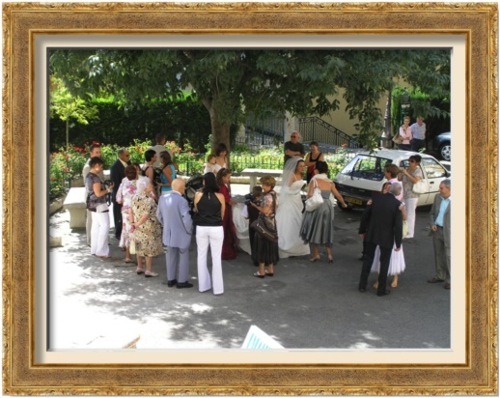


This picture, a typical wedding scene, shows the bride to be greeting all the guests before they enter the church for the ceremony. She introduces friends and family to each other so that there is no ‘bride and groom’ side of the church. People who have been introduced mingle and are more likely to converse at the wedding breakfast thereafter. This simple act of facilitation (a ingrained tradition) helps shape the event.

So while not every km professional can be a bride we can suggest that a core competence in putting the km tools to work is facilitation. Toolkits are vitally important but without the skill and processes to deploy them they are a wasted investment.

Its why perhaps CIAT‘s km team who are much admired have titles such as Leader, Capacity Strengthening and Knowledge Management Initiative. Theirs is a focus on helping to equip others in their organization; faciltation skills are a huge part of the core competencies they use to help others.

knowledge tours = knowledge transfer (understanding puffins and olefins)

Today under the ‘people I admire (and why) section of the site I posted an anecdote from a meeting I once had with the then Vice President of Mobil. It brought back recollections from a posting I made a year ago on Sparknow’s site about the value of knowledge tools  for encouraging good knowledge retention and transfer. Here’s that updated posting:

Ahead of a trip to the ECCI creativity & innovation event in Portugal I was looking for examples of good knowledge transfer from km practitioners. Let me share one anecdote from an interview with Barney Smith a former CKO and CIO and champion yachtsman in response to a question on measurement.

Barney: 80% staff have attended a knowledge tour. Oh yeah, we did knowledge tours. That was cool.

Sandra: What’s a knowledge tour?

Barney: They were great! Natural England owns and manages about 0.6%% of  England’s surface, its natural resource…we actually got people to leave their day job and come down literally. And rather than them doing job shadowing and things like that, we got them to build a day where staff could turn up and then could actually experience what that person does. And they could take 10-15 out. So if a person is responsible for monitoring environmental impacts around the Lundy islands, he would take people on a boat around Lundy island and looking at birds with a Lundy Warden.

Barney: Lundy (Norse for Puffin Island) is part of a Marine Conservation Zone managed by Natural England. The warden who lives on site managing it is actually an employee. We took our staff out to spend a day on the islands with the warden talking about puffins and things like that.

But the point was for those people sitting in finance or those people sitting advising farmers on agri-environment schemes or those people who are promoting or designating the  South Downs national park or New Forest national park, that’s what they’re doing at Lundy. And of course that was the pilot, great stuff. But we had the chief executives and senior staff who said everyone’s got 15 development days. One of those days must be knowledge tour.

And we even created one that’s virtual. So it was actually a guy walking land with a video camera, looking at things. And then he did a talk-over. It was done like a documentary.

It reminded me of a time long past when I was a lending banker managing a portfolio of energy clients.  I knew little about hydro crackers and cat crackers, even less about olefins, polyamides and bottoms all of which were about to become part of my expanding oil and petrochemical vocabulary.

My boss, a visionary and talented Yale educated and very well travelled American who could and did argue vociferously in Arabic, Cantonese and English reasoned that if I were to be of value I needed to understand the practices and language of the industry I was working alongside.  So courtesy of Mobil I attended a programme designed to educate financial people into the workings and economics of oil refining.

I never thought about that week at a refinery in Paulsboro New Jersey as a knowledge tour but now looking back I can see the connection and the importance of experiencing what others do in order to make better decisions. That this was a one off initiative and never replicated by the bank was regrettable since it gave me an insight into a world that would otherwise have been opaque and because I had a modicom of knowledge, the ability to have more meaningful dialogue with my clients.

Barney’s knowledge tours have become regular events, measurable as KPI’s and part of the knowledge charter used to mobilise and shape Natural England’s approach to knowledge management. That they are built into the calendar with compulsory attendance is key.

And finally and perhaps not unrelated the Lundy Puffin is no longer on the endangered list as a result of a programme to eradicate the island of rats.


the role of narrative grids in knowledge retention & knowledge sharing

In a recent discussion about how to surface issues that need addressing as part of a km strategy the subject of timelines and objects came up. Here’s a post I wrote for Sparknow at the end of a working session:
At the back end of 2010 Victoria, Carol and I were in Barbados helping to develop a knowledge management strategy.

The strategy needed to be reflective of the institution yet grounded in the reality of the changing nature of the economic marketplace in the Caribbean where the alleviation of poverty remains a core objective of most developmental efforts.

People have become dismissive of the value of km after years of failed attempts to institutionalize it in organizations. Yet the principles of working towards a knowledge sharing/transferring culture remain valid especially in development. And the potential for improvement in operational efficiency cannot be underestimated even if at times is not easily quantifiable.

We began by looking for good examples of knowledge sharing; using a structured framework for the initial assessment has benefited the client (as well as us) and provided an organizing mechanism for reporting.  Adopting a critical decision interviewing approach has also made it much easier to unearth some of the stories that illustrate how knowledge flows. Perhaps our biggest (re) learning is the value of a neutral object in acting as a catalyst for conversations around the working practices of organizations.

Most people feel uncomfortable talking about something intangible, they need a hook to hang their conversations on.  In much of our work we’ve asked people we are interviewing to draw a time line to help ground them in chronological events; that tended to be a good launching point for dialogue and stories. It was especially effective in our mission to Darfur back in March where the enormity of the problem tended to obscure people’s specific recollections unless they had just occurred.

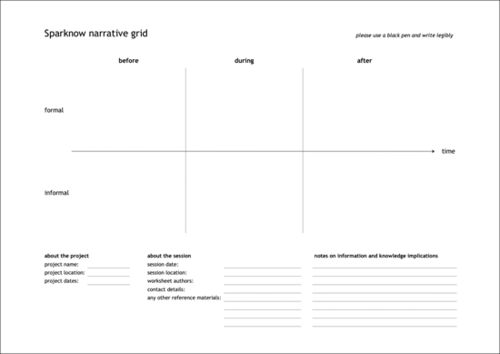
In Barbados though we were looking for evidence of how knowledge and information flows across an organization and how it is used to inform decisions.  Drawing on the excellent tome Working Minds by Gary Klein et al we combined a critical decision interviewing approach with a timeline approach to create a Narrative Grid.

Perhaps most importantly we built on previous work with Royal Mail and others to ask our interviewees to describe what was going on in the formal and informal channels (“above and below the line”) while a decision was being made.

image

Did it work?

  • As a conversation piece and in a 1:1 situation it was extremely effective and moreover became the neutral object that the interviewee was happy to channel their thoughts into. We learned a lot about the use of the right pen and of the value of the subtle prompt. It was also very effective as a way of assessing different cultural types; there were those who instantly took the pen and began writing; those who would take the pen after we had begun writing; and those who were happy to have us do the writing while they “dictated”.
  • In a group session the Narrative Grid shone. Teams would gather round correcting each other and while the outputs were often anything but neat the results of a genuinely collaborative effort were not purely visual. Getting each group to summarize was especially useful since it often revealed similar patterns of behaviors, good examples/stories of knowledge sharing and areas ripe for process improvement.

Over the last decade Sparknow has experimented with many techniques to capture organizational stories. For helping to identify organizational knowledge and information flows around events and decisions the Narrative Grid has proved among the most effective.

insiders view on knowledge in the Middle East

In 2011 I spoke at the inaugural KM Middle East event about a knowledge survey we created for the event and drawing on recent diagnostic work and the knowledge management strategy and implementation framework it spawned.

image

photo | Tom Spender

One of the tools Sparknow has used before as a way of raising awareness of, testing the receptivity for and measuring the impact of, a knowledge initiative is an online questionnaire. We usually keep it to about five sets of questions and ensure it takes no more than five minutes to complete – about the length of time it takes to drink a cup of coffee!

It often kicks off a diagnostic process and provides useful pointers/insights into what an organization understands knowledge management to be as well as highlighting ‘the way we do things around here’ through snippets and anecdotes.

KM Mid East seemed like a good opportunity to stimulate a debate through an online questionnaire: knowledge management roles are beginning to appear in quasi government organizations and some recognize that the way ‘stuff’ is stored today will impact on its potential reuse. And this is being conducted against the following backdrop:

  • Libya has descended into a civil war.
  • The outcomes of the Bahrain protests are by no means clear.
  • The Saudi authorities have just handed out over $37bn in pay rises and improved conditions to its inhabitants having reportedly adopted rough tactics with protesters.

The response from within the region’s commercial organizations has been to take a good look at disaster recovery, contingency planning and risk evaluation; assess their value of portfolios. Few would instantly associate this ‘burning platform’ moment with knowledge management but it’s totally relevant. In fact it’s what got me into this business two decades ago when a bomb blast took out the paper records my organization had and I led an ambitious programme in a Middle East focused investment bank to capture what we knew and make it available for reuse electronically. It was our attempt to create a one-screen view of a client and the forerunner of what today people call intranets.

So what has emerged from the Sparknow Knowledge Survey?

  • The majority of respondents were from government organizations.
  • Most people felt lessons learned were best examples of knowledge sharing at work.
  • The spectre of poor records management looms large.
  • Learning and by implication knowledge transfer are the areas many people believe KM should be addressing.
  • While cash incentives are attractive carrots for some to share knowledge the majority wanted recognition and a sense of ownership in the outcomes.
  • Unsurprisingly given the astonishing technological revolutions this region has been witness to, most answers to the question ‘the thing I always carry with me to help with knowledge…’ focused on technological solutions.

‘I cried for an hour…’

The words of a Colombian American who’d been to school in England, whose family are Colombian intellectuals and whose children live and work in the USA. The psychological impact of May’s Bogota bombing on a country rapidly emerging from decades of internecine conflict cannot be underestimated. It is a setback, yet I’d back this country and the people. It is a great place, a fusion of South American and European cultures and its people have a strong work ethic and an insatiable thirst for knowledge which is how I came to be here.

The 5th Knowledge Management & Organizational Learning Summit held over 2 days attracted 200+ many of whom booked late. Colombians I was told leave most decisions such as where to go on holiday until the last minute which places a premium on contingency planning. Perhaps unsurprisingly given the country is emerging from a difficult period personal financial decisions are driven by short-term expediency rather than long term accumulation of wealth. This translates into ‘knowledge is power’ mentality that makes efforts to promote the sharing of knowledge a challenge.

Despite being the sole European and linguistically challenged I nevertheless felt part of a family. My presentation delivered in English with simultaneous translation was given to an audience of bankers, industrialists and government officials. The hour I spent in advance going through the presentation with Carolina the interpreter paid off handsomely and enabled me to run in tandem with Luisa Sucre (an excellent facilitator from Venezuela) a number of interactive sessions that revealed how good South Americans are at dialogue.

I began by asking how many had been in km for more than 5 years – about 1/3rd. How many had km in their title – about 1/5th and how many thought km had been around for more than 10 years – about 2/3rd.  This was a topic they’d clearly thought about even if it had not become an accepted discipline in the organizational hierarchy.

I was also able to garner a dozen varying views on the role of the future knowledge manager in Colombia – more of that in a subsequent posting.  The allotted 2 hours flew by (at least for me); I wished I’d had longer.

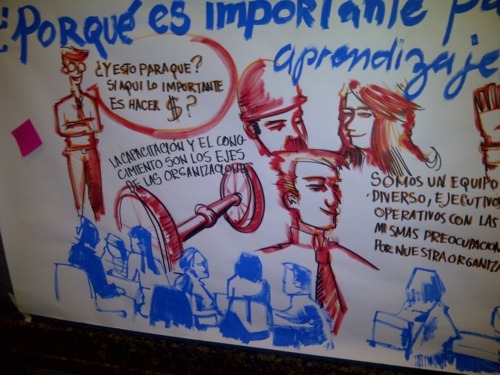
The afternoon of Day Two featured a World Café run by Zulma Sofia Patarroyo a very energetic Colombian who used the 3 hour session to surface what the delegates had learned and would take away from the event.  She began by asking each table of four to listen to each other’s learning points and then for the table ‘host’ to remain while the other three found an alternative table.  This continued for a further 2 ½ hours which seemed like an eternity to some but was enthusiastically embraced by most as I was to see evidence of the following day when meeting a delegate who had his ‘takeaways’ on the wall of his office. Jorge Enrique Merchan a graphic artist was on hand to expertly record the activities.

image

My personal takeaways:

—     A very well organized event that covered the little details well and didn’t try and pack too many speakers into the two days

—     The audience was attentive and respectful; it took little prompting to get them to participate in a karaoke style community singing at the start of Day Two led by Maria Helena Magalhaes from Brasil, creating music at the end of Day One with Patricia Molla from Argentina and embracing the World Café concept with abundant enthusiasm; laughter is always near the surface of conversations

—     There is a lot of km style activity going on in South America albeit under other labels especially Organizational Learning; people see its potential value

—     The big issues organizations face are similar to those found everywhere and include knowledge retention and knowledge transfer though here perhaps more than anywhere there is a need for a structured contextual approach in order to gain endorsement across an organization

—     The use of stories to drive change and underpin initiatives is in its infancy

—     A visit to the Botero Museum where much of Fernando Botero Angulo’s work is displayed in a remarkably open manner should be an essential component of any trip to Colombia