a knowledge retention technique: recognising contributions

Knowledge retention is a big issue for many organisations. This blog first published in 2011 talks about how Sparknow planned for and marked the retirement (his second) of its Financial Controller Roger Doughty. I’ve republished it here since it addresses a key challenge namely that of recognition of the contribution made by an outgoing knowledge worker.

Roger was there in 1997 when Spark began. Through 14 years he has guided us through a maze of fiscal legislation, keeping a watchful eye on our finances and helping us become a limited liability partnership. That Sparknow has been able to develop the stellar list of client names bears testimony to the strength of our backroom support nearly all of which has been done on a virtual basis by Roger.

Our challenge is similar to that we’ve seen with clients when experienced people depart.

  • How to pass on the knowledge he’s gained much of which has been tacit.
  • How to ensure the same level of service is provided. And finally
  • How to recognise his contribution in a manner befitting of our style and values.

Tacit knowledge transfer has been/is being covered by a period of parallel running with his successor Mark Barrett who is also a Welshman with an accounting background. Mark has been shadowing Roger for the last couple of months and now that is reversed and Roger is shadowing Mark. I then hold monthly review sessions with the pair of them to see what issues have arisen and fine tune our processes. Our intention is ensure a smooth seamless transition which thus far it has been.

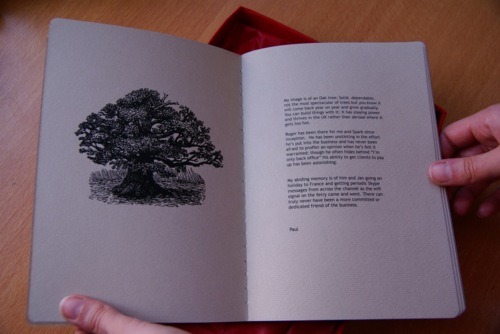
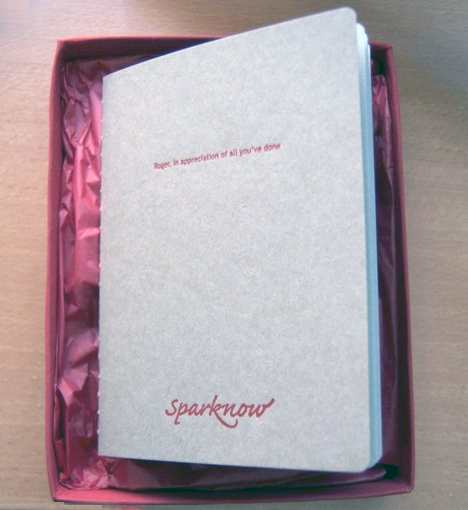
To recognise his contribution we asked a number of associates, friends, collaboration partners and clients to think of an image that best described Roger and then to write a brief anecdote.

The material was assembled; should we print off a set of postcards, produce a virtual card or make a set of recordings? Webster’s Pictorial provided the inspiration and with the help of Curtis James, a Brighton based ‘letter presser/purveyor of collections…’, Roger’s ‘book of memories’ was born.

image

image

A very suprised and delighted Roger was presented with his gift at a garden party held in Lewes.

image

Many struggle to find a way that recognises the contribution of key people in a business so that when they depart their legacy lives on. Roger reading his ‘book of memories’ shows how much pleasure can be gleaned from a simple gesture.

knowledge management I an old wine in a new bottle?

I was back in Khartoum for a couple of days at the end of March at the invitation of the Sudan Engineering Society and University of Khartoum.  They’d asked me to talk about knowledge management, research into the evolving role of the ‘knowledge manager’ and the implications for Sudan.

Apart from the honour of addressing 150 or so engineers, acadamics and ministers on Wednesday at the National Telecomunications Center, my presentation at the Faculty of Mathematical Science on Thursday was made at the end of the working day (so at the start of the Sudanese weekend) to a crowd of nearly 200 including families.  It brought home to me how keen the Sudanese people are to learn and exchange ideas especially since the Campus had only just reopened after a period of unrest.

Knowledge management as a formal discipline is in its infancy in Sudan. There are pockets of good practice albeit under different labels and many companies are following the well trodden path of focusing on technology such as an intranet as a way of storing ‘stuff’.  It’s not easy though operating in an environment which restricts access to software updates as an example. That said there is a groundswell of interest led by Dr Gada Kadoda who is mobilising a group calling itself the Sudanese Knowledge Society who are about to meet formally for the first time.
image

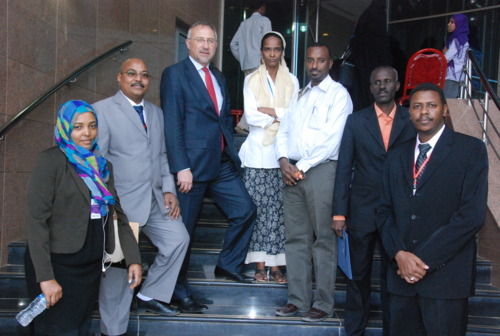
Photo Taken outside the National Telecommunications Center Khartoum with some of the founding members of the Sudan Knowledge Society

The Khartoum presentations prompted an interesting exchange with one of the participants who attended both. Here with his permission is an extract.

Hi Paul

Thank you. I have attended both sessions. All day on Wednesday and the Thursday evening session… Few years ago while I was working in the UAE, I came across The European Business Excellence Model and the work of Peter Senge at MIT ( The Learning Organization ). Is this KM a new Fad, old wine in new bottles or is it a real contribution to your management thinking? It seems to me I am getting mixed signals…. To this day I still remember Business Processes Reengineering, as advocated by Prof Michael Hammer at MIT
Best regards

Mustafa

The Rio Tinto video (about a Community of Practice) in my humble opinion is a Quality Circle drill, which was helped by the advance in ICT…

And my reply:

Dear Mustafa thank you for your kind words and the background.

You raise a number of interesting points, let me answer them in sequence:

  • Old wine in a new bottle: to continue the analogy, if it is then it is ageing quite well as some 10 years ago Professor T D Wilson at Sheffield University in a paper entitled ‘The nonsense of knowledge management’ wrote the following:

The inescapable conclusion of this analysis of the ‘knowledge management’ idea is that it is, in large part, a management fad, promulgated mainly by certain consultancy companies, and the probability is that it will fade away like previous fads. It rests on two foundations: the management of information where a large part of the fad exists (and where the ‘search and replace marketing’ phenomenon is found), and the effective management of work practices. However, these latter practices are predicated upon a Utopian idea of organizational culture in which the benefits of information exchange are shared by all, where individuals are given autonomy in the development of their expertise, and where ‘communities’ within the organization can determine how that expertise will be used. 

  • Yet today as our research has indicated people and organisations are organising themselves to make better use of what they know and if knowledge management is a convenient label to achieve that then who are we to complain.
  • Quality Circle vs Community of Practice: Yes and no would be my response.  However for me the concept of a quality circle is much more around a particular incident (yes that was highlighted in the clip) but the idea of a Community of Practice is that it represents an ongoing and dynamic resource. The bigger point here I think is that the engineers were able to post something onto the platform used to run the CoP and locate people who’d had the same experience.
  • As to BPR and the other management ‘fads’ I would say there is a difference.  I see km as a horizontal thread running across the organisation; its a way of doing if you like a common sense approach to improving the sharing of what people and organisations know.  BPR et al gave no consideration to the transfer of know how from experts about to depart or how to bring people who’ve just arrived in the business up to speed as quickly as possible. Where km falls down is that it is often put into a corporate siding – the place where communications, marketing and HR don’t want to tread and as a result does not have the institutional clout that more established disciplines have.

km has been written off many times and yet as research into the evolving role of the ‘knowledge manager’ has uncovered there are still a large number of people engaged in km type activity. Even with km in their job title (and many still don’t) they are having significant impact and reach across their organizations.

Yesterday for example I received a copy of the excellent Asian Development Bank Intersections digital newsletter and was drawn to an article entitled Ahead of the curve: the long reach of short tales by the Knowledge Management Center headed by Olivier Serrat which said

In 2010, ADB embarked on its most ambitious story-driven exercise yet. It launched the ADB Sustainable Development Timeline multimedia project, which currently hosts over 11 hours of sympathetic reminiscences and expertise rendered in video from 72 ADB staff. The material is broken down into 1–5 minute snippets covering a veritable plethora of topics, e.g., communities of practice, corporate governance, gender equity, forest conservation, knowledge management, renewable energy, sustainable infrastructure, etc. But, beyond these, the interactive platform also contains short documentaries of projects shot on location, sounds, B-roll footage, animations, graphics, voice-overs, videos, statistics, photo essays, etc. The product has been warmly received, both in and outside ADB, and augurs well for ready use in staff recruitment and induction, learning and development, conferences and other events, education, and external relations.

I am looking forward to continuing this discussion when I am at the 5th International Knowledge Management and Organizational Learning Summit in Bogota in May. More on that in a later posting.

a knowledge retention technique: importance of business trips and missions

By a stroke of serendipity (a meeting with one of the speakers while he was in London) I went to Khartoum early in the New Year to participate in an event run by University of Khartoum styled “Knowledge Management Capacity in Africa”.

It promised to be an interesting event since unlike a previous mission to Khartoum, Nyala and El Fashar I was to be based in one centre for the week. Also the list of practitioners and speakers is very heavily weighted in favour of the African continent and I was the sole European representative. An honour indeed!

I was asked to focus on a couple of topics: Missions and Creative Commons. More on the latter in a subsequent posting. Here’s a taster from the abstract I wrote with Victoria Ward for the event:

Missions are one of the key ways any development bank or agency can collect, disseminate and synthesize knowledge but the opportunities to do so are often overlooked or wasted.

Most of the processes are focused on producing a report (back to the office report- BTOR), managing risks and making decisions yet every component can be adjusted and fine-tuned or used in more than one way.

This presentation, based in part on a mission to Sudan conducted in 2010 by Sparknow working alongside the World Health Organisation (WHO), will examine a variety of mission collection methods and discuss how the ‘fire of the field’ can be brought back into an organization.

Imagine you are a bank looking to set up a new Islamic finance operation targeted at the private sector in West Africa. There are few peer groups you can look to for advice; it’s by and large unchartered territory. What are your options?

·       talk to the founding fathers of other Islamic institutions

·       undertake a scoping mission to the country

·       identify others in your own institution that have core skills you might draw on.

You actually do all the above but in addition you put in place a programme to ensure that you capture all the learning’s from this new venture; the nuances around operating ‘offshore’ from HQ; the peculiarities of the culture and the way things are done and; you create a missions guide and a mechanism for feeding back what you learn into your organisation. This charts Sparknow’s mission journey illustrated by some of the techniques we’ve found to be of value.

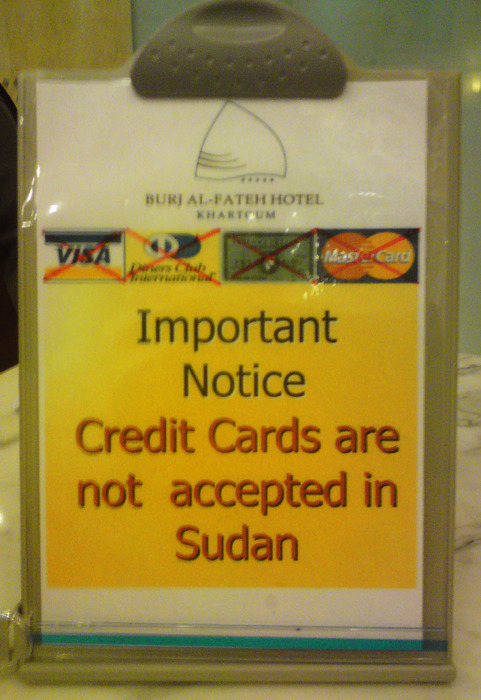
Oh and this time I am going to remember to take nice new shiny dollar bills and not my credit card.

image

handling cultural nuances in Asia

It’s Thursday morning and I am in Hong Kong to run the closing panel session on day two of the inaugural Online Asia Pacific held at the Hong Kong Convention Centre.

On the first day I’d tweeted

‘Difficult to assess whether audience will ask questions; only one allowed thus far per session and all been from visitors to the region’.

Despite a very convivial lunch with my fellow panellists to discuss options it isn’t readily apparent what will meet the objectives to send the delegates away with a smile on their face, with a set of real ‘takeaways’ and bring the conference to a memorable conclusion.

Having been given the remit to do what I think appropriate it is going to be a case of trust my instinct and make sure there is enough interesting content to back me up if I needed it.

After a very promising start on Day One, with 150 people attending the keynote presentation and official opening by Stephen Mak HK Government’s recently appointed Chief Information Officer, the crowd thinned perceptively for the remainder of the event prompting the thought that being seen to sign up is more important than attending.

Those who stayed the course (probably an average of 50 per session) looked like they got their money’s worth and I take the opportunity, having watched Hazel Hall perfect the art at the 2010 Online Conference, of tweeting the bits I feel worth recording.

My ears prick up when Stephen Mak suggests that HK has Communities of Practice at the heart of its drive to build a knowledge based society. This was worth a question; in the interests of timekeeping my request to speak is declined so I corral Stephen before he leaves for a more pressing engagement of putting Information and Communications Technology & Knowledge at the disposal of HK’s population – its Digital 21 Strategy! Yes he says they do use CoP’s but only for internal purposes and then among the IT community. And off he sweeps to perform the opening ceremony which involved dragons, sticks and tambourines.

An intranet consultant from Singapore then talks about an assignment in Manila arguing that an Intranet is the blood line of an organisation; the most important part of an IT infrastructure. Again I was interested since the client is Asian Development Bank an organisation we’d come to know and respect greatly a year or so back.  His premise that ‘culture is what happens when a boss leaves the room’ an interesting take on working in Asia further reinforced by an insightful presentation from a Thai energy company who impose through KPIs a requirement on their engineers to contribute to Communities of Practice.  Here’s the conundrum:

  • while workers in Asia are taught to respect their superiors, follow their directives and defer to them in conversations, do ‘hits’ or ‘contributions’ to a lessons learned database enforced via a must contribute policy represent a real change in the way an organisation is working? Or is it merely the way things get done around here and some contribution is better than no contribution?

This conundrum was vividly illustrated later in a Q&A panel which included a session on Open Source technologies:

Q. what are the reasons for OS community here not growing up? A. No evidence that people in Asia will to contribute to online forums

Which brings me back full circle to my closing session dilemma: would a very eclectic public audience of mixed race, faith and gender be willing to embrace Sparknow’s participative work-shopping approach?

Here’s what I did:

  • rearrange the room by stacking previously unused chairs to get a much tighter feeling among the delegates.
  • prepare a brief presentation with plenty of illustrations to provide a backdrop to a conversation about how information and knowledge professionals needed to adapt.
  • ask the other panellists to sit in the audience for most of the session and use them as catalysts for conversations.
  • invite the delegates to consider what their three ‘takeaways’ are from the event (including the exhibition) and then to have a conversation with the person next to them about their choices.
  • at this point my fellow panellists (Robert, Bonnie and Waltraut) and I engage with anyone looking left out and the level of animated conversation bears testimony to a willingness to have a say at least in a small group.
  • I now want to invite the delegates to voice opinions but fear asking them from behind a lectern will be unproductive. Instead I pass the roving microphone to Robert Hillard (the keynote speaker and one of the panellists who is in the audience) to give me his.  Robert bemoans the lack of a open forum for information professionals in the region.
  • rather than give it back to me I invite him to select someone else in the audience and pass the microphone on to them.  That simple act both diffuses and increases tension; everyone watches anxiously to see if they are selected but focuses on what they might say if they are. It has become much more light hearted and I am able to joke about who is next and throw in anecdotes as the mike moves around.
  • this continues for 20 minutes or so; everyone who wants to speak does; Lorna Candy the conference organiser of Incisive Media is taking note of the takeaways – a much better feedback loop than the usual tick box/score forms handed out at conference.
  • the session concludes when I invite the panellists to take their places on the podium (a rather grand description for a table at the front) and give their own summaries which talk to the resonance of information literacy and the need to adopt language that business understands.

What were my takeaways from Online Information Asia Pacific?

  • economic value of reusing public sector information in Asia is not understood though strangely the value of good curation is.
  • conversely the museums sector don’t show digital collections on their website, a real opportunity lost since every other aspect of Hong Kong life including the Ding Ding is presented virtually as streaming video.
  • laughter (not too loud) can overcome basic inhibitions and while its easy to offend an advance apology can go a long way to ensuring there is no lasting damage!
  • when serving chicken remember the breast is what Westerners like; the legs and feet are tastier and considered more appropriate.

using knowledge for competitive advantage: a graphic illustration from history

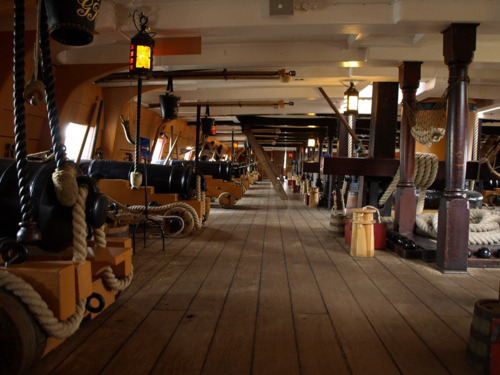
It being a lovely afternoon and with a guest over from Washington DC my wife and I decided to pay a visit to the Naval Dockyard at Portsmouth where some of Britain’s most famous warships have been restored and are on display.

I didn’t expect to find such a vivid example of how the application of what you know allied to an entrepreneurial spirit can make such a difference.

Here’s the background: By the time of the Battle of Trafalgar in 1805 the rate of fire from a cannon on the British Fleet was every 90 secs whereas for that of the enemy it was 5 minutes; a major factor in the competitive advantage of the British Fleet and the ensuing victory.

Here’s why:

Captain Charles Douglas, commander of the 90 gun ship Duke in 1778, had such great confidence in the efficiency of the flintlock for firing guns that he equipped his ship with them out of his own purse. When Douglas became captain of Lord Rodney’s flagship Formidable (90 guns) in April 1782, he demonstrated his superior rate of fire and hitting power in the victory over the French at the Battle of the Saints in the West Indies. Douglas’s son, Major General Sir Howard Douglas, improved the gun lock system by introducing a double headed hammer to house the flint. This made it unnecessary to change flints frequently during action as this new form of hammer could be turned through 180 degrees to engage the second flint.

What that quote omitted was that the French forces were the inventors of the original flintlock and indeed had trialled (without much success) its introduction to the fleet.

On the British side this became a grass roots incremental change programme spread by word of mouth that ultimately became ‘corporate’ policy. Individual Captains’ who were often quite wealthy paid for the enhancements to the guns on their vessels and were able to see significant improvements in productivity. By the time of the great sea battles of the late 18th and early 19th century most British ‘ships of the line’ were fitted with these devices with devastating impact.

It struck me as I walked around HMS Victory that today many organisations aren’t aware  of what others in different areas of their business do and are often not involved in the redesign of process. Indeed two of the recurring comments we hear are “I didn’t know they did that” or “yet another top down HO initiative we pay lip service to”.

This example spoke to me of the value of knowledge sharing and the need to engage rather than impose change.  I hope you agree?

image

flickr.com/4142/4737534619_aa7c70470e_b.jpg