‘Probably the best PKM in the world’: KMUK 2016 uncovered

It’s conference season which means I get to go to nice places and meet and learn from interesting people. This week I was in London for the annual Knowledge Management UK event and a cracking good couple of days it turned out to be.
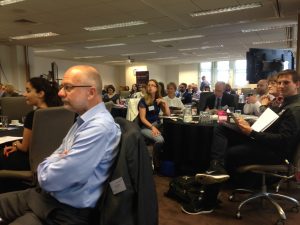
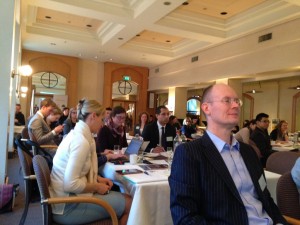
IMG_4774Well attended by 60 or so KIM professionals, it was chaired by Ian Rodwell @Irodwell of Linklaters who I’d recommended and who did me and Laura Brooke of Ark @LauraAtArk, proud.

From the ice breaker opener onwards Ian’s touch was light but assured and the delegates all participated with enthusiasm.

What surprised me?

  • I got something out of every presentation which might sound a bit arrogant but when you’ve been to many KM events there are usually a couple that don’t quite cut it. This time each speaker slotted in well with the next and the event flowed.
  • The number of KM ‘Veterans’ attending for the first time in a long while commenting how lonely the role can be (whatever it’s called) and how durable KM’ers have to be.
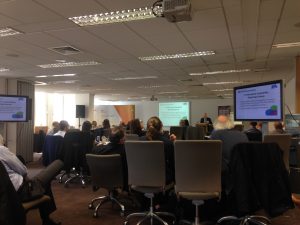
  • IMG_4786Learning that the Govt’s 5 year Knowledge & Information Strategy (GKIS) produced in 2013 is still not published and unlikely to see the light of day.  Yet work is still going on as David Smith explained to create career pathways for the cadre of professionals who comprise the civil service’s Knowledge & Information Management profession. I didn’t get the feeling that CILIP are integral to those competency framework discussions which is a missed opportunity on both sides as there is no current industry group that effectively represent the KIM global profession as does a CMI or CIPD in Marketing or Human Resources (Personnel).
  • Discovering that the average age of people in E&Y is 27 (hence generation Z to the fore). E&Y’s big challenge for is to move from a vertical to horizontal communications and employee engagement approach. Their Communities of Practice / Skills are a great way of cutting across silos.
  • Despite all the ballyhoo around technology search is still not cutting it for most and my recent musings on the continued need for Assisted Search valid.

What intrigued me?

  • The session on Artificial Intelligence (AI) whcih included the suggestion that it is ‘parked on the lawn’ of call centres and people who have to read long books for a living and are also engaged in risk management. Today AI does not do emotional intellience very well but that is changing despite reservations about the ethics of it.  Linklaters are a good example of an organisation experimenting with AI to improve efficientcy.
  • Nick Milton’s @nickknoco thoughts on adopting the 7 step Lean Model for a KM programme and the wastes of KM supply chain: excess production, delay, too many steps, excess hand-offs, defects etc.  By a strange coincidence 7 came up in my presentation when I talked about the 7 ‘ates of a Knowledgeur. A separate blog will be forthcoming to coincide with my address to the CILIP annual Confrence in three weeks time.

What delighted me?
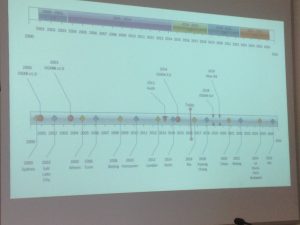
  • IMG_4785Christopher Payne’s @cjapayne excellent account of the Knowledge Management effort that is embedded in the Olympics.  It is the most visible of all Project KM programmes (see alongside) with great potential to act as a benchmark for all big cross border multinational projects. Imagine the expertise they have developed (with quite a small team) in transferring knowledge from London to Rio to Tokyo all in the gaze of the global public. I know Chris is keen to share his IMG_4787knowledge with the greater KM community so contact him or hear him speak.
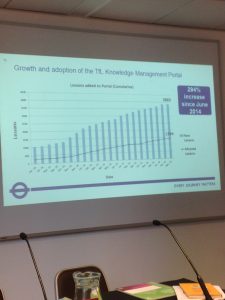
  • TfL’s approach outlined by @LemmerLutz to making great use of Lessons Learned and feeding improvements back into process.  The graph alongside illustrates the successful postings of lessons to their KM portal (up nearly 300% in 2 years).
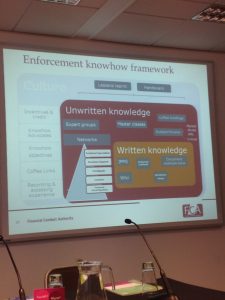
  • The broad acceptance that you can achieve a lot with a little.  The Financial Conduct Authority presentation being a great example of how to make effective use IMG_4790of people by using communities and having an easily understood framework. I noted though that poor search is a real barrier to adoption and that the lack of a technical underpinning a constraint.
  • Hearing from a couple of people how Random Coffee Sessions can be effective. The idea is simple: develop a list of people who are interested in having short coffee meetings with peers on a 1:1 basis and pair them up on a periodic basis.

What frustrated me

  • The continued reluctance to share thoughts / observations on Twitter, a stance at odds with the audience’s oft stated desire to ‘Work out Loud”.  How can you encourage others to do so if you don’t do it yourself?  I wrote more on this subject a year back coining this phrase: It was like throwing a dart into a vacuum.

What did I not hear I expected to?

  • Social Network Analysis: Despite a real focus on Communities Social Network Analysis was not discussed. Not knowing who people go to for answers or who knows what is a risk to many businesses if those key but often hidden people depart. To a large extent the risk from the sudden departure of the ‘Expert’ is diminishing with the rise of empowered and informed knowledge workers and processes that contain embedded knowledge.

And finally

My favourite quote (used in the content of maintaining focus):

Don’t be like a dog who sees a squirrel
 

A ‘newbie’s guide to Tweet Chat hosting (on Knowledge Capture & Retention)

Screen Shot 2016-03-03 at 17.17.39

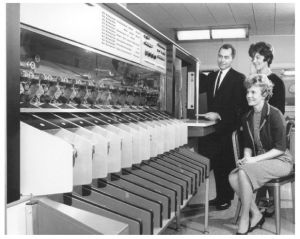
I first worked in the City in 1972 as a summer intern in the cheque processing arm of Lloyds Bank Ltd.  We used machines that looked something like this. No typing, just machine minding!

15 years later I was sitting in the machine room of the Marriott Hotel in Jeddah faxing, over an encryted line, a confidential trip memo for my secretary to type up and distribute to selected directors.  Laptops were only just appearing on the market and as for typing, Managers in those days didn’t. If you wanted to communicate confidential information quickly it was the fax.

Fast forward to this afternoon and I am about to host my first TweetChat some 44 years on from my first immersion in technology.

Think about it: I can’t see who I’m talking to; I don’t know who’s ‘listening’; I have little idea whether what I am going to ‘say’ will resonate with the audience: and I have to type at lightening speed. It feels like ‘drinking from the fire hydrant’ to boot!

But there are huge advantages: I can reach a global audience without leaving my Home Office; what I say will have a very long ‘tail’; and it forces me to articulate my thoughts in a very concise way to an audience who may not speak English as their 1st language.

I know from many conversations I’ve had recently that everyone is expected to be up to speed with new technologies and few get trained adequately to do so.

Screen Shot 2016-03-03 at 07.59.06

Here, with grateful thanks to Luis Suarez (@elsua), Ana Neves (@SocialNowEvent) and Ana Aguilar-Corney (@aguilarinteriors) who provided the wise words and tips I show below, is how I went about it.

Set up

  • Use http://www.tchat.io/ to handle the chat. Load that on the browser and forget about everything else.
  • Focus on the tweet chat for the entire time, even if it looks like things may be a bit slow with tweets coming through, don’t go elsewhere. That way you are free of interruptions and focused on the chat.
  • Have a look into the questions of the tweet chat ahead of time, and write some potential answers ahead of time that would fit in tweets, within the 140 character limit. That way when the answers come in you just have to copy and paste and focus on what people tweet for potential responses, faves, RTs. etc. etc.
  • As you see tweets coming through, don’t think about responding to them all. Think about peppering out the interactions: some responses, some RTs, some faves, to balance your interactions without demanding you to type too much, so you can focus on the conversations themselves.
  • Enjoy the tweet chat under the notion you won’t be able to read and respond to everything while the chat lasts and that’s just fine! You can always come back at a later time if you feel you’d need to. Enjoy the flow as if you were reading a fast paced news tracker skimming through and stopping where you feel you can and want to contribute.
  • If you are going to refer people to blog posts or articles make sure you condense the URL’s as you ‘cut and paste’ into your Tweets.
  • Establish a live back channel with the facilitator while you are conducting the chat.
  • Be clear about who is performing what role and ensure someone is producing a Storify of the event that can be circulated later.
  • Don’t be afraid to let the virtual ‘silence’ hang.

Conduct

So armed with the above and a set of thoughts for three questions off I went.

And if you are up for reading an account of how it went go to the Storify Account of the discussion which is here

And finally

The hour (the optimum time) flew by. Armed with the checklist above it was plain sailing.  It did however reinforce the veracity of the ratio I use for physical workshops namely 3-4 x times preparation vs. the length of the event. I spent 3 hours on potential answers and it paid off.

Would I do it again? Yes tomorrow provided there is a clear mandate and set of questions to be addressed.


Great illustrations: valuing Knowledge, Orchestrated Serendipity & Immunity Management

I’ve been in Iran and Dubai. And as often happens when working collaboratively great ideas emerge.

Valuing Knowledge

Firstly to Tehran and an issue which so many organisations struggle with: how to describe the true value of Knowledge to an organisation?  We are good at valuing fixed assets but poor at applying similar criteria to intangible Knowledge Assets or Intellectual Capital.

bluetooth-keyboard-for-htc-evo-4g-lte

This story, the keyboard and the patent, might change perceptions:

A few weeks back a new keyboard costing $20 was delivered to the Director. After a couple of days a lady from premises appeared to place a sticker on it to denote it was an asset of the company and henceforth will appear on the company’s register of assets. The asset is managed!

Coincidentally the same day as the premises lady appears the Director gets notification of the award of a US patent which costs in excess of $20,000 to acquire.

US Patent

US Patent Certificate

The patent will need to be protected and if necessary enforced yet in most organisations that patent is not shown as an asset of the company on its balance sheet even though its value (in terms of future revenues) is very significant.

By way of a further example, if I lose my Macbook I can replace the hardware (at a cost) but the value of the intangible ‘Knowledge’ stored on it (documents, emails, presentations, videos, contacts) can’t be replaced instantly unless I’ve taken steps to back it up on an external hard drive or in the cloud in which case I have managed my Knowledge!

Orchestrated Serendipity -creating a physical Knowledge Sharing environment

On my way back from Tehran I stopped in Dubai to catch up with a number of old friends which is why on Wednesday I spent a couple of hours at the Knowledge and Human Development Authority (KHDA) located in Dubai Academic City who:

… is responsible for the growth and quality of private education in Dubai. We support schools, universities, parents, students, educators, investors and government partners to create a high quality education sector focused on happiness and wellbeing.

Having arrived at my hotel in the early hours I was not at my best when some 5 hours later the cab dropped me outside KHDA’s offices.  I was early for my meeting with Luke Naismith Director of Research so thought I might see if I could find a coffee shop.

IMG_4461

KHDA’s Reception

I was warmly greeted by two very affable Emirati who ushered me to a seat whereupon coffee was served. Over the next 15 minutes my whole demeanour changed.

IMG_4457

Luke demonstrating the presentation ‘lectern’ in the boardroom.

‘Abdullah’ one of the Excellence Team responsible for ensuring adherence to the  Dubai Government’s Excellence Program showed me around as Luke was in a meeting.

I saw senior people conducting meetings in very transparent meeting areas; the Head’s PA was arranging appointments from the lobby. There was a relaxed yet professional atmosphere despite the presence of budgerigars flying around.

What caught my eye (apart from the boardroom) was the merging of the old and the new.

IMG_4455

The Clipping Service

Each day KHDA compiles a clipping service of relevant news that it sends to all employees.

In addition it houses them in its downstairs work area so that all visitors and employees who choose to work in the communal area can keep up to speed.

IMG_4456

Boardroom

Luke emerged and showed me around. I noted the layout promoted an environment of transparency so that people share and can find others.

The boardroom was an eye opener. Everyone can see what’s going on and the strategy appears as a set of diagrams as the picture shows.

PowerPoint presentations do take place and Video Conferencing but the emphasis is on brevity, agile working and rapid empowered decision making.

Paper is absent from most areas, people are treated like adults and act like them.  And staff turnover is low though if people leave the collaborative team working nature of KHDA means their loss is covered.

IMG_4462

Upper floor: Collaboration and Training Area

Interestingly Enterprise Social Networking Tools such as Yammer have not yet had the impact I thought they might even though the whole physical environment is geared up for collaboration.

Immunity (Risk) Management

The most visible illustration of KHDA’s positive approach shows in how the board manages risk (often the driver for KM initiatives).  One of the team coined the term Immunity Management as a way of anticipating future ‘bumps in the road’. So they have an Immunity Register not a Risk Register that is reviewed regularly by the board. The simple act of taking a positive view has resulted in very innovative ideas.

And finally

In Dubai the imposition of quality standards permeates organisational thinking and sets a blueprint for organisations to follow. At its best (Emirates Airline) service is exceptional; at its worst strict adherence to standards can stifle creativity. KHDA is an illustration of how the pursuit of customer service excellence can change the way an organisation delivers it.

Where the above examples meet is in the need for identification and maintenance of Knowledge Assets or Intellectual Capital. More on that in future postings.

The rise of Legal ‘Lean’ and its impact on Knowledge Management: looking back at KM Legal Europe 2016

IMG_4381A year on from the Breakfast Breakout Martin White and I ran for Legal Knowledge & Information Management professionals in London I found myself back among them in Amsterdam at KM Legal Europe.

My brief was to provide a stimulating opening to the conference (I went with In at the Deep End – an Icebreaker I used at KMUK) and then give a presentation on the second day on Working Virtually. I was delighted with the enthusiastic response and the level of interaction that occured over the two days expertly led by Chairman Raffael Büchi.

Opening

So what did I see and hear (and learn), and where is Legal KM a year on?

Who or What’s driving KM in the Legal Sector?

Firstly, clients are becoming more sophisticated and insisting law firms are better. And new offshore firms are emerging that are making legal advice more a commodity product that can be disintermediated through technology. That’s having a knock on effect as firms bow to pressure for greater transparency, more efficient processes and better use of technology.

Some firms have also recognised the risk arising from the potential loss of knowledge when people and teams leave or the need to do more effective due diligence on the knowledge they are acquiring when people and teams join.

They are responding by ‘offshoring’, adopting established process improvement methodologies such as Lean/Six Sigma and integrating that into continuous proces improvement,  combining CRM with EDRM, building Legal Project Management capability,  attempting to get into their client’s shoes and using horizon scanning to take a look at the future.

From a Quality & Standards perspective, ISO 9001 certified firms and their Quality Managers are also casting a watchful eye on the emergent standards having noted the introduction of the amended regulations in September 2015 which for the first time made mention of Knowledge Management (Clause 7.1.6. Knowledge) noting: “The concept of organizational knowledge introduced to ensure the organization acquires and maintains the necessary knowledge”

The early KM adopters on dsplay in Amsterdam had visionary leadership to thank for embarking on their initiative, their challenge is sustainability when their sponsor departs.

These categories I find useful as a way of identifying the drivers behind a KM initiative:

  • Innovation / Process Efficiency
  • Risk Management
  • Quality & Standards
  • Vision

What trends did I see?

The ‘big’ trends for me were:

  • Rise of Continuous Process Improvment initiatives supported by Process Mapping and Automated Document Assembly,
  • Increasing use of Predictive Analytics “law has talked billable hours for ever. Clients using Artifical intelligenceI to cross check time sheets and identify duplicate effort”
  • A recognition that billable time can be apportioned to KM related activites. I noted, “big change happens when lawyers can charge billable hours while working on KM. some tried contributor of the month rewards.”

What surprised me?

The number of partners who are known as Knowledge Partners which illustrates a career path now for Legal KM’ers.

We use Social Media to recruit but not to collaborate. In a good open discussion it was clear that the majority were sceptical about using Social Tools citing confidentiality. I was drawn to this comment from Erik Hunter who in his opening to Day Two encouraged the audience to: “think about the science of social media, the thoughts behind it, not just as push tools for comms & sales.

Offshoring – where is my knowledge? Few of the people I spoke to had considered or made attempts to mitigate the risk of knowledge loss from outsourcing operational activitives.

The idea of a “call outs for know how” by the KM team. A tailored process based on deal flow. Looking for nuggets from across the firm.

The establishment of a Corporate University in a legal firm who have a competency framework that includes a metric of min 50 hours per year commitment to KM.

Continuous Process Improvement supported by Enterprise Search that can look across Matters Directories.

Despite recognising the importance of good project management training for the changing world the training was described as being too generic.

Use of the Knowledge Assets phrase in a couple of presentations.

Quotes that stuck (or got retweeted)

“KM means bringing the brain of the organization to the client” Paul Corney

“The value of a flexible and evolving strategy cannot be underestimated.” Andrea Alliston

“Active collaboration leads to better communication leads to more innovation.”Contract Express

“To get collaboration right you need to have good community management and know what your knowledge is” “Don’t let the collaborative tool lead the effort” and “Good stories drive good collaboration habits.” Andrew Pope

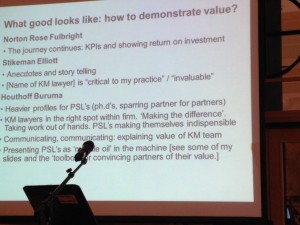
What Good Looks Like

“what good looks like: demonstrating value” (of KM)

What advice would I give Legal KM’ers?

  • Fix something for someone quickly.” A great quote from a panel session to which I’d add, focus on a maximum of 3 issues, adopt a pilot approach and show results in first 6 months.
  • Embrace the ‘Barbarians at the Gate‘: Legal KM’ers are getting their accreditation as Green or Black Belts. KM’ers have the facilitation skills needed to get lawyers to do process mapping and need to learn the language and practices of Lean / Continuous Process Improvement supported by Enterprise Search or change the dialogue at the senior level so that KM interventions are embedded into process. I noted: “continuous improvement can reinvigorate KM importance of process maps and fishbone diagrams” from a session by Arjan Krans.
  • You need to be seen as a contributor to the delivery of the service to the client: During one of the sessions looking at turnover this statement was made: “Knowledge teams tend to be stable in Law firms”  prompting this question ‘Why?”  The reply: ‘A KM role is lifestyle decision with predictable time”.  The point was made that Legal KM’ers are less inclined to do the unsocial hours associated with Lawyers. In plenary I made the point that in all organisations those who are seen as ‘support’ or ‘operational’ rarely get the recognition rain makers do.
  • Become skilled at facilitating virtual meetings and collaboration. Communities (inwards and outwards) will continue to grow in importance. Firms are not spending enough equipping people with the social skills to make virtual encounters work effectively.
  • Get in front of the client. A quote that really struck home. A lawyer was asked if he had run the proposed Application past the prospective client base. His response: “No I have a clear ideal of what they want.”
  • ‘Get the squeaky wheels on side’.  Have a One Pager (preferably with a visual) that summarises what you do (and don’t) do.
  • “We (legal) use scattergun approach to sharing knowledge. Use social media or die!” Nicky Leijtens

And finally:

I heard this from the two legal counsels pleading for a change in the way the client / firm dynamic works: “collaborate not push, it starts to rain newsletters all of which are the same”.”Clients don’t want exclusive portals with law firms. Don’t think me & my client, think in terms of communities”

Law firms need to ensure the knowledge circulated and shared w/ clients differentiates, distinguishes & sets them apart.

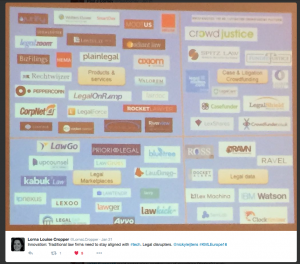
I left with this, a slide captured by Lorna Louisa Cropper: “Innovation: Traditional law firms need to stay aligned with .”

Screen Shot 2016-01-26 at 18.30.30


“Bringing the brain of the company to the field”: behind the scenes look at the production of our book

If ever there is a great justification for starting a Knowledge Management (KM) programme then the title quote from an interview with John McQuary encapsulates it. KM works when client proposals or solutions draw on the collective wisdom of an organisation.

It’s one of many superb quotes and stories, from the series of research interviews conducted with global practitioners: from Colombia to Australia by way of USA, Canada, UK, France, Belgium, Malaysia and Singapore, for the forthcoming book Patricia Eng and I are co-authoring. In all 18 interviews and more than 40 hours of audio material on KM in Energy, Shipping, Nuclear, Financial Services, Military, Engineering Services, Aviation, Health, Consulting, Manufacturing, Education, Food and Regulatory.

Patricia, who was previously Head of Knowledge Management at US Nuclear Regulatory Commission, and my task is now to turn the material collected into, in her words:

” The book I wish I’d had when I started”

IMG_4320

Which is why she and I spent time in Henley-on-Thames last week analysing what we’d heard in the interviews.

Let me take a step back.

It all began when:

I met Patricia in 2014 while I was chairing KMUK and she was a guest speaker describing the KM programme she’d set up and run for the organisation that oversees the US Nuclear industry.  Learning from near misses and from good practices while improving the way ‘newbies’ are inducted into the business had saved her organisation an estimated US$37 million while she was at the helm of the programme.

About the same time I was running Masterclasses on Effective Knowledge Capture and Retention and seeing real interest from organisations who’d recognised the potential risk of knowledge loss from merging, downsizing and retirements or as a result of having specialist skills resident in a small number of individuals only.

After exchanging ideas post conference we felt we had sufficient synergy to begin collaborating on a book focused on “Proven Knowledge Capture & Retention: Between Theory & Practice.”

Though our combined experience is approaching 80 years of business with a significant slug in KM and related activities we wanted to draw on the experiences of great practitioners.

Establishing criteria / identifying interviewees:

We agreed it was important to approach people who’d actually done it and got their hands dirty: who experienced highs and lows and maybe also seen their programmes wither on the vine after they or their sponsor left.

We knew many global practitioners, from chairing and speaking at/ attending KM related events but we wanted to spread the net wider than our own sphere of influence so in effect conducted a virtual “Peer Assist’ with senior global KM’ers and these are the criteria we set for selecting interviewees:

  •  A KM professional that actually built a KM program for an organization they worked in, as opposed to a consultant who was brought in to work on a KM program and then left.
  •  Have spent at least 2 years on the programme.
  •  Primary person responsible for the KM programme – interfaces with executives
  •  Can point to a clear ROI, e.g., productivity or monetary
  •  A KM professional who can speak to what constituted the ROI:

Our thanks go to Patrick Lambe, David Gurteen, David Williams, Karuna Ramanathan, Shawn Callahan and Chris Collison for their recommendations.

Setting up the interviews, thinking about the questions:

In my Masterclasses I always stress how important the interview set up is.  Apart from thinking about the where its always vital to give the prospective interviewee time to think about the answers and to tell them what the process is. Here’s the questions we asked:

  • Tell me about the circumstances and the drivers behind the original knowledge retention programme and who was involved?
  • How did you go about determining what knowledge to try and capture/retain?
  • Give me a brief snapshot of how you went about capturing it.
  • What was the biggest challenge you had to overcome?
  • How did you convince your management to go for it? ‘Business Case?’
  • What difference do you think it made to your organisation?  What was the actual return on investment?
  • Is there a particular highlight you remember?
  • Having done this if you had to do this over again what would you do differently?
  • And finally what would you tell someone about to set out on a programme to capture and retain knowledge?

We also added:

  • If there is one book you felt helped or inspired you what would it be?

Conducting and recording the interviews:

We had a list which grew from 12 to 18. Patricia volunteered to do the interviews (she is good at it) as we felt continuity in style was important.

We thought about using technology to help with the cataloguing and analysis. Instead we agreed not to transcribe verbatim but to each listen to the interview and make our own notes / key points which we’d discuss face to face in January 2016.

We learned a lot (remembered a lot) about the importance of having technology back ups and also that many corporates don’t allow Skype.  We found that taping the conversation proved good enough for us to listen to and that DropBox was an effective and secure storage vehicle for the tapes.

Analysing & Sensemaking:

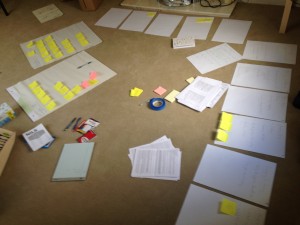
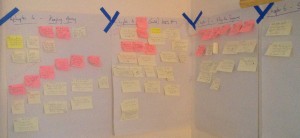
And so last week we found ourselves awash with flip charts, postit note, and marker pens. By Friday evening we had a structure for the chapters of the book and a pretty good idea of the examples, stories and quotes that would fill them. Here’s a snapshot of how we went about organising the material:

IMG_4343

What I found interesting, the varying drivers for starting KM across the interview base. Most were due to Risk, a lot were down to Innovation & Process Improvement, some were as a result of the CEO’s Vision and a couple because of Regulatory or Audit findings and a call to action.

And finally:

With an outline (and publisher) in place we can now set about writing to meet the deadline of having a good manuscript that does justice to the insights provided by the interviewees (e.g. KM Bonus Points, ‘Knowvember’ Award, Rock Lite, Adaptive Case Management,  XpressoX, ‘Pick a Problem’, SME Protoge Program…) ready before the summer.