What Turkish steps and an Iranian wrestler can teach us about learning during and learning after.

Its 00.15 on Monday morning and Turkish Airlines flight TK0898 from Istanbul Sabiha Gokcen International Airport has arrived on stand 20 minutes late in swirling snow at Tehran Imam Khomeini International Airport. To be fair the journey which started at London Gatwick at 11.55 on Sunday has been very good but with a busy day ahead, and a 60 Turkish Air Stepsminute drive to Hotel Niloo, the chances of being in bed much before 2am are receeding.  Then events take a turn for the worse!

The steps to dissembark have a fault and it will be a further 20 minutes before an alternative is delivered to offload a plane load of very grumpy passengers many of whom are Europeans on the first visit to Iran.

Fortunately I am at the front of the plane so able to converse with the Cabin Cheif.  She is looking at the manual of useful information to give passengers during the flight and there is no entry to cover this situation. So she declines to make a comment while passengers fulminate. It could have all been so different!

I am a great fan of checklists believing them to be knowledge enabled documents which should be, if they are regularly updated, the best practices of an organisation. And as I was to suggest during my client visit the best way to bring about a change in checklists often starts with an After Action Review (AAR) or a Learning Review.

I know organisations where after an event (like the end of a flight) the team would have held a quick debrief using the AAR template:

  • What was supposed to happen;
  • What did happen;
  • Why was there a difference:
  • What can we learn from this;
  • What can we do better next time;
  • What actions should we take; and
  • Can we celebrate success?

The AAR session would have surfaced all the issues about the lack of communication and (maybe) occasioned a change in operating procedures and their checklist – encouraging the cabin staff to keep people updated when things go wrong!

This is where the true value of tools such as AAR come in, they are precursors to a change in procedures or checklists. Many organisations’ Knowledge Management (KM) activity culmiates in the share and reuse step. I have come to realise while working alongside Ron Young and Knowledge Associates that the true value of KM comes from the step of Harvesting which involves turning what has been collected into learning’s and proposed process improvements which the process owner and subject matter experts review and accept or reject.  Checklists then get updated (or not) at that point and the organisation learns from doing!

Lessons Learned when ‘my knowledge is my soul’

For the Harvesting step to work effectively though there has to be an environment that recognises and values the process of capturing and building on learning’s from such tools as AAR. Too often this process throws up dozens of action points few of which get actioned. If you can’t count the actions on the fingers of one hand its unlikely anything will happen as a result.

A few years ago in Khartoum I was to discover that knowledge has a more spiritual feel/meaning in the Arabic and Farsi speaking world. ‘My knowledge is my soul’ is a good indicator of how personal knowledge is viewed and this (taken from a corporate Code of Ethics booklet) reinforces the view that a purely Western approach to the use of tools such as After Action Reviews, Lessons Learned Workshops and Pause & Reflect sessions will not work:

We believe the ethical confrontation with failures should be through awareness, consultation giving the subordinates the opportunity to rectify and compensate for mistakes and applicaton of regulations fairly,,,

So what will? Perhaps this gives an insight.

The Wrestler’s story

During my recent trip to Iran I was taken to the landmark Milad Tower. Around the viewing gallery are a collection of silicon ‘wax’ works of some of Iran’s most famous and loved figures.  There are many poets, writers, a few politicians and one sportsman:

Iran Wrestler

Gholamreza Takhti

Gholamreza Takhti is one of the most, if not the most, loved sportsman in Iran. Here’s why: Takhti tended to act fairly when competing against rivals during his career, something which originated from traditional values of Zurkhaneh, a kind of heroic behaviour that epitomizes chivalrous qualities known as Javanmardi.

For instance, once he had a match with Russian wrestler Alexander Medved who had an injured right knee. When Takhti found out that Medved was injured, he avoided touching the injured leg and tried to attack the other leg instead. He lost the match, but showed that he valued honorable behavior more than reaching victory.

This act of chivalry and exceptional sportsmanship is seen as the desired way to behave and permeates a lot of business dealings.

And finally

Effective Knowledge Management relies on effective Personal Knowledge Management.  Appealing to the corporate good and the team ethic is not going to win supporters or make people feel individually empowered.

Addressing the  ‘What’s in it for me?’ question is vital: this is not purely about money but also recognition, self esteem and personal development.  It’s one reason why many senior corporate positions are filled by academics and people value certification as a way of demonstrating knowledge and expertise.

On the downside it can breed a culture of learning but not necessarily doing: ‘if I am to be punished for making a mistake then why would I try to do it in the first place and I certainly won’t acknowledge it afterwards.’

While we in the West think its quite natural to have an open and frank dialogue about what we could do better next time, its not always the case elsewhere. Our challenge is to find a way to surface learning’s and build them back into process while recognising its counter culture in a personal risk averse environment.

Think ‘Hippo’: good public speaking and the importance of ‘knowledge enabled’ checklists

This week I was at a Public Speaking Competiton in memory IMG_4167of Ian Gow the former MP for Eastbourne and Northern Ireland Secretary murdered by a bomb some 25 years ago.  Ian was a vociferous opponent of the broadcasting of parliament so it was ironic he was to give the first televised speech in the House of Commons.  A great piece of oratory, its well worth the 15 minutes or so to watch it: https://www.youtube.com/watch?v=La00bV3I4q8

The MP for Eastbourne Caroline Ansell was inspired by Mr Gow and initiated this event for local schoolchildren aged 13-14. The topic they were given to speak on was ‘Democracy’ (an apposite topic in the light of the challenge to ‘our’ way of life posed by Da’ish) and the pupils from 5 schools had 10 minutes in groups of 3.  The judging panel included Broadcaster and Journalist David Dimbleby also a local resident. I decided to attend on the basis you are never too old to learn from others not matter how young.

The performances were hugely impressive and reflected well on the UK’s oft maligned education system. Well reasoned arguments were put forward by articulate youngsters often with humour and passion.  Of course there were the odd hiccup’s: one group who spoke without notes forget their lines; another group used stapled notes and got them mixed up; and when some groups used the lecterns they became a barrier between them and the 100 strong audience.

The 3 winners, from Gildredge House School, were well rehearsed, used small prompt cards (no lectern) and spoke with clarity, purpose and passion.

Here are my ten speech making recommendations (having heard Claire Carpenter, a speaking coach and the chair of judges, give her critique).

  • Think: about how you dress for the occassion; to blend in or to stand out?
  • Open: make a strong start; share the journey on how you came to be here.
  • Heart: show passion with humility as well as humour, if you believe then the audience will find your conviction compelling.
  • Pace: be constant, don’t go faster as you near the end.
  • Pause: for key points by looking up at the audience.
  • Knowledge: demonstrate by using stories and statistics to illuminate what you are saying; make the stories relevant to the audience.
  • Intrigue: pose rhetorical questions (and let the silence hang).
  • Notice: be aware of the audience; let them feel part of the speech.
  • Implements: ensure props and prompts do not become barriers.
  • Hold: your audience is likely to remember a maximum of three messages/points.

As someone who has delivered keynote speeches across 4 continents I am indebted to the training I received back in the 1980’s when I worked at Saudi International Bank. Each of the front line managers were sent away for a couple of days to work on presentation and speech making. Much of what I learned then has stuck, especially the need to use the ‘did you get that’ pause while looking up at the audience when making a key point.

Perhaps the greatest lesson was this, no matter what the technology or means of delivery: ‘Tell them what you are going to say, say it and then tell them what you said.’

Which brings me to the related item I’d like to raise.

‘A tool to make experts better’

Instead of watching TV I often spend some of my leisure time looking at TedTalks. Recently, thanks to a recommendation by Dr Dominique Poole-Avery of Arup, I viewed a thought provoking lecture ‘How do we heal medicine’ given by Dr Atul Gawande and seen by more than a million.

Author of The Checklist Manifesto, Dr Gawande charts the expenential growth of knowledge in medicine contrasting the experience of entering hospital in 1937 with that of today. Then, if your symptom didn’t fit one of the main areas of clinical expertise, your survival was questionable whereas today the problem is not too little but too much knowledge (of the tens of thousands of conditions a human can contract) and being able to pinpoint the symptom and prescribe the right medication or surgical procedure.

Then, autonomy and independence were the prized values. Today there is a recognition that we cannot know everything and everyone is a specialist with a piece of the care pathway but the constraint now is cost not knowledge.

He pointed out that there is a limited correlation between the cost of care and the effectiveness of the treatment. Having great components isn’t enough, it has to be about how it all comes together and used the anology of how pulling together the best parts of the best cars wouldn’t make the best car – it would be a piece of expensive junk!

The drive for cost management has meant health care has to become more process driven. In surgery people are very well trained with great technology but often it isn’t joined up with repeatable processes like aviation as an example.

Screen Shot 2015-11-26 at 13.19.03He spoke eloquently about the how the use of a 19 item 2 minute checklist (process – see alongside) helped to bring about a 47% reduction in surgical mortality rates in 8 hospitals across the globe during a World Health Organisation sponsored initiative.  It was bigger than a drug!

What I found compelling is the recognition that surgical team set up (and introductions) are just as important as anticipation of critical events.

The checklist forces people to confront the fact they are not a system and to work with humilty, discipline and teamwork.

Having visited Darfur as part of a WHO mission in 2010 and then Khartoum in 2013 to  help Sudan’s Health Industry to look at what Knowledge Management might do for them I have seen the importance of checklists as a Knowledge Transfer tool.

My message to the young speech makers (and to all who read this), we can all learn from others no matter what age or profession. Dr Gawande’s TedTalk ticks most of the good speech boxes while also making some memorable points about the importance of a tool that has become a life saver and shows the power of Knowlege Management.

So what is a checklist?  A tool or process that consolidates best knowledge and needs constant updating to reflect new experiences of practioners, organisations and communities.

And finally

The keen eyed among you with a gift for scrabble may have worked out that the ten observations above form ‘THINK HIPPO’.cartoon-hippo-06


The elephant fable: a Chinese reflection on KM, innovation and knowledge capture techniques

Introduction

To set the following discussion into context, my name is ‘Jonny’ Jiang, I am a PhD candidate on service design and service innovation at a design school in London.Jonny I am working part time with Paul at a start-up charity Plan Zheroes to deliver services to make better use of surplus food and help people in food poverty.

Thanks to Paul, I have been given opportunities to learn from his expertise in knowledge management and practice some of his methods to capture knowledge and insights in that charity.

As result, I am able to reflect upon my journey of knowledge management at the charity and my research in service design.

Interestingly, by comparing these two distinctive fields of practices, it gives me some thoughts around the importance of how we can generate new knowledge and insight around innovation.

KM tools for learning during and after

Let’s talk about some of the knowledge management methods I learnt in this process. Before jumping into these practices, I should tell you I had very little understanding of knowledge management apart from my general reading around business journals.

Paul sat down and demonstrated to me one of the previous knowledge capture sessions he ran with one of employees at the charity. He explained the rationale of capturing and sharing knowledge among staff through interviews with employees before their leaving and during their life cycle with us.

As I understood, it is very important to understand each individual’s experience and perspectives on his or her journey here and on specific events in particular in order to spot and improve the internal and external operation.

One of the other rationales I understood very well at the end is Paul’s point on the element of constructively building a better relationship with interviewees even after their leaving to help them reflect upon the personal growth and learning during the period of working inside the organisation, which I realise is very important to each party and helps nurture Alumni Networks.

Later on, I have been given an exercise to listen to Paul’s recording on his interview and using his knowledge management toolset (e.g. brief, time map, experience circle, questions) and conclude my findings based on those.

Then a few days after, we sat down again to compare our capture of knowledge based on the same interview and reflected together on some of my questions and learning’s. This was an incredibly effective session with Paul because I am able to learn by practice from Paul’s expertise to help equip a newbie in knowledge management with knowledge, practical tools and confidence.

I took the lessons and tools from this exercise and conducted an interview with employee who was about move to another city and leave the charity. Once the interview has done, I sat down with Paul again to reflect on my interview and report of this knowledge capturing practice.

Most of Paul’s methods have been already described and explained very well in this blog, so if you want to figure out what tools and methods I have used, please click on this post ‘Going not forgotten: knowledge capture in a hurry’.

Check out the timeline tool as a way to effectively reflect the knowledge and insights accumulated along the journey. It is a powerful tool because

  • It gives a common language that visually displays our thinking’s and provokes thoughts around the highlights and lowlights of the journey. In my interview it helped us to reflect on interviewee’s expectations at the start of job, which gives us lots of insights on how we manage the expectation during staff induction.
  • Mutually, it also gives an opportunity to help the interviewee consolidate the learning from the job that can be transferred to future careers.

My elephant and the correlation between design and knowledge management

As Paul invited me to write down my reflections after this exercise, I was fascinated by how similar and powerful the practices around knowledge management and design as a source for organisational innovation can be. As many of us  interpret the word ‘knowledge’ with a connection to ‘science’ ‘scientific’ and ‘objective’, there seems to be a misunderstanding of the value in ‘subjectivity’ and ‘social artefacts’.

As we all come from different experiences in life and become who we are because of those experiences, we all develop very distinctive perspective on the world based on the things we learnt and have done in the past.

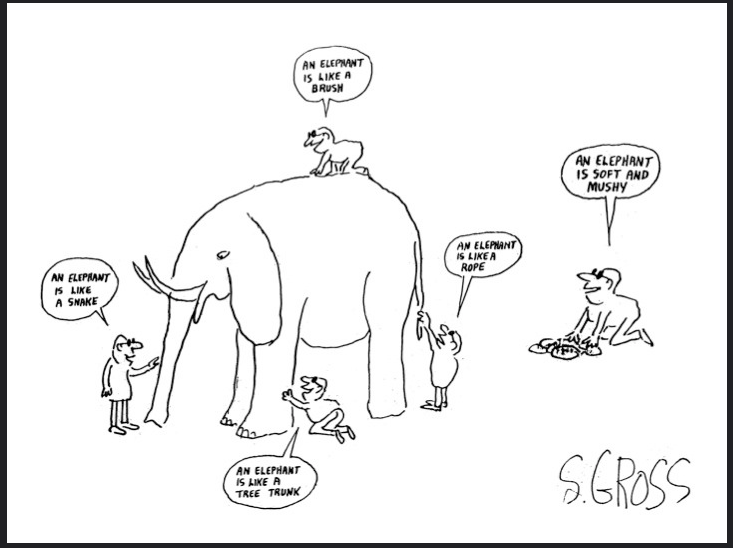
It is like one of fables I learnt as a child which described four blind people who gave a very different description of the elephant by touching it from their own positions.

https://www.flickr.com/photos/climateinteractive/13944682478Each seems to be fully convinced by their ‘objective’ interpretation and deny others’ views of what the elephant ‘truly’ is. It is obvious, in the fable, that each of them only ‘sees’ their part of reality.

The elephant and social facts. source: https://www.flickr.com/photos/climateinteractive/13944682478

In real life, this fable maintains a sense of inspiration too. We all experience a building differently from where we look at it. It can look small from a bird’s eye view or intimidating if standing alongside it.

In organisational management nowadays, particularly large organisations, operations can be highly siloed and lacks ways of detecting those subtleties in perspectives. It means each department may have their very own budget and competing agenda and develop their very own ways of understanding and doing things under the cover of ‘specialisation’.

Those silo operations based on ‘the only one way’ present danger of neglecting the values in perceiving or doing something differently that is at the core of innovation.

As such, knowledge management is becoming increasingly critical to recognise subtlety in each individual’s interpretation and map them in order to spot opportunities in the gap of our personal knowledge and experience.

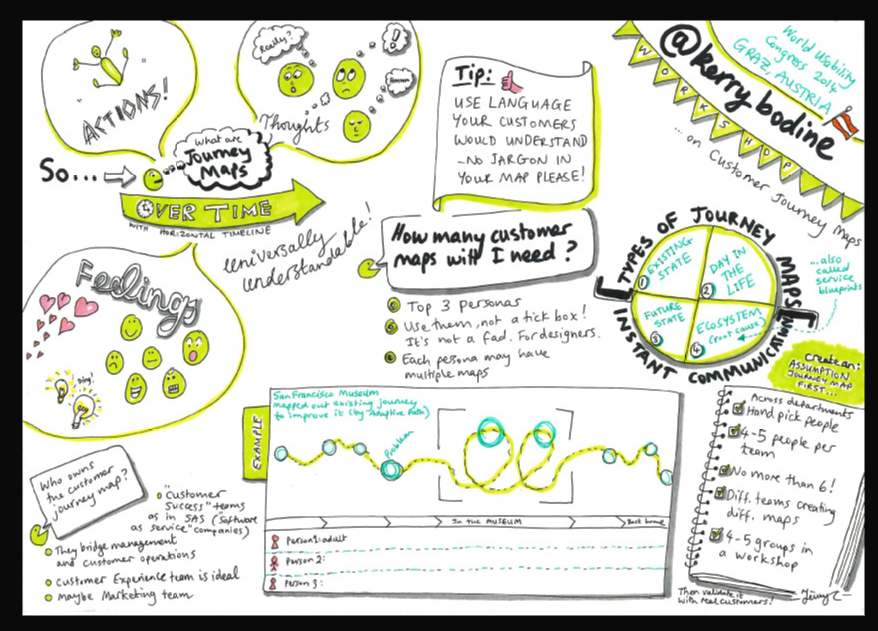
Screen Shot 2015-10-26 at 14.46.57In service design, this idea of interpretation has been very important in user research.

By mapping extensively, designers can understand better the users’ perceptions and behaviours and gather deep insights on where the opportunities can be for designing better customer experience and services.

One example of customer journey mapping. Source: (https://www.flickr.com/photos/97823772@N02/15410073995)

In Knowledge Management these interpretations can often reveal opportunities and strengths as well as failures and weaknesses.

And finally

The advice I can give to someone who is about to do the same exercise and interview a colleague who is about to leave is to take the default position of ‘he-or-she-knows-much-more-than-me’ rather than being judgemental on what you believe as the ‘truth’ or ‘reality’.

As many as we are coming from this global village, there is a great value in the diversity of perspectives and this is where I believe is the infinite source of innovation.

And of course, definitely check out those knowledge management tools on Paul’s shelf. They are really effective and surprisingly practical.

A comment from Paul

I have had the pleasure of mentoring ‘Jonny’ for the last couple of years during which time he has participated in board meetings, helped select a project management tool to act as store for the knowledge and documents on the various projects we’ve undertaken and conducted knowledge capture sessions. He is also the curator of our digital library.

I invted Jonny to be a guest contributor as I felt his experiences might be of value to others. Indeed his comments about the ‘give, get’ component of a knowledge capture process is particularly perceptive as often the drivers for such programmes are downsizing and layoffs where there is little positive feeling.

I am delighted he has contributed and would encourage you to join in with your comments.

From the ‘outside’: tips for running virtual meetings

Yesterday Plan Zheroes, the charity I am proud to be the Knowledge Trustee of, held a board meeting. Unablle at the last minute to get to the venue I participated virtually. Here are a few learnings I’d like to share from the ‘Outside’ of the meeting.

Visibility

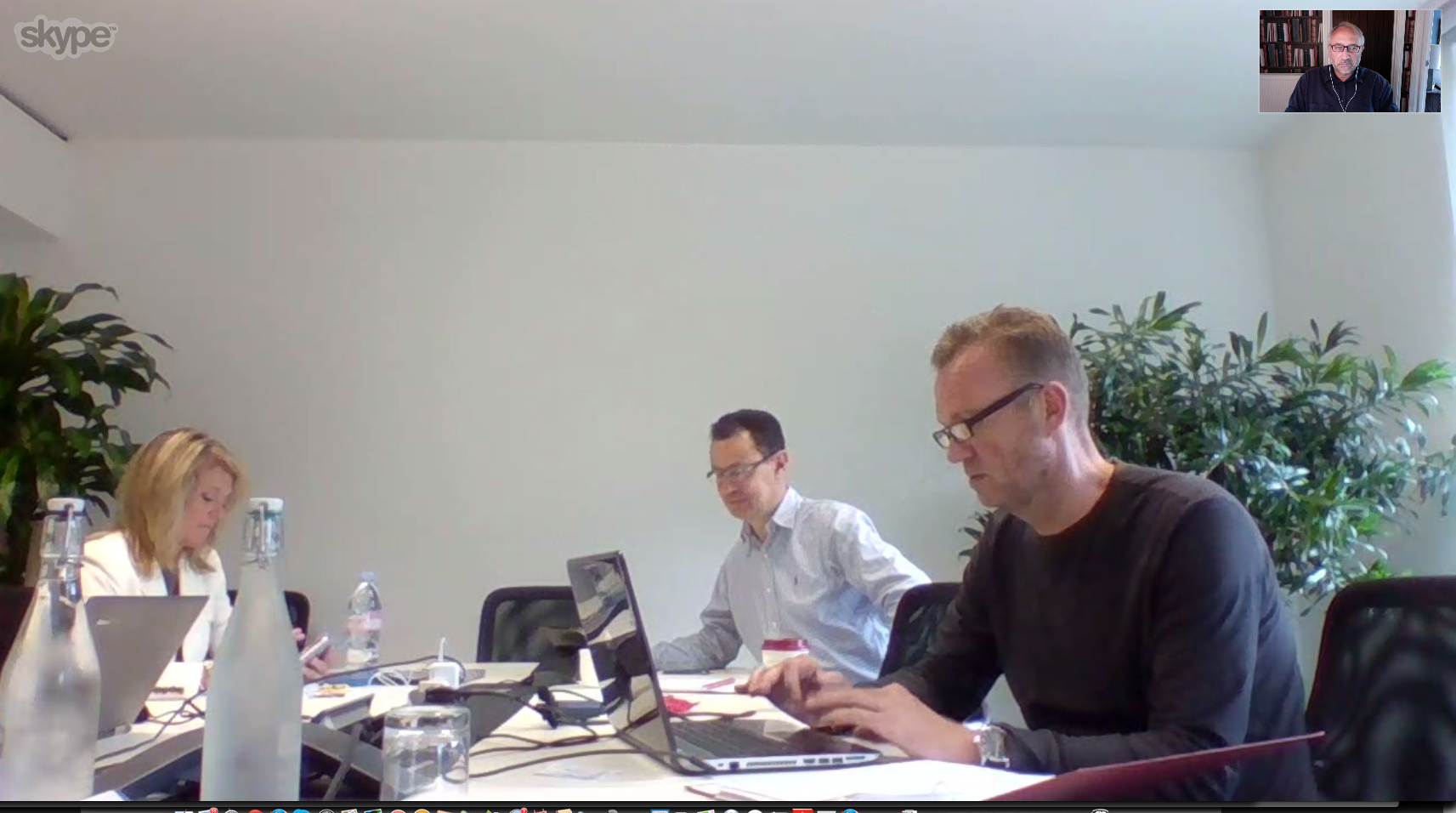
Screen Shot 2015-08-19 at 12.01.30All people in the room should be visible to the virtual attendee (s). If impractical then make sure the key players are.

As you can see we started with an empty space next to the Chairman where the CEO should have sat.

Connectivity

Unless you are in two specially built VC facilities the chances are you will be reliant on Skype or an equivalent VOIP connection.  To improve reception make sure all other programmes (especially email) are switched off on the host and virtual machines.

Scheduling

Build in breaks and make no session last for more than an hour.

Summarising

SInce conversations can often be distorted and difficult to follow from a distance (especially if there is interference on the line) make sure whomever is chairing the meeting summarises what was agreed at the end of each section of the agenda.

And finally

Don’t assume every word spoken in the room can be heard outside of it and be patient. I’ve seen virtual meetings fail because of an irritation with the technology +/or connection – why is it we always blame the other end for the poor connection – don’t apportion blame, apportion ownership of the task to get it right next time and have a back up system in place such as Facetime, ooVoo or Viber.

If you want more on this subject follow this link to a piece I wrote with Martin White of Intranet Focus for KM Legal 2015: 10 tips for effective virtual teams.

how to draw on the experience of others: OpenSpace Peer Assist

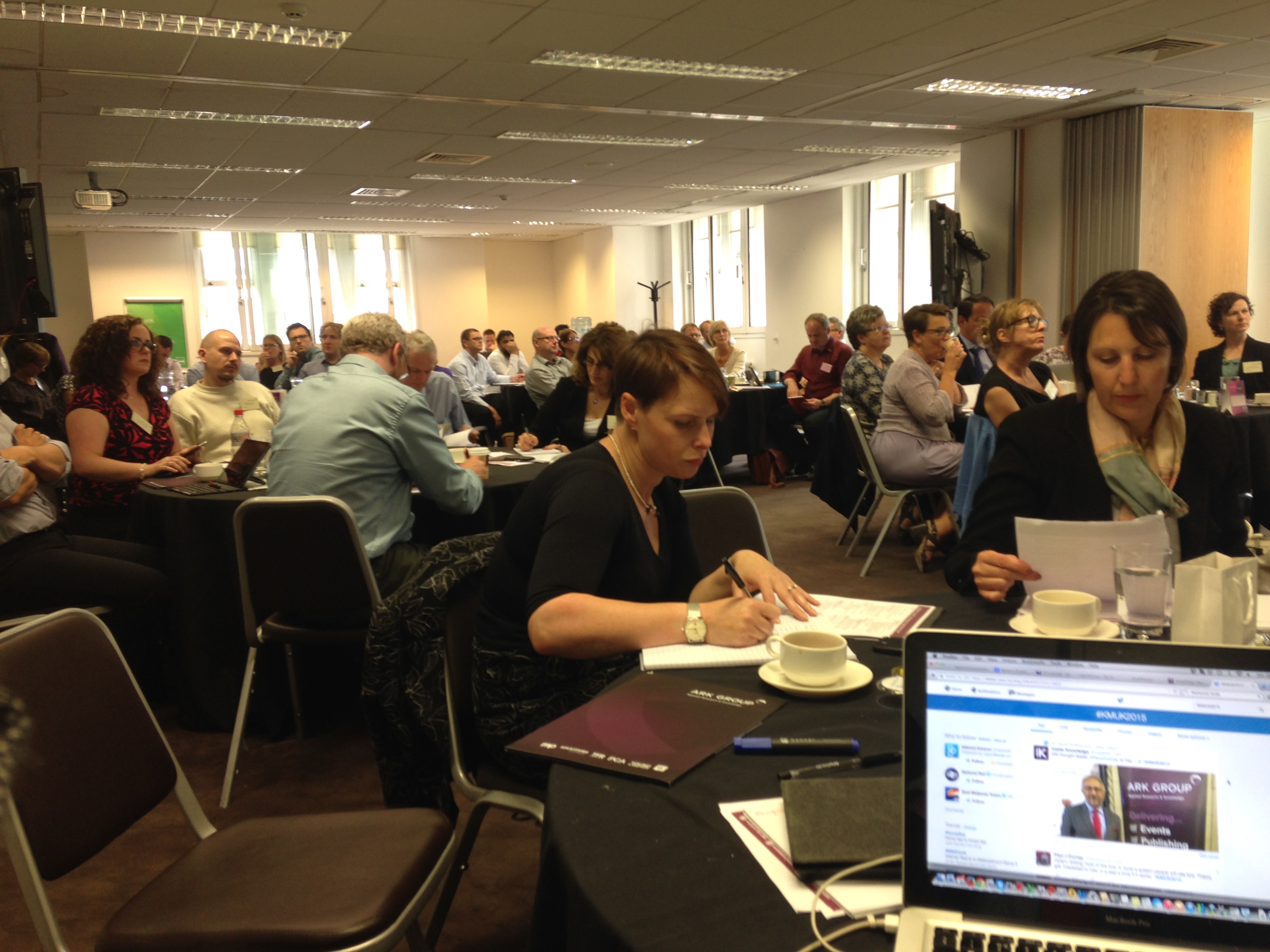
Last week I attended the 12th annual Knowledge Management UK event in London.

The format has changed little over the years: predominantly show and tell for IMG_3607an audience that is a mix of new in post and established mid level practitioners all looking for something to take back into their business.

This year I noted an increase in the average age of the delegates and more from Small and Medium Enterprise (SME) sector perhaps reflecting how KM has become an accepted discipline across many organisations. I am particularly looking forward to seeing the feedback comments this year.

I only attended Day One, my colleague Martin White was presenting on Knowledge Collaboration in Virtual Teams on Day Two (I know he will have a few comments to add). Suffice here to give a shout for a couple of the presentations which struck a chord:

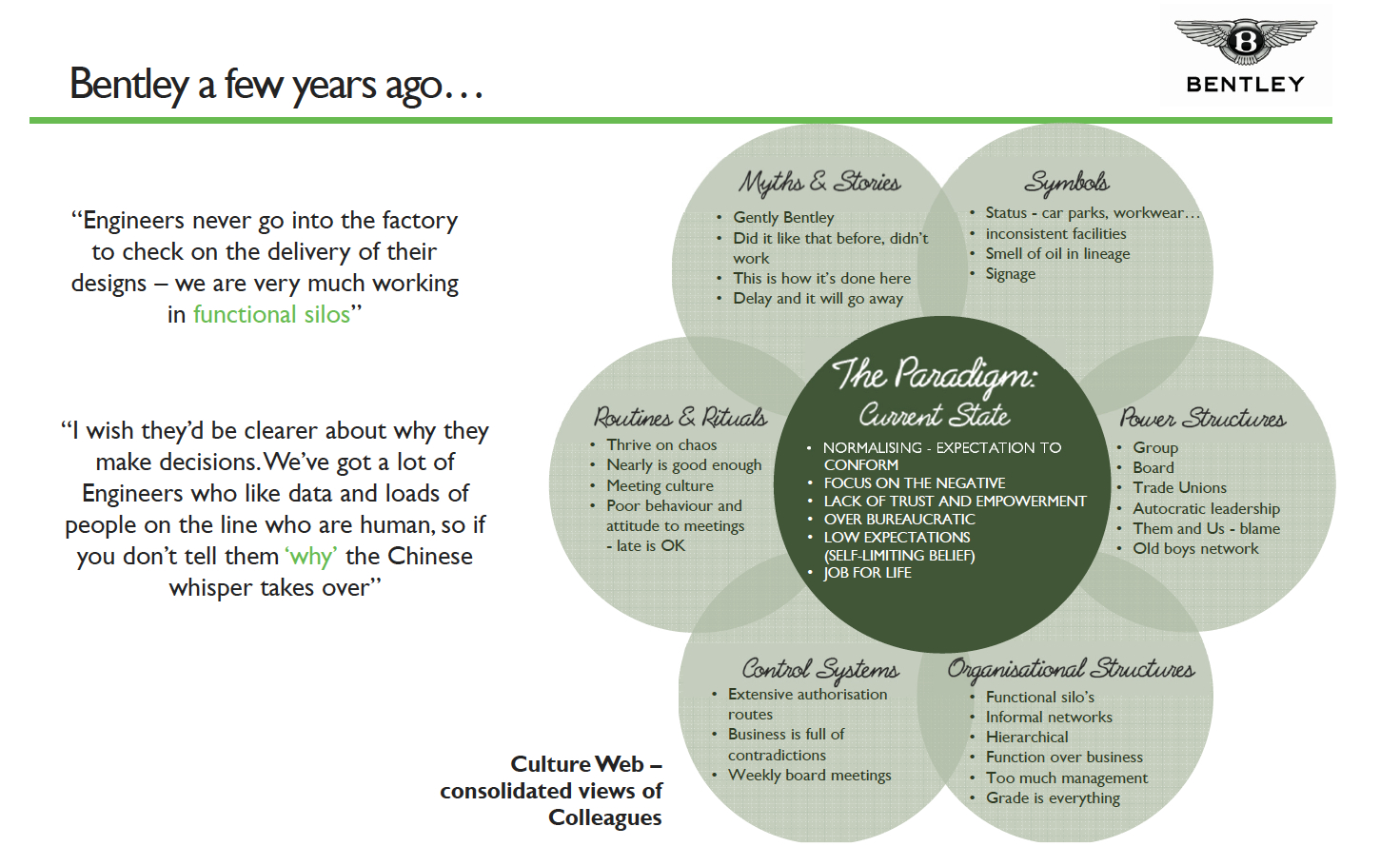
Culture Change in bentley motors to facilitate information sharing

Bentley CultureI particularly liked this Bentley Motors presentation as it mirrored my experience helping to intergrate a group of Anglo / Dutch / German / US businesses a decade ago. Now part of VAG group it has embarked on a medium term programme to align itself with their aspirations and working practices without a loss of the perception of quality.

The Hofstede findings when looking at German and UK characteristics pick up nicely where the potential Hofstede country comparisonareas of conflict were likely to be.

The premise behind the programme: information sharing requires the right cultural environment not a set of slloed business units.

building a minimum viable product: Oxfam

This session provided a great illustration of the importance of working to an agreed vision for a KM programme.

OxfamThe slide I’ve picked here makes explicit the concept of get/give – if you benefit from something you have a responsibility to contribute something back in return.

Its a great example of what being a knowledge driven business is truly about.

The second slide provides an image of what collaboration will look like in Oxfam Futurethe future at Oxfam. What’s really interesting is the explicit acknowledgement of the need for information underpinnings (including Search) to provide KM benefits.

There were a couple of others and if anyone wants a truncated account follow this hashtag #KMUK2015.

OpenSpace Peer Assist

My brief was to run an interactive closing session (lasting 1 hour) that enabled the delegates to answer:

  • What problems are you facing?
  • In what areas would you like to share your experience with others?
  • What are others doing that you would like to find out more about?

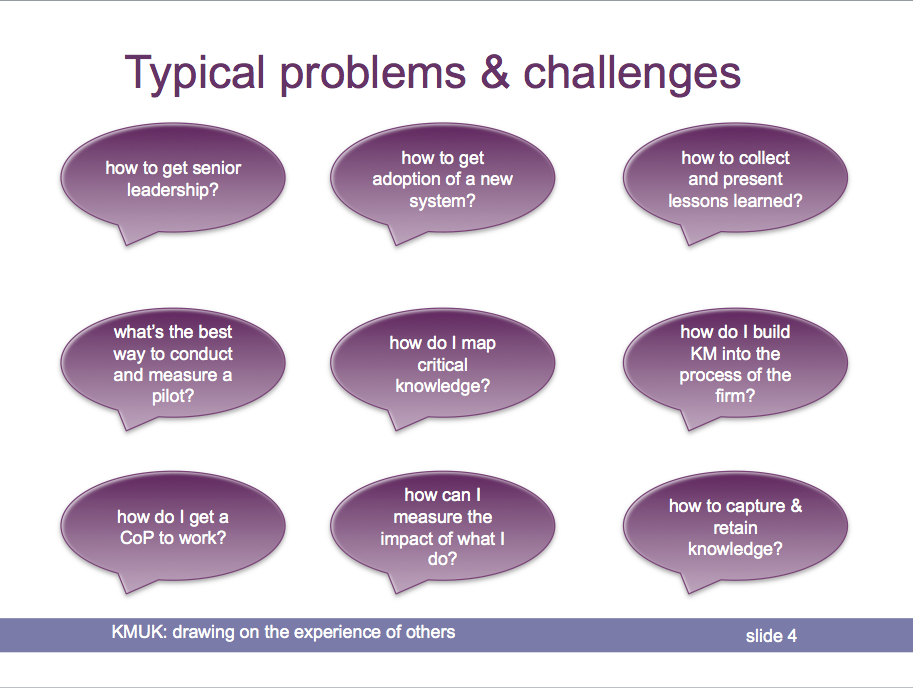
Typical problemsAs a backdrop I shared this list to stimulate discussion.

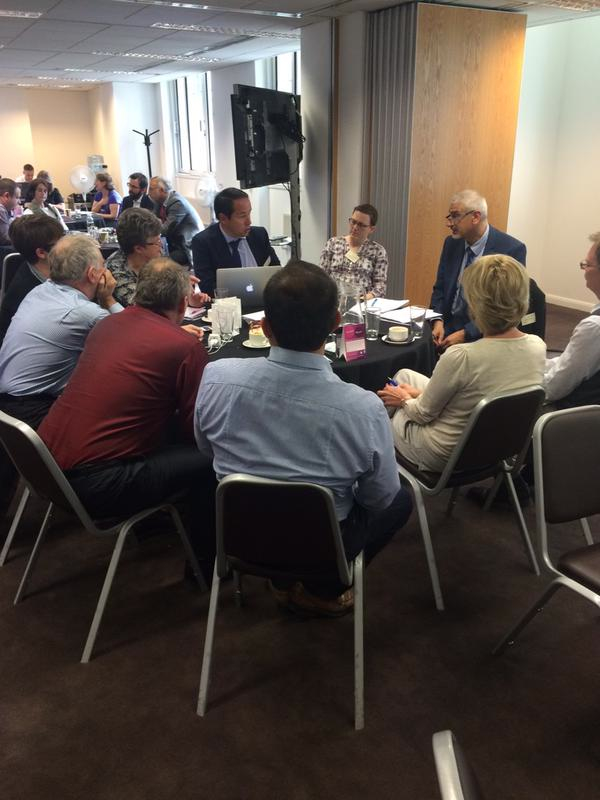
It wasn’t needed as many of the delegates were keen to have their challenge discussed and half a dozen volunteers came forward offering to act as the Assistee (host the discussion around their challenge).


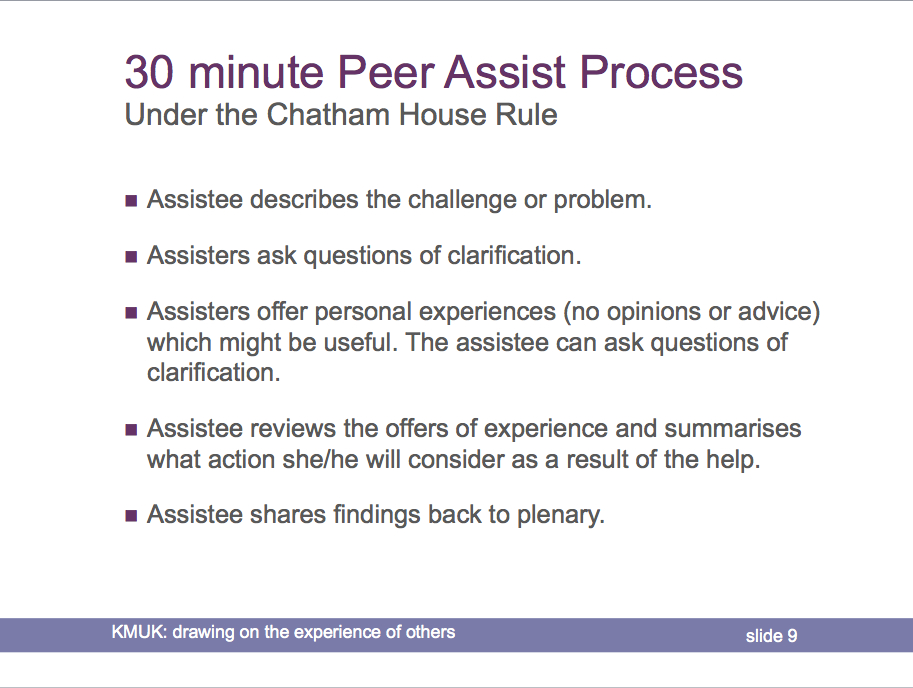
Having decided which challenge each delegate wanted to discuss, these guidelines were put up:Peer Assist Process

Below is a snapshot of the discussions taken from summaries which Laura Brooke of Ark Group  captured on her smart phone.

The idea of getting the Assistee to summarise is to consolidate the discussions and reflect back in plenary. I’ve shared them in case some of these might help you to overcome a challenge.

Knowledge Capture In a Legal environment

  • On getting people to talk about experiences: Documents don’t work, stories of events do!
  • On conducting After Action Reviews and getting people to acknowledge when things go wrong: often spoken about in meetings but minutes are not always taken and when they are they are not interactive so need a better way to record.
  • Asking someone to tell you what they know won’t work, instead ask them: What questions do you get asked all the time?  If you don’t know what people know at least you should know who to go and ask?
  • Challenge of self perceptions: Some people think they know a lot others don’t think they know anything important which is where a 3rd party might come in to tease out the valuable stuff.
  • Where to store: If you put everything into a site it would be too much. SharePoint to apply an automatic taxonomy.

how to measure real value on km and learning from experience

  • Saving time: at the beginning of the journey take an estimate of time to be saved and OpenSource Peer Assistmeasure throughout.  Help to develop people faster.  If KM is making a contribution on a project that should be recorded.
  • Improving the onboarding process so that new hires do not lose interest and leave.
  • Idea box (self funding): adopted by an expert, any returns should be applied back to KM.
  • Managing records: looking at information that has gone past sell by date and not legally required.
  • Why are we asked about KM value: should be a given that its needed.

system adoption

  • Practical examples of what’s in it for me tailored for each office.
  • Huge challenge getting people to fill in profiles on a people finder: need to show good examples with leaders to the fore.
  • Collaborative groups: form a community among the leaders of each.
  • Contributions to the system: change appraisal process to recognise the contributions.
  • Steering Group: make better use of it as system advocate.
  • Metrics: really good internal measures should be used for advertising.
  • When all else fails shut down the other systems!

How to get leaders to take km more seriously

  • While senior people understand the value they don’t back it financially.
  • Siloed approach to communications: – a set of inconsistent messages even from KM champions.
  • While KM is part of a strategy its often seen as a tick box exercise.
  • Accountability: make objectives more transparent.
  • Business Case: more analysis on where we are starting from and show tangible stuff.
  • Reporting lines: KM should be an agenda item on senior level meetings just like risk!

Engaging with it

  • Make them heroes part of the vision for future which they jointly own and where their role is clear.
  • Recognise their workload and surface their inability to deal with multiple objectives with current resources.
  • Reaffirm the importance of the KM development strategy and its priority.
  • Look at success in other organisations: take IT ‘guys’ along to other organisations who have made it work.

what the participants said

Here’s a few of the comments from the Assistees and Assistors (names removed to preserve anonymity):

“Peer assist is a very powerful tool to deliver”
“I very much enjoyed being able to discuss a particular challenges with a group of peers.

Interesting to hear others’ view points and ideas and the types of challenges they face”
“Very good speaker – Style of session was very useful and interesting, more like this please!”
“Engaging, fun, informative – learned a lot from the session”
“Very good peer assist. I got a few ideas generated by the group for my situation”

and finally

Perhaps what surprised me the most was the show of hands I got to the question:

A Peer assist is a process that enables the gathering of knowledge drawn from the experiences of colleagues before embarking on a project or piece of work, or when facing a specific problem or challenge within a piece of work – How many of you have used Peer Assists in your business?

Less than 10% put up their hands.  Even with a modesty factor it still means less that 25% of Knowledge Management professionals at the event had used one of the most basic and valuable tools to draw on the experiences of others.  I’m glad I gave people the chance to try it out and learn from each other in so doing to solve real problems they are facing.