The rise of Legal ‘Lean’ and its impact on Knowledge Management: looking back at KM Legal Europe 2016

IMG_4381A year on from the Breakfast Breakout Martin White and I ran for Legal Knowledge & Information Management professionals in London I found myself back among them in Amsterdam at KM Legal Europe.

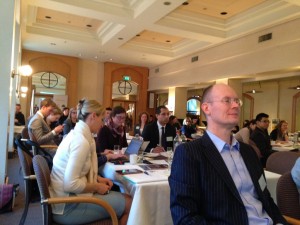
My brief was to provide a stimulating opening to the conference (I went with In at the Deep End – an Icebreaker I used at KMUK) and then give a presentation on the second day on Working Virtually. I was delighted with the enthusiastic response and the level of interaction that occured over the two days expertly led by Chairman Raffael Büchi.
Opening

So what did I see and hear (and learn), and where is Legal KM a year on?

Who or What’s driving KM in the Legal Sector?

Firstly, clients are becoming more sophisticated and insisting law firms are better. And new offshore firms are emerging that are making legal advice more a commodity product that can be disintermediated through technology. That’s having a knock on effect as firms bow to pressure for greater transparency, more efficient processes and better use of technology.

Some firms have also recognised the risk arising from the potential loss of knowledge when people and teams leave or the need to do more effective due diligence on the knowledge they are acquiring when people and teams join.

They are responding by ‘offshoring’, adopting established process improvement methodologies such as Lean/Six Sigma and integrating that into continuous proces improvement,  combining CRM with EDRM, building Legal Project Management capability,  attempting to get into their client’s shoes and using horizon scanning to take a look at the future.

From a Quality & Standards perspective, ISO 9001 certified firms and their Quality Managers are also casting a watchful eye on the emergent standards having noted the introduction of the amended regulations in September 2015 which for the first time made mention of Knowledge Management (Clause 7.1.6. Knowledge) noting: “The concept of organizational knowledge introduced to ensure the organization acquires and maintains the necessary knowledge”

The early KM adopters on dsplay in Amsterdam had visionary leadership to thank for embarking on their initiative, their challenge is sustainability when their sponsor departs.

These categories I find useful as a way of identifying the drivers behind a KM initiative:

  • Innovation / Process Efficiency
  • Risk Management
  • Quality & Standards
  • Vision

What trends did I see?

The ‘big’ trends for me were:

  • Rise of Continuous Process Improvment initiatives supported by Process Mapping and Automated Document Assembly,
  • Increasing use of Predictive Analytics “law has talked billable hours for ever. Clients using Artifical intelligenceI to cross check time sheets and identify duplicate effort”
  • A recognition that billable time can be apportioned to KM related activites. I noted, “big change happens when lawyers can charge billable hours while working on KM. some tried contributor of the month rewards.”

What surprised me?

The number of partners who are known as Knowledge Partners which illustrates a career path now for Legal KM’ers.

We use Social Media to recruit but not to collaborate. In a good open discussion it was clear that the majority were sceptical about using Social Tools citing confidentiality. I was drawn to this comment from Erik Hunter who in his opening to Day Two encouraged the audience to: “think about the science of social media, the thoughts behind it, not just as push tools for comms & sales.

Offshoring – where is my knowledge? Few of the people I spoke to had considered or made attempts to mitigate the risk of knowledge loss from outsourcing operational activitives.

The idea of a “call outs for know how” by the KM team. A tailored process based on deal flow. Looking for nuggets from across the firm.

The establishment of a Corporate University in a legal firm who have a competency framework that includes a metric of min 50 hours per year commitment to KM.

Continuous Process Improvement supported by Enterprise Search that can look across Matters Directories.

Despite recognising the importance of good project management training for the changing world the training was described as being too generic.

Use of the Knowledge Assets phrase in a couple of presentations.

Quotes that stuck (or got retweeted)

“KM means bringing the brain of the organization to the client” Paul Corney

“The value of a flexible and evolving strategy cannot be underestimated.” Andrea Alliston

“Active collaboration leads to better communication leads to more innovation.”Contract Express

“To get collaboration right you need to have good community management and know what your knowledge is” “Don’t let the collaborative tool lead the effort” and “Good stories drive good collaboration habits.” Andrew Pope
What Good Looks Like

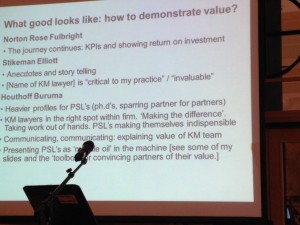
“what good looks like: demonstrating value” (of KM)

What advice would I give Legal KM’ers?

  • Fix something for someone quickly.” A great quote from a panel session to which I’d add, focus on a maximum of 3 issues, adopt a pilot approach and show results in first 6 months.
  • Embrace the ‘Barbarians at the Gate‘: Legal KM’ers are getting their accreditation as Green or Black Belts. KM’ers have the facilitation skills needed to get lawyers to do process mapping and need to learn the language and practices of Lean / Continuous Process Improvement supported by Enterprise Search or change the dialogue at the senior level so that KM interventions are embedded into process. I noted: “continuous improvement can reinvigorate KM importance of process maps and fishbone diagrams” from a session by Arjan Krans.
  • You need to be seen as a contributor to the delivery of the service to the client: During one of the sessions looking at turnover this statement was made: “Knowledge teams tend to be stable in Law firms”  prompting this question ‘Why?”  The reply: ‘A KM role is lifestyle decision with predictable time”.  The point was made that Legal KM’ers are less inclined to do the unsocial hours associated with Lawyers. In plenary I made the point that in all organisations those who are seen as ‘support’ or ‘operational’ rarely get the recognition rain makers do.
  • Become skilled at facilitating virtual meetings and collaboration. Communities (inwards and outwards) will continue to grow in importance. Firms are not spending enough equipping people with the social skills to make virtual encounters work effectively.
  • Get in front of the client. A quote that really struck home. A lawyer was asked if he had run the proposed Application past the prospective client base. His response: “No I have a clear ideal of what they want.”
  • ‘Get the squeaky wheels on side’.  Have a One Pager (preferably with a visual) that summarises what you do (and don’t) do.
  • “We (legal) use scattergun approach to sharing knowledge. Use social media or die!” Nicky Leijtens

And finally:

I heard this from the two legal counsels pleading for a change in the way the client / firm dynamic works: “collaborate not push, it starts to rain newsletters all of which are the same”.”Clients don’t want exclusive portals with law firms. Don’t think me & my client, think in terms of communities”

Law firms need to ensure the knowledge circulated and shared w/ clients differentiates, distinguishes & sets them apart.

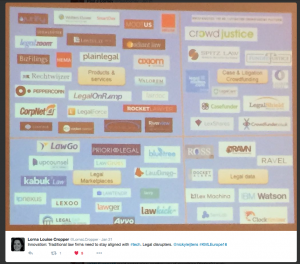
I left with this, a slide captured by Lorna Louisa Cropper: “Innovation: Traditional law firms need to stay aligned with .”

Screen Shot 2016-01-26 at 18.30.30


In recognition of my Dad “a lovely man”: when knowledge capture becomes personal

John Corney, my Dad, died in August a month shy of his 87th birthday. Though not unexpected the timing of it was.  I was lucky in the sense I got to say goodbye and to reflect while he was still with us on his amazing contribution to and guidance for my own life.

Dad was a ‘lovely man’ a phrase / tribute we oft heard from those who knew him and a private man. I realised as he neared the end of his life that though we were close there were so many aspects of his background that were opaque to me.

He was of the ‘old school’ a meticulous senior banker involved in international trade who passionately believed ‘my word is my bond’ and that debt is a commitment to be honoured.  He was not loquacious or a natural storyteller; instead he eschewed the limelight though he was well read, capable of deep insight and eager to debate topics he found stimulating.

For him ‘social’ was a word associated with a gathering of people not an online activity.  Though he recognised the value of the internet, Apps, Smartphones and Tablets were alien concepts to him.

What you might ask has this personal story got to do with business? Here’s how:

  • As Executor of his estate charged with carrying out his wishes I wanted to understand the thinking behind his approach to investment.
  • I also wanted to understand more about his early life and how he made decisions.
  • Dad was similar to many senior executives who are often reluctant to acknowledge that their contribution has been significant.

Perhaps subliminally I drew on many of the techniques I encourage others to adopt when trying to capture critical knowledge from people about to retire or relocate:

  • I used a timeline to look at significant milestones in his life with photos as a prompt.
  • We talked about books he had read that had helped shaped his thinking.
  • We talked about people he most admired.
  • We went through his ‘blue book’: a transactional history and ledger of all assets.
  • We sat and watched something and used that as a neutral space for a conversation.
  • I spent days ploughing through his archives.

A big regret is that I didn’t record any of these discussions but the stories and artefacts remain and I am now their custodian with a duty to pass them onto his great grandchildren so that they too can appreciate John’s legacy.

And finally

When people leave organisations after a long period legacy is a word often cited as the justification for a knowledge capture interview. What many overlook is the step of thinking up front what is the critical knowledge they are looking to surface during the process.

This mirrors many of the stories emerging from the interviews my co-author Patricia Eng is undertaking for “Navigating the Minefield: A Practical KM Companion” book which we are aiming to publish next year. Often the driver for these initiatives has been a reorganisation, takeover or downsizing; in effect a firefighting exercise.

Setting up a programme to consciously capture knowledge is expensive and time consuming: it needs a clear rationale/driver and a set of measurements to track its efficacy and value.

Knowledge Capture EventI am looking forward to evolving my own thinking when I am in Lisboa next month running this masterclass with Ana Neves. It aims to raise awareness of the importance of critical knowledge: how to identify it, how to go about capturing it and how to go about making it available for reuse.


how to draw on the experience of others: OpenSpace Peer Assist

Last week I attended the 12th annual Knowledge Management UK event in London.

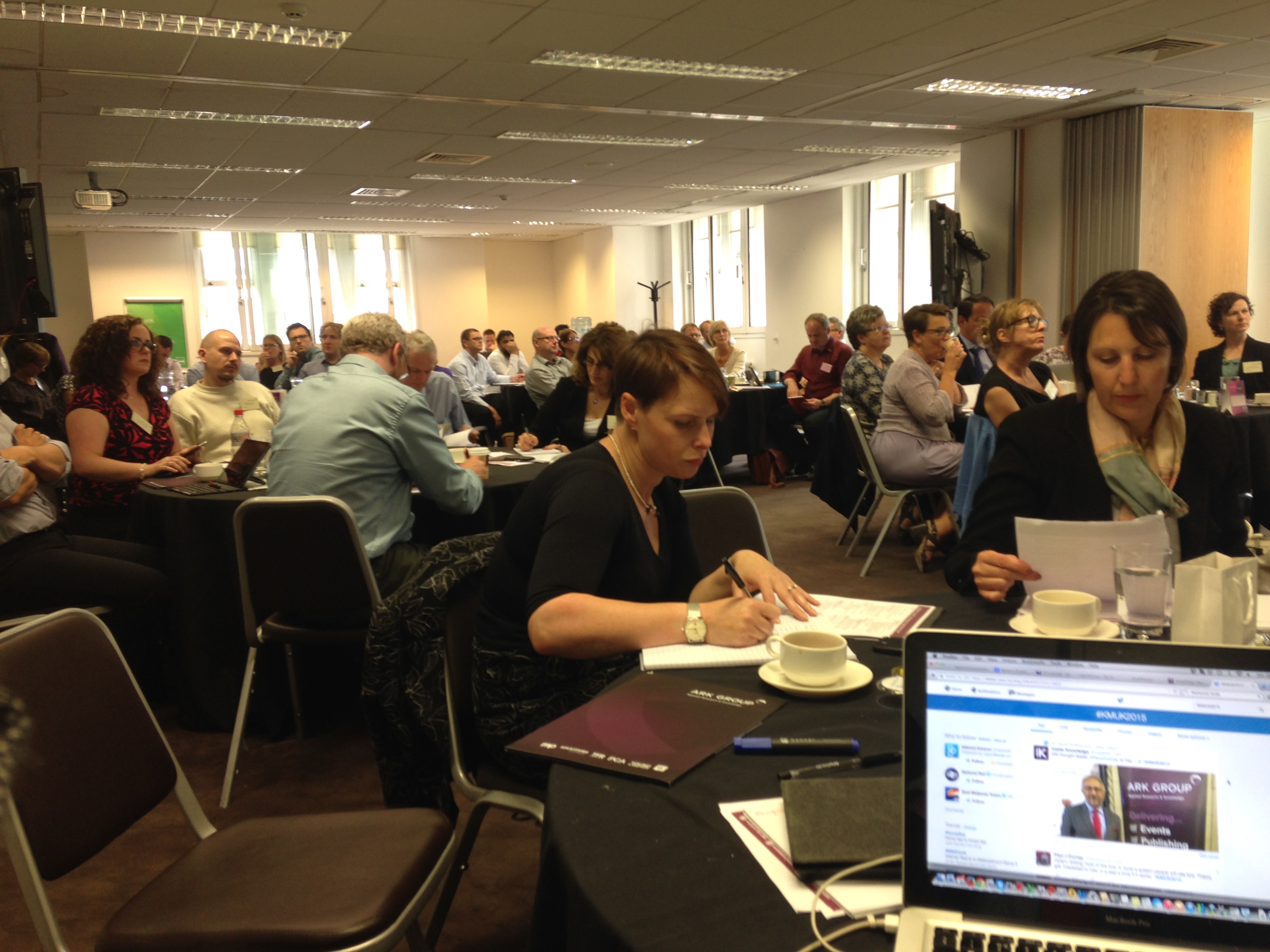
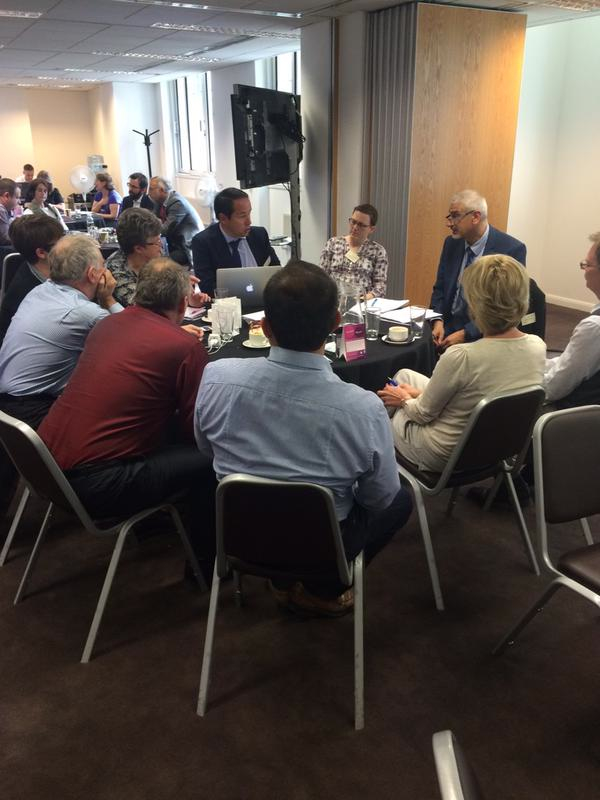
The format has changed little over the years: predominantly show and tell for IMG_3607an audience that is a mix of new in post and established mid level practitioners all looking for something to take back into their business.

This year I noted an increase in the average age of the delegates and more from Small and Medium Enterprise (SME) sector perhaps reflecting how KM has become an accepted discipline across many organisations. I am particularly looking forward to seeing the feedback comments this year.

I only attended Day One, my colleague Martin White was presenting on Knowledge Collaboration in Virtual Teams on Day Two (I know he will have a few comments to add). Suffice here to give a shout for a couple of the presentations which struck a chord:

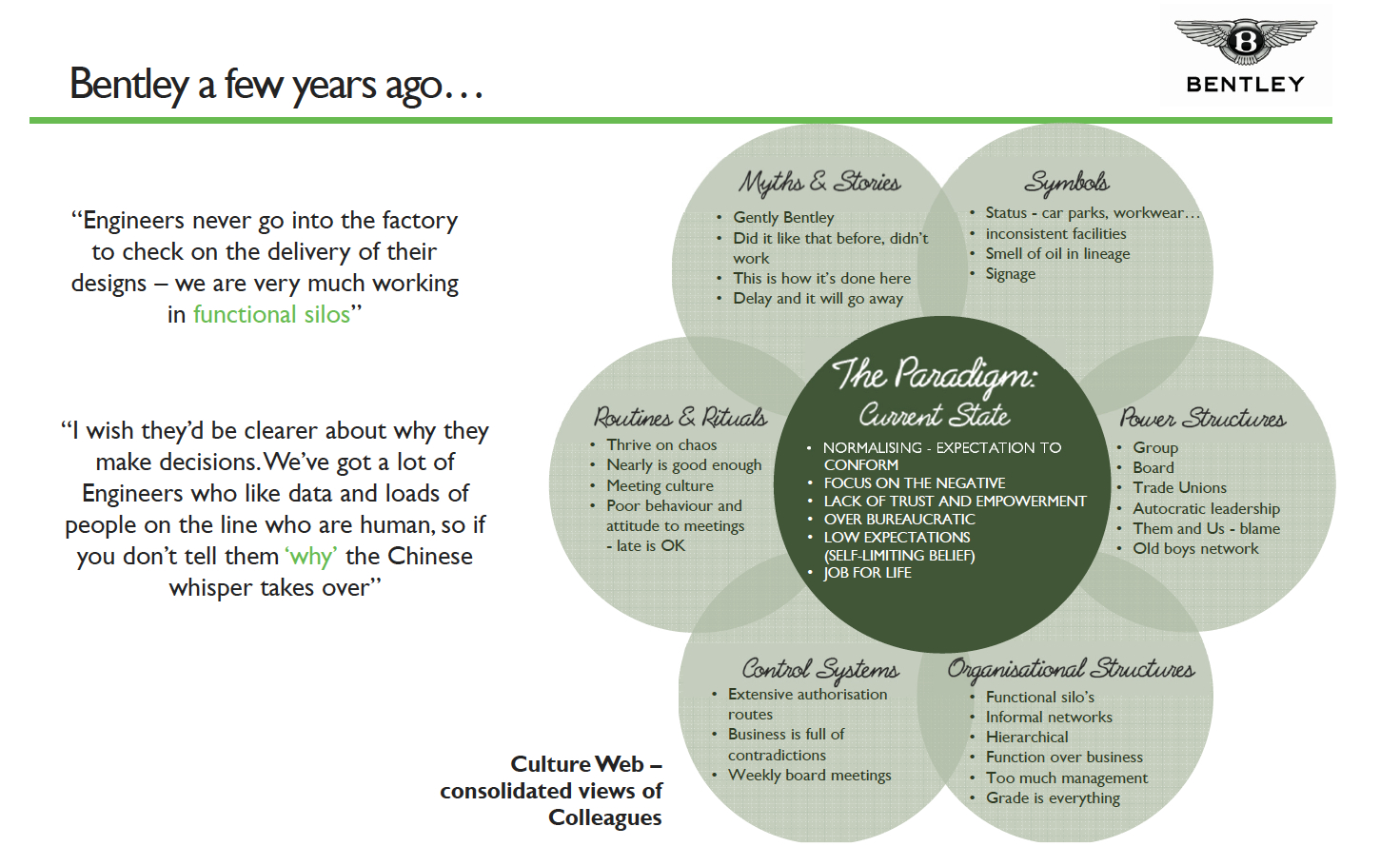
Culture Change in bentley motors to facilitate information sharing

Bentley CultureI particularly liked this Bentley Motors presentation as it mirrored my experience helping to intergrate a group of Anglo / Dutch / German / US businesses a decade ago. Now part of VAG group it has embarked on a medium term programme to align itself with their aspirations and working practices without a loss of the perception of quality.

The Hofstede findings when looking at German and UK characteristics pick up nicely where the potential Hofstede country comparisonareas of conflict were likely to be.

The premise behind the programme: information sharing requires the right cultural environment not a set of slloed business units.

building a minimum viable product: Oxfam

This session provided a great illustration of the importance of working to an agreed vision for a KM programme.

OxfamThe slide I’ve picked here makes explicit the concept of get/give – if you benefit from something you have a responsibility to contribute something back in return.

Its a great example of what being a knowledge driven business is truly about.

The second slide provides an image of what collaboration will look like in Oxfam Futurethe future at Oxfam. What’s really interesting is the explicit acknowledgement of the need for information underpinnings (including Search) to provide KM benefits.

There were a couple of others and if anyone wants a truncated account follow this hashtag #KMUK2015.

OpenSpace Peer Assist

My brief was to run an interactive closing session (lasting 1 hour) that enabled the delegates to answer:

  • What problems are you facing?
  • In what areas would you like to share your experience with others?
  • What are others doing that you would like to find out more about?

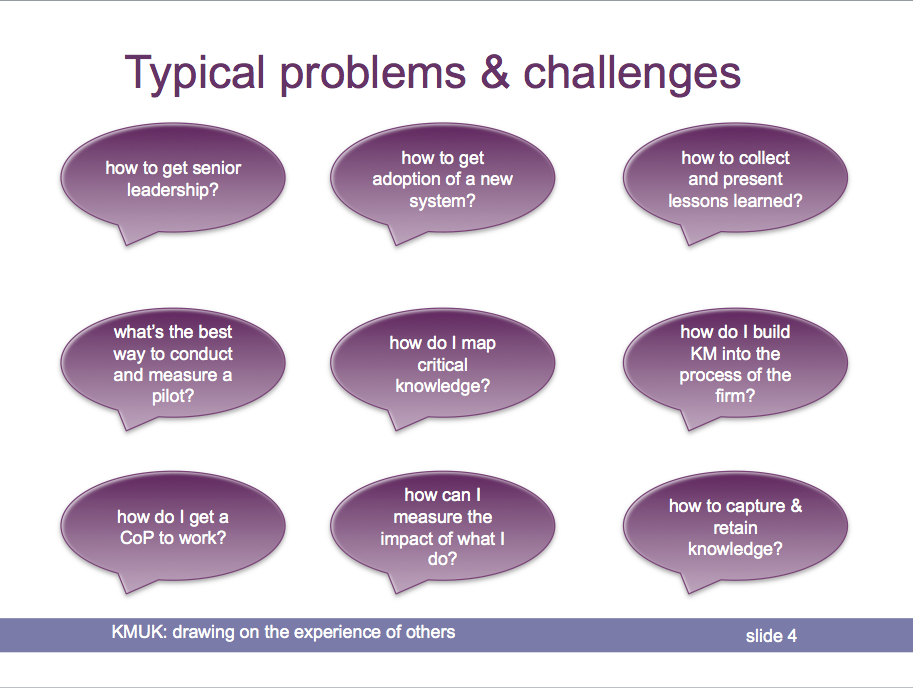
Typical problemsAs a backdrop I shared this list to stimulate discussion.

It wasn’t needed as many of the delegates were keen to have their challenge discussed and half a dozen volunteers came forward offering to act as the Assistee (host the discussion around their challenge).


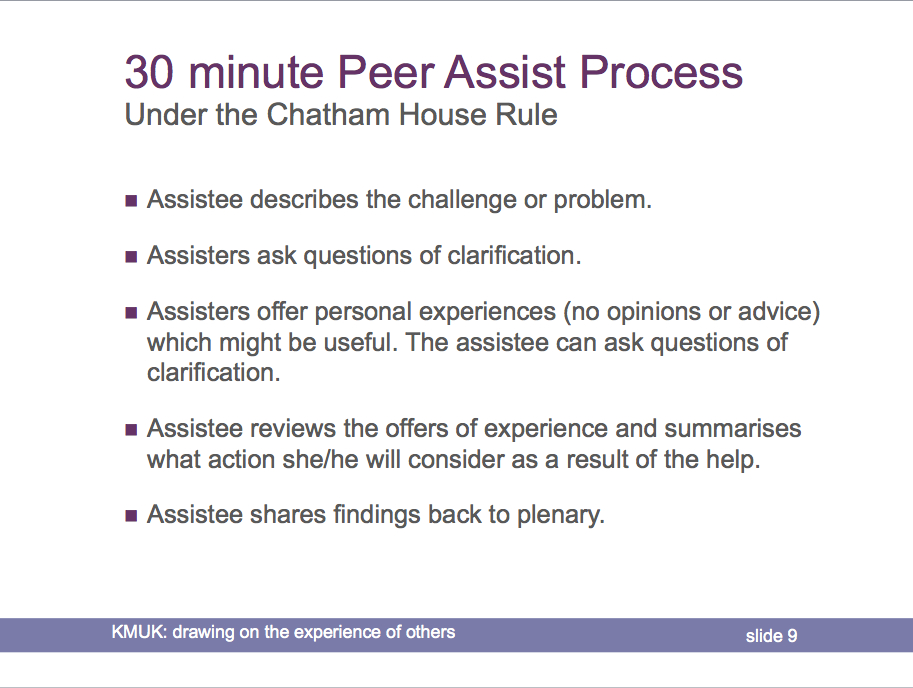
Having decided which challenge each delegate wanted to discuss, these guidelines were put up:Peer Assist Process

Below is a snapshot of the discussions taken from summaries which Laura Brooke of Ark Group  captured on her smart phone.

The idea of getting the Assistee to summarise is to consolidate the discussions and reflect back in plenary. I’ve shared them in case some of these might help you to overcome a challenge.

Knowledge Capture In a Legal environment

  • On getting people to talk about experiences: Documents don’t work, stories of events do!
  • On conducting After Action Reviews and getting people to acknowledge when things go wrong: often spoken about in meetings but minutes are not always taken and when they are they are not interactive so need a better way to record.
  • Asking someone to tell you what they know won’t work, instead ask them: What questions do you get asked all the time?  If you don’t know what people know at least you should know who to go and ask?
  • Challenge of self perceptions: Some people think they know a lot others don’t think they know anything important which is where a 3rd party might come in to tease out the valuable stuff.
  • Where to store: If you put everything into a site it would be too much. SharePoint to apply an automatic taxonomy.

how to measure real value on km and learning from experience

  • Saving time: at the beginning of the journey take an estimate of time to be saved and OpenSource Peer Assistmeasure throughout.  Help to develop people faster.  If KM is making a contribution on a project that should be recorded.
  • Improving the onboarding process so that new hires do not lose interest and leave.
  • Idea box (self funding): adopted by an expert, any returns should be applied back to KM.
  • Managing records: looking at information that has gone past sell by date and not legally required.
  • Why are we asked about KM value: should be a given that its needed.

system adoption

  • Practical examples of what’s in it for me tailored for each office.
  • Huge challenge getting people to fill in profiles on a people finder: need to show good examples with leaders to the fore.
  • Collaborative groups: form a community among the leaders of each.
  • Contributions to the system: change appraisal process to recognise the contributions.
  • Steering Group: make better use of it as system advocate.
  • Metrics: really good internal measures should be used for advertising.
  • When all else fails shut down the other systems!

How to get leaders to take km more seriously

  • While senior people understand the value they don’t back it financially.
  • Siloed approach to communications: – a set of inconsistent messages even from KM champions.
  • While KM is part of a strategy its often seen as a tick box exercise.
  • Accountability: make objectives more transparent.
  • Business Case: more analysis on where we are starting from and show tangible stuff.
  • Reporting lines: KM should be an agenda item on senior level meetings just like risk!

Engaging with it

  • Make them heroes part of the vision for future which they jointly own and where their role is clear.
  • Recognise their workload and surface their inability to deal with multiple objectives with current resources.
  • Reaffirm the importance of the KM development strategy and its priority.
  • Look at success in other organisations: take IT ‘guys’ along to other organisations who have made it work.

what the participants said

Here’s a few of the comments from the Assistees and Assistors (names removed to preserve anonymity):

“Peer assist is a very powerful tool to deliver”
“I very much enjoyed being able to discuss a particular challenges with a group of peers.

Interesting to hear others’ view points and ideas and the types of challenges they face”
“Very good speaker – Style of session was very useful and interesting, more like this please!”
“Engaging, fun, informative – learned a lot from the session”
“Very good peer assist. I got a few ideas generated by the group for my situation”

and finally

Perhaps what surprised me the most was the show of hands I got to the question:

A Peer assist is a process that enables the gathering of knowledge drawn from the experiences of colleagues before embarking on a project or piece of work, or when facing a specific problem or challenge within a piece of work – How many of you have used Peer Assists in your business?

Less than 10% put up their hands.  Even with a modesty factor it still means less that 25% of Knowledge Management professionals at the event had used one of the most basic and valuable tools to draw on the experiences of others.  I’m glad I gave people the chance to try it out and learn from each other in so doing to solve real problems they are facing.


the future workplace seen from the streets of London and the importance of conversations

Running a portfolio of activities is great. It has downsides though: The feeling of anxiety about what’s next; or guilt at taking a time out to do pro bono work when I could be responding to a request from a prospective client. And like every business marketing and relationship management has its cost.

But yesterday I decided to take a time out to reflect and think about the closing session at KMUK which I’ve been asked to lead. And this is how I ended up walking the streets.

John Blackwell is someone I met many years back while he was an IBM’er.  His ‘new’ organisation Quora devotes much of their time to help organisations think about the future of work and workspace.  Those who follow what I write will know working environments (space: virtual and physical) is a topic I feel neglected in Knowledge Management strategies and implementation plans.

mobile knowledge cafe in the street?

When John invited me to attend an afternoon session run by Street Wisdom at the Royal Society of Arts as part of his Smartworking Summit I was intrigued as the concept has caught on around the globe and seemed to be a sort of Knowledge Cafe in the street. Here’s what happened:

  1. Scene setting: David, Chris and Mel, explained what was about to happen over the next 3 hours.  In a pre-session discussion I’d described my ‘doctrine’ of Orchestrated Serendipity and that was used to illustrate what might happen. This is what we did.
  2. AIMG_3579 1wareness: Having assembled in 3 groups of 6 outside of the RSA we were invited to go off on our own for 8 minutes and observe – our choice, what we see and record. I noticed this pile (and someone’s bed) not 100 yards from this lovely peaceful spot.IMG_3580 1
  3. Slow: Back at ‘base’ we were asked to go off again at a very slow pace to see whether what we noticed is different because we have slowed down. My immediate emotion was of being in a bubble as everyone around me hurried about their business. Certainly I was more attuned to ‘things’ and it felt like I do at airports where I often switch off and withdraw in as a way of coping with the vagaries of travel. My 8 minutes over I return to ‘base’.
  4. Patterns: With my new ‘friend’ Mark from Sheffield I set off in search of patterns. This was interesting. As we walked we reflected on how we had already seen things we’d not normally see. We parted, me to Caffe Nero, he to the pub, both to watch.  I noticed: in a cafe people give themselves permission to talk; no one seems to use a paper map anymore, they use their smartphones; buses do come along in threes.
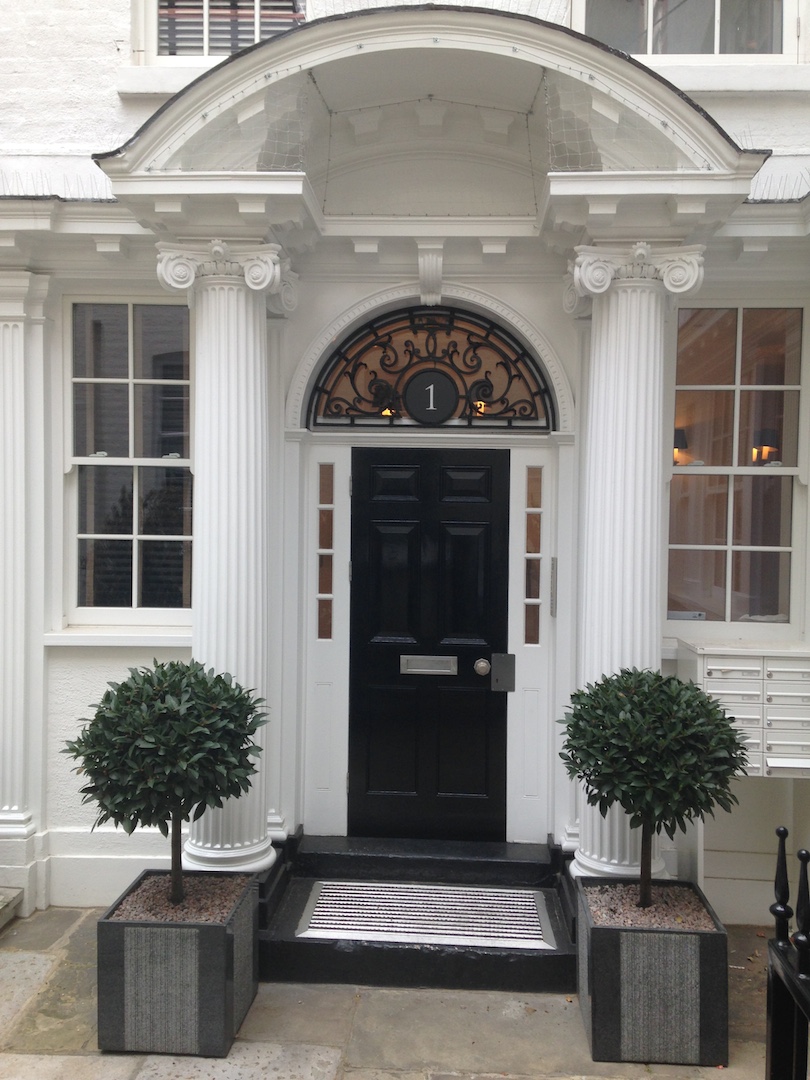
  5. IMG_3582 1Beauty: If the 8 minutes searching for patterns seemed a bit frivolous, 8 minutes looking for beauty (definition: ‘in the eye of the beholder’) was revealing. Literally 400 years from the rubbish and garden, up a twitten off The Stand I came across this magnificent abode which was being shown to a young Asian Student and his father. Amid the hustle and bustle of The Strand here was an oasis (at a price-1 bedroom starting at £895k!) which was aesthetically pleasing.
  6. Burning question: Fired up and ready to go I returned for my last task assignment.  I was to go off for 30 minutes to answer a burning question.  In my case this was to think about how I was going to run the forthcoming closing session at KMUK.
  7. Plenary: All valuable interventions end with a debrief / reflection session. Here we sat in a circle and shared what we’d seen and done. This was a precursor to a more expansive group conversation among two dozen people drawn from HR/Change/Facilities Management functions.

observations from plenary

The plenary session was stimulating: some worked virtually, others from Academia did a combination of home and away.  Here’s what emerged:

  • While virtual working is hugely advantageous to many, not everyone’s personal circumstances or culture fits.  Last week in Hong Kong I realised that with personal space at such a premium work has to take place away from the home. One virtual worker also noted that as a mother the flexibility is essential for her. She did note though that personal contact is essential to make sure a virtual team functions to its optimal level.
  • The grouping of people around a central office or campus is declining.  One view was that the Google and Facebook campus facilities are the last hurrah for this type of environment.
  • The future is about creating community hubs (closer to where people live) that permit drop out/drop in attendance based on a concierge hotel style service.
  • Current contractual arrangements are too restrictive and Zero hour contracts exploitative and not conducive to creating the element of trust needed for a different approach to task management. We discussed the idea of giving staff ‘space cards’ which they can redeem against usage at such approved venues.
  • No one is training us to work in the new way or in virtual teams and the training should begin in schools.
  • Digital was an adjective, now its a noun and with Bring Your Own Devices (BYOD) we are entering an era of extreme customisation of the workplace by the consumer.
  • No one ‘owns’ the topic at a senior level. Like Knowledge Management ways of working and workspace environment is seen as being a horizontal function straddling many disciplines.

my takeaways

  • The next 5 years will see an accelaration in the growth of the generic workspace.
  • ‘No one can speak twice until everyone has spoken once’ was a lovely approach from David Pearl (Founder of Street Wisdom) to ensure everyone in the plenary session got their say.
  • People and conversations matter, in fact they are vital for innovation and knowledge sharing: people share not technology.  I realised halfway through the session how important it is to have the imaginery ‘water cooler’ or coffee station area where you can go to share and be stimulated. By listening to others I was able to craft an agenda which otherwise I might have struggled with.
  • Street Wisdom worked for me when I recognised I had given myself permission to take time to slow down and reflect. It is an effective way of changing mindset and a case of: ‘when you look at things differently, the things you look at change.’
  • And finally, I managed to create a wrap up session for next week’s KMUK event. Watch this space to see what I did and how it went.

one to watch

Re-Imagining Work remains one of my all time favourite videos.  Dave Copin imagines what might be possible if more organisations embraced the empowering potential of technology and encouraged a truly open working culture.  It is a great accompaniment to this discussion and one I use frequently to stimulate a debate.

a reluctance to tweet: 10 success factors for virtual teams

It was like throwing a dart into a vacuum

Is how I responded on Twitter to Mark Gould an offsite observer of #KMLegal2015 who bemoaned the lack of online activity by the 100 or so Knowledge & Information Management (KIM) professionals who were attending this year’s Ark Group gathering of the UK KM legal community.

Its baffling: vendors, consultants and indeed KIM practitioners promote the value of social collaboration tools such as Yammer and Jive. Indeed KIM professionals are often at the forefront of efforts to get adoption in their organisation in order to improve collaboration and knowledge sharing. Yet they seem reluctant to ‘walk the talk’ in a public forum.

Perhaps Joanna Goodman got it right when she said:

sessions were quite interactive, so hard to be fully engaged and tweeting

It made me think more about why I tweet at a conference, this is what I posted during a virtual conversation with Luis Suarez a prodigious tweeter (58k to nearly 12k followers):

Why tweet a conference? Expand reach, collaborate, collect and share thoughts ‘on the fly’. Make notes for future blogs.

What really struck me though was the contrast with the Janders Dean Legal Knowledge & Innovation Conference, London #JDKMConf held the week before. That audience made sufficient ‘noise’ that even those who didn’t attend were able to draw conclusions. Here’s what Stephen Sander (The Vue Post) wrote in a witty piece about being a non attendee:

I curated below what I consider to be the best tweets from the Conference. These tweets offer an interesting insight into current themes and issues in legal knowledge, innovation and technology.

Perhaps this is the difference? The Janders Dean event was invitation only – a thought leaders event – whereas KM Legal is an open conference, if you pay up you can go!

Whatever the merits of both, facilitation should be at the core of the KIM professionals competency set and ‘putting stuff out there’ ia good part of that. Too many broadcast rather than engage. Knowledge Management in a comfort zone is not going to change the way a firm works and responds to the significant challenges facing the legal profession which brings me onto why I was there:

Managing Virtual Teams

In December, Martin White and I ran a breakfast breakout event at the RSA entitled The Future for Legal KIM: an outside in perspective’. One of the challenges firms identified as significant but for which they were ill prepared was the management of virtual teams. As a couple of long in the tooth practitioners who have worked across many continents we’d seen a wide range of organisations fail to match their virtual team technology investment with training in how to go about facilitating virtual encounters.

Virtual Teams Presentation StructureOur brief for KM Legal 2015 was therefore entertain the audience, bring the issues to life. Our approach: tell stories and show images.

We divided the presentation into these areas each drawing on events from our knowledge base.

In tackling the culture piece I noted the following:

Let me say right up front: you can’t manage culture just the same as you can’t manage knowledge. In both cases you can create environments in which people are willing to collaborate, share and work towards a shared set of goals.

Many organisations have a set of values and a social contract that underpins the relationship between the firm and employees.

Ultimately a firm is a collection of individuals each with their own reasons for being there. In a virtual team people’s fears, prejudices and behaviours are magnified.

In thinking and rehearsing for the session Martin and I had worked virtually. We learned a lot about clarity of messages and intent behind words and phrase (and we are both English). We (re) discovered the need for a collaboration space with a framework that suited us both.

We discovered a lot more besides, here’s what we shared with the delegates:

Ten virtual team success factors

  1. Virtual teams are the way work gets done: Recognise that virtual teams are going to be increasingly important to any organisation, and ensure that current and potential participants have access to training and mentoring on virtual team management and virtual team meetings.
  2. Set very clear and achievable objectives: Virtual teams should have very clear objectives so that it is possible to set the investment in the team against the outcome and also that team members bring appropriate skills, expertise and authority to take action.
  3. Chose virtual team leaders carefully: Leadership skills that work for physical teams may not be as valuable in a virtual team environment. Other skills are needed and have to be acquired through practice, not just through reading or teaching.
  4. Develop protocols for virtual meetings; Without good team meetings a virtual team is very unlikely to achieve its objectives and so particular care should be taken in developing guidelines for virtual meetings and for facilitating feedback.
  5. Provide team member profiles: Develop good profiles of each team member, taking into account local availability of technology and offices which can be used to take part in virtual meetings (especially in the case of open-plan offices) and language expertise.
  6. Build virtual relationships before putting them to the test: Each team should have an opportunity to meet with other members of the team through an initial virtual meeting where members can introduce themselves and gain experience with the technology being used before the first formal meeting of the team.
  7. Team dynamics can be difficult to manage: Team dynamics of virtual teams can be quite fragile, often depending on a very high level of trust in people they may not have met before. Introducing a new team member into an existing team may mean starting the process of building trust all over again.
  8. Gain consensus on what needs to happen between meetings?: Team members may have different reporting lines, which may impede the overall achievement of objectives. The measure of a virtual team is what it accomplishes between meetings, not how enjoyable the meetings are
  9. “English is our corporate language”: Issues of language and culture need careful consideration but should never be an excuse not to bring specific individuals into a team. There may be a mix of abilities in reading, speaking, understanding and writing in English
  10. Evaluate team and individual performance: The performance of the team and of each member should be carefully evaluated and training and support given where needed.