“… a brilliant and eye opening experience”: using ‘The Apprentice’ format for a good cause

This quote, from one of the Accenture team who took part in a Corporate Social Responsibility (CSR) volunteer day in blistering conditions at Islington, London a few weeks back, was in response to a question I posed at the conclusion of the event:

Q) As you leave: if someone in the office asked you about the day what would you say?

A) ‘Was a great day with a chance to do some real good.’ was another participant’s reply.

Those who follow my musings will know how honoured I am to be invited to become a founder trustee of the charity PlanZheroes (PZ) who aim to help make use of surplus food. The CSR day, one of a number of imaginative ‘offerings’ PZ developed, gives organisations and their employees a chance to put something back into their community while concurrently testing their innovation, teamwork, sales, negotiation and project management skills in a real life setting.

‘…your task…’

To make the day really energetic PZ introduced an Apprentice-style competitive element. Fifteen people, three teams, three separate areas of London: Who will raise most awareness and get most businesses and charities added to the map?

I was there with CEO Designate Maria Ana Neves and a team from PZ whose role was to shadow the teams as they made their way around Islington and to provide input for the debrief session that was to end the day.

The 16 participants began by introducing themselves and noting something that others might not know about them. This was to prove a great kick off session, part of the briefing to equip them for the time they were about to spend out and about in Islington.  We asked later what they’d expected:

Q) On arrival what were you expectations?

A) I did not expect the day to be as organised as it was or to have such supportive helpers

fired up and ready to go

Briefing over and armed with PZ badges and little books each team spent a while perfecting their strategy, the messages they were going to give to the organisations they met and who would be doing what.  A large part of the challenge of approaching food outlets is to recognise that surplus food is a natural by product of the suply chain, hence we advised them to avoid using the word ‘waste’.

IMG_1007

We were not to see them now for 5 hours so Maria Ana and I monitoroed their progress via Twitter and the PZ Map updated as contacts were made and organisations signed up.

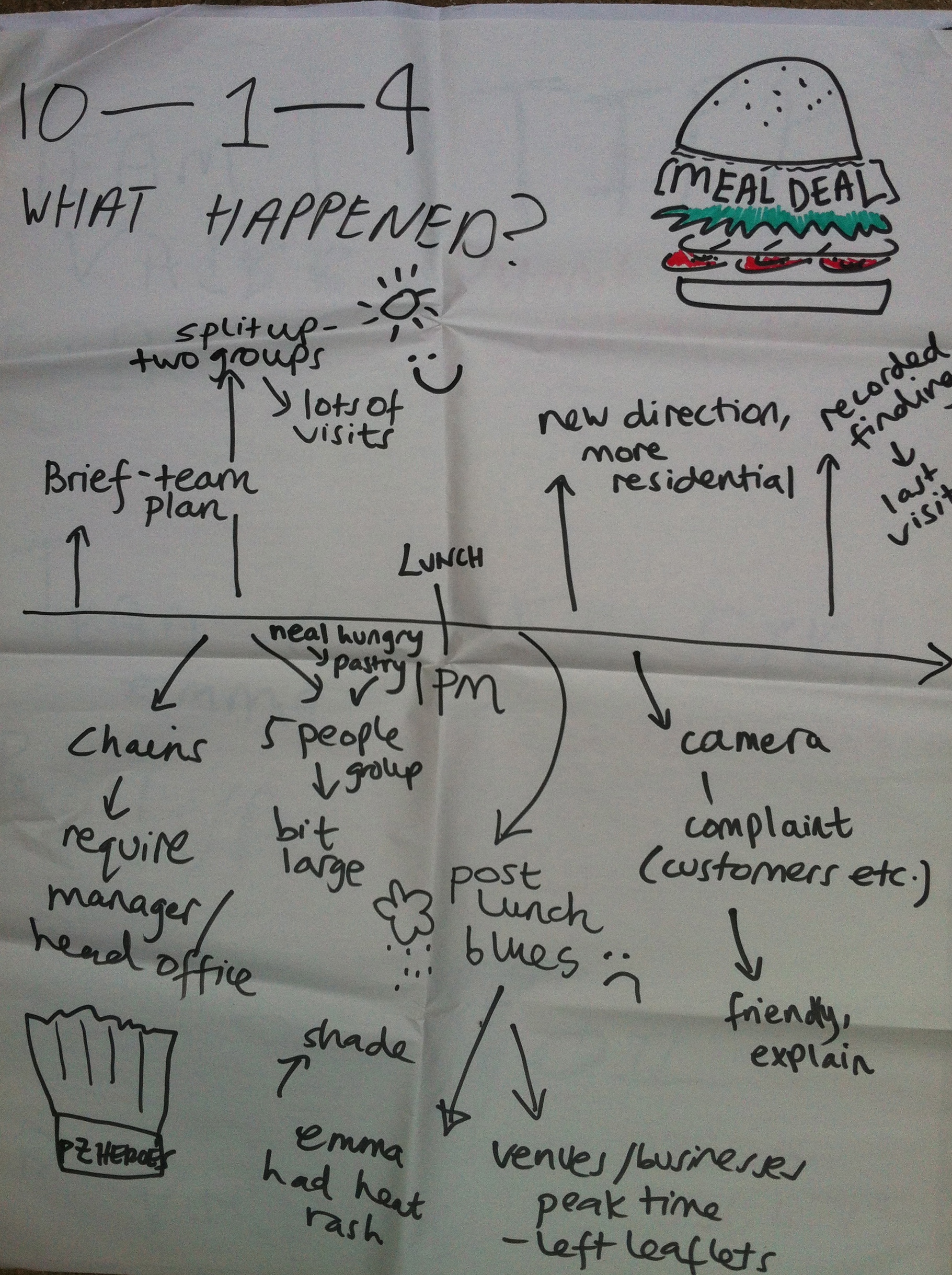
The teams assembled back at base just before 4pm for the debrief. I asked them to use a timeline as a prompt to describe what happened, when and who was involved with a further commentary as to how they overcame difficult moments.

One of the team's timelines

One of the team’s timelines

Though lighthearted it gave the teams (and a senior manager who joined at this point) a chance to compare and contrast: what had worked and what hadn’t; where did they get pushback, from whom (and why)?

amazing results

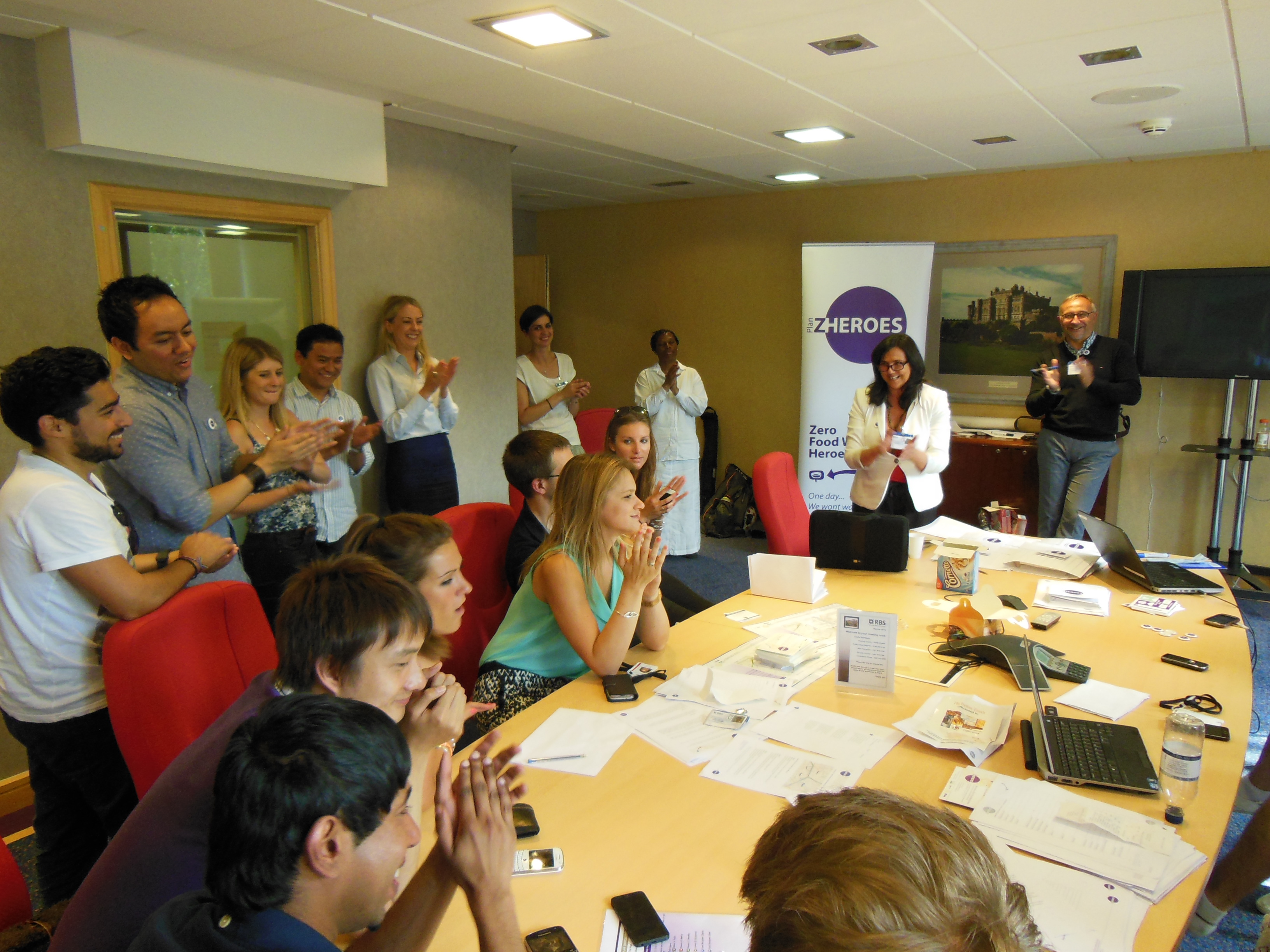
Before revealing the results Maria Ana asked the teams to develop a one sentence ‘why we should win’ statement. The ‘results’ were amazing:

Announcing the scores

Announcing the scores

  • 14 new businesses on the map & 1 new charity sign-up
  • 35 businesses to follow up & 2 new charities to follow-up
  • one team even walked to Holborn to talk with Sainsbury’s head office
  • two teams got their lunches for free (or part of it!)
  • 130 mix of facebook likes and tweets/followers and we were told one celebrity chef is supporting us (details to find)

Perhaps the most value though comes from the way the teams come together and the roles they play throughout the day. Here’s a couple of responses to my question about role models:

Q) Role model: who did you admire during the day and why – tell us about what they did?

A) One memeber of the team really came out of their shell and were particularly confident when approaching businesses …

A) …The person was awesome and I think I have learnt some people skills that day.

To learn more about Plan Zheroes’ special days for volunteers and organisations please contract us via the PZ website

Brighton’s Food Waste Collective to run ‘making use of surplus food’ event

I met a woman last week in a cafe in Eastbourne.  Her name was Tam, a young Buddhist with a passion for helping others less fortunate. She is a member of the Brighton Food Waste Collective and she’d come from Brighton to interview me about the ‘making use of surplus food’ initiative I set up in Lewes in 2012.

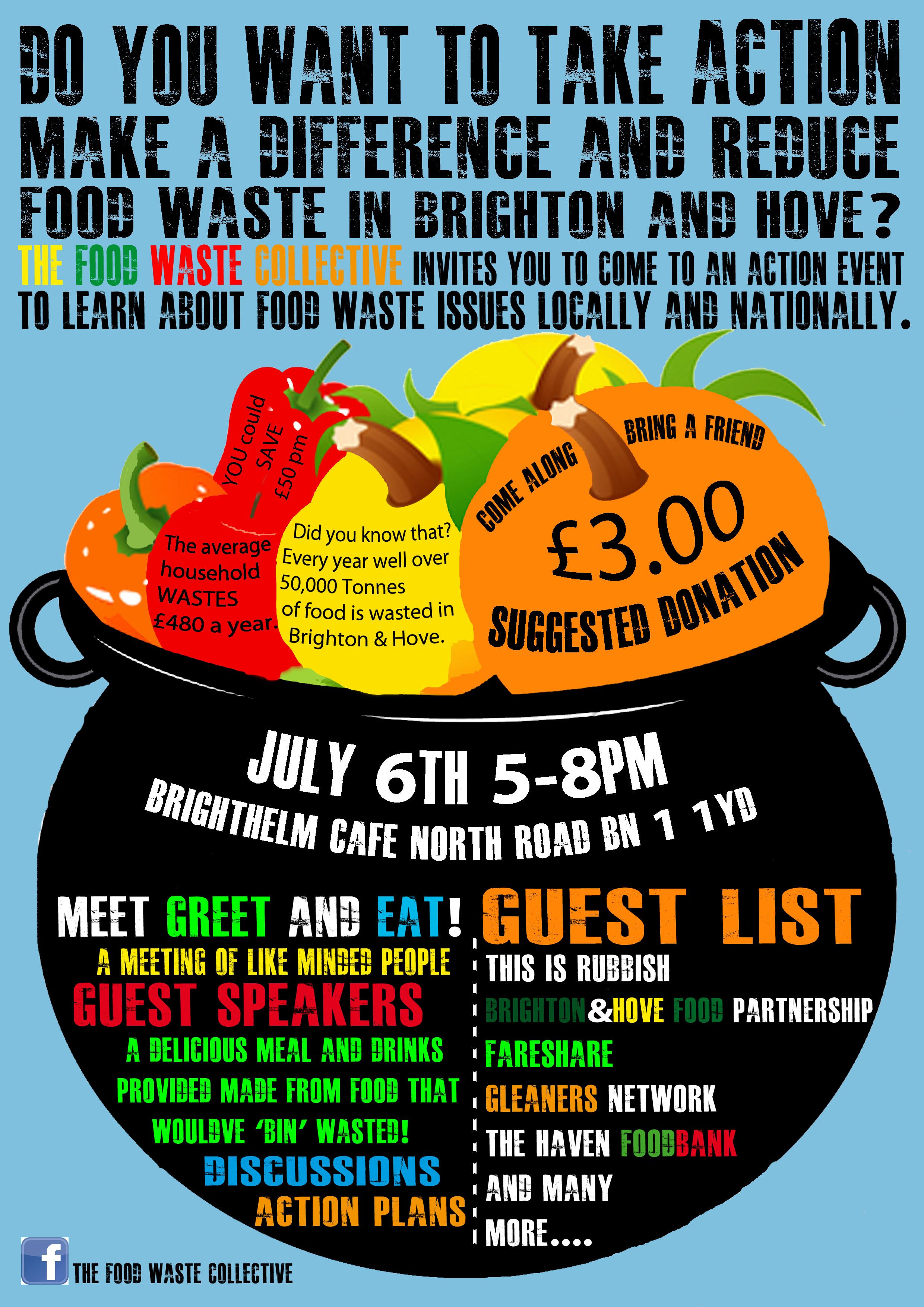
Tam and her team are going to be running an event in a couple of week’s time which I’d heartliy endorse and not just because Maria Ana Neves of Plan Zheroes (she was a great hit in Lewes) is speaking.

food waste collective event posterTo be held at Brighthelm Cafe in North Road Brighton its going to be a real opportunity for donors and charities to come together and see how they might make use of a host of willing volunteers keen to make a difference.

In the hope it might help others who are thinking about a similar activity I want to share something from the excellent interview notes Tam took and published.

‘He said that there are the two ends, who wants and who has to give but it is the middle that creates the logistical nightmares – the getting the food from a to b. I talked about there having to have leaders and ideas people and the technology of the map but also we need the “foot soldiers” – the bodies, cars and bicycles to move daily food from a to b. This is what our event can find. People! Willing people! Hurray 🙂

Paul then asked if I would like some advice, I said yes please! He said “my experience tells me that…” in a nutshell he suggested starting small and high lighting six charities representing “demand”, and six restaurants or shops representing “supply” then set a finite time scale of six months to put only those twelve into action. Make pilot projects! Then he suggests we re-assess and see what has worked? What has failed? Why? He suggested treating it like a research project. He suggested using Google Groups (?) He said “Don’t spread yourself too thin!” Also, which I adored, “Don’t attempt to boil the ocean!”

Paul suggested making objectives: Can we identify the demand? Can we identify the supply? Develop a picture. Two ends – who wants? Who has to give? Make a brief: identify potential charities to supply to….

Paul talked about reverse brain storming – I love this – it’s a technique where you ask the people at the event “what are the best ways to prevent the food getting from a to b?” “How can we make sure the food is wasted/rots/has to go in the landfill?” “How would you ensure that the surplus food re-distribution chain would not work?” He described how he uses this technique in his professional life to get folks’ brains to work in a different way.’

Plan Zheroes is moving ahead apace with plans to be come a registered charity and I am honoured to have been invited to become one of the founding Trustees to provide a focus on knowledge sharing. This is what sets Plan Zheroes apart.  As its evolving technology platforms get completed it will be able to provide an instant view of where surplus food is located and so match the charities who need it with those who have it to give.  It’s skill is then in coming up with innovative solutions on how to get it from A-B.

And by making the knowledge of how to set up an initiative (and a guide for volunteer management) Plan Zheroes is attempting to help replicate the model (here and overseas) that is working so well in London.

Good luck Tam and the Brighton Food Waste Collective!

when Moscow and Bangkok meet: conducting a cross border/cultural debrief

A couple of weeks ago I was the fictitious CEO of a global insurance group listening to a presentation by a combined group of Russian and Thai delegates at a training programme. Their task was to convince me that my company should engage them and to do so they had to demonstrate knowledge and understanding of the approach they’d spent the previous 4 days learning about.

They had a few rules to adhere to:

  • The presentation was to last for a maximum of 50 minutes and minimum 25 minutes
  • Each person had to present for at least 5 minutes and no more than 10 minutes

Those familiar with both cultures will know that one is voluble and will openly debate, happy to occupy centre stage; the other more reserved preferring offline conversations with an aversion to open criticism.  After lunch my challenge was to conduct a debrief on this exercise with the group drawn from consulting and energy with a good to acceptable command of English.

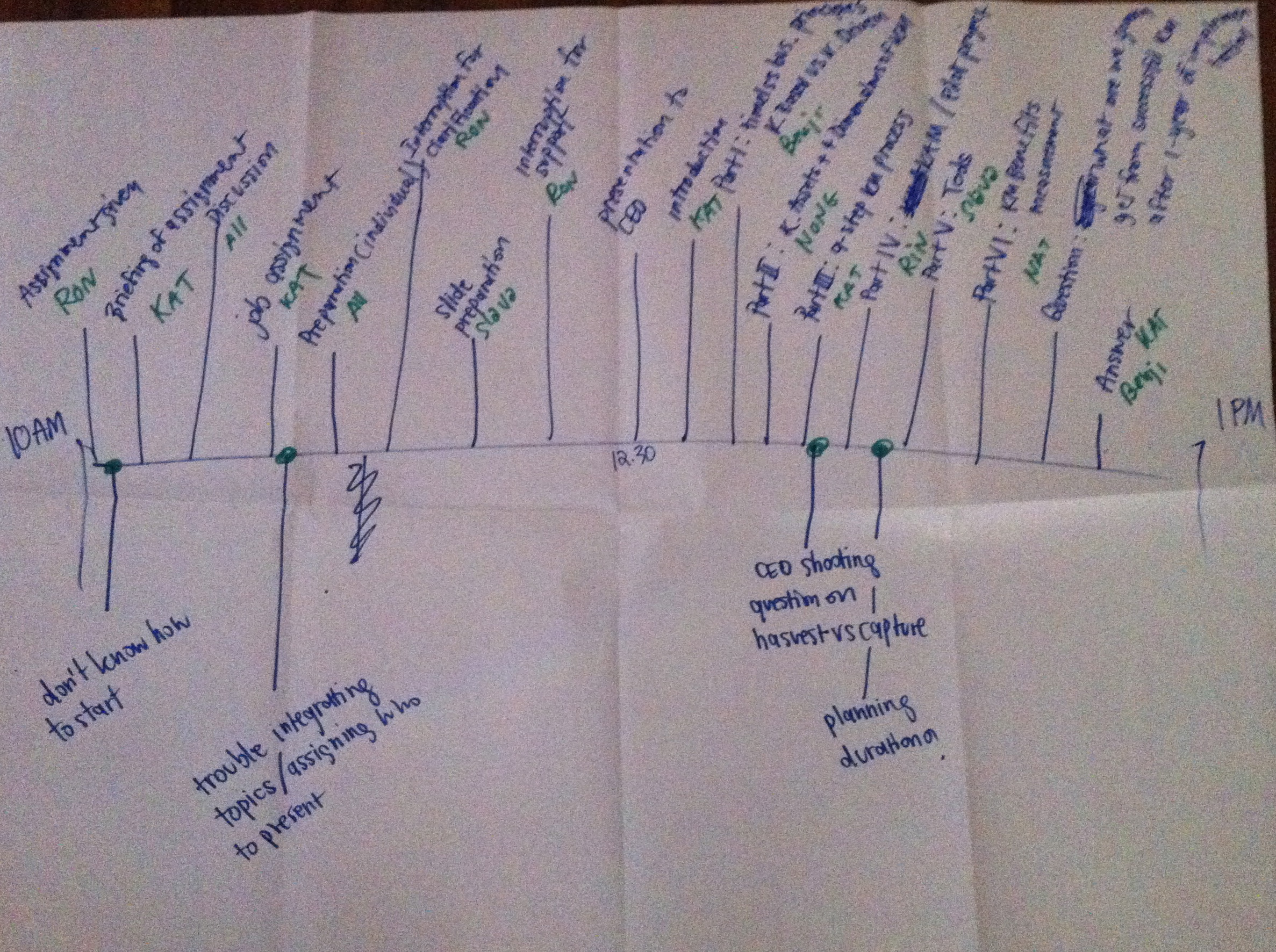
I settled on using a timeline as a way of giving both groups a neutral object on which to focus.  I was trying to get them to recognise how differently groups from varied backgrounds and cultures can view the same exercise while concurrently acknowledging their very positive actions as a group. 

using a timeline as a catalyst for coming to an understanding about an event

Here’s the instructions I used:

  1. Please split into two groups Russian Team and Thai Team and take 15 minutes to:
    1. draw a timeline: from handing over to presentation
    2. now trace the steps and the chronology, noting down key moments/decisions as you saw them and who was involved
    3. were there any moments the group got stuck and if so how did you overcome them?
    4. when you’ve completed your sheet put it up on the wall
    5. then inspect the other team’s and note down any obvious differences

A key request was that ‘above the line’ they should record the key moments and ‘below the line’ the sticky (or difficult) moments. TimelineThe Thai team with their energy (engineering) background created a detailed forensic account whereas the Russian Team provided summaries for each of the headings above. The group found it very useful to discuss the difference in approach and outputs since it has real implications on the way to roll out new initiatives in a global organisation.

There was a lot of laughter (a good sign) when I invited them to split 50/50 Russian/Thai in pairs. I invited them to

  1. Get into pairs and discuss
    1. What is something that worked well in this activity?
    2. What is something that did not work well in this activity?
    3. What is something you would do differently next time?
    4. And finally, what behaviours did you find most helpful as you worked in a team for the first time.
  2. Back into plenary and capture each person’s comments.

Once we’d surfaced positive behaviours it enabled me to split the ‘teams’ and as a mark of progress I asked the listener to repeat back what their partner had said.

my takeaways

The formality of the timeline allowed both cultures to fully participate in their own way and  gave the less voluble Thais a mechanism to voice their feelings which otherwise might have remained hidden.

It re-emphasised the maxim that in a global business tailoring your messages to each audience is critical to get adoption.

And finally it underscored the idea that when undertaking a debrief it is important to always recognise and acknowledge the good behaviors that others adopt.

Importance of KM in Health: the story of Doctor Anwar and making use of what he and others know in Sudan

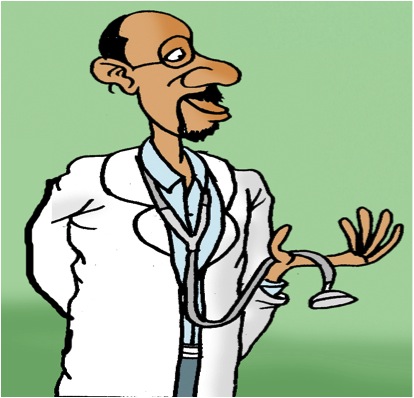
Meet Anwar, a Sudanese doctor. Just one of 5 fictional characters created by delegates at the Knowledge Management for Health in Sudan event I spoke at, helped plan and run.

Sudanese Doctor

Anwar

This exercise, Scenarios for the future, was set in 2020 and invited the 80 or so delegates drawn from across the whole of the health industry in Sudan to consider what a day in the life of each character might look like.  This was a new and warmly embraced concept in an environment where my information is my soul and much of the debate about the future takes place against a backdrop of uncertainty and increasing austerity where:

  • 2/3rds of all drugs are purchased ‘out of pocket’ not from health system
  • drugs are proportionately more expensive than in other domains
  • funds from external sources are available to assist with health informatics.

Having settled on a description of each character the delegates who were by this time in groups of 8-10 then set about imagining what their day might look like on January 1st 2020. A vivid imagination is required and was evident in the quality of the stories that were told by each group’s nominated storyteller.

The story of the Health Worker

Ismail’s story – Health Worker

I will in due course and with the organising committee’s permission publish the two ‘winning’ stories; yes we did do voting while the storytellers left the room.

One of Sudan’s leading pharmacists noted in a one:one conversation how important listening was and how difficult a technique this is for many to use when prescribing drugs.

By inviting each of the storytellers to play back the story to each of the other groups it was good to hear them say in the summing up that by the end they really felt they were the character.


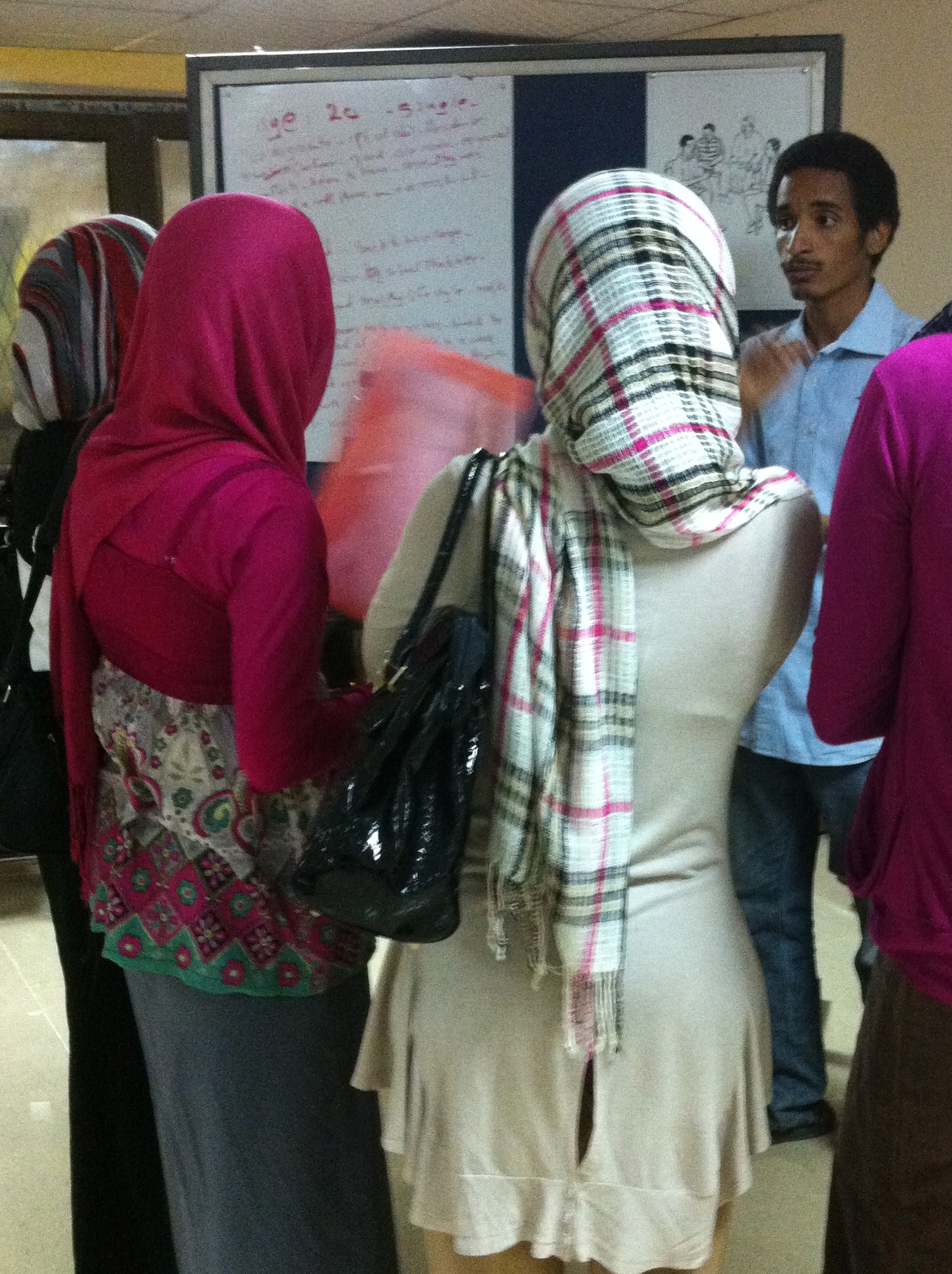
The previous day I’d invited the delegates to change the way they looked and think about issues and barriers.  Using when you change the way you look at things, the things you look at change exercise conducted in the best breakout rooms I’ve ever worked with, the delegates who are naturally loquacious soon grasped the concept of seeing the room through the lens of different professions.

Breakout room

Breakout room

This change of mindset was important: it allowed the subsequent round table (well round conference room) session that discussed:

‘What are the biggest issues we face in sharing knowledge and information about the health of our nation and how can we overcome them’

I’d invited each delegate to introduce themselves to three people they didn’t know. This worked well and encouraged a very frank discussion. The main issues highlighted were:

  • no systematic collection of information and limited understanding of its value
  • transparency of process (where do the figures go) and credibility of the data
  • lack of human resources to do the collection
  • limited statistical information to undertake scientific research on
  • ownership of data and the whole process – fragmentation
  • accountability to deliver
  • communication/awareness of what each organisation is doing – lots of ‘stuff’ is happening but there is a real risk of duplication of effort e.g. many of the disease control programmes are creating their own informatized information systems

Delegates recognised the tremendous strides being made by the Public Health Institute (one of the event’s sponsors and host of the official dinner) in developing professional public health administration programmes, the creation of a Data Dictionary and the publication of the first Annual Health Performance Review though many bemoaned the lack of official  support for research projects where Sudan has a prominent global position, Mycetoma Research Centre an example.

I came away from reflecting on a discussion I had around the event:

Its all about ‘informization’ – the ability to report from a health centre level with ‘point of sale’ data collected via PDA’s / mobiles as well as computers; about logistics management as a result to ensure supplies get to where they can do the most use.

This can be monitored by the minister, routine reports can be prepared showing which centre reported, which district has complete reporting, which state has complete and timely reporting and % of stock outs of basic drugs or vaccines etc.

And inspired by many of the presentations I’d seen on the morning of the second day from University of Khartoum’s research centre and of course the Public Health Institute who are reaching out to try and create greater awareness through public forum, newsletter and other events.

Perhaps the presentation that struck the biggest chord was from EpiLab
who have achieved impressive results in helping to reduce the incidence of TB and Asthma and whose research and community communication techniques are highly innovative. I loved the cartoons they developed on how to self treat and prevent the incidence of illnesses which were drawn up BY the local communities.  Their pictures and their words are published as guides for the nation and I know they will make them available so I can share them in future blogs.

It was an honour, a challenge but nevertheless great fun enhanced by the warmth of the welcome and a genuine sense of appreciation. Sudan’s people are among the most engaging and intelligent I’ve met. One anecdote from a conversation with a young professional in the communications business illustrates their dilemma:

‘…of the 95 people who graduated in my year a few years back 90 are now working overseas, the majority in highly paid good positions…’

In my address I acknowledged the support I’d had from many people in preparing for the event. They were: Ahmed Mohammed, Dr Alim Khan, Dr Anshu Banerjee, Ana Neves, Andrew Curry, Archana Shah, Chris Collison, David Gurteen, Dr Gada Kadoda, Dr Ehsanullah Tarin, Dr Madelyn Blair, Sofia Layton, Steven Uggowitzer, Victoria Ward

knowledge management is dead but it won’t lie down: a 10 year review of a KIM initiative

In the past few months I’ve heard talk of a resurgence in knowledge management.  km conferences are once again burgeoning; the UK’s Civil Service now has knowledge & information management as one of 22 recognised professions; last week while in Portugal I learned that the legal industry is now km aware; and many of my peers in the industry are finding themselves busier than ever providing advice to help organisations set up km initiatives across the globe.

One downside of providing external advice and assistance to organisations is that you are not always around to see the outcomes of your work especially when its  knowledge and information management related.  Occasionally you get the chance to get back under the covers and see how clients have implemented km style tools and techniques.

back under the covers

Such an opportunity took place at the end of December when I went back to the 7th largest global reinsurance broker (BMS) to see Phil Hill the Chief Information Officer I first worked alongside in 2001.

Reinsurance brokers are arbitrageurs: they place risk on behalf of large global organisations. They use knowledge of a client’s specific needs and apply that to find the best market to take the risk. They must know about clients and markets and manage relationships in both.

At the turn of the Millennium BMS was a top ten broker with aspirations to grow internationally and make better use of the combined knowledge of its dozen or so operating entities. It was dipping its toe into the document, records and information management waters and attempting to provide a technological backbone to support a growing demand for relevant and timely information. It had a very embryonic intranet.

Today BMS has broadened its business focus; it has expanded beyond reinsurance into underwriting working with a number of trusted partners. And it has focused much of its activity on building US based business development and transactional processing capability.  Seamless connectivity and access to internal and external information on clients, markets and BMS’ own resources are support prerequisites.

So how has it managed this transition and what are the significant milestones in its journey that has seen it become one of the most admired and technologically advanced practitioners in the market? One that is:

  • at the forefront of electronic placement; is regularly up for awards for innovation;
  • whose CIO Phil is a frequent and sought after speaker and panellist on industry platforms?

BMS is now an institution where joiners get a preloaded iPad with 24×7 access to the latest global and internal information as well as the ‘big data’ (catastrophe modelling in BMS’ case) that has become must have software in the insurance/reinsurance industry.

a decade reviewed

In the 2001 knowledge and information audit I conducted I noted that:

  • More than 60% of all items saved on the common H drive had been put in the ‘miscellaneous’ folder; there was no common terminology about how documents were to be named or catalogued; and no central place to find information on markets and clients.
  • As was common around that time there was limited collaboration between the various businesses and as a result potential for pursuing the same clients.
  • New joiners relied on traditional role shadowing and a tour of the building (s) to get up to speed.
  • BMS was spread out across a couple of locations and on different floors in a building at Aldgate which discouraged informal interactions.
  • Recognition of the concept of critical knowledge assets was a long way off and the words knowledge management dismissed as being jargon.  Busy people at the business end had no real interest in filing documents let alone thinking about how they might be reused; even in 2001 everyone expected the system to do it for them and the idea of ‘drag and drop’ from one platform to another was still in its infancy.

The shocking events of 9/11 in the US provided the ‘burning platform’ moment for a change in attitudes. Everyone wanted up to date consolidated news and opinion. The Intranet, website and content management system were approved as a combined project and with my assistance the newly formed Marketing & Communications (Marcoms) Team set about creating BMS Today and building up a cadre of volunteers willing to help identify the critical knowledge and information that should be captured and stored.

A definition or aim for the system emerged:

adopting a publish once use many basis provide a one screen view of activity with clients and the markets in which they operate and a central hub for knowledge and information on the organisation and its operations.

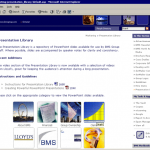
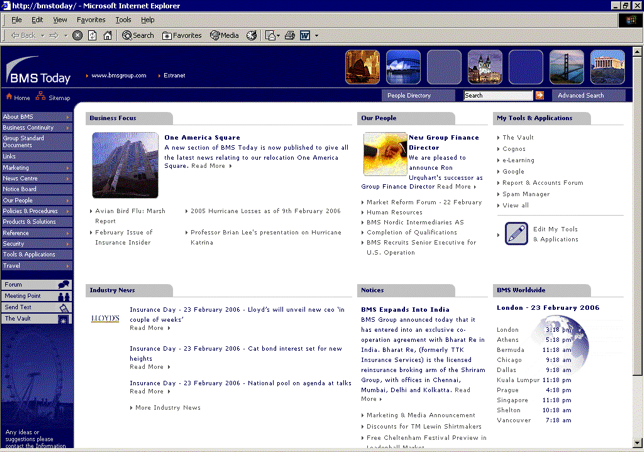
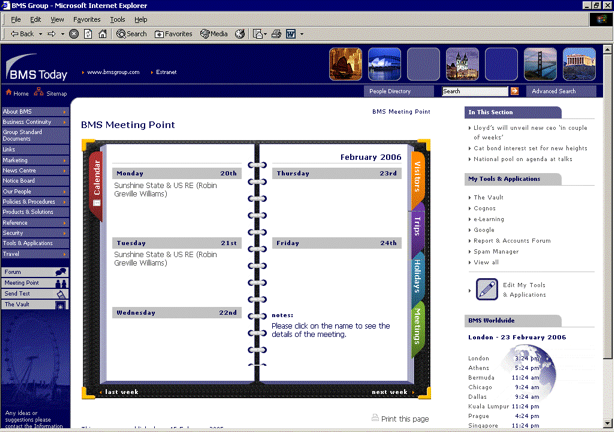
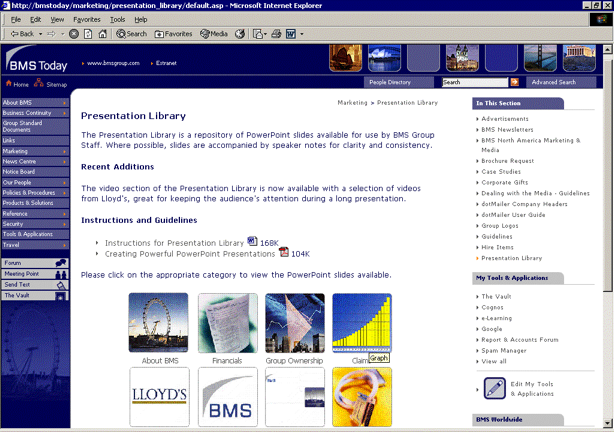
Here’s what BMS Today eventually became:

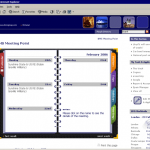
Intranet Home Page

Corporate Calendar

Though at the cutting edge of intranets BMS Today was not enough. The Marcoms team needed to go further to encourage knowledge sharing so concurrent with a relocation to One America Sq they began a series of Learn@Lunch and Breakfast Briefings aimed at showcasing different aspects of the business.

Still collaboration was a distant objective though the move to One America Square in 2008 did throw up an interesting opportunity to introduce social media.  One of the team (who been enrolled on a journalist programme) was deployed among the builders and fitters on site to provide a regular ‘blog from the battlements’.  Widely read at the time it provided an insight into life at the soon to be occupied premises and a metaphorical bridge to help people acclimate to the new surroundings.

One America Square enabled BMS to plan collaborative physical spaces in which to hold breakfast briefings and learn@lunch sessions. There was a lot of discussion about the efficacy of such a space.  ‘Connexions’ as it became known was a hub for meetings and with a business lounge in close proximity it enabled serendipitous meetings at the coffee machine (and water cooler) to continue in a relaxed but more formal setting.Connexions 600x400
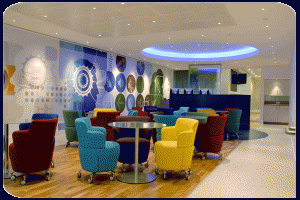
And of course the best coffee, subsidized snacks and rapid internet access were made available to encourage traffic to the site and make external visitors feel welcome.

changing focus & new technologies

A change of focus combined with the arrival of disruptive technology proved a challenge and an opportunity. The broking teams needed improved access to information on the move and an easy way to demonstrate the modelling systems that enable risk to be better evaluated. But technology costs and the benefits of investment are not always easy to quantify. So CIO Phil (aided and abetted by Philip Gibson of Sparknow) used a traditional storytelling technique and the idea of developing a set of personae as a way of illustrating what BMS’ world might look like in a few years time if some technological improvements were introduced. Here’s an extract from one of the scenarios:

Jade Thompson is 35 and has worked in the London Market for 14 years. She has agreed to join BMS as a senior underwriter, moving on from one of the big managing agents. She wants to work for a company that really supports her initiative and drive – not one that swaddles her in red tape.

The week before Jade joins, she receives at home via courier a package from BMS.

Inside she finds an iPad, with a BMS logo with the slogan: “Using clever technology”. There’s also an iPhone, also with a BMS logo and her name.

She reads the attached note, welcoming her to BMS and giving her the logon and password information she needs to use the equipment. “Wow!” she says to herself, “this is great – they really know how to make you feel special.” Jade switches on the iPad and logs on as instructed. There‘s an icon on the first screen, “Welcome”. Touching the icon starts a video of the CEO welcoming her to the company. Various members of the board and HR provide insights into BMS and what she might expect in her first few days.

There is also a pointer to other information on the iPad, such as all aspects of the induction procedure including health and safety. Thrilling, she thinks to herself…

This scenario has come to fruition thanks to the investment in technology (in this case iPads) made by the BMS board which has continued to support further development on BMS Today and a decade on, this is where many of the ideas and initiatives outlined above merge.

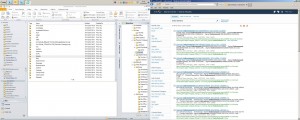
BMS Box Office Soon all 9 BMS offices will be able to log into the new intranet irrespective of domicile. It will meet the original aim of providing a one screen view of all activity with a client as well as providing real time access to the latest social media applications and real time information.

Submission to the corporate document storage system is a simple drag and drop process that recognises and acknowledges peoples preference for an Outlook Mail style filing BMS Searchstructure. ‘Stuff’ can be easily located via a search engine that accesses all operating systems via iPads which permit electronic placement.
 

takeaways

The team and I drew on techniques found in business development, communications, marketing, information and project management, engagement, facilitation as well as knowledge management to provide an infrastructure and ways of working that formed a backdrop to the continued expansion and development of the business.

Many who work in the knowledge & information arena would recognise most of the above activities, its what they do on a regular basis.  Yet at no point during the years I worked alongside the team at BMS was km used as a phrase or established as a discipline.

That a decade on BMS is thriving is an illustration that km by any name takes time but has value.

And finally by way of acknowledgement I should mention the names of those people with whom I worked most closely during my time as Advisor.  They were from BMS: Phil Hill, CIO; Roger Cooper, COO; Jeff Martin, Director; Anne-Marie Hawtin, Manager; and John Spencer Former CEO. From Intranet Focus: Martin White, CEO.