3 great toolkits and a facilitation tip for Knowledge & Information Management professionals

Toolkits are much in vogue. Three I’d recommend are:

While knowledge managers are not short of reference points or advice on how to go about things there is no one size fits all template to describe the role, where it sits and the skills to discharge it.

Yet so many km professionals in emerging markets are thirsting for the certification that goes with having completed training in an industrial discipline such as km. With few exceptions (KMI Institute in Washington being one) the km profession unlike CIPD or CIM has no recognised industry body. Those that might be closely related such as SLA or CILIP have not claimed the km space. Instead conference organisors award ‘gongs’ at their events and others rely on the MAKE awards to signify progress.

Most km discussions though tend to land in the same place: what does a knowledge manager do, where do they sit in the organisation, what are there crossover points (Organisational Development, Learning, HR, IT, Strategy, Communications/Marketing) and how do we measure impact? Success depends on individuals, the passion they bring, their ability to judge what to do and when and the way they present to/influence many stakeholders.

Here’s one example of good facilitation from France:
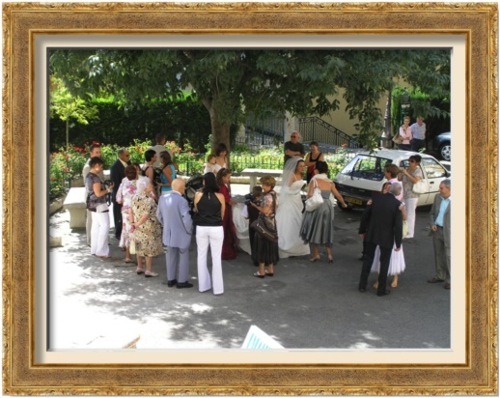


This picture, a typical wedding scene, shows the bride to be greeting all the guests before they enter the church for the ceremony. She introduces friends and family to each other so that there is no ‘bride and groom’ side of the church. People who have been introduced mingle and are more likely to converse at the wedding breakfast thereafter. This simple act of facilitation (a ingrained tradition) helps shape the event.

So while not every km professional can be a bride we can suggest that a core competence in putting the km tools to work is facilitation. Toolkits are vitally important but without the skill and processes to deploy them they are a wasted investment.

Its why perhaps CIAT‘s km team who are much admired have titles such as Leader, Capacity Strengthening and Knowledge Management Initiative. Theirs is a focus on helping to equip others in their organization; faciltation skills are a huge part of the core competencies they use to help others.

Knowledge Cafe Tips: printers, posters and event management

I’ve been printer challenged: what seemed like a good idea a few years back to buy an all in one inkjet has turned into a logisitical nightmare as printer cartridge costs (at least Epson) have rocketed while I try to become greener, use recyled paper and print less. While social media and emails have an increasing role in raising awareness snail mail and hand delivered notices are still very important especially at this time with the avalanche of material that will greet returning vacationers. If not then why do so many corporates engage in poster campaigns in their offices to augment their online activities?

So having secured a date, venue, speaker and got an endorsement from David Gurteen I am going to run the inaugural knowledge cafe in Lewes to discuss a topic that’s been on my agenda for some time – helping to make use of surplus food – the Plan Zheroes initiative. And I’ve been trying out Eventbrite as the management tool for the registration.

For those who are new to Eventbrite it is a very simple free to use and effective tool that handles all the online administration of an event.  It took me less than a couple of hours from zero knowledge to setting up this event online and registering half a dozen people. See what you think? Knowledge Cafe:making use of surplus food

In case you are interested I’ve ended up buying a Brother Wireless All in One (though the reviews say it looks like a tank) that prints A3 as well as A4, essential to produce the worksheets that can often transform a working session.  Here’s one example from the work of my colleagues at Sparknow who excel at this kind of creativity in workshop design.


Picture taken by Julie Reynolds at a workshop run by Victoria Ward at The Whitechapel Gallery.


knowledge tours = knowledge transfer (understanding puffins and olefins)

Today under the ‘people I admire (and why) section of the site I posted an anecdote from a meeting I once had with the then Vice President of Mobil. It brought back recollections from a posting I made a year ago on Sparknow’s site about the value of knowledge tools  for encouraging good knowledge retention and transfer. Here’s that updated posting:

Ahead of a trip to the ECCI creativity & innovation event in Portugal I was looking for examples of good knowledge transfer from km practitioners. Let me share one anecdote from an interview with Barney Smith a former CKO and CIO and champion yachtsman in response to a question on measurement.

Barney: 80% staff have attended a knowledge tour. Oh yeah, we did knowledge tours. That was cool.

Sandra: What’s a knowledge tour?

Barney: They were great! Natural England owns and manages about 0.6%% of  England’s surface, its natural resource…we actually got people to leave their day job and come down literally. And rather than them doing job shadowing and things like that, we got them to build a day where staff could turn up and then could actually experience what that person does. And they could take 10-15 out. So if a person is responsible for monitoring environmental impacts around the Lundy islands, he would take people on a boat around Lundy island and looking at birds with a Lundy Warden.

Barney: Lundy (Norse for Puffin Island) is part of a Marine Conservation Zone managed by Natural England. The warden who lives on site managing it is actually an employee. We took our staff out to spend a day on the islands with the warden talking about puffins and things like that.

But the point was for those people sitting in finance or those people sitting advising farmers on agri-environment schemes or those people who are promoting or designating the  South Downs national park or New Forest national park, that’s what they’re doing at Lundy. And of course that was the pilot, great stuff. But we had the chief executives and senior staff who said everyone’s got 15 development days. One of those days must be knowledge tour.

And we even created one that’s virtual. So it was actually a guy walking land with a video camera, looking at things. And then he did a talk-over. It was done like a documentary.

It reminded me of a time long past when I was a lending banker managing a portfolio of energy clients.  I knew little about hydro crackers and cat crackers, even less about olefins, polyamides and bottoms all of which were about to become part of my expanding oil and petrochemical vocabulary.

My boss, a visionary and talented Yale educated and very well travelled American who could and did argue vociferously in Arabic, Cantonese and English reasoned that if I were to be of value I needed to understand the practices and language of the industry I was working alongside.  So courtesy of Mobil I attended a programme designed to educate financial people into the workings and economics of oil refining.

I never thought about that week at a refinery in Paulsboro New Jersey as a knowledge tour but now looking back I can see the connection and the importance of experiencing what others do in order to make better decisions. That this was a one off initiative and never replicated by the bank was regrettable since it gave me an insight into a world that would otherwise have been opaque and because I had a modicom of knowledge, the ability to have more meaningful dialogue with my clients.

Barney’s knowledge tours have become regular events, measurable as KPI’s and part of the knowledge charter used to mobilise and shape Natural England’s approach to knowledge management. That they are built into the calendar with compulsory attendance is key.

And finally and perhaps not unrelated the Lundy Puffin is no longer on the endangered list as a result of a programme to eradicate the island of rats.


one of the truly great presentations: implication for knowledge workers

I was in Turkey on July 6th 2005 when Sebastian (now Lord) Coe stood up to address the International Olympic Committee (IOC) in Singapore at the start of what was to culminate in the games of the 30th Olympiad just ended in London. His speech was never shown on Turkish TV and as the ghastly events of July 7th were about to unfold in London, and I was dodging a bomb in Kusadasi at the same time, I missed it.

Seb Coe’s story, described by many as one of the truly great presentations given to the IOC is worth revisting now that London 2012 is a very vivid, fresh and warm memory.

I am indebted to Nick Davies who reminded me (and the audience at KMUK 12 back in June) of Seb’s words. Here’s an extract to give you a flavour:

When I was 12 ..I was marched into a large school hall with my classmates.
We sat in front of an ancient, black and white TV and watched grainy pictures from the Mexico Olympic Games.
Two athletes from our home town were competing. John Sherwood won a bronze medal in the 400m hurdles. His wife Sheila just narrowly missed gold in the long jump.
That day a window to a new world opened for me.
By the time I was back in my classroom, I knew what I wanted to do and what I wanted to be.
The following week I stood in line for hours at my local track just to catch a glimpse of the medals the Sherwoods had brought home.
It didn’t stop there. Two days later I joined their club.
Two years later Sheila gave me my first pair of racing spikes. 35 years on, I stand before you with those memories still fresh.  Still inspired by this great Movement.

The value of using images and stories as a presentational technique in business and especially knowledge management which often struggles with measurement and convincing sponsors of its relevance should not be underestimated.  The ability to inspire future generations by drawing on and bringing to life the experiences of others is at the heart of what is increasingly described as knowledge retention.

Let me know if this strikes a chord with you.

KMUK 12 closing: getting wet in the shallow end!

At David Gurteen’s Knowledge Cafe Monday run by Arthur Shelley, who coincidentally I interviewed as part of the ‘evolving role of our knowledge manager’ enquiry, I bumped into Adrienne Monteath-van Dok of Plan International who was one of the speakers at June’s KMUK event.  Adrienne said she’d enjoyed the closing session I’d facilitated and that I should share the mechanics with the wider community – so here goes.

If you recall I’d used a ‘swimming pool’ exercise as an ice breaker to promote dialogue and I returned to the same theme to create a sense of animated closure.

I’d left up the six ‘stations’ round the room:’changing room’; ‘poolside’; diving board’; ‘shallow end’; ‘deep end’; and ‘bar’. This is how the 25 minute session was conducted:

I began by describing each of the ‘stations’ :bar = had lots of experiences/war stories and in a position to raise a glass to congratulate or commiserate.

I invited each person to return to the position they’d assumed the previous day. NB ‘newcomers’ had to choose their station at this point as well.

At this point as delegates moved around the room there was a lot of reacquainting and an audible buzz.

The delegates were then asked to consider three questions (and remain standing):

  • What surprised you at KMUK?
  • What are you going to take back to your organization?
  • How do you feel at this point?

I invited them to share the answers with the person next to them.

I concluded the exercise by walking round the room with a roving microphone; each delegate I approached was asked to give a rapid fire answer and to pass the microphone onto a person of their choosing.

This took about 5 minutes culminating in a very positive response (in the shallow end) from a delegate who said what he’d heard over the two days made him believe that far from being dead and in contrast to the feeling he took away from KMUK 2010 KM (in whatever guise it appears) is very much alive. He felt re-energised as indeed did I.

Many events end on an exhausted low note; from the feedback KMUK 2012 wasn’t among them.