Just one of the many postcards sent back from the future (2020) to today by the delegates at Henley Business School’s 12th meeting of their KM Forum. Putting learning at the heart of the organisation was the theme of the annual two day retreat and I was there running a Sparknow timeline exhibit that featured highlights of the evolving role of the ‘knowledge manager’ research we’ve carried out. More of that in a future post.
This post is about the exhibit and how postcards were used as a technique to develop a delegate view on the changing environment and role of a ‘knowledge manager’.
why a postcard?
In many ways the postcard serves a powerful metaphoric role for key dimensions of knowledge management and of time:
- It is personal/private but at the same time both shareable and publishable via a noticeboard.
- It maintains its quality of having been individually authored, so the link to the originator stays explicit.
- It is light, compact, and highly portable.
- It is asynchronous, but interactive and annotatable
- It is an ideal vehicle for messaging
- It is time saving for the author.
- It is an early form of multimedia, allowing an almost infinite range of attached images
Sparknow’s research into the use of postcards goes back over a decade. Victoria Ward and Professor Clive Holtham of Cass Business School and others from Sparknow wrote about the uses of the postcard in re-forming organisational time, place and meaning” for the ‘In search of time’ conference, held in Palermo in 2003. A copy of that paper and one presented in 2010 on slow knowledge can be found here.
why a timeline?
Our experience suggests people respond best when they are asked to situate comments against a time and place (and often an object or event) as a backdrop.
postcards and time lines as a combination.
The visual impact of a series of postcards on a timeline is visually compelling.
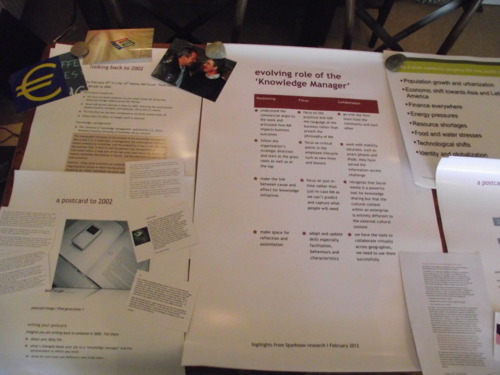
materials for the timeline
By putting up background material for the three focus points on the timeline (2002 > 2012 > 2020) we were able to provide context for the postcards people were writing; to get them thinking back from 2020 to today and then from today to 2002. We were particularly grateful to Andrew Curry and The Futures Company for letting us reference their work. Andrew wrote an interesting and thought provoking blog to accompany The World in 2020 publication we drew on to design the exhibit.
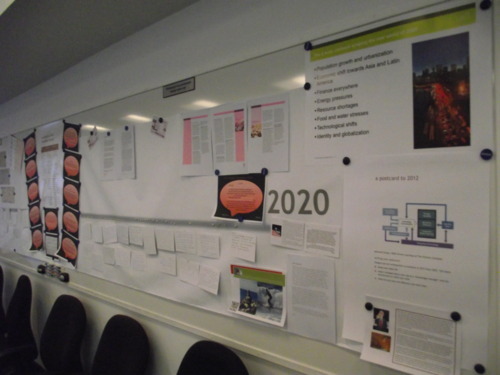
looking back from 2020
the questions posed were:
Imagine you are writing back to someone in 2012 from 2020 (or to 2002 from 2012). Tell them:
- about your daily life
- what’s changed about your job as a ‘knowledge manager’ and the environment in which you work
- what kit and tools are different now from then.
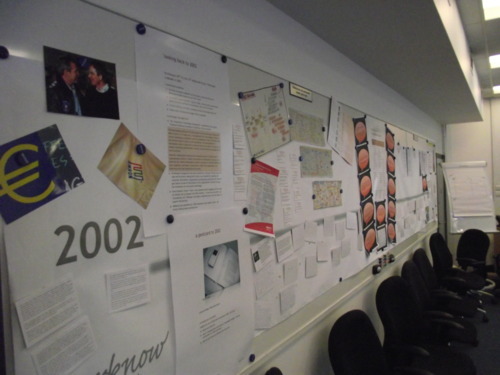
looking back to 2002
and the outcomes
More than 25% of the delegates completed a postcard. Each revealed something about the writer and their vision of the world.
A couple of revealing postcards from today back to 2002
You’re still in KM. And for a while it’s even in your job title. You do a lot of technology. You spend a lot of time in “programmes” and service development, development in general, is project-based rather than continuous. The KIM profession is government recognised, but frequently struggles to find direction and leadership.
Hello, we’ve almost forgotten how to pick up the phone or walk over to speak to people. We spend a lot of time sending “texts” from our phones and reading about our friends’ activities from their “electronic” Facebook page. It can be quite lonely at times.
Many felt strongly that being networked will be one of the key differentiators in 2020; that technological advances will continue to enhance our ability to work wherever and whenever we want to but that time savings (to enjoy more leisure) is a forlorn aspiration.
Few saw the ‘knowledge manager’ title as being around in 2020, it being best illustrated by this:
The Knowledge Manager is extinct. Culture and behaviors of the knowledge manager are embedded into all employees as the modus operandi.
though another said in 2020:
I am working as an advisor, consultant, advocate, counselor, co-creator. I work to Board level leadership but I roam The Organization, working to improve colleagues’ personal and group knowledge management.
Technology has simply become the channel, its just the ‘thing’.
a great piece of advice:
Try to write letters as much as possible because otherwise your handwriting will get even worse.
what would I do differently next time?
Actually not too much though I’d probably have more people versed in the material, able to explain the significance of the dates to ‘visitors’ to the exhibit. And I’d make sure I had enough people around to help put up an 18 foot poster when I arrived at the venue.