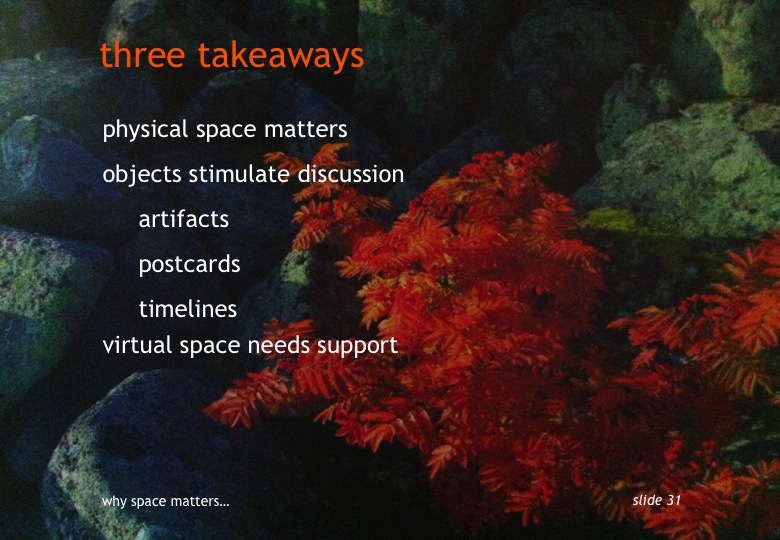
I have just published an updated research note on Scribd. following the workshop I ran for the NetIKX community last week and wanted to share the findings here:
To succeed in the 21st Century organisations will need to be good at collaboration and co-creation and the research I’ve undertaken suggests some organisations are changing working environments and patterns in order to accommodate this. Are they doing enough to take their staff with them though or do their people merely see this as an attempt to cut cost?
a case for ‘Orchestrated Serendipity’
This has been a mantra of mine for some time. The RSA clip on reimagining work cites the example of people sat in open plan offices emailing colleagues sitting a few desks away. Rather than promoting dialogue open plan has often had the reverse effect.
ADB Knowledge Hub
Where I’ve seen organisations working well they have tended to look at workflows, people’s habits, made them an inclusive part of the process of change and communicated effectively. They’ve accepted that serendipity needs a bit of a push and have recognised that ‘ah ha’ moments often come from such serendipitous meetings and arranged space such as a khub to accommodate that. I often speak about how interactions to and from prayers in the Muslim world are often the most productive and why knowledge hubs and information centres are often situated in close proximity to refreshments areas.
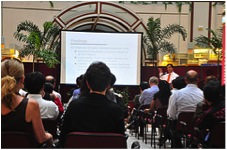
Nelia R. Balagapo in May 2013 described how ADB had gone about the process of creating a physical knowledge hub.
The library reorganized its physical space to become a knowledge hub (kHub) to host book launches, meetings and forums of the COPs. In collaboration with the different departments and COPs, an average of four activities are held in the kHub weekly, including “Insight Thursdays,” a weekly forum where staff share insights on topics or issues of interest to ADB. Wireless Internet connection and videoconferencing facilities enable staff at regional offices to participate online in these forums. The introduction of these facilities, including a coffee shop in the library, contributed to the transformation of the library spaces into dynamic learning areas.
It seems our personal habits are changing too: this week it was announced that more and more homeowners crave for multipurpose ‘living’ areas that can accommodate, cooking, eating and lazing!
the rise of ‘Freelancers’
Knowledge workers are changing too, despite what Melissa Meyer said that all Yahoo workers should come to the office or quit! In a thought-provoking article How Freelancers Are Redefining Success To Be About Value, Not Wealth Sarah Horowitz suggests that today in the US Independent workers make up a third of the workforce. By 2020, just six years from now, 40% of Americans will be working as freelancers, contractors, and temps. Here’s a couple of quotes that stuck:
…Freelancers are shaping the new economy. As flexible schedules and ubiquitous communication become the norm, the work-life balance that we’ve always struggled for is becoming achievable. As community and teamwork become more necessary than ever to thrive, the lonely, closed-off cubicle will make way for meaningful collaboration. And as the demand for healthy food and workspaces increases, industry will increasingly connect corporate profits and social good…
So if this phenomenon is growing how are we responding? I recall a presentation I gave in Houston in 1999 where I said that growth in the number of independent (non-salaried) workers was dependent on three factors:
- supportive collaborative technology
- a rise in physical meeting hubs
- a change in the way financial services organisations assess the credit of non-salaried workers with irregular income patters.
All three now exist and so the key challenge is Trust (among peers as well as with direct reporting lines) as the Yahoo example would seem to suggest.
the importance of social and technology
I am a founding trustee (Knowledge Trustee) of a charity that aims to make better use of surplus food. www.PlanZheroes.org has no formal offices yet its governance process is all very formal and in the cloud. We hold virtual meetings and new volunteers are given access to all the materials and instructions they need to begin sourcing donors and recipients. As a knowledge hub for surplus food we perform a brokerage role helping to facilitate contacts between those who generate surplus food and those charitable organisations that make use of it. All of this is made possible by collaborative technology, the rise of social media, which encourages and facilitates collaboration, a culture that is aligned around a shared vision and the availability of suitable meeting places in which to conduct essential f2f interactions that underpin social exchanges.
objects and the role of neutral space
 One of my 3 takeaways is to use objects as a stimulus for dialogue and innovation. The idea of neutral space is core: if you accept the premise that it is important to create hubs for interaction such as that illustrated at ADB then the same logic applies when looking at how to facilitate those interactions.
I saw a salesman use a very informal worksheet last weekend and wrote about it. By using a worksheet (a neutral object) he was able to elicit valuable information that helped make a sale.
the symbiotic relationship between virtual and physical space
As often happens with the wonders of modern technology, a comment I made on a news item on the simply communicate newsletter entiitled working out loud at Deutsche Bank led to a really interesting exchange with Managing Director John Stepper. John has achieved a lot using a Jive platform to encourage social collaboration and change the ways of working there. I asked him:
Hi John, I’d be interested in whether you paid attention to how virtual and physical space come together? I’ve just published on Scribd. an updated report on ‘when space matters…’ And one of the questions was whether virtual could replace physical! How did you manage to marry the two?
John replied:
Paul, I’m an admirer of well-designed spaces though by no means an expert. But I’ve written about how virtual spaces complement the physical (and systems) design: http://johnstepper.com/2013/02/23/the-best-office-design-for-collaboration-is-also-the-cheapest and
/http//johnstepper.com/2014/02/01/creating-places-we-care-about/
Do take the time to read his thoughts. If anyone has coined a more apt description of what many organisations have become then I have yet to see it:
We discarded some of the age-old principles of what motivates and engages people. Somewhere along the way we’ve forgotten we should be designing organizations for the benefit of the human beings in them.