In a world of High Value Work the case for informed and empowered Knowledge Workers is becoming stronger

Whether Lisboa, London or Tehran the pace of change is gathering apace with increased pressure for improved performance, greater efficiency and reduced risk.

Over the last couple of months I have been working in all three of the above capitals. It has been a priviledge and an eye opener: Iran is eagerly awaiting ratification of the Geneva deal and Tehran is awash with foreign companies looking to position themselves post sanctions; in Lisboa they are feeling the effects of a ‘drawn’ election and in unchartered territory over the formation of a new government and whether to continue with a programme of austerity and; in London there is considerable angst about the impact of cheap Chinese steel on an already depressed commodity market and on local communities.

In each of these capitals the role and standing of the ‘Knowledge Worker‘ is different:

  • In Lisboa, many young innovative Knowledge Workers have felt the full force of the austerity programme and fled the country rather than face an uncertain future while the cadre of secure middle managers hang onto their jobs.
  • In London, consolidation (especially in the legal sector) is growing and the push to outsource a core part of the UK Government’s drive to reduce the role of the state. Further afield UK Manufacturing continues to be battered by cheaper cost centre imports with inevitable plant closures.
  • In Tehran, as they face an openiing up of their market place and an influx of of overseas competition, local knowledge is becoming much in demand and creating a sense of eager anticipation in a workforce that has traditionally sought overseas postings as a way of enhancing their knowledge and careers.

What are the implications? 

The role of the informed knowledge worker is going to become more critical and they will need to move up the value chain in order to do so!

If you have not already done so I’d encourage you to look at a recent blog post by Andrew Curry of the Futures Company. The Futures Company has been collaborating with the Association of Finnish Work for more than eighteen months on the idea of “High Value Work”. They define this as work that is productive (it creates new value); that is durable (it creates value over time); and work that is inclusive (it spreads value beyond the business — or the C-suite. This combination, based on the emerging post-crisis literature, also creates work that is meaningful, for employees and customers. They identify four routes to acheiving it:

These are service innovation, based on a full understanding of the customer and their needs; value in authenticity, based on on a full understanding of cultural context; resource innovation, based on a full understanding of material flows; and rich knowledge, based on a full understanding of the technical knowledge held inside the organisation and a method to capture and codify it.

High value businesses combine these; for example, mastery of resource innovation often creates new technical capabilities that lead to new forms of rich knowledge.

Finland is a great example of a country that is highly technological, expensive with a great education system. That it commissioned the work is unsurprising and the findings underpin the growing realisation across many organisations that people matter, are transient in nature and that processes need to be in place to recognise that.

The future role of the Knowledge Worker?

Much of my recent work has been about helping organisations to recognise that if Knowledge Management is to have value above its traditional tactical operational bias there has to be a way of measuring the output (the Intellectual Property ‘IP’ or Knowledge Assets) that is created as a result of the activity.  And generating Knowledge Assets is reliant on empowered and stimulated people. As Andrew’s findings suggest ‘Increasingly business research is finding that people drive value.’

Last Friday I hosted a Peer Assist with a group of senior HR thought leaders on People Stimulation an idea being promulgated by Dr Abdelaziz Mustafa of the Islamic Development Bank Group. A very experienced HR Director and core member of the Association of Development Agencies HR Forum he argues the need of a work enviornment that recognises and stimulates:

  • Human Imagination
  • Individual Discretionary Behavior
  • Deeply Embedded Interests
  • Self-Knowledge, Self-Accountability and Self-Development
  • The One Person Difference
  • T.E.A.M Culture
  • Happiness at Work

While to many this may seem axiomatic it is indicative of the shifting thinking around the way organisations manage and nurture today’s and tomorrow’s Knowledge Workers.

And finally

On Monday I was at Chiswick for the first meeting of the reconstituted BSI KM Standards Committee established to provide inter alia the UK’s input into the global ISO debate on the need for standards for Knowledge Management. While hugely encouraging that KM is now being more formally recognised it was instructive to see how slowly the wheel of change turns.

Finally if I needed validation of the value of embedding effective Knowledge Management techniques I got it last night in an exchange with a Chinese mentee. In discussion over the knowledge capture interviews I’d helped him to conduct for the charity I am involved with. He said:

‘It is interesting how much good ‘after taste’ after the previous interview techniques and knowlege managemnet toolsconducted a few interviews for my research using the time line map, very effective tool!’

I have asked him to write a guest blog to reflect on some of the knowledge capture techniques we used. Watch this space!
Good Knowledge Drives Good Business

This is an article inspired by a session I ran with new businesses as part of Surrey University’s Investor Readiness Programme and my work with Plan Zheroes, It sets out to illustrate why good knowledge and information management matters to a new business.

A business is the sum total of its intellectual capital/property (‘knowledge assets’).  Drawing on examples from hospitality, renewable energy storage and third sectors, it will demonstrate the value of checklists, a technical backbone, the right cultural environment and feedback loops in identifying, nurturing and exploiting knowledge assets.

Here’s what Claire & Luke (Editors of Business Information Review) had to say about it in their Editorial:

Good knowledge drives good business

Another regular contributor to Business Information Review, Paul Corney shares his experiences of working with emerging enterprises and business start-ups in developing good knowledge and information management practices. Reflecting Screen Shot 2015-09-02 at 09.16.05on the experiences of small and medium-sized enterprises in the business and third sector, Paul illustrates in his article why information and knowledge management matter to new businesses. As Paul notes, ‘ultimately a business is worth the value of its intellectual capital/intellectual property. These “Knowledge Assets” might take the form of patented products, an efficient process, a unique piece of software or brand and reputation built over time’. The lessons here for directors of start-up are obvious, but there are lessons also for those who work with information on a day-to-day basis within larger or more established organizations.

I’m glad Claire & Luke ‘got it’.  Well run and profitable business is about making effective use of knowledge and creating and enhancing its Knowledge Assets. So it follows that:

Putting in place effective measurement is key in order to demonstrate value. As KM standards get integrated into global quality and manufacturing standards so the drive for better KM will be felt. Young organizations can get ahead of that curve by putting some of these simple techniques in place today.
As a footnote I am particularly delighted to have been asked to serve on the BSI KM Standards Committee that is going to input into the to be publsihed ISO Quality Standards.

And finally

You can get the full article from here: Business Information Review Q3 2015

Helping businesses plan exit strategies and pitch for funds: “when I becomes we”

Ironically a day after the 144th Open Championship I am at the Surrey Research Park in Guildford helping a group of entrepreneurs practice their pitching though not on the golf course! Its part of the University of Surrey’s Investor Readiness Programme that brings together fledgling business owners seeking early stage funding.

The programme, spread over 3 days and featuring a range of accountants, lawyers, former CEO’s and government officials, is one reason why University of Surrey ranks among the top 3 incubator centres in the UK. I’ve been invited along to make the programme more interactive and will be using facilitation tools and techniques often found in a Knowledge Management Toolkit.

My formal brief for the afternoon on Day One is two fold:

  • Get the businesses to think about a possible exit strategy
  • Begin the process of pitiching to investors

My unstated and informal brief:

  • Create an environment that is conducive to sharing knowledge as a community in the future.

Planning for exit

Few businesses begin life thinking about how they might hand it over and transfer their knowledge.  But investors are keen to know what their exit strategy is likely to be and whether it will survive their departure.

Since many embryonic businesses are centred on a bright individual who often holds the key to the Intellectual Property ‘door’ it is essential that good Knowledge & Information governance practices are adopted from Day One so that it can withstand his or her departure.

Simple steps such as cataloguing and storing of formal governance meetings are essential: Due diligence professionals will demand such documentation so better to have assembled it from the get go rather than incur cost later.

I begin by asking this simple question:Screen Shot 2015-07-22 at 08.01.45

Regular readers of my postings will be familiar with this technique (Reverse Brainstorm) and the 6 step process I use to run it:

  1. Get into groups (4 is a good #)
  2. List how to make ‘it’ fail
  3. Go see what others have done
  4. Add what you like to your list
  5. Choose the most important 3
  6. Share in plenary

The aim of this session which I ran with the programme director James Macfarlane was to get the businesses to develop their own checklist and key performance indicators (KPI’s) to measure how they are progressing along their journey.

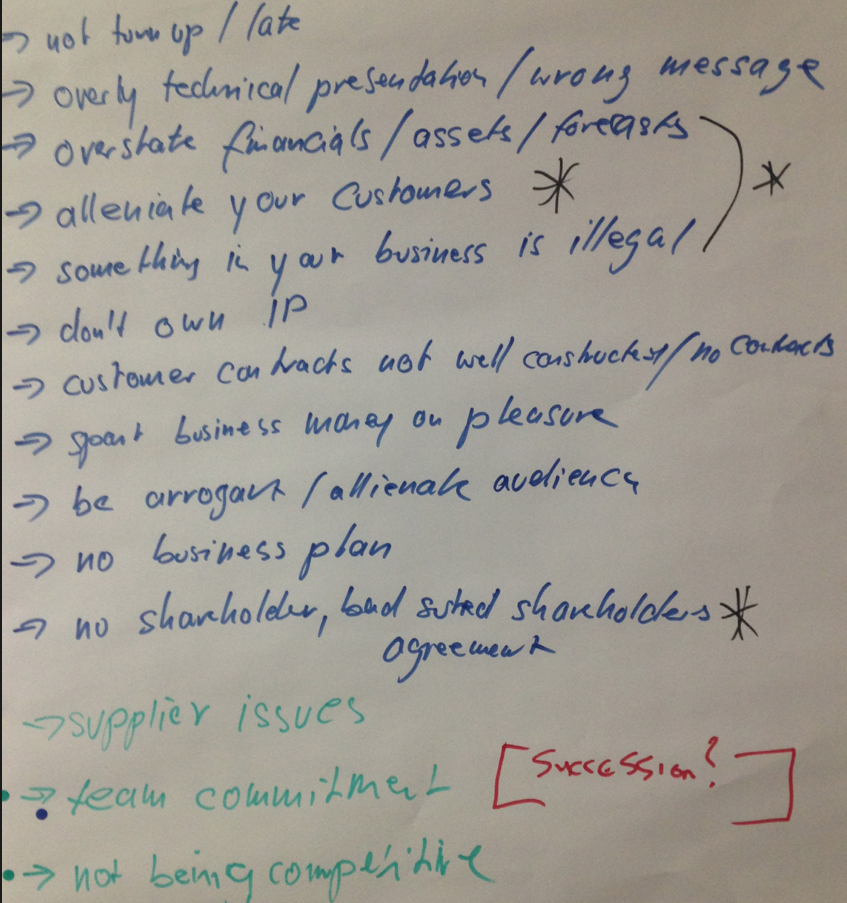
Here’s one of the team’s workings and below the 6 major issues likely to derail an exit prior to and including the due diligence phase:Screen Shot 2015-07-22 at 10.55.51

  • Failure to protect their Intellectual Property
  • Lack of clarity among team over personal and organisation’s exit strategy
  • Failure to plan for departures and who will succeed
  • Failure to meet over optimistic targets
  • Misrepresentation of warranty information
  • Failure to develop testimonials and reference sites

Testing what others heard

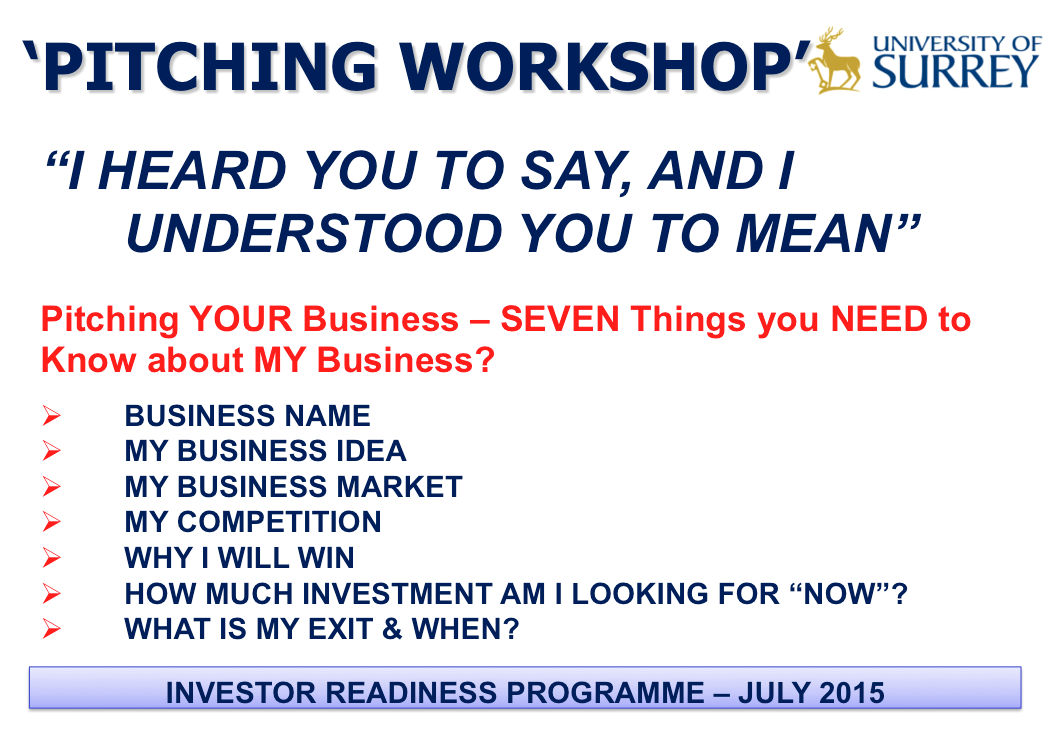
Having recognised the importance of at least thinking about the exit strategy before making a pitch for funds James and I now challenged each business to present their proposition in 90 secconds using these headings. I gave these instructions:

  1. Break into pairsScreenshot 2015-07-21 09.00.20
  2. Take 5 minutes to plan what you are going to say
  3. Give the pitch to your partner
  4. Listen to your partner’s pitch
  5. Back in plenary: make your partner’s pitch to the whole group
  6. In 2 groups discuss what you liked about styles and content
  7. Debrief in plenary and vote for the most compelling proposition

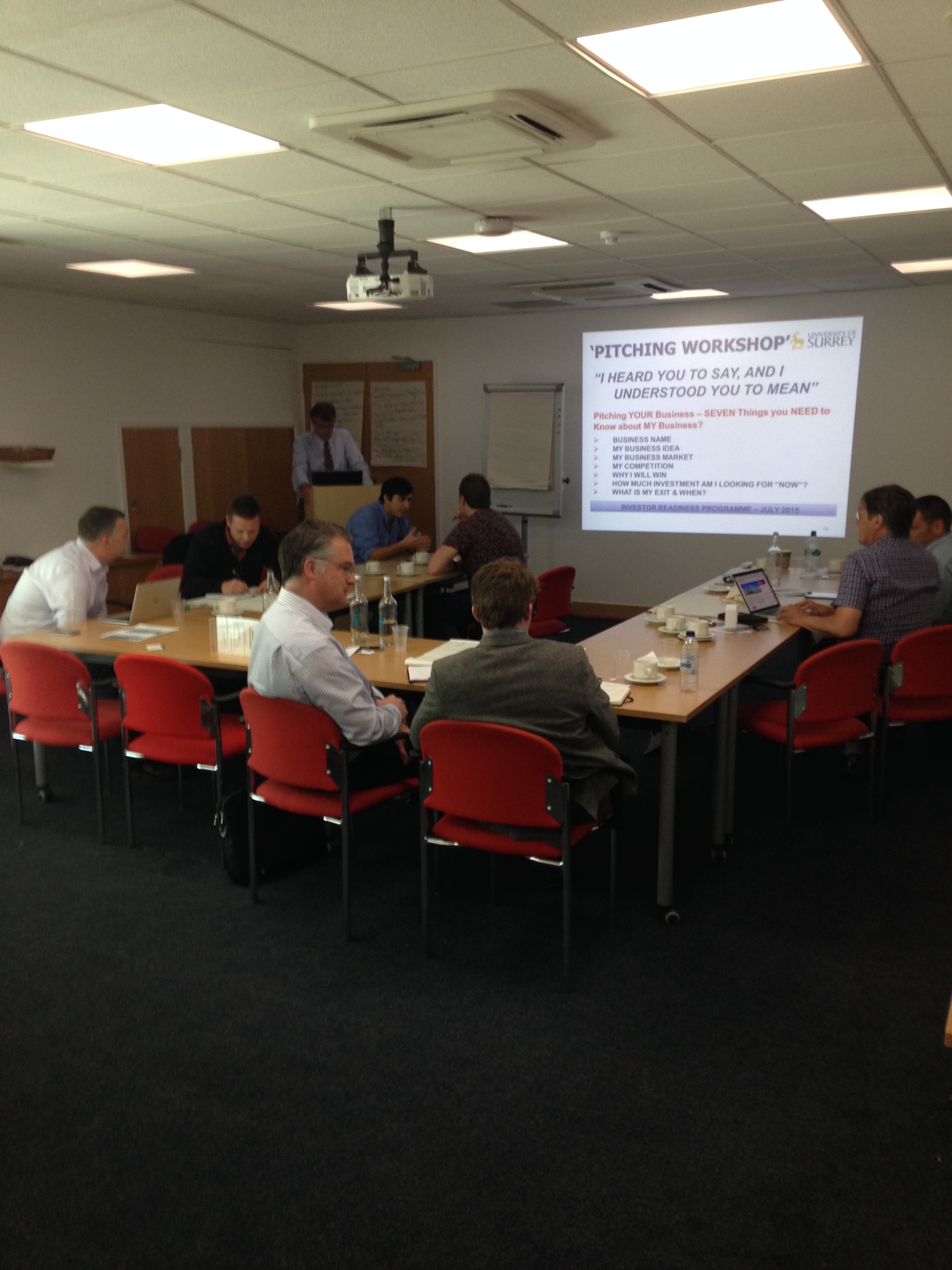
IMG_3701Listening (and watching) well is important to presenting well and the title I heard you to say and understood you to mean’ is a pointer to the need to focus on different ways to tell the story of the business opportunity to different audiences.

We encouraged each presenter to think about how the message they are giving will be interpreted and left them with this metaphor.

Imagine you are writing a press release, this part of your pitch is the headline and the synopsis of the article.  The aim is to get questions (in more detail) from interested investors as a result of this (very) brief pitch.

And finally

As always when you work with bright people you learn.

  • The importance of revenue recognition in the software industry when buying or selling a business – for a good description see: SOP 97-2
  • The point at which you do a business plan is ‘when I becomes we’
  • A good strategy should be capable of being represented as a picture
  • When promoting your business remember to say ‘what it does not how it does it’
  • People buy you not the numbers and they buy the story you tell: if you can’t say what difference your ‘product’ will make then investors won’t be interested either

the future workplace seen from the streets of London and the importance of conversations

Running a portfolio of activities is great. It has downsides though: The feeling of anxiety about what’s next; or guilt at taking a time out to do pro bono work when I could be responding to a request from a prospective client. And like every business marketing and relationship management has its cost.

But yesterday I decided to take a time out to reflect and think about the closing session at KMUK which I’ve been asked to lead. And this is how I ended up walking the streets.

John Blackwell is someone I met many years back while he was an IBM’er.  His ‘new’ organisation Quora devotes much of their time to help organisations think about the future of work and workspace.  Those who follow what I write will know working environments (space: virtual and physical) is a topic I feel neglected in Knowledge Management strategies and implementation plans.

mobile knowledge cafe in the street?

When John invited me to attend an afternoon session run by Street Wisdom at the Royal Society of Arts as part of his Smartworking Summit I was intrigued as the concept has caught on around the globe and seemed to be a sort of Knowledge Cafe in the street. Here’s what happened:

  1. Scene setting: David, Chris and Mel, explained what was about to happen over the next 3 hours.  In a pre-session discussion I’d described my ‘doctrine’ of Orchestrated Serendipity and that was used to illustrate what might happen. This is what we did.
  2. AIMG_3579 1wareness: Having assembled in 3 groups of 6 outside of the RSA we were invited to go off on our own for 8 minutes and observe – our choice, what we see and record. I noticed this pile (and someone’s bed) not 100 yards from this lovely peaceful spot.IMG_3580 1
  3. Slow: Back at ‘base’ we were asked to go off again at a very slow pace to see whether what we noticed is different because we have slowed down. My immediate emotion was of being in a bubble as everyone around me hurried about their business. Certainly I was more attuned to ‘things’ and it felt like I do at airports where I often switch off and withdraw in as a way of coping with the vagaries of travel. My 8 minutes over I return to ‘base’.
  4. Patterns: With my new ‘friend’ Mark from Sheffield I set off in search of patterns. This was interesting. As we walked we reflected on how we had already seen things we’d not normally see. We parted, me to Caffe Nero, he to the pub, both to watch.  I noticed: in a cafe people give themselves permission to talk; no one seems to use a paper map anymore, they use their smartphones; buses do come along in threes.
  5. IMG_3582 1Beauty: If the 8 minutes searching for patterns seemed a bit frivolous, 8 minutes looking for beauty (definition: ‘in the eye of the beholder’) was revealing. Literally 400 years from the rubbish and garden, up a twitten off The Stand I came across this magnificent abode which was being shown to a young Asian Student and his father. Amid the hustle and bustle of The Strand here was an oasis (at a price-1 bedroom starting at £895k!) which was aesthetically pleasing.
  6. Burning question: Fired up and ready to go I returned for my last task assignment.  I was to go off for 30 minutes to answer a burning question.  In my case this was to think about how I was going to run the forthcoming closing session at KMUK.
  7. Plenary: All valuable interventions end with a debrief / reflection session. Here we sat in a circle and shared what we’d seen and done. This was a precursor to a more expansive group conversation among two dozen people drawn from HR/Change/Facilities Management functions.

observations from plenary

The plenary session was stimulating: some worked virtually, others from Academia did a combination of home and away.  Here’s what emerged:

  • While virtual working is hugely advantageous to many, not everyone’s personal circumstances or culture fits.  Last week in Hong Kong I realised that with personal space at such a premium work has to take place away from the home. One virtual worker also noted that as a mother the flexibility is essential for her. She did note though that personal contact is essential to make sure a virtual team functions to its optimal level.
  • The grouping of people around a central office or campus is declining.  One view was that the Google and Facebook campus facilities are the last hurrah for this type of environment.
  • The future is about creating community hubs (closer to where people live) that permit drop out/drop in attendance based on a concierge hotel style service.
  • Current contractual arrangements are too restrictive and Zero hour contracts exploitative and not conducive to creating the element of trust needed for a different approach to task management. We discussed the idea of giving staff ‘space cards’ which they can redeem against usage at such approved venues.
  • No one is training us to work in the new way or in virtual teams and the training should begin in schools.
  • Digital was an adjective, now its a noun and with Bring Your Own Devices (BYOD) we are entering an era of extreme customisation of the workplace by the consumer.
  • No one ‘owns’ the topic at a senior level. Like Knowledge Management ways of working and workspace environment is seen as being a horizontal function straddling many disciplines.

my takeaways

  • The next 5 years will see an accelaration in the growth of the generic workspace.
  • ‘No one can speak twice until everyone has spoken once’ was a lovely approach from David Pearl (Founder of Street Wisdom) to ensure everyone in the plenary session got their say.
  • People and conversations matter, in fact they are vital for innovation and knowledge sharing: people share not technology.  I realised halfway through the session how important it is to have the imaginery ‘water cooler’ or coffee station area where you can go to share and be stimulated. By listening to others I was able to craft an agenda which otherwise I might have struggled with.
  • Street Wisdom worked for me when I recognised I had given myself permission to take time to slow down and reflect. It is an effective way of changing mindset and a case of: ‘when you look at things differently, the things you look at change.’
  • And finally, I managed to create a wrap up session for next week’s KMUK event. Watch this space to see what I did and how it went.

one to watch

Re-Imagining Work remains one of my all time favourite videos.  Dave Copin imagines what might be possible if more organisations embraced the empowering potential of technology and encouraged a truly open working culture.  It is a great accompaniment to this discussion and one I use frequently to stimulate a debate.

a reluctance to tweet: 10 success factors for virtual teams

It was like throwing a dart into a vacuum

Is how I responded on Twitter to Mark Gould an offsite observer of #KMLegal2015 who bemoaned the lack of online activity by the 100 or so Knowledge & Information Management (KIM) professionals who were attending this year’s Ark Group gathering of the UK KM legal community.

Its baffling: vendors, consultants and indeed KIM practitioners promote the value of social collaboration tools such as Yammer and Jive. Indeed KIM professionals are often at the forefront of efforts to get adoption in their organisation in order to improve collaboration and knowledge sharing. Yet they seem reluctant to ‘walk the talk’ in a public forum.

Perhaps Joanna Goodman got it right when she said:

sessions were quite interactive, so hard to be fully engaged and tweeting

It made me think more about why I tweet at a conference, this is what I posted during a virtual conversation with Luis Suarez a prodigious tweeter (58k to nearly 12k followers):

Why tweet a conference? Expand reach, collaborate, collect and share thoughts ‘on the fly’. Make notes for future blogs.

What really struck me though was the contrast with the Janders Dean Legal Knowledge & Innovation Conference, London #JDKMConf held the week before. That audience made sufficient ‘noise’ that even those who didn’t attend were able to draw conclusions. Here’s what Stephen Sander (The Vue Post) wrote in a witty piece about being a non attendee:

I curated below what I consider to be the best tweets from the Conference. These tweets offer an interesting insight into current themes and issues in legal knowledge, innovation and technology.

Perhaps this is the difference? The Janders Dean event was invitation only – a thought leaders event – whereas KM Legal is an open conference, if you pay up you can go!

Whatever the merits of both, facilitation should be at the core of the KIM professionals competency set and ‘putting stuff out there’ ia good part of that. Too many broadcast rather than engage. Knowledge Management in a comfort zone is not going to change the way a firm works and responds to the significant challenges facing the legal profession which brings me onto why I was there:

Managing Virtual Teams

In December, Martin White and I ran a breakfast breakout event at the RSA entitled The Future for Legal KIM: an outside in perspective’. One of the challenges firms identified as significant but for which they were ill prepared was the management of virtual teams. As a couple of long in the tooth practitioners who have worked across many continents we’d seen a wide range of organisations fail to match their virtual team technology investment with training in how to go about facilitating virtual encounters.

Virtual Teams Presentation StructureOur brief for KM Legal 2015 was therefore entertain the audience, bring the issues to life. Our approach: tell stories and show images.

We divided the presentation into these areas each drawing on events from our knowledge base.

In tackling the culture piece I noted the following:

Let me say right up front: you can’t manage culture just the same as you can’t manage knowledge. In both cases you can create environments in which people are willing to collaborate, share and work towards a shared set of goals.

Many organisations have a set of values and a social contract that underpins the relationship between the firm and employees.

Ultimately a firm is a collection of individuals each with their own reasons for being there. In a virtual team people’s fears, prejudices and behaviours are magnified.

In thinking and rehearsing for the session Martin and I had worked virtually. We learned a lot about clarity of messages and intent behind words and phrase (and we are both English). We (re) discovered the need for a collaboration space with a framework that suited us both.

We discovered a lot more besides, here’s what we shared with the delegates:

Ten virtual team success factors

  1. Virtual teams are the way work gets done: Recognise that virtual teams are going to be increasingly important to any organisation, and ensure that current and potential participants have access to training and mentoring on virtual team management and virtual team meetings.
  2. Set very clear and achievable objectives: Virtual teams should have very clear objectives so that it is possible to set the investment in the team against the outcome and also that team members bring appropriate skills, expertise and authority to take action.
  3. Chose virtual team leaders carefully: Leadership skills that work for physical teams may not be as valuable in a virtual team environment. Other skills are needed and have to be acquired through practice, not just through reading or teaching.
  4. Develop protocols for virtual meetings; Without good team meetings a virtual team is very unlikely to achieve its objectives and so particular care should be taken in developing guidelines for virtual meetings and for facilitating feedback.
  5. Provide team member profiles: Develop good profiles of each team member, taking into account local availability of technology and offices which can be used to take part in virtual meetings (especially in the case of open-plan offices) and language expertise.
  6. Build virtual relationships before putting them to the test: Each team should have an opportunity to meet with other members of the team through an initial virtual meeting where members can introduce themselves and gain experience with the technology being used before the first formal meeting of the team.
  7. Team dynamics can be difficult to manage: Team dynamics of virtual teams can be quite fragile, often depending on a very high level of trust in people they may not have met before. Introducing a new team member into an existing team may mean starting the process of building trust all over again.
  8. Gain consensus on what needs to happen between meetings?: Team members may have different reporting lines, which may impede the overall achievement of objectives. The measure of a virtual team is what it accomplishes between meetings, not how enjoyable the meetings are
  9. “English is our corporate language”: Issues of language and culture need careful consideration but should never be an excuse not to bring specific individuals into a team. There may be a mix of abilities in reading, speaking, understanding and writing in English
  10. Evaluate team and individual performance: The performance of the team and of each member should be carefully evaluated and training and support given where needed.