‘Freelancers’, orchestrated serendipity and the symbiotic relationship between virtual and physical space

I have just published an updated research note on Scribd. following the workshop I ran for the NetIKX community last week and wanted to share the findings here:

To succeed in the 21st Century organisations will need to be good at collaboration and co-creation and the research I’ve undertaken suggests some organisations are changing working environments and patterns in order to accommodate this. Are they doing enough to take their staff with them though or do their people merely see this as an attempt to cut cost?

a case for ‘Orchestrated Serendipity’

This has been a mantra of mine for some time. The RSA clip on reimagining work cites the example of people sat in open plan offices emailing colleagues sitting a few desks away.  Rather than promoting dialogue open plan has often had the reverse effect.
ADB Knowlelge Hub

ADB Knowledge Hub

Where I’ve seen organisations working well they have tended to look at workflows, people’s habits, made them an inclusive part of the process of change and communicated effectively. They’ve accepted that serendipity needs a bit of a push and have recognised that ‘ah ha’ moments often come from such serendipitous meetings and arranged space such as a khub to accommodate that. I often speak about how interactions to and from prayers in the Muslim world are often the most productive and why knowledge hubs and information centres are often situated in close proximity to refreshments areas.

Nelia R. Balagapo in May 2013 described how ADB had gone about the process of creating a physical knowledge hub.

The library reorganized its physical space to become a knowledge hub (kHub) to host book launches, meetings and forums of the COPs. In collaboration with the different departments and COPs, an average of four activities are held in the kHub weekly, including “Insight Thursdays,” a weekly forum where staff share insights on topics or issues of interest to ADB. Wireless Internet connection and videoconferencing facilities enable staff at regional offices to participate online in these forums. The introduction of these facilities, including a coffee shop in the library, contributed to the transformation of the library spaces into dynamic learning areas.

It seems our personal habits are changing too: this week it was announced that more and more homeowners crave for multipurpose ‘living’ areas that can accommodate, cooking, eating and lazing!

the rise of ‘Freelancers’

Knowledge workers are changing too, despite what Melissa Meyer said that all Yahoo workers should come to the office or quit! In a thought-provoking article How Freelancers Are Redefining Success To Be About Value, Not Wealth  Sarah Horowitz suggests that today in the US Independent workers make up a third of the workforce. By 2020, just six years from now, 40% of Americans will be working as freelancers, contractors, and temps. Here’s a couple of quotes that stuck:

…Freelancers are shaping the new economy. As flexible schedules and ubiquitous communication become the norm, the work-life balance that we’ve always struggled for is becoming achievable. As community and teamwork become more necessary than ever to thrive, the lonely, closed-off cubicle will make way for meaningful collaboration. And as the demand for healthy food and workspaces increases, industry will increasingly connect corporate profits and social good…

So if this phenomenon is growing how are we responding? I recall a presentation I gave in Houston in 1999 where I said that growth in the number of independent (non-salaried) workers was dependent on three factors:

  • supportive collaborative technology
  • a rise in physical meeting hubs
  • a change in the way financial services organisations assess the credit of non-salaried workers with irregular income patters.

All three now exist and so the key challenge is Trust (among peers as well as with direct reporting lines) as the Yahoo example would seem to suggest.

the importance of social and technology

I am a founding trustee (Knowledge Trustee) of a charity that aims to make better use of surplus food. www.PlanZheroes.org has no formal offices yet its governance process is all very formal and in the cloud. We hold virtual meetings and new volunteers are given access to all the materials and instructions they need to begin sourcing donors and recipients. As a knowledge hub for surplus food we perform a brokerage role helping to facilitate contacts between those who generate surplus food and those charitable organisations that make use of it.  All of this is made possible by collaborative technology, the rise of social media, which encourages and facilitates collaboration, a culture that is aligned around a shared vision and the availability of suitable meeting places in which to conduct essential f2f interactions that underpin social exchanges.

objects and the role of neutral space
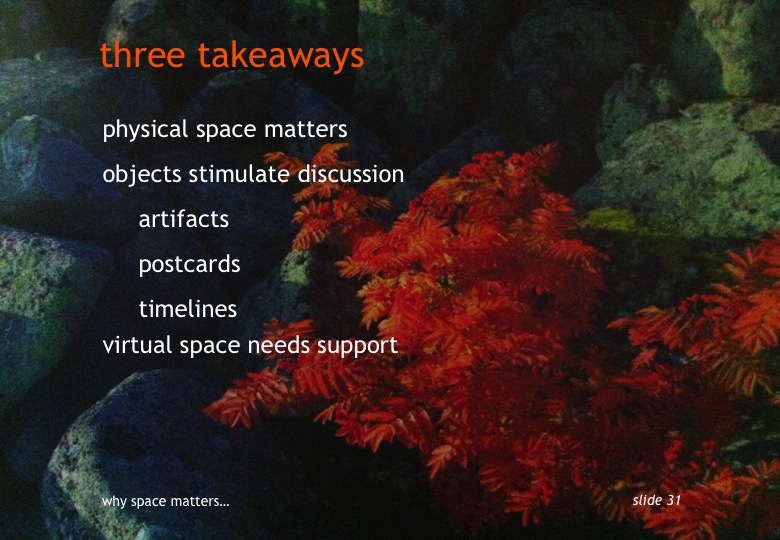
Slide31One of my 3 takeaways is to use objects as a stimulus for dialogue and innovation.   The idea of neutral space is core: if you accept the premise that it is important to create hubs for interaction such as that illustrated at ADB then the same logic applies when looking at how to facilitate those interactions.

I saw a salesman use a very informal worksheet last weekend and wrote about it.  By using a worksheet (a neutral object) he was able to elicit valuable information that helped make a sale.

the symbiotic relationship between virtual and physical space

As often happens with the wonders of modern technology, a comment I made on a news item on the simply communicate newsletter entiitled working out loud at Deutsche Bank led to a really interesting exchange with Managing Director John Stepper.  John has achieved a lot using a Jive platform to encourage social collaboration and change the ways of working there. I asked him:

Hi John, I’d be interested in whether you paid attention to how virtual and physical space come together? I’ve just published on Scribd. an updated report on ‘when space matters…’ And one of the questions was whether virtual could replace physical! How did you manage to marry the two?

John replied:

Paul, I’m an admirer of well-designed spaces though by no means an expert. But I’ve written about how virtual spaces complement the physical (and systems) design: http://johnstepper.com/2013/02/23/the-best-office-design-for-collaboration-is-also-the-cheapest and

/http//johnstepper.com/2014/02/01/creating-places-we-care-about/

Do take the time to read his thoughts. If anyone has coined a more apt description of what many organisations have become then I have yet to see it:

We discarded some of the age-old principles of what motivates and engages people. Somewhere along the way we’ve forgotten we should be designing organizations for the benefit of the human beings in them.

 

A great knowledge capture / engagement technique: the customer worksheet

Today my wife Ana upgraded her phone as her current contract had expired.  Being a born negotiator she always gets a good deal but it’s a long process involving a couple of offers from competing suppliers. That brunch on the seafront was mentioned was sufficient for me to tag along. I’m glad I did. Here’s why.

After a brisk 3.5km along Eastbourne’s seafront to The Beach Deck and the best Eggs Benedict I’ve had in Eastbourne we ended up in town in the phone shops.

We started at EE, Ana’s current provider.  Friendly and welcoming yes but their approach was “tell me something and I’ll fill it onto my system.” He was behind a counter and his computer screen was a barrier as was the counter we were sitting at. Ana had to write down what he was saying and ask for a piece of paper to do so.  And their offer was appalling.

Next up was phones4u a chain of mobile phone shops.  We’ve been there before and I’ve always liked their commercial yet subtle sales process which is underpinned by a knowledge capture worksheet (checklist) KM’ers could learn from when they are conducting interviews.

a checklist that isn’t

It’s clever. Every piece of detail the salesman needs to form an opinion about you is there but the overlapping circles are not at all threatening or official. It mixes informality with the need for capture and here’s the twist, the salesman can choose which question to pose and when depending on his assessment of the person sitting in front of him and their answers to some of the questions.IMG_1760

It has ‘doodle’ space so it feels like a document that is purely for taking notes when actually it is the basis on which their document of record is created.

I asked Andy Waller, an experienced salesman who listens – a huge asset, how it differed from their previous checklist. He said and I paraphrase:

The previous form was sequential and official. It pushed you to ask questions in order. This one allows you to move around at a pace that suits the customer and explore areas that they want to discuss.

why it works

  • Co-created: it feels like a sketch you both create.
  • Informal: it encourages you both to scribble – it doesn’t feel like it’s an official record.
  • Personal: It’s all about u….is the title and that’s how it comes across.
  • Structured flexibility: it’s an interview spine that in the hands of good interviewers (which is what successful sales people are) provides an insight into a prospective clients’ needs against which they can pitch a product.
  • Neutral object: we focus on filling in the worksheet not the system – its a neutral space and so different from the EE approach.

Today reminded me that successfully capturing information and knowledge is very much dependent on the way you go about it. It reinforced the need for good tools and techniques and people well versed in using them and seeing the value in them.  phone4u got Ana’s business today and they’d get mine next time.  As their form says:

It’s all about u…

So with his and my wife’s permission I have shared the experience and the worksheet.

Why stories matter for Knowledge Management: From Colombia to Iran via Portugal

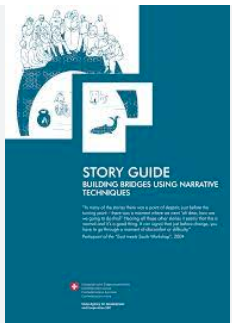
Building Bridges: SDC Story Guide

A year or so back while I was in Colombia I was asked to do an interview for publication in Brasil.  It was about the role of storytelling as a effective technique for Knowledge Management and I thought I’d share (in English) some of the answers I gave then which I believe are still really relevant today. Here’s why:

Last week in Tehran as part of Stage 2 of an exciting KM project I have been invited to work on I was in a room with a dozen or so senior managers and engineers. We were trying to map a process to see where it could be enhanced / reengineered by embedding KM techniques.

There were flow diagrams, boxes and arrows.  The process (and the engineer describing it) came to life when he was invited to ‘tell us a story about what happened’. He opened up – it was as if I had given him permission to be himself and let go of ‘corporate or technology speak’. He then went onto describe what we styled ‘The Lube Oil Pump Incident’.

At the conclusion (and in the following day’s sessions) our sponsor and I encouraged everyone talking about a process to use narrative and to think of a title for their story.

It brought back two questions I was asked for the Brasilian article which I conducted while I was Managing Partner of Sparknow LLP:

Why stories? What is so special about them?

Hi Ana, thank you for this opportunity. Let me tell you why I think the use of narrative (storytelling) is a hugely powerful and insightful technique not merely for use in organizational KM.  Stories have the power to unhinge and unearth insights, experiences and emotions often hidden in the jargon and protocols of corporate world.

Sparknow’s tradition in using story in KM goes back to the late 90’s when the Founder Victoria Ward commissioned Carol Russell (a storyteller with origins in Jamaica and story roots in Ghana) to write and tell a story about the KM journey at one of the UK’s leading Banks.

Not long after ‘Corporania’ was completed and shared to much acclaim Sparknow was running a series of open sessions at the KM Europe conference held in Den Haag.  Among the attendees was a Geographer from Switzerland who had recently been asked to head up knowledge management at Swiss Agency for Development and Cooperation (SDC) in Bern.  Manuel wanted to explore story-telling tools as a way to increase knowledge transfer between the Agency and its partners, different places, and the edges of the organization and the centre; that began a 5-year joint exploration that culminated in the production of Building bridges, using narrative approaches to knowledge management still viewed by many as one of the most useful works on organizational storytelling, and tangible evidence of how effective the use of story can be in KM.

I digress. To illustrate the point a bit more clearly.  Everyone can remember their best teacher or professor and I’m sure they were good because they shared anecdotes and stories that brought a topic to life. My law teacher was brilliant at describing in a humorous way cases that illustrated the law of tort. Moreover great leaders tend to be adept at using stories to engage and communicate, its one of their core skills.  So sharing lessons, bringing strategies to life, getting messages out across the organization, getting buy in to new ways of working and perhaps most importantly hearing what people actually think and care about are all improved by the use of a story in whatever form it is told. I’ll talk more about that later.

For me a big turning point was conducting an interview as part of an inquiry on behalf of the UK Tax & Revenue.  We were asked to find a way of augmenting quantative surveys to identify among other things how clients (taxpayers) perceived them and the help they gave.  While the interviews were but 20 minutes they were constructed in such a way as to encourage the interviews to tell the stories of their experiences in seeking help.

This particular interview which ended up being called ‘tippex and the kitchen table’ helped paint a graphic picture (through the words of the interviewee) of what it felt like to be filling in a tax form which you had to keep correcting through a lack of knowledge while running your own business and bringing up two children.

How is this relevant to KM?  By playing back the interview (with permission) to a wider audience it set the backdrop for potential changes in the way the department worked with clients.


Stories are prone to misinterpretation. Is there the danger of that causing problems in communication? If so, how can that be prevented?

Context is key. What I takeaway from a story might be different to you because of when and where I hear or read it and what my knowledge base is.  The same though applies to every form of communication. How many times do organizations seize up because of poor email practices and verbosity? This is a real issue across continents and languages and I can recall how the knowledge transfer in an R&D function stopped purely because of a different style of email communication.

The way to reduce the potential for misunderstanding is to give people the skills, the confidence and the equipment to identify, collect and share stories. And to ensure they are targeted at the right audiences in a manner that can be understood. Here is how we’d go about tackling the issue of whom to target and what to share with them. This applies equally to a KM programme as to a piece of engagement or communications.

1 |  Develop a strategic story that explains the direction in which their organization is heading, the prizes, the pitfalls and what’s expected of them. Bring it to life through words, images, etc that can be used to explain it to everyone with an interest in your organization. This provides a context for more specific communications and discussions.

2 |  ‘Support the strategic story with a series of smaller, individual ‘stories’ – accounts of people’s experiences in parts of the organization. These smaller stories can be used to bring the strategy to life, generate enthusiasm, spark ideas, resolve dilemmas, spread thinking and initiate conversations.

3 |  Create resources and assets to enable leaders and managers to put the story to work. Deliverables could include an engagement programme or roadmap, communication materials and experiences to bring the story to life, a story database, workshop designs and agendas, toolkits, training and ad hoc advice.

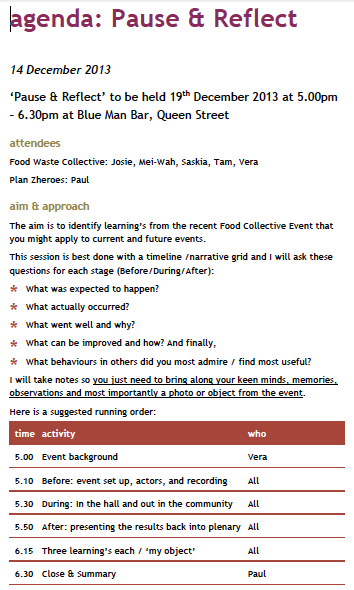
‘Pause & Reflect’ session vs. an ‘After Action Review’

Pause & Reflect AgendaTonight (Thursday) I will be in Brighton on behalf of Plan Zheroes running a Pause & Reflect session with the Food Waste Collective. We are going to be taking a look at the recent event they held at Brighton University and which I wrote about a few weeks back – when a good deed is lentil shaped: why a group of Brighton based women deserve our support.

Since a previous posting about a Plan Zheroes Pause & Reflect session on a CSR Day we ran attracted some interest I decided to share with a wider audience how I go about setting them up

The agenda is time specific and requires the attendees to have thought in advance about an object or image that sums up the event for them. The other departure from the more traditional After Action Review process is that I try to get people to focus on the behaviours in others that really helped make the event work.  This appreciative inquiry technique is one I’ve found to be highly effective reflecting as it does on behaviours in a group environment.

the power of 3

I’ve always been a great believer in the principle that less is more especially when looking back at an event or decision. And I tried to get everyone I’ve mentored or coached to focus on ‘the power of 3’. Most people can remember 3 things and act on them.

Professor Victor Newman often tells a story about one of his early experiences going into an organisation and finding a lessons learned exercise came up with more than 200 ‘lessons’ which were noted down and taken away never to be acted upon.

3 ‘things’ is also a theme I apply in reverse brainstorming when getting people to consider how they can tackle ‘stuff’ that is broken.

capacity building and knowledge transfer

Tonight’s event is part of Plan Zheroes ongoing commitment to support volunteers outside of its core market. If we can equip others with basic skills and tools to improve the way they run events and interact with food donors and recipients fewer people will be facing food poverty and we will all be making better use of surplus food.

I am looking forward to the session.

‘your entire career is your exit interview’: embedding knowledge capture & retention techniques

This tweet, from this year’s KM Russia event, reminded me of an interview I had with a senior Asian banker a few years back.  Retiring, after three decades during which time he’d been pivotal in the regeneration of Asia after the crisis of 1997,  he was asked at his exit interview, ‘have you returned the stapler?‘ The sense of disappointment in his voice was palpable as he told me (I paraphrase), ‘you devote your life to an organisation and then puff, you are gone along with your sense of identity’.

It echoed a similar conversation with the former CEO of a major reinsurance group whose departure remains a source of unhappiness because his experience and network of contacts were not considered important enough to devote time and resource to by his successors who were taking the company in a new direction.

Fortunately many organisations are now making knowledge capture and retention part of the ‘way we do things around here’, recognising the need for effective processes throughout the life cycle of employees and projects. One such organisation is Her Majesty’s Revenue & Customs who employed us* to run a pilot programme capturing and exploiting corporate knowledge’ to equip senior business heads with tools and techniques they might use to capture and retain critical knowledge.

In previous posts I described the programme modules 1-3. Here I’d like to share with you modules 4 and 5.

HMRC’s Pilot Programme: : Modules 4 & 5 Analysing & Sharing

Analysing how to analyse and organise the material that has been captured
Sharing how to share the knowledge that’s been captured how to engage with your audience

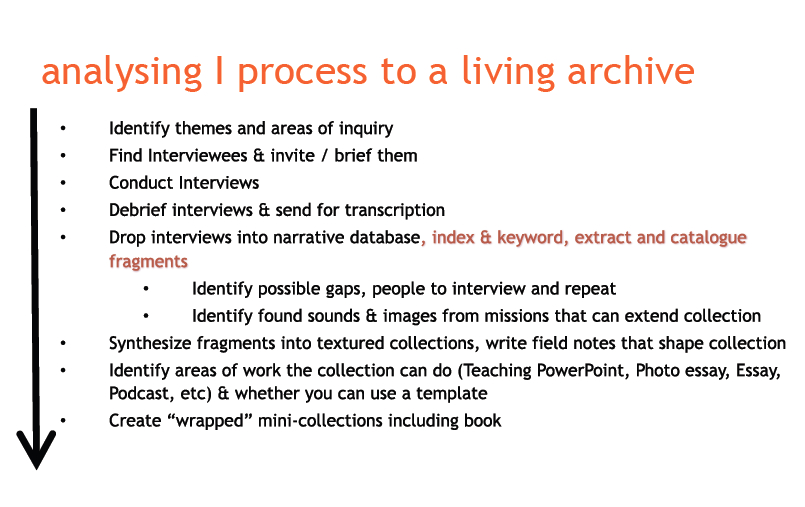
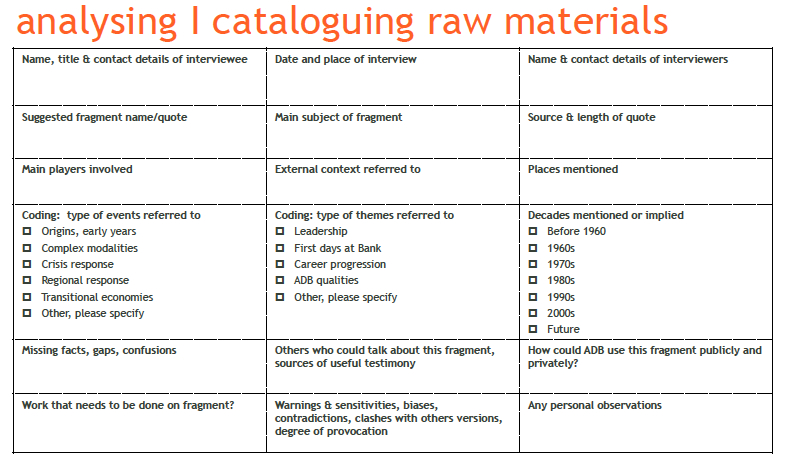
Analysing (cataloguing and curating) the material captured is often overlooked, the assumption being that search will reveal all. The delegates were invited to listen to a couple of recorded interviews and consider how they might catalogue the material.

We accepted that not every piece of critical knowledge (defined previously as the knowledge HMRC would struggle without if it lost’) is likely to be recorded on voice or camera. However the process of thinking about how to catalogue material does provide a steer on the importance of structuring what you are capturing. We spend money on creating taxonomies which is another form of categorisation and cataloguing.

Here’s one example tablog 2ken from a piece of work featured in ‘making Knowledge Management work in your organisation’ (an Ark Group publication). It shows the process adopted for the creation of a Living Archive. Note the importance of the indexing or cataloguing process (in red).

blog 3And here’s the cataloguing process that is referred to above and was shared in HMRC module 4.

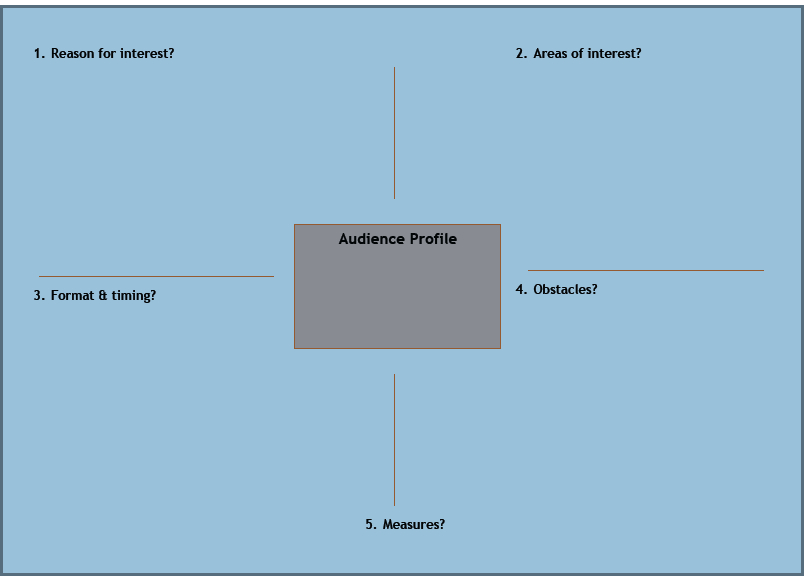
In Sharing (Module 5)  we looked at numerous ways of engaging with the stakeholder community previously discussed and identified in Module 2. Our aim here was to illustrate that no one size fits all and that each person or group might respond differently.

The delegates had to map the profile of the audience and then think about what might be the best method of engaging.

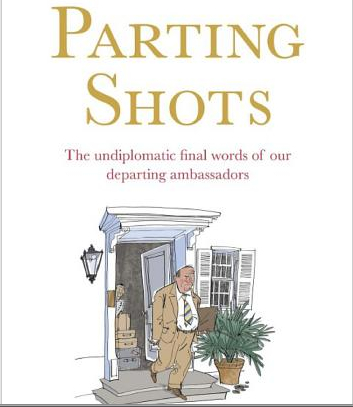
Blog 1Aside from examples of companies who have successfully use: Baton Passing, an Audience With, Fellows, Knowledge Markets, Dare 2 Share Fairs and Memoirs on Camera we discussed the (now discontinued) practice wherein a returning diplomat would complete a Valedictory Despatch after his or her tour of duty overseas ended.

Parting ShotsAs in previous modules the delegates were asked to consolidate their learning ‘off line’ and as a way of consolidating all the exercises were given an assignment to be working on before we reassembled for the final session.  I will conclude this series of blog posts next time and look at how we evaluated the programme.

Parting Shots by Matthew Parris

*Sparknow and Knowledge et al worked in partnership to deliver this programme.