Does Gamification work in a Knowledge Management environment?

I spoke last week on the topic of gamifcation with Andrzej Marczewski ‏(@daverage) and Stephen Dale (@stephendale).  Both have more than a passing interest in this topic:

  • Andrzej is currently ranked the #1 ‘Gamification Guru’ (in a US online poll) who focuses on inter alia User Types, who blogs and publishes the Gamification News;
  • Steve who has a long and distinguished career in Knowledge & Information (and who has chaired Online for a number of years) is interested in how behaviours are influenced by gamification and recently ran a well received workshop for NetIKx ‘#Gamification strategies for incentivising knowledge sharing and engagement: http://slidesha.re/1iJIYxO

I first heard Andrzej at Ana Neves’ excellent 2013 Social Now event in Lisboa where many of the presenters described how they’d used gamification techniques. It occured to me then that as communicators and marketers are increasingly using Gamification for engaging with staff and external stakeholders, so why should Knowledge Managers be different?

Fast forward 12 months and Andrzej, Steve and I are talking about whether Gamification might work in a Knowledge Management environment, the topic of Andrzej’s presentation and a joint session I am running with him at this year’s KMUK event on 11th and 12th June which I have the pleasure of co-chairing with David Gurteen.

KMUK Presentations

This session will take a look at the technique through the eyes of one of its leading evangelists and delegates will then have a chance to discuss its potential application in a knowledge management environment. Here’s the ‘blurb’

Gamification: Past, present and future – Andrzej Marczewski

  • a review of the landscape and its evolution
  • a look at current practices and examples
  • how to decide when to apply it
  • identifying and working with different audiences
  • critical success factors
  • where will it be in 5 years time

Gamification in a KM environment – Paul J Corney

Paul will draw on research being undertaken in advance of the conference to lead a group discussion prompted by Andrzej’s presentation to examine:

  • has it caught on in KM – a review of adoption across knowledge workers
  • what are the barriers and how might knowledge workers might overcome them
  • where it can be most effective and with whom?

Seeking gamification examples in a KM environment

Over the next few months Andrzej, Steve and I are going to be trying to identlfy whether examples really do exist and if not why not!  In Steve’s excellent presentation to NetIKx he unearthered a couple of great examples from the world of health including Pain Squad – the App that gamified healthcare in Canada but he struggled to identify KM examples.

Perhaps its because we associate the phrase with technology?

In my book many of the experiential exercises my colleagues at Sparknow and I developed (and are written up elsewhere) such as:

  • A day in the Life
  • Future Story backwards
  • In their shoes

are all examples of gamification – that by doing and experiencing knowledge is shared, people are engaged and behviours shift.

More in the months to come.  Keep watching Andrzej’s excellent site for a chance to participate.


and finally (July 2014)

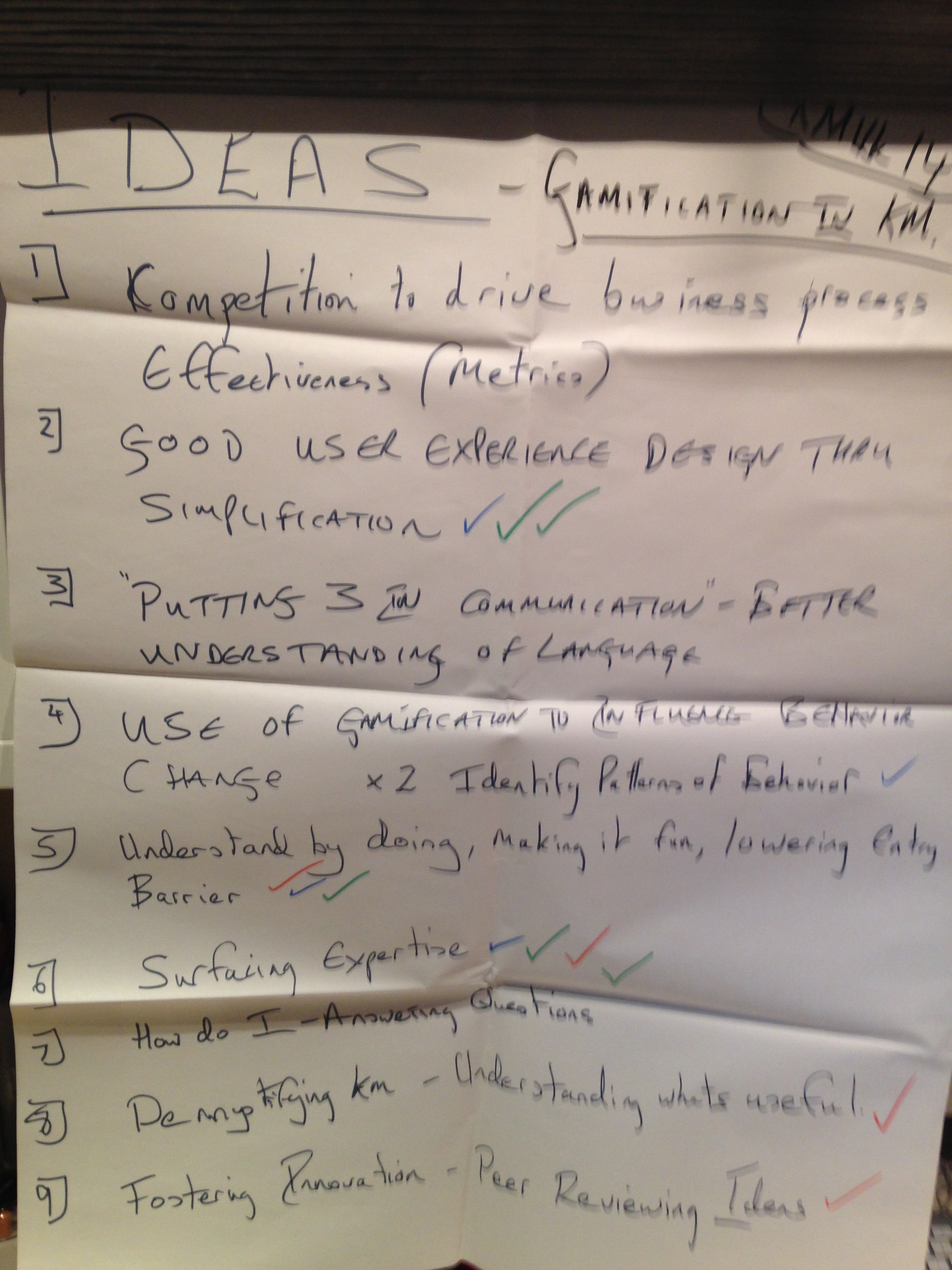
Here’s the outcomes from the group sessions at KMUK of where KM’ers thought Gamification might work in a KM environment.

IMG_2915

‘Freelancers’, orchestrated serendipity and the symbiotic relationship between virtual and physical space

I have just published an updated research note on Scribd. following the workshop I ran for the NetIKX community last week and wanted to share the findings here:

To succeed in the 21st Century organisations will need to be good at collaboration and co-creation and the research I’ve undertaken suggests some organisations are changing working environments and patterns in order to accommodate this. Are they doing enough to take their staff with them though or do their people merely see this as an attempt to cut cost?

a case for ‘Orchestrated Serendipity’

This has been a mantra of mine for some time. The RSA clip on reimagining work cites the example of people sat in open plan offices emailing colleagues sitting a few desks away.  Rather than promoting dialogue open plan has often had the reverse effect.

ADB Knowlelge Hub

ADB Knowledge Hub

Where I’ve seen organisations working well they have tended to look at workflows, people’s habits, made them an inclusive part of the process of change and communicated effectively. They’ve accepted that serendipity needs a bit of a push and have recognised that ‘ah ha’ moments often come from such serendipitous meetings and arranged space such as a khub to accommodate that. I often speak about how interactions to and from prayers in the Muslim world are often the most productive and why knowledge hubs and information centres are often situated in close proximity to refreshments areas.

Nelia R. Balagapo in May 2013 described how ADB had gone about the process of creating a physical knowledge hub.

The library reorganized its physical space to become a knowledge hub (kHub) to host book launches, meetings and forums of the COPs. In collaboration with the different departments and COPs, an average of four activities are held in the kHub weekly, including “Insight Thursdays,” a weekly forum where staff share insights on topics or issues of interest to ADB. Wireless Internet connection and videoconferencing facilities enable staff at regional offices to participate online in these forums. The introduction of these facilities, including a coffee shop in the library, contributed to the transformation of the library spaces into dynamic learning areas.

It seems our personal habits are changing too: this week it was announced that more and more homeowners crave for multipurpose ‘living’ areas that can accommodate, cooking, eating and lazing!

the rise of ‘Freelancers’

Knowledge workers are changing too, despite what Melissa Meyer said that all Yahoo workers should come to the office or quit! In a thought-provoking article How Freelancers Are Redefining Success To Be About Value, Not Wealth  Sarah Horowitz suggests that today in the US Independent workers make up a third of the workforce. By 2020, just six years from now, 40% of Americans will be working as freelancers, contractors, and temps. Here’s a couple of quotes that stuck:

…Freelancers are shaping the new economy. As flexible schedules and ubiquitous communication become the norm, the work-life balance that we’ve always struggled for is becoming achievable. As community and teamwork become more necessary than ever to thrive, the lonely, closed-off cubicle will make way for meaningful collaboration. And as the demand for healthy food and workspaces increases, industry will increasingly connect corporate profits and social good…

So if this phenomenon is growing how are we responding? I recall a presentation I gave in Houston in 1999 where I said that growth in the number of independent (non-salaried) workers was dependent on three factors:

  • supportive collaborative technology
  • a rise in physical meeting hubs
  • a change in the way financial services organisations assess the credit of non-salaried workers with irregular income patters.

All three now exist and so the key challenge is Trust (among peers as well as with direct reporting lines) as the Yahoo example would seem to suggest.

the importance of social and technology

I am a founding trustee (Knowledge Trustee) of a charity that aims to make better use of surplus food. www.PlanZheroes.org has no formal offices yet its governance process is all very formal and in the cloud. We hold virtual meetings and new volunteers are given access to all the materials and instructions they need to begin sourcing donors and recipients. As a knowledge hub for surplus food we perform a brokerage role helping to facilitate contacts between those who generate surplus food and those charitable organisations that make use of it.  All of this is made possible by collaborative technology, the rise of social media, which encourages and facilitates collaboration, a culture that is aligned around a shared vision and the availability of suitable meeting places in which to conduct essential f2f interactions that underpin social exchanges.

objects and the role of neutral space

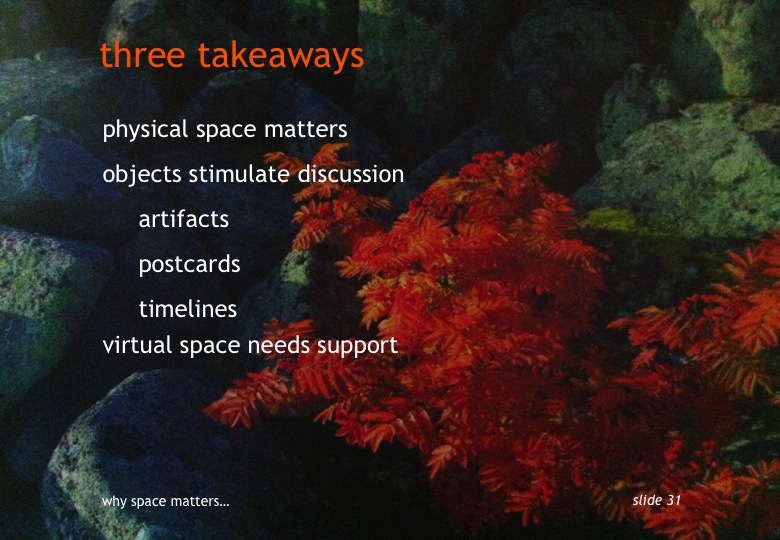
Slide31One of my 3 takeaways is to use objects as a stimulus for dialogue and innovation.   The idea of neutral space is core: if you accept the premise that it is important to create hubs for interaction such as that illustrated at ADB then the same logic applies when looking at how to facilitate those interactions.

I saw a salesman use a very informal worksheet last weekend and wrote about it.  By using a worksheet (a neutral object) he was able to elicit valuable information that helped make a sale.

the symbiotic relationship between virtual and physical space

As often happens with the wonders of modern technology, a comment I made on a news item on the simply communicate newsletter entiitled working out loud at Deutsche Bank led to a really interesting exchange with Managing Director John Stepper.  John has achieved a lot using a Jive platform to encourage social collaboration and change the ways of working there. I asked him:

Hi John, I’d be interested in whether you paid attention to how virtual and physical space come together? I’ve just published on Scribd. an updated report on ‘when space matters…’ And one of the questions was whether virtual could replace physical! How did you manage to marry the two?

John replied:

Paul, I’m an admirer of well-designed spaces though by no means an expert. But I’ve written about how virtual spaces complement the physical (and systems) design: http://johnstepper.com/2013/02/23/the-best-office-design-for-collaboration-is-also-the-cheapest and

/http//johnstepper.com/2014/02/01/creating-places-we-care-about/

Do take the time to read his thoughts. If anyone has coined a more apt description of what many organisations have become then I have yet to see it:

We discarded some of the age-old principles of what motivates and engages people. Somewhere along the way we’ve forgotten we should be designing organizations for the benefit of the human beings in them.


‘Nothing has changed and yet everything is different’: 10 observations from a special event at CILIP

Image

Yesterday I was at a special invitation summit to discuss the future direction of the Chartered Institute of Library & Information Professionals.  CILIP is undergoing a fairly dramatic repositioning under new CEO Annie Mauger and this was the first of a couple of attempts to broaden the debate with a wider constituency.

It was well organised (and run) by Martin White and Sandra Ward, two people whose names are synonymous with the words ‘Information’ and ‘management’, and whose best efforts had persuaded many thought leaders in the Information Management space to attend. Attendees were asked not to tweet and to follow The Chatham House Rule that states:

When a meeting, or part thereof, is held under the Chatham House Rule, participants are free to use the information received, but neither the identity nor the affiliation of the speaker(s), nor that of any other participant, may be revealed’

So (as a member of Chatham House and compelled to comply) here are my observations aided by a couple of pictures and slides published with the speakers permission.

10 observations:

‘Nothing has changed and yet everything is different’. Jean-Paul Sartre’s quote is apposite: 20 years on since my colleagues and I at Saudi International Bank were creating a one screen view of what we knew about a client (the forerunner of an intranet / CRM system) I suggest that despite all the gismos (technical advances) senior executives are still looking for reliable trustworthy information/intelligence – the synopsis they can trust, from people they trust. And don’t want to do self searching to find it. At the closing a wonderful story was told about a senior executive who has a team that provide abridged briefing notes and expected outcomes (in his native language) for every meeting.

People are still the important navigational hub and their knowledge networks vital. When they go their knowledge (and their networks) go with them. HM Government Knowledge & Information Strategy will make clear the importance of people and the public as the client and it will recognise that ‘who we know’ is as important as ‘what we know’ hence the investment in a Knowledge Harvesting Toolkit for KIM professionals (and training on Knowledge Capture & Retention).

We want measurements! Stories that amplify events and justification for Information and Knowledge team activity are hugely important but must be accompanied by statistics and measures which accounts in part for the increased call in the Public Sector for inventories of information and knowledge assets. In a world of data half a page of stats supported by a story is more powerful than two pages of prose.

We want certification! East, North and South of Istanbul there is a huge demand for education and certification.  Competency management is king and certificates from accredited organisations a way of enhancing career prospects. West of Istanbul people (especially the young) are just happy to be in a job and employers are increasingly demanding new entrants to be more self aware.

Apps are the future, websites are the past: Perhaps driven by a healthy scepticism of advertising and brochure ware websites dynamic content is key. This is presenting a challenge to the information industry who need to be more proactive in saying ‘read this and here’s why’. Ask yourself when did you last go to a corporate website and believe what it said – buying decisions are being driven by recommendations of people (and organisations) YOU trust. And Apps are making the process smoother as mobile replaces pc’s and tablets, laptops.

Fear is driving (in)action / lack of collaboration: the financial services industry has taken a bashing and the regulators are all over them extolling the virtues of a change in culture and trying to audit whether they have. Chinese Walls are getting higher so no Yammer or Jive to cross fertilise ideas and clients and silos will get more pronounced. In the Public Sector the rise of the SIRO (Senior Information RIsk Officer) as a board member suggests a greater and more visible role is emerging where risk aversion becomes a major driver of decisions.

Organisations are becoming hermetically sealed bubbles virtually impenetrable to anyone who is not of the same size. It used to be accepted doctrine that ‘no one got fired for hiring IBM’,  now the same applies with big consultancy firms. A vivid illustration was given: despite agreeing the scope of work with the client, being the best qualified and most experienced, formal sign off was not forthcoming for this internationally renowned consultant because ‘he is not …’ (three letters)!  

Modular competency acquisition the way forward/ Facilitation key: Many of the speakers and delegates commented on the need to be good at getting others to work well and be opportunistic. A role where the KIM professional, briefs, analyses and introduces, new processes, systems and ways of working. The idea of a modular incremental approach to competency development was lauded, perhaps in conjunction with business schools and Universities. As was the new CILIP Professional Knowledge and Skills Base, that the UK Government’s Head of KIM has been a strong supporter of.

IMG_1554KIM is here to stay: It was a common theme – KM especially is back (even if there is still ambiguity over what it is – especially in the North West).  This from John Quinn is lovely, a quote from a report in 1894 on the Department for Education’s use of knowledge:

 …failing to record the knowledge it obtains for future use and unable to obtain information as to what is being done elsewhere either at home or abroad…’

IMG_1553

To finish, a quote, from award winning Clive Holtham celebrating 25 years as one of the few to hold a Professor of Information Management title, ‘technology brings no competitive advantage’  – its an essential underpinning (my addition). Here’s Clive and his Intelligent Exploiter Framework – note the importance of ‘Mindset’.


And finally

Check out Full Fact a non profit making group that specialises in independent fact checking.  Despite a bit of a spat with UK Column a year back it has become a must go to site to check the veracitiy of ‘facts’ and ‘stats’ that appear in the media and emanate from the mouths of our politicians. Will Moy’s BBC Question Time piece ‘Will you point out when panellists are lying?’ is worth a read and his stories given a hearing.

‘…education, education, education…’ and the role of critical knowledge in government as seen from Whitehall

Our top priority was, is and always will be education, education, education. To overcome decades of neglect and make Britain a learning society, developing the talents and raising the ambitions of all our young people.

Prime Minister Blair, ahead of the 2001 General Election

Paul at Cabinet Office 1It was an interesting and Westminster focused week. A chance to see first hand whether more than a decade on the aspiration of making Britain a learning society had been realised.

Monday, I was a guest at a Cabinet Office Knowledge Cafe facilitated by David Gurteen; Thursday, I ran a workshop* at the Department for Education on knowledge capture and retention.

At the Knowledge Cafe there was a nice mix of people from across the Civil Service. The 40 or so, assembled by Susan Chan of The Cabinet Office and hosted by Roger Smethurst, Deputy Director and Head of Knowledge and Information Management at the Cabinet Office were discussing:

How can we more actively share knowledge in the workplace?

The Knowledge Cafe format encourages conversation (it’s David Gurteen’s mantra) asking as it does for three rounds of conversation after an opening round of 2 minute introductions. For some the lack of any obvious outcomes is a source of frustration, for others its a liberating way of discussing a topic of interest and testing your own hypotheses.

I found myself in conversation about the diametrically opposed tasks of promoting voluntary transparency across government while protecting the exemptions of the Freedom of Information Act.

We discussed the difficulties of establishing Twitter dialogue and of being tied to SharePoint.   Everyone had a tale to tell about lack of handover time when being faced with a new assignment. Few seemed to have heard of Collaborate the internal government social media/chatline.  To a man (and woman) there was disquiet over the abandonment of the Local Government Agencies Community Network.

Yet the vast majority had concerns about potential loss of knowledge when organisations downsize and move to more flexible and generalist working.  This was a theme that was to resurface on Thursday.

‘I spent the morning waiting for a login…’

The dozen or so people who attended the 2nd of 3 knowledge management expert sessions held at the Department for Education were drawn from Policy, Administration and Delivery. My topic:

capturing and exploiting critical knowledge in Department for Education

An exercise I’ve found works really well when trying to get to the bottom of what critical knowledge looks and feels like is to ask people to think about a time when they needed to know…. Often mundane administrative issues (a good handover/briefing pack being rendered ineffective by lack of access to a system) get in the way!

Introductions SlideThis slide gives you the narrative.

A variety of frustrations were aired as well as great examples of good knowledge sharing practices. And yet so much revolved around the need for signposts and people acting as knowledge hubs – knowing who to go to being as important as knowing where to look.

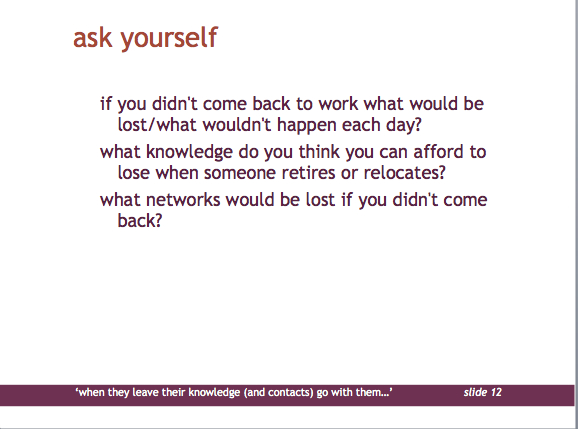
If I didn't come back tomorrow                                                           The discussion really came alive when the delegates split into three groups to work through one of these questions.  Some of the learnings:

  • Critical knowledge is often held at Grade 6 & 7 and these are neglected when it comes to knowledge capture. While Directors and Deputy Directors are adroit at managing, their domain knowledge is unlikely to be as detailed.
  • The narrative (context) surrounding critical knowledge is hugely important. By focusing on events and decisions it’s easier for this to emerge.
  • As the propensity for greater disclosure (authorised and unauthorised) increases so does the need for informal discussion – ‘An audience with..‘ sessions increases.
  • Reputation risk (from not drawing on previous experience) is viewed as a core issue.

takeaways from Westminster

Revision of the Government Knowledge & Information Strategy has sharpened the focus on the need for effective knowledge capture and retention.  That needs the active support and participation in the business areas (not just in the Knowledge and Information Management Professionals across government) for this to happen and for continuous knowledge harvesting to become ingrained behaviour.

There is still some way to go before Tony Blair’s vision is realised!

* informed by a programme run by knowledge et al and Sparknow for HMRC


“True tacit knowledge can’t be passed on when people leave”: embedding knowledge capture & retention

On Wednesday I had the pleasure of meeting and listening to Karen McFarlane who is Head of Profession, Knowledge & Information Management (KIM) for the UK Government’s Civil Service. I’d been invited as a guest by NetIKX as a precursor to a talk I am giving there early in 2014. And with due permission (Karen’s ‘day job’ is quite sensitive) I posted a few Tweets on what I heard which you can find on their twitter feed for the event #netikx63.

The Knowledge Council – setting frameworks and strategy for the KIM Profession

Karen outlined the work that has taken place over 18 months at the Knowledge Council to develop a framework and a new Government Knowledge & Information Strategy (GKIS). Her aim is to ensure people in KIM roles have KIM qualifications with good succession planning. A profession (currently 1,000 people across government are considered KIM professionals) that will attract and maintain talent and create an environment where KIM civil servants can move across roles equipped to do so.

These comments (which I am paraphrasing) stood out:

There is a real concern about loss of knowledge when people leave which is why a lot of effort has gone into building a knowledge harvesting toolkit for the KIM community….

One of the techniques is a Mastermind Chair; another, getting people to ask ‘what questions do you wish you’d asked…Try and identify the critical people… many departments use social media to share knowledge…

...True tacit knowledge can’t be passed on when people leave, you need a strategy to ensure you don’t get to that point…

Some organisations are now making use of Alumni networks to keep access to people who’ve left…

And finally… Department of Work and Pensions (DWP) and Her Majesty’s Revenue and Customs (HMRC) are now sharing stories on their intranet…

an accredited career pathway

Karen painted a backdrop wherein the topic of knowledge & information management is higher up the agenda in government than it has been for more than two decades. All of which is really positive as is the work being done with external bodies such as CILIP on accreditation and training and career pathways for KIM professionals in government.  Its impressive progress which the soon to be released GKIS will place into context.

This brings me back to the capturing and exploiting corporate knowledge’ pilot we* have been running for HMRC’s businesses under the supervision of their KIM professionals.

HMRC’s Pilot Programme: Setting Up and Capturing: Modules 2 & 3

My previous postings looked at why HMRC had set up the pilot programme, what critical knowledge is, how to identify it and why it is important.  Modules 2 & 3 of the programme focused on:

Setting up how to identify and approach the knowledge holders & networks how to design a knowledge capturing approach
Capturing develop an understanding of different capture techniques benchmark against existing approaches

‘Our’ delegates recognised:

  • not everyone who changes jobs or leaves has critical knowledge whose loss will severely damage the organisation.  Its important to be proactive to identify where it resides and with whom – the knowledge holder.
  • everyone is different. Each person who partially retires will feel differently about what they want to give back. Some people might initiate. Approach each person differently in order to find out how they feel about knowledge capture.

In Module 2 we looked at the setting, preparation and clarity of purpose which are all key to successful capturing of knowledge.  A key task is to think seriously about how a request for time with a knowledge holder is likely to be received.

A typical Knowledge Holder?

A typical Knowledge Holder?

Profiling and Archetype Mapping are used extensively in design, it is even more important when dealing with intangibles to have identified and acknowledged likely preferences of the person you are approaching?

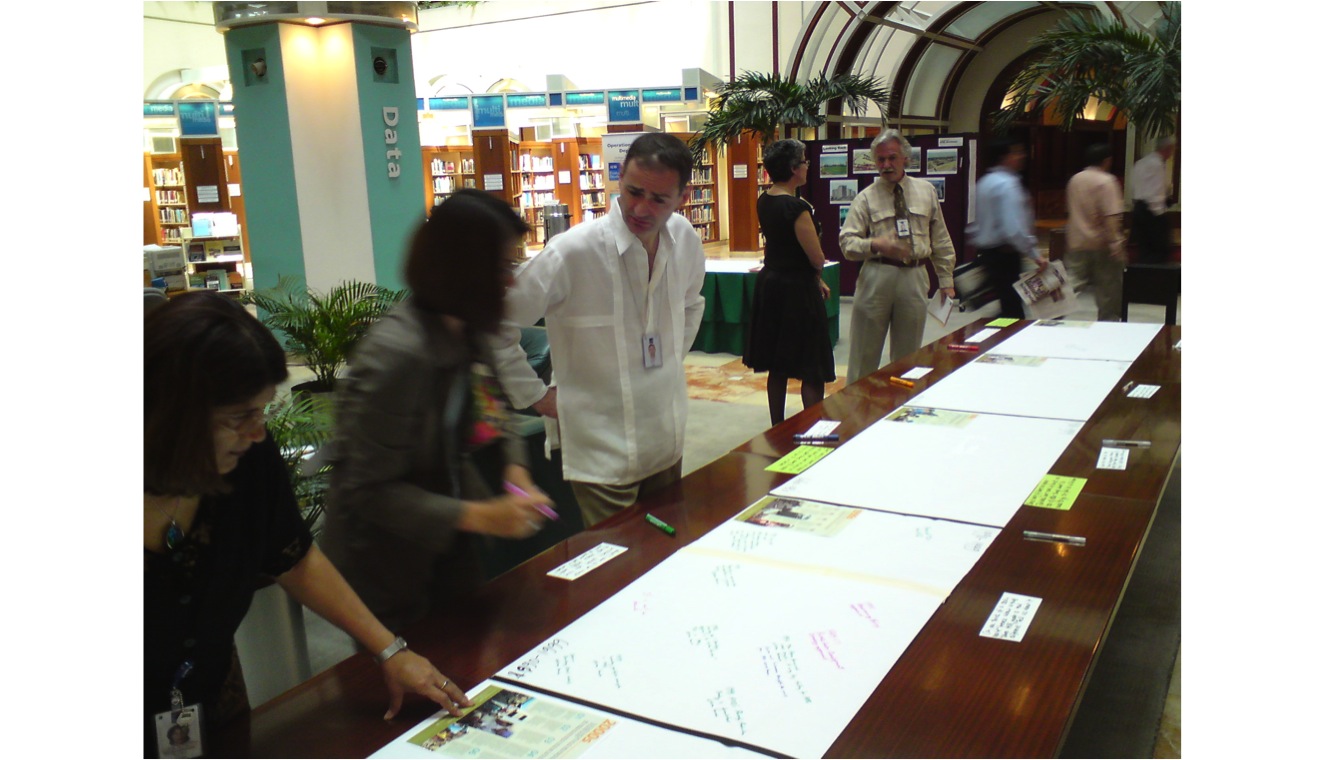
A large exhibit in Asia

A large exhibit in Asia that sought to identify major events in the life of an institution. Passers by were asked to note on a timeline events that were of interest to them.  This helped to target key players for future interviews and the subject areas to be covered.

Focusing on the individual is just one aspect of knowledge capture & retention: it’s vital to focus in addition on decisions, events and processes (documented as well as practiced) to see what knowledge is called upon in the first place and from where and then what is produced during the process.

Another key aspect is to create the right environment for the discussion/interview/observational session.  This is especially important when the intervention is to be recorded or a large response is sought.

The delegates spent time thinking about the right form of consent, how they might craft the invitation to participate and the mechanism they’d use to capture material.

Module 3 was very much about trying out. The delegates looked at:

  • Sketchbooks
  • Interviewing
  • Recording
  • Group Elicitation
  • Reverse thinking

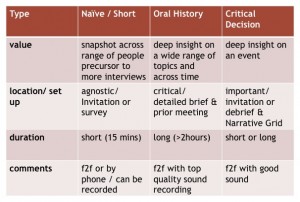
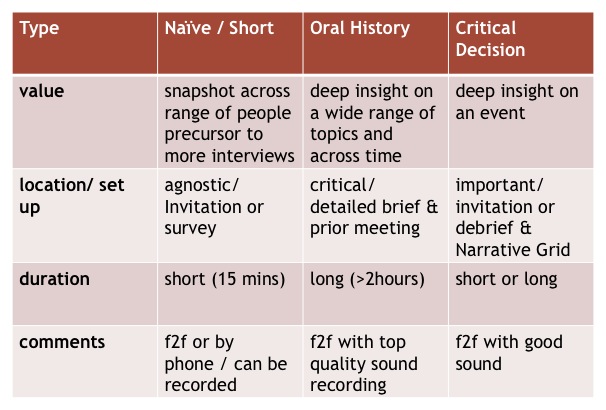
Types of interviewsThey discussed a variety of approaches to interviewing, comparing those with the checklist already developed for HMRC.

And they worked on interviewing (and listening) skills comparing and contrasting experiences.

As part of the benchmarking exercise we encouraged delegates to look at the 47 step knowledge capture process as articulated in Professor Nicholas Milton’s book Knowledge Acquisition in Practice which was very successfully adapted by John Day, at Sellafield that in itself drew on work done by Shell on its Retention of Critical Knowledge (ROCK) programme.

As in the previous modules offsite work involved listening to audios developed exclusively for this programme including a clip on Baton Passing, a technique used by the British Council adapted for their use by Professor Victor Newman.

importance and danger of Knowledge Harvesting

To return to the beginning. The Knowledge Council’s focus on equipping KIM Professionals with tools and techniques in Knowledge Harvesting is admirable. Yet I felt there is a missing skill from the training ‘suite’ shown by Karen McFarlane at the NetIKX meeting, namely that of facilitation which for me is critical.

If knowledge harvesting (what I might call knowledge capture and retention) is to become an ingrained ‘way of working’ across government then people in the business need to be equipped with those skills as well. KIM professionals must have the skills to facilitate others in Knowledge Harvesting not just conduct them.
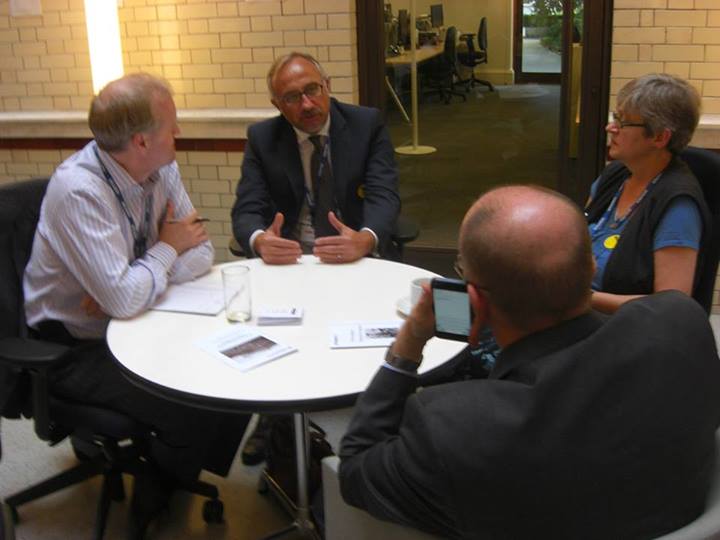
Last minute captureThe alternative scenario is that the KIM professional gets called in to do a last minute ‘tell us what you know’ knowledge harvesting session with a prominent person and the resultant  ‘pearls of wisdom’ are placed on a database that few look at or listen to.

*Sparknow and Knowledge et al worked in partnership to deliver this programme.