why the UK Government is seeking to capture and retain critical knowledge

As I write this an updated Government knowledge & information Strategy is being crafted.

Following the recognition of knowledge & information management (KIM) as one of the professions of government and building on Information Matters published in 2008 it represents another important milestone in the journey towards a more flexible workforce able to recognise, capture and retain that knowledge & information critical for its current and future business.

More on that in due course once the Strategy has been released.

turning the km & i vison into reality

Recently HMRC (through Civil Service Learning) commissioned Sparknow and I to run a set of pilot programmes on capturing and exploiting corporate knowledge. HMRC like all areas of governement face the threefold challenge of:

  • equipping new joiners with sufficient knowledge and information that they are able to hit the ground running (while making the most of the knowledge they are bringing to the organisation)
  • ensuring that when staff are reassigned they have sufficient time and access to the knowledge they need to transition into the new role
  • capturing the huge experience and knowledge (often tacit) from staff who are coming up for retirement, whose job may be dissapearing or who are leaving to pursue a career elsewhere.

In welcoming the participants our sponsor said:

This proposed programme…aims to make knowledge retention part of the engrained behavior and the way ‘we’ work. It should be a continuous process fuelled by the belief that everyone has something to contribute and much to learn from sharing knowledge.

Our challenge then: to develop an informative, participative and enjoyable set of interlinked modules that gives exposure to a dozen or so tools and techniques that will help to identify, capture and reuse what are often termed ‘critical knowledge assets. And find a measurement (we used Dr Donald Kirkpatrick’s Learning Evaluation Model) to assess the success of this capacity building initiative.
View from first training room

The view from the venue for modules one and two.
Picture by Victoria Ward

Over the next month I am going to be taking a more in depth look at the modules we ran and the areas that stimulated most interest among the dozen or so senior HMRC staff from different areas of the business around the UK.  So as ‘they’ say: ‘watch this space’!

when knowledge & information  flow

As part of the discussions leading up to the programme we developed a vision (a future story) of what an knowledge & information friendly environment might look like:

I’ve just returned from ‘an audience with…’ session with  John who is about to retire. It was different from the usual breakfast briefing – we got to learn about topics and events we’d identified as being of interest. Hearing those described by someone who’d been through it all was really insightful for a relative newcomer.

I relocated this year: thanks to Agnieska who’d built a bridge between my predecessor and me there were few surprises and I still see Jane for a regular catch up. I am much more aware of things that are going on, who I can go to and ask a question. Most importantly I now have a set of useful questions and the confidence to ask them in any situation.

I am keeping my Decision Journal: who’d have thought it but it’s  been immensely valuable as a prompt when having conversations.  And I am now a timeline convert and shocked my Director when I  used postcards on a timeline to share my regular update.

I do feel that should I leave it would be easier to pass on what I’ve learned in a more illuminating way. If only I’d begun it earlier – using objects as prompts has made sharing experiences intuitive.

The business has benefited: an idea brought in by a new staff member resulted in process improvements that improved collection rates; when Roger transferred to East Kilbride the transition time was much shorter as he was able to tap into the networks of his predecessor and the insights that emerged from the sessions with Priyanga prior to her departure helped shape the new set up in Southend. Whereas before we may have lost touch, now she still feels a sense of attachment and was at one of the recent breakfast events that are now open to alumni.


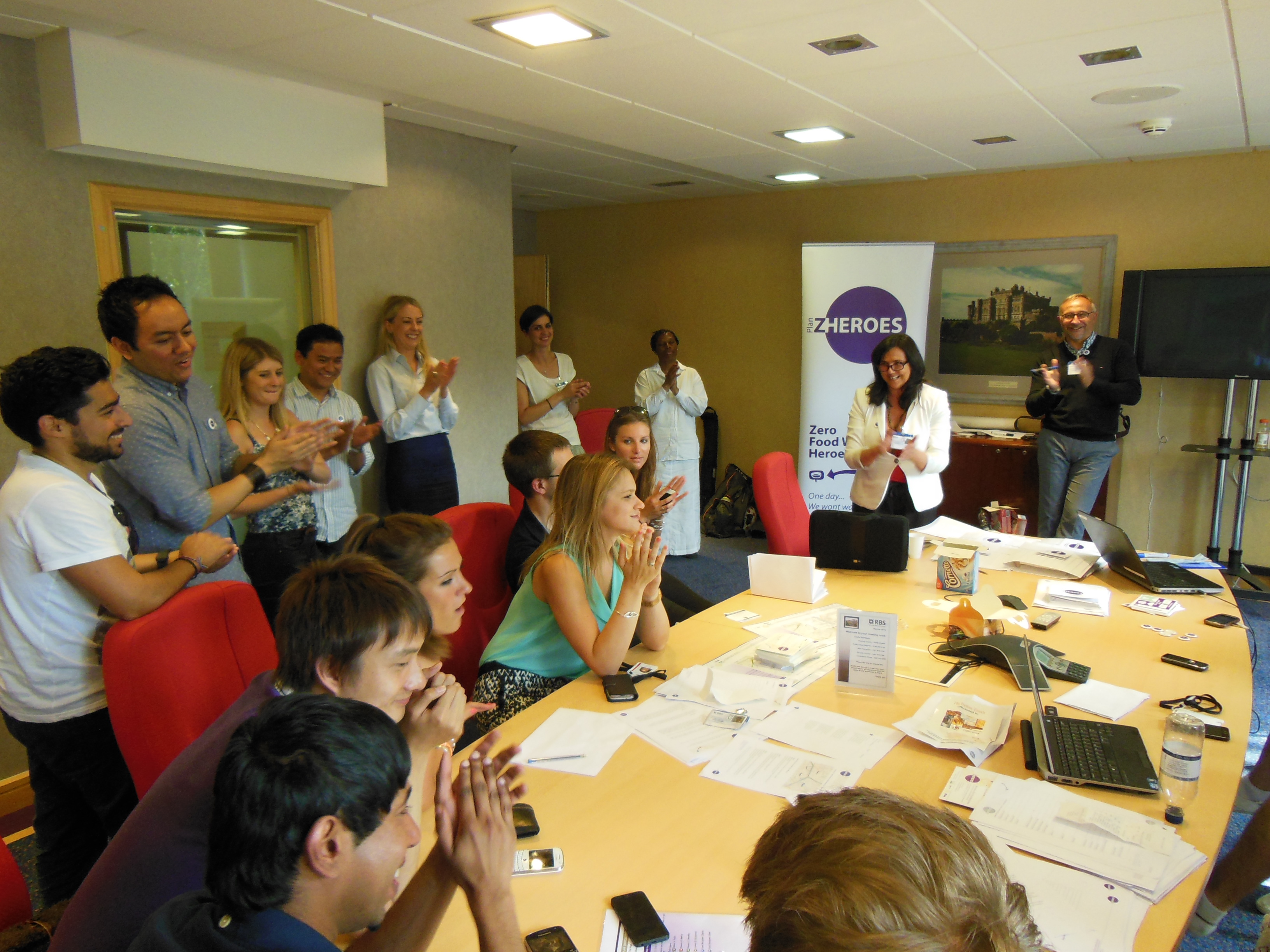
“… a brilliant and eye opening experience”: using ‘The Apprentice’ format for a good cause

This quote, from one of the Accenture team who took part in a Corporate Social Responsibility (CSR) volunteer day in blistering conditions at Islington, London a few weeks back, was in response to a question I posed at the conclusion of the event:

Q) As you leave: if someone in the office asked you about the day what would you say?

A) ‘Was a great day with a chance to do some real good.’ was another participant’s reply.

Those who follow my musings will know how honoured I am to be invited to become a founder trustee of the charity PlanZheroes (PZ) who aim to help make use of surplus food. The CSR day, one of a number of imaginative ‘offerings’ PZ developed, gives organisations and their employees a chance to put something back into their community while concurrently testing their innovation, teamwork, sales, negotiation and project management skills in a real life setting.

‘…your task…’

To make the day really energetic PZ introduced an Apprentice-style competitive element. Fifteen people, three teams, three separate areas of London: Who will raise most awareness and get most businesses and charities added to the map?

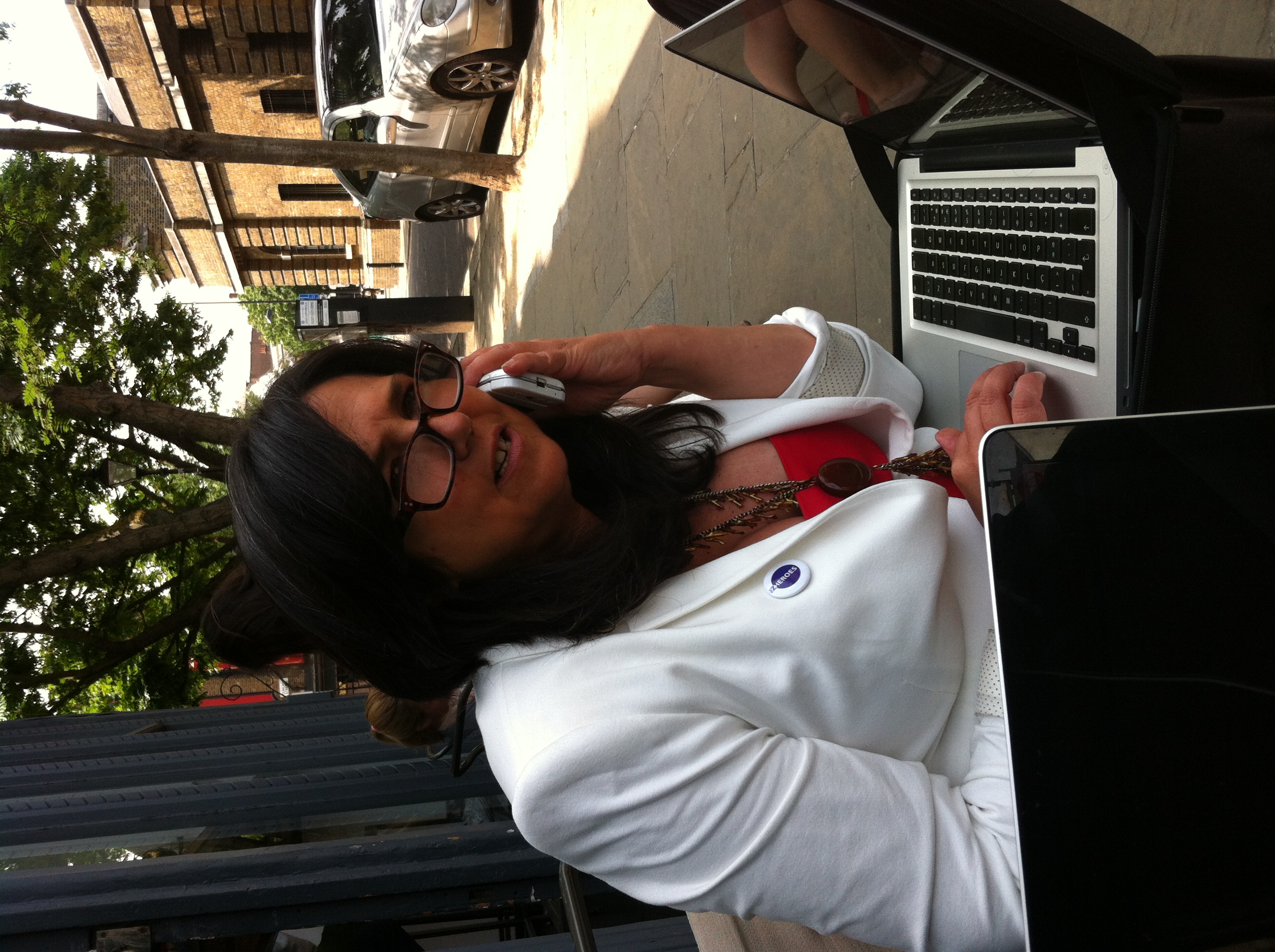
I was there with CEO Designate Maria Ana Neves and a team from PZ whose role was to shadow the teams as they made their way around Islington and to provide input for the debrief session that was to end the day.

The 16 participants began by introducing themselves and noting something that others might not know about them. This was to prove a great kick off session, part of the briefing to equip them for the time they were about to spend out and about in Islington.  We asked later what they’d expected:

Q) On arrival what were you expectations?

A) I did not expect the day to be as organised as it was or to have such supportive helpers

fired up and ready to go

Briefing over and armed with PZ badges and little books each team spent a while perfecting their strategy, the messages they were going to give to the organisations they met and who would be doing what.  A large part of the challenge of approaching food outlets is to recognise that surplus food is a natural by product of the suply chain, hence we advised them to avoid using the word ‘waste’.

IMG_1007

We were not to see them now for 5 hours so Maria Ana and I monitoroed their progress via Twitter and the PZ Map updated as contacts were made and organisations signed up.

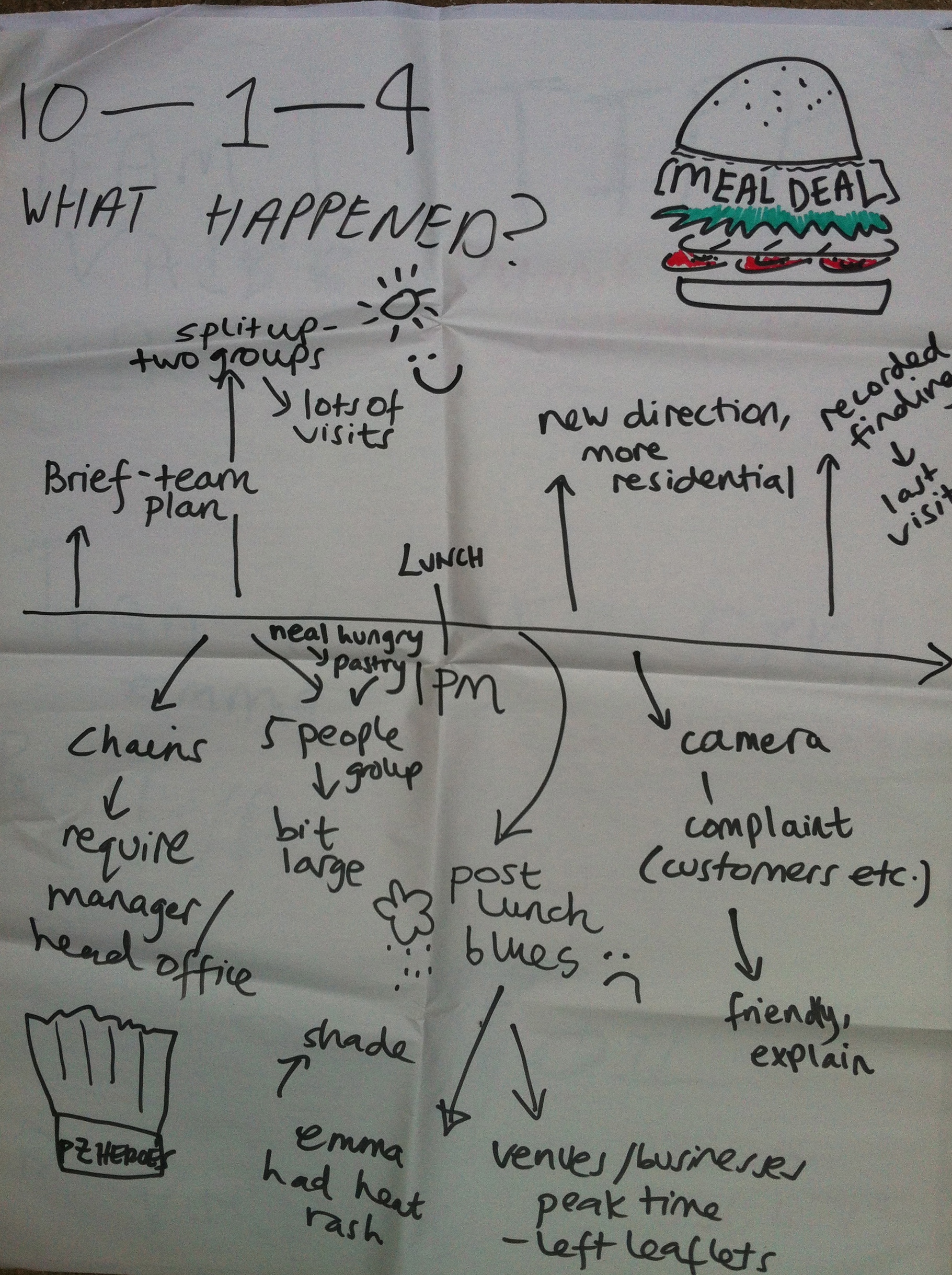
The teams assembled back at base just before 4pm for the debrief. I asked them to use a timeline as a prompt to describe what happened, when and who was involved with a further commentary as to how they overcame difficult moments.

One of the team's timelines

One of the team’s timelines

Though lighthearted it gave the teams (and a senior manager who joined at this point) a chance to compare and contrast: what had worked and what hadn’t; where did they get pushback, from whom (and why)?

amazing results

Before revealing the results Maria Ana asked the teams to develop a one sentence ‘why we should win’ statement. The ‘results’ were amazing:

Announcing the scores

Announcing the scores

  • 14 new businesses on the map & 1 new charity sign-up
  • 35 businesses to follow up & 2 new charities to follow-up
  • one team even walked to Holborn to talk with Sainsbury’s head office
  • two teams got their lunches for free (or part of it!)
  • 130 mix of facebook likes and tweets/followers and we were told one celebrity chef is supporting us (details to find)

Perhaps the most value though comes from the way the teams come together and the roles they play throughout the day. Here’s a couple of responses to my question about role models:

Q) Role model: who did you admire during the day and why – tell us about what they did?

A) One memeber of the team really came out of their shell and were particularly confident when approaching businesses …

A) …The person was awesome and I think I have learnt some people skills that day.

To learn more about Plan Zheroes’ special days for volunteers and organisations please contract us via the PZ website