KMUK 12: Olympics, KM and the Mexican Wave

Ahead of the KMUK conference in London that Professor Jane Mckenzie and I chaired we thought we’d approach some of the speakers for their observations on knowledge management by posing a set of ‘vox pop’ questions.

It being 2012 and with the London Olympics on the horizon we decided to ask:

Using an Olympic analogy how would you describe what you do to others?

Their replies were illuminating. Here is a sample:

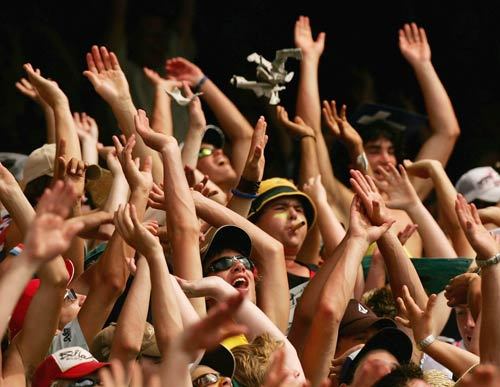
I help people prepare for the journey and then support them. Middle distance runners because change is about sustainability. Becoming part of the crowd clapping and applauding. I’d really love to be the Mexican wave.

image

My Olympian role is to facilitate, lead and mentor others to perform better in whatever game they enter for.

I am an Ambassador, generating excitement and enthusiasm for the event. I am a connector bringing people together.

I see myself as the Coxswain in a community of oarsmen. They have to get things moving, but my job is to keep the enthusiasm and the momentum for sharing knowledge going.

I would say the `on-boarding team coordinator` role. Helping team members come on board, ensuring they all the right information they need to adjust well to the Olympic park, including who to talk to if they have problems, offering the right agendas and maps that could be useful, the lessons learnt from past Olympic Games that could help them and of course organising the social events and the best places to eat!

A field hockey player. It’s a fast team sport where you have to pay attention all the time, everyone gets to play in it, and you respect each others roles and capabilities and work together to achieve success from different angles.

Sebastian Coe – My job is winning the business over to KM Going out and getting engagement and then when they are committed handing over to the team to deliver it. We have a team of torch bearers who keep the energy going and raise awareness of what is happening and the central team are there to coach. We also have people in the K and IS team who keep the olympic equipment in tip top condition
One of the respondents also told us that as Olympic Learning Legacy Partners they are responsible for sharing key lessons in transport, technology and the built environment. In the light of the recent issues on London’s tube system, I am looking forward to that presentation.

What strikes me from these responses (drawn from practitioners across three continents) is how accurately they reflect the variety of skills required by someone fulfilling a knowledge management role which is perhaps why so few people today seem to have KM in their job title.

I will be posting more in due course in the run up to the event and responses to questions such as:

What technique have you found most effective for bringing about change in the way people work/respond?
KMUK 12: whose doing what in KM I stories from afar

I’ve been to some events that focused purely on activity from within their host region. For me that’s a mistake and as recent trips to Africa and South America have confirmed there is a much to be learned from the way different people across the globe approach knowledge management.

Which is why I was delighted when Ark asked me to lead the wrap up session on Day One of KMUK entitled ‘Stories from around the world: Knowledge management trends and experiences’.

I have a couple of examples to share from Africa including the Sudapet Book Project and a Rwandan World Cafe and I know Andy Boyd, Brigitte Ireland, Adrienne Monteath-van Dok and Arthur Shelley will likewise be drawing on global experiences for what promises to be an interesting session.

Don’t worry if you can’t be there, Ark have very kindly agreed to take notes and I will publish some of the findings once the event has taken place. For those of you keen to expand your global knowledge two sources I’d recommend:

  • KM4Dev (the community of km people in the development arena) and the KM4Dev Dgroup discussion and
  • Swiss Agency for Development & Corporation’s learning and networking blog which regularly features stories from across the community of nations they support.

‘I cried for an hour…’

The words of a Colombian American who’d been to school in England, whose family are Colombian intellectuals and whose children live and work in the USA. The psychological impact of May’s Bogota bombing on a country rapidly emerging from decades of internecine conflict cannot be underestimated. It is a setback, yet I’d back this country and the people. It is a great place, a fusion of South American and European cultures and its people have a strong work ethic and an insatiable thirst for knowledge which is how I came to be here.

The 5th Knowledge Management & Organizational Learning Summit held over 2 days attracted 200+ many of whom booked late. Colombians I was told leave most decisions such as where to go on holiday until the last minute which places a premium on contingency planning. Perhaps unsurprisingly given the country is emerging from a difficult period personal financial decisions are driven by short-term expediency rather than long term accumulation of wealth. This translates into ‘knowledge is power’ mentality that makes efforts to promote the sharing of knowledge a challenge.

Despite being the sole European and linguistically challenged I nevertheless felt part of a family. My presentation delivered in English with simultaneous translation was given to an audience of bankers, industrialists and government officials. The hour I spent in advance going through the presentation with Carolina the interpreter paid off handsomely and enabled me to run in tandem with Luisa Sucre (an excellent facilitator from Venezuela) a number of interactive sessions that revealed how good South Americans are at dialogue.

I began by asking how many had been in km for more than 5 years – about 1/3rd. How many had km in their title – about 1/5th and how many thought km had been around for more than 10 years – about 2/3rd.  This was a topic they’d clearly thought about even if it had not become an accepted discipline in the organizational hierarchy.

I was also able to garner a dozen varying views on the role of the future knowledge manager in Colombia – more of that in a subsequent posting.  The allotted 2 hours flew by (at least for me); I wished I’d had longer.

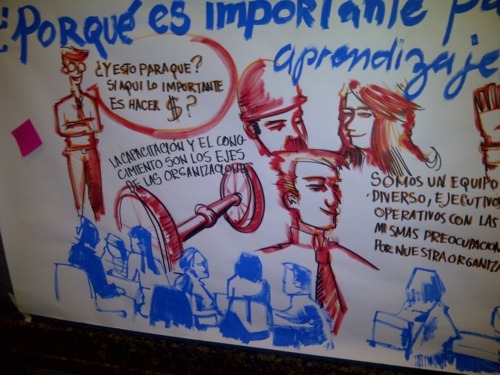
The afternoon of Day Two featured a World Café run by Zulma Sofia Patarroyo a very energetic Colombian who used the 3 hour session to surface what the delegates had learned and would take away from the event.  She began by asking each table of four to listen to each other’s learning points and then for the table ‘host’ to remain while the other three found an alternative table.  This continued for a further 2 ½ hours which seemed like an eternity to some but was enthusiastically embraced by most as I was to see evidence of the following day when meeting a delegate who had his ‘takeaways’ on the wall of his office. Jorge Enrique Merchan a graphic artist was on hand to expertly record the activities.

image

My personal takeaways:

—     A very well organized event that covered the little details well and didn’t try and pack too many speakers into the two days

—     The audience was attentive and respectful; it took little prompting to get them to participate in a karaoke style community singing at the start of Day Two led by Maria Helena Magalhaes from Brasil, creating music at the end of Day One with Patricia Molla from Argentina and embracing the World Café concept with abundant enthusiasm; laughter is always near the surface of conversations

—     There is a lot of km style activity going on in South America albeit under other labels especially Organizational Learning; people see its potential value

—     The big issues organizations face are similar to those found everywhere and include knowledge retention and knowledge transfer though here perhaps more than anywhere there is a need for a structured contextual approach in order to gain endorsement across an organization

—     The use of stories to drive change and underpin initiatives is in its infancy

—     A visit to the Botero Museum where much of Fernando Botero Angulo’s work is displayed in a remarkably open manner should be an essential component of any trip to Colombia

a knowledge retention technique: recognising contributions

Knowledge retention is a big issue for many organisations. This blog first published in 2011 talks about how Sparknow planned for and marked the retirement (his second) of its Financial Controller Roger Doughty. I’ve republished it here since it addresses a key challenge namely that of recognition of the contribution made by an outgoing knowledge worker.

Roger was there in 1997 when Spark began. Through 14 years he has guided us through a maze of fiscal legislation, keeping a watchful eye on our finances and helping us become a limited liability partnership. That Sparknow has been able to develop the stellar list of client names bears testimony to the strength of our backroom support nearly all of which has been done on a virtual basis by Roger.

Our challenge is similar to that we’ve seen with clients when experienced people depart.

  • How to pass on the knowledge he’s gained much of which has been tacit.
  • How to ensure the same level of service is provided. And finally
  • How to recognise his contribution in a manner befitting of our style and values.

Tacit knowledge transfer has been/is being covered by a period of parallel running with his successor Mark Barrett who is also a Welshman with an accounting background. Mark has been shadowing Roger for the last couple of months and now that is reversed and Roger is shadowing Mark. I then hold monthly review sessions with the pair of them to see what issues have arisen and fine tune our processes. Our intention is ensure a smooth seamless transition which thus far it has been.

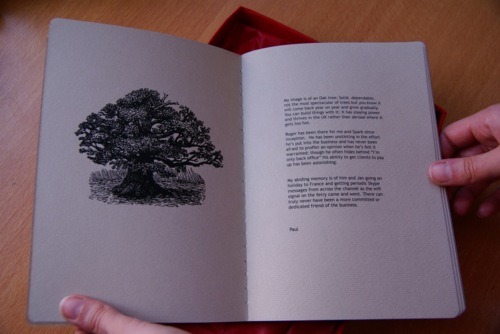
To recognise his contribution we asked a number of associates, friends, collaboration partners and clients to think of an image that best described Roger and then to write a brief anecdote.

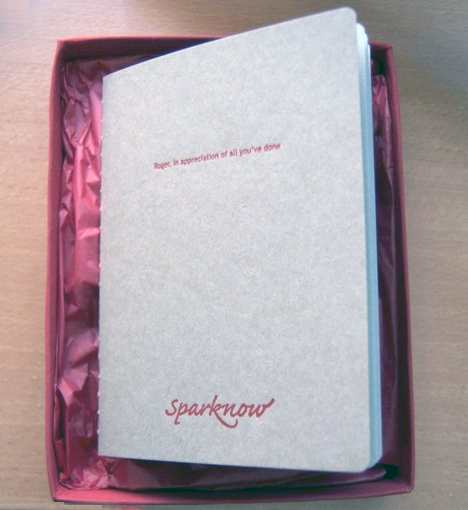
The material was assembled; should we print off a set of postcards, produce a virtual card or make a set of recordings? Webster’s Pictorial provided the inspiration and with the help of Curtis James, a Brighton based ‘letter presser/purveyor of collections…’, Roger’s ‘book of memories’ was born.

image

image

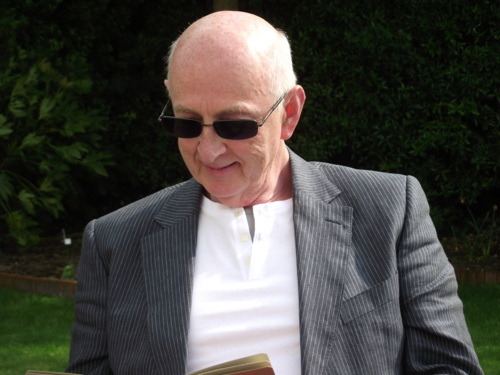
A very suprised and delighted Roger was presented with his gift at a garden party held in Lewes.

image

Many struggle to find a way that recognises the contribution of key people in a business so that when they depart their legacy lives on. Roger reading his ‘book of memories’ shows how much pleasure can be gleaned from a simple gesture.

Knowledge retention: questions that say a lot

One technique Sparknow uses when trying to understand how information and knowledge flows in and around an organization is to ask a set of short simple ‘vox pop’ questions. They are short questions, the answers to which are usually very insightful.

While I am in Bogota, Colombia this week speaking at the 5th Knowledge Management & Organizational Learning Summit I am going to be continuing our ongoing enquiry into the evolving role of the ‘knowledge manager’ by asking the delegates to think about these simple questions:

  • How do you describe what you do to others?
  • Is there an image, an object or a sound that sums up your experience of working in this field?
  • What tool or technique do you find you use more than any other?
  • What is the biggest issue you have had to face in getting people to support what you are doing?
  • What aspect of your work are you most proud of?
  • Knowing what you now know what advice would you pass onto someone looking to follow in your footsteps?

I