KMUK 12 closing: getting wet in the shallow end!

At David Gurteen’s Knowledge Cafe Monday run by Arthur Shelley, who coincidentally I interviewed as part of the ‘evolving role of our knowledge manager’ enquiry, I bumped into Adrienne Monteath-van Dok of Plan International who was one of the speakers at June’s KMUK event.  Adrienne said she’d enjoyed the closing session I’d facilitated and that I should share the mechanics with the wider community – so here goes.

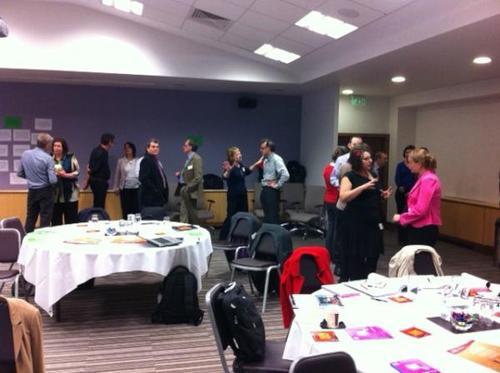
If you recall I’d used a ‘swimming pool’ exercise as an ice breaker to promote dialogue and I returned to the same theme to create a sense of animated closure.

I’d left up the six ‘stations’ round the room:’changing room’; ‘poolside’; diving board’; ‘shallow end’; ‘deep end’; and ‘bar’. This is how the 25 minute session was conducted:

I began by describing each of the ‘stations’ :bar = had lots of experiences/war stories and in a position to raise a glass to congratulate or commiserate.

I invited each person to return to the position they’d assumed the previous day. NB ‘newcomers’ had to choose their station at this point as well.

At this point as delegates moved around the room there was a lot of reacquainting and an audible buzz.

The delegates were then asked to consider three questions (and remain standing):

  • What surprised you at KMUK?
  • What are you going to take back to your organization?
  • How do you feel at this point?

I invited them to share the answers with the person next to them.

I concluded the exercise by walking round the room with a roving microphone; each delegate I approached was asked to give a rapid fire answer and to pass the microphone onto a person of their choosing.

This took about 5 minutes culminating in a very positive response (in the shallow end) from a delegate who said what he’d heard over the two days made him believe that far from being dead and in contrast to the feeling he took away from KMUK 2010 KM (in whatever guise it appears) is very much alive. He felt re-energised as indeed did I.

Many events end on an exhausted low note; from the feedback KMUK 2012 wasn’t among them.
the role of narrative grids in knowledge retention & knowledge sharing

In a recent discussion about how to surface issues that need addressing as part of a km strategy the subject of timelines and objects came up. Here’s a post I wrote for Sparknow at the end of a working session:
At the back end of 2010 Victoria, Carol and I were in Barbados helping to develop a knowledge management strategy.

The strategy needed to be reflective of the institution yet grounded in the reality of the changing nature of the economic marketplace in the Caribbean where the alleviation of poverty remains a core objective of most developmental efforts.

People have become dismissive of the value of km after years of failed attempts to institutionalize it in organizations. Yet the principles of working towards a knowledge sharing/transferring culture remain valid especially in development. And the potential for improvement in operational efficiency cannot be underestimated even if at times is not easily quantifiable.

We began by looking for good examples of knowledge sharing; using a structured framework for the initial assessment has benefited the client (as well as us) and provided an organizing mechanism for reporting.  Adopting a critical decision interviewing approach has also made it much easier to unearth some of the stories that illustrate how knowledge flows. Perhaps our biggest (re) learning is the value of a neutral object in acting as a catalyst for conversations around the working practices of organizations.

Most people feel uncomfortable talking about something intangible, they need a hook to hang their conversations on.  In much of our work we’ve asked people we are interviewing to draw a time line to help ground them in chronological events; that tended to be a good launching point for dialogue and stories. It was especially effective in our mission to Darfur back in March where the enormity of the problem tended to obscure people’s specific recollections unless they had just occurred.

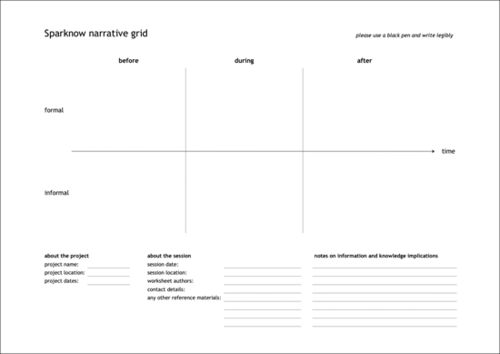
In Barbados though we were looking for evidence of how knowledge and information flows across an organization and how it is used to inform decisions.  Drawing on the excellent tome Working Minds by Gary Klein et al we combined a critical decision interviewing approach with a timeline approach to create a Narrative Grid.

Perhaps most importantly we built on previous work with Royal Mail and others to ask our interviewees to describe what was going on in the formal and informal channels (“above and below the line”) while a decision was being made.

image

Did it work?

  • As a conversation piece and in a 1:1 situation it was extremely effective and moreover became the neutral object that the interviewee was happy to channel their thoughts into. We learned a lot about the use of the right pen and of the value of the subtle prompt. It was also very effective as a way of assessing different cultural types; there were those who instantly took the pen and began writing; those who would take the pen after we had begun writing; and those who were happy to have us do the writing while they “dictated”.
  • In a group session the Narrative Grid shone. Teams would gather round correcting each other and while the outputs were often anything but neat the results of a genuinely collaborative effort were not purely visual. Getting each group to summarize was especially useful since it often revealed similar patterns of behaviors, good examples/stories of knowledge sharing and areas ripe for process improvement.

Over the last decade Sparknow has experimented with many techniques to capture organizational stories. For helping to identify organizational knowledge and information flows around events and decisions the Narrative Grid has proved among the most effective.

insiders view on knowledge in the Middle East

In 2011 I spoke at the inaugural KM Middle East event about a knowledge survey we created for the event and drawing on recent diagnostic work and the knowledge management strategy and implementation framework it spawned.

image

photo | Tom Spender

One of the tools Sparknow has used before as a way of raising awareness of, testing the receptivity for and measuring the impact of, a knowledge initiative is an online questionnaire. We usually keep it to about five sets of questions and ensure it takes no more than five minutes to complete – about the length of time it takes to drink a cup of coffee!

It often kicks off a diagnostic process and provides useful pointers/insights into what an organization understands knowledge management to be as well as highlighting ‘the way we do things around here’ through snippets and anecdotes.

KM Mid East seemed like a good opportunity to stimulate a debate through an online questionnaire: knowledge management roles are beginning to appear in quasi government organizations and some recognize that the way ‘stuff’ is stored today will impact on its potential reuse. And this is being conducted against the following backdrop:

  • Libya has descended into a civil war.
  • The outcomes of the Bahrain protests are by no means clear.
  • The Saudi authorities have just handed out over $37bn in pay rises and improved conditions to its inhabitants having reportedly adopted rough tactics with protesters.

The response from within the region’s commercial organizations has been to take a good look at disaster recovery, contingency planning and risk evaluation; assess their value of portfolios. Few would instantly associate this ‘burning platform’ moment with knowledge management but it’s totally relevant. In fact it’s what got me into this business two decades ago when a bomb blast took out the paper records my organization had and I led an ambitious programme in a Middle East focused investment bank to capture what we knew and make it available for reuse electronically. It was our attempt to create a one-screen view of a client and the forerunner of what today people call intranets.

So what has emerged from the Sparknow Knowledge Survey?

  • The majority of respondents were from government organizations.
  • Most people felt lessons learned were best examples of knowledge sharing at work.
  • The spectre of poor records management looms large.
  • Learning and by implication knowledge transfer are the areas many people believe KM should be addressing.
  • While cash incentives are attractive carrots for some to share knowledge the majority wanted recognition and a sense of ownership in the outcomes.
  • Unsurprisingly given the astonishing technological revolutions this region has been witness to, most answers to the question ‘the thing I always carry with me to help with knowledge…’ focused on technological solutions.

KMUK12 opening: taking the plunge

How do you set the tone for a two day event (KMUK) with a large gathering of skilled km practitioners many of whom can do such sessions in their sleep? Over a cup of tea at the National Gallery, Victoria Ward and I recalled an exercise Philip Gibson had run a few years back for an EDRM event I’d chaired.

‘Taking the plunge’ is intended to

  • Get people involved
  • Get them to interact with colleagues outside their immediate teams
  • Generate energy at the start of an event

Here’s how (with Philip’s help) I ran it:

I had six large signs, placed conspicuously around the room, reading:

pool side
changing room
diving board
shallow end
deep end
bar

I introduced the exercise with a picture of a swimming pool (actually Pells Pool in Lewes where I live which is the oldest outdoor pool in the country)

image

I then said:

I’d like you all to imagine that you’re at the KMUK swimming pool. Where would you be?

at the pool side – for those still observing rather than being involved

in the changing room – for people who are preparing but not yet ready to take on their km role

on the diving board – for those who are about to ‘take the plunge’

at the shallow end – for those who are ‘testing the waters’ and not too sure if they want to get deeper

at the deep end – for those who are already well and truly ‘immersed in’ their km role

at the bar – for those who are celebrating achievements.

Now please would each of you go to the sign which you feel best represents where you personally have got to with your km role. You have two minutes to do this. Go to the stations which best represents where you think you are now in your role and NOT where your colleagues are going to!

At this point there was a lot of tooing and froing as the delegates decided where they should assemble. Once order was restored I invited them to:

Please take a minute to reflect in silence about why you’re where you are.

And then

I’d like each of you to pair up with someone near you, preferably someone whom you don’t already know well and take a minute or two each to share with them your reasons for being where you are. Let the first person in the pair begin while the second listens.

image

Some of the delegates (including Arthur Shelley and David Gurteen) at ‘the Bar’

After a couple of minutes I asked them to switch and repeat the process. At the end of the first round (which took 6 minutes) I invited them to:

Now pair up with someone else near you whom you don’t already know well and repeat the exercise.

The session concluded after 15 minutes with this

I hope that’s got you thinking about your km role as well as helping you to get to know a few of your colleagues a bit better. I also hope that all of us will get further along through the day ahead. Now please take your seats.

Over the course of the 2 days many of the delegates and speakers referred back to the swimming pool and the individual locations became a good metaphor for discussions.

knowledge retention: a story collectors guide

At the back end of May 2012 I was in Bogota and met a team from the International Center for Tropical Agriculture (CIAT) to discuss the timetable for completing the story collectors guide first conceived during the second half of 2011 during Victoria Ward’s trip to Colombia.

CIAT’s mission:

To reduce hunger and poverty, and improve human health in the tropics through research aimed at increasing the eco-efficiency of agriculture

is one Sparknow fully supports so it is a great pleasure for us to be able to help them bring this guide to fruition.

Soon, researchers jetting from country to country will have guidance and ideas on how they might go about noticing and collecting the stories and anecdotes that bring data, events and topics to life at their finger tips to complement traditional field data and observations. The field guide will challenge researchers to use sounds, photos, stories and other materials in order to share experiences and engage others.

Check out CIAT’s blog for an account of the Bogota meeting and plans for the guide’s publication.

Keep watching for further updates.