CILIP’s KM quandary in Brighton

This was my first Chartered Institute of Library & Information Professionals (CILIP) annual conference though I’d previously chaired events for them on outsourcing and participated in discussions on CILIP’s future direction.  Vice Chair Karen McFarlane, a fellow BSI KM Standards Committee member asked me to speak to the Managing Information stream which for the 3rd consecutive year featured ‘leading KIM practitioners and commentators’. After speeches and masterclasses in 2016 in Amsterdam, Lisbon and London, Brighton was a nice and close change.

My first impressions on arriving at The Dome Brighton were: the size (600+ delegates); the slickness of the organisation (including the ‘hydration’ areas); and the lack of people (I counted less than 10%) with Knowledge in their title among the delegates. Cilip speechI wondered how many might turn up to mine and Andy Bent’s session in The Courtroom.
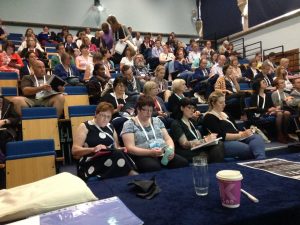
In the event the session chaired by Sandra Ward was full (I counted 100) with some familiar faces in the audience including Sian Tyrrell who, despite not having ‘knowledge’ in her title, is doing great KIM work at Royal Horticultural Society.

My last bog post Future role of the Knowledge Manager: The Knowledgeur? described what my 30 minute address would cover so I won’t dwell on that here.

poor communication = poor knowledge sharing

Following me was Andy Bent, Bolton Metropolitan Borough Council, who sparked a lot of interest with his case study of an unnamed organisation who’d fallen foul of Ofsted and received a damming report which included censure about how they shared knowledge and information in the back office and how that translated to poor decision making at board level.

Inevitably the remedy included better communication and engagement and greater ownership of the issue at board level by the appointment of an officer to ensure changes are made.
Screenshot 2016-07-19 10.57.26

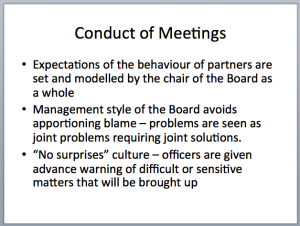
Perhaps the most important observations Andy made were contained in this slide:

It made me recall the time when I was the Chairman of a business and gave my CEO explicit instructions to introduce a “no surprises’ regime. Each week I asked her to let me have a list of the key issues from the week and how they were resolved. If any were outstanding they became issues for board discussion.

Knowledge Management is dependent on good communication and engaged people. Andy’s presentation was a good reminder of how by getting it right you can turn bad news into good. The organisation in question subsequently got a great Ofsted report.

KM in a library & information environment

Does KM and KM’ers sit comfortably within CILIP? If so how is that recognised across the membership and in its charter? Is it a broad enough church to accommodate, Librarianship, Information Management and Knowledge Management or is it a case of oil and water?

Obviously the CILIP team think it all voices can be heard. The opening paragraph of the leaflet I was given before I presented said:

CILIP is committed to embracing KIM (Knowledge and Information Management) fully within its work. It is part of our challenging Action Plan 2016-2020, recently agreed following a major consultation exercise with CILIP members and other stakeholders.

And CILIP has just launched a new KIM Special Interest Group starting in 2017.

Is there a natural synergy? I can think of a number of very good KM professionals such as Sian who have a Library & Information grounding.  Indeed KM is very much dependent on good curation of knowledge assets and the maintenance of effective knowledge bases.

I struggle though to make the leap from Public Librarian, those that work in institutions that seem to be under permanent threat of closure and who are often a great community hub, to that of a Knowledge Manager (let alone that of a Chief Knowledge Officer) who is often solving a burning business issue or mitigating a business risk.

Certainly there is a difference in perception and financial reward.  Last year a prominent law firm made 2 C-Suite appointments noting:

The roles of Chief Knowledge Officer and Chief Information Officer are increasingly important to a global law firm’s success.

A quick glance at salary scales reveal that a Director of Knowledge Management will be remunerated in excess of £100k. A more junior Knowledge Management Officer is likely to be paid £60k+ and be expected to perform these tasks:

  • The Knowledge Management Officer is responsible for capturing, developing, sharing, and effectively using organisational knowledge. This role is fundamental to continuous improvement in sales excellence and bidding in order to drive an increase in the bidding success rate across …..
  • By storing and sharing information effectively (e.g. case studies, exemplar responses, previously developed value propositions) and through the production of best practice processes, templates, how to guides and checklists, the Knowledge Management Officer will help … to win work more efficiently by enabling those involved in bidding opportunities small or large to harness the experience of others.

Few of the KM jobs specify a requirement for academic qualifications in Knowledge Management but most Library roles ask for MSc in Library & Information Management and it is unlikely that the Head of Library & Information Services will be remunerated as handsomely as their KM counterparts.

Where the ‘rubber hits the road’, and the overlap between Libriaranship, Information Management and Knowledge Management is most obvious, is in the health sector. Interestingly there is a Chief Knowledge Officer of Public Health England whose remit is:

The Chief Knowledge Officer (CKO) is responsible for delivering an effective knowledge and intelligence service that covers research, statistics and know-how, to inform the practice of public health and public health improvement.

Knowledge for Healthcare can shape society, improve the wellbeing of people and save lives through the effective use of knowledge sharing which depends of the solid foundation that Library & Information Professionals bring. The use of checklists has transformed post operation mortality rates and F1 technology improved the monitoring of children’s recovery. Health informatics (and Open Data) are helping to improve global hygiene and reduce disease transmission.

accentuating the difference

The closing keynote from Lauren Smith took me by surprise.  Her tweet a good illustration of her key theme which was that Libraries (and Librarians) should be / are already political, providing a service for the good of the public.

Need to shift debate with stories and evidence to get public to see public libraries as institutions for social justice

Screenshot 2016-07-19 13.49.15

This tweet alongside from a delegate pretty much summed up what the audience heard.:

That is some way though from the mindset of the KM professional who (apart perhaps from Healthcare KM’ers) is focused on delivering business value to his / her organisation rather than providing a service for the good of mankind.

Therein lies the quandary and the challenge for peaceful and fruitful co-existence if CILIP”s future vision of being the natural Industry Body for Knowledge Management professionals as well as Librarians and Information Professionals is to be realised.

And finally

Contained in the ‘Surprises and Admiration’ Chapter of the forthcoming book I mentioned at the start we note:

… there is no recognized industry body promulgating KM setting universally agreed qualification or certification criteria that employers find acceptable for entry and advancement.

Instead global KM’ers are attracted to training programs run by private organizations in order to demonstrate knowledge through external certification. Experience is gained on the job and there have been few mentors or coaches to help a newbie KM’er take their first steps.

Engagement with the Government’s Knowledge and Information Management Group (GKIM) is to be welcomed as a first and critical step as I have long argued that Knowledge and Information Management are natural and synergistic bedfellows. Where better to start than with the Civil Service who have KIM as one of its Professions.

I wish CILIP well in their efforts to becoming the go to body for KIM’ers.
Future role of the Knowledge Manager: The Knowledgeur?

As the book Patricia Eng and I are writing takes shape – we spent a productive couple of days last week editing chapters and agreeing key points for those still to be completed – so my thoughts continue to evolve as to the future role (and skills needed) to be a Knowledge (and Information) Manager.

This week I am charged with delivering a provocative ‘wake up’ call when I speak to the annual conference of the Chartered Institute of Libraries & Information Professionals (CILIP). Here’s the gist of what I am going to say,

Operational KM to the Fore: Strategic KM to the rear

  • The majority of KM programs appear to be operationally focused addressing a burning platform issue or an urgent business problem.
  • These tactical programs address risk (loss of knowledge due to downsizing, retirement, reorganization or acquisition). Some focus on being more efficient and meeting internal and external quality standards.
  • Few it seems are driven strategically as a result of visionary leadership and if you look at where KM is located most surveys reveal its part of an operations division or unit. Rarely is a Chief Knowledge Officer part of the C-Suite of an organization. Often KM is treated like a hot potato.
  • Less than 1 in 5 are strategically aligned.  Where they are its because Knowledge is perceived to be the core product of that organisation.
  • The downside of being operationally driven is that when the burning platform issue or business problem is resolved KM is often left looking for a rationale for being and a new sponsor.

Step forward the ‘Knowledgeur’

So what can KM’ers or KIM’ers’ do, how can they protect themselves and their programme? For some time I’ve suggested that the Knowledge Manager needs to have facilitation and social skills that make them the ‘go to’ person in an organisation. Someone who makes and nurtures connections. Here’s my definition of that person I call a Knowledgeur:

‘A Knowledge Manager (Knowledgeur) is someone who makes use of his/her/others’ knowledge in one activity or market and applies it for beneficial use in another.

Originally inward facing the role is becoming more outward facing with the rise of communities and the subsequent need to collaborate outside of the organisation.’

The Skills (‘…ates) of a Knowledgeur

Here’s what I think you will need to do to if you are to perform this role:

  1. Investigate: Are you putting a burning fire out / solving an immediate business need / addressing a risk (Operational KM) or is this driven by the vision from the top consistent with the organisation’s business direction (Strategic KM)?
  2. Navigate: Work out / Map the critical knowledge areas of your organisation and create a directory of the organisation’s knowledge assets.
  3. Negotiate: Agree the scope of your role with your sponsors and be tough negotiating what success will look like and how it’s measured.
  4. Facilitate: So much of what a KM Manager does involves facilitation. You will become a hub knowing who to go to to ask if you don’t know yourself. You have to facilitate connections, meetings, interactions, events and communities. This requires resilience, a lot of social skills and a real understanding of cultural nuances.
  5. Collaborate: You are in alliance with business areas and occasionally external suppliers or partners. You have to be capable of virtual cross border collaboration.
  6. Communicate: Senior KM’er’s tell you to devote 30% of your time to communicating what you do and getting feedback – its not just about broadcasting. Have your KM Elevator pitch always with you. Let all your stakeholders know what you are doing and why.
  7. Curate: So much of what passes for Knowledge Management is about creating and storing content and making it available for reuse. It’s more than the role formerly undertaken by Information Professionals and Librarians, here we are talking about being a custodian of organisational knowledge and organisational knowledge bases.
  8. Celebrate: The role can be a lonely one as reporting lines and sponsors change, yours is a cost not revenue line and the initial burst of enthusiasm fades. Collect stories, be prepared to acknowledge contributions and celebrate successes.

My address ‘The changing KM landscape, the future of KM and our role in it as KM professionalswill look at each of these ‘…ates in more detail.

And finally

I am looking forward to seeing the response I provoke at Wednesday’s event at Brighton. Watch this space!

‘Probably the best PKM in the world’: KMUK 2016 uncovered

It’s conference season which means I get to go to nice places and meet and learn from interesting people. This week I was in London for the annual Knowledge Management UK event and a cracking good couple of days it turned out to be.

IMG_4774Well attended by 60 or so KIM professionals, it was chaired by Ian Rodwell @Irodwell of Linklaters who I’d recommended and who did me and Laura Brooke of Ark @LauraAtArk, proud.
From the ice breaker opener onwards Ian’s touch was light but assured and the delegates all participated with enthusiasm.

What surprised me?

  • I got something out of every presentation which might sound a bit arrogant but when you’ve been to many KM events there are usually a couple that don’t quite cut it. This time each speaker slotted in well with the next and the event flowed.
  • The number of KM ‘Veterans’ attending for the first time in a long while commenting how lonely the role can be (whatever it’s called) and how durable KM’ers have to be.
  • IMG_4786Learning that the Govt’s 5 year Knowledge & Information Strategy (GKIS) produced in 2013 is still not published and unlikely to see the light of day.  Yet work is still going on as David Smith explained to create career pathways for the cadre of professionals who comprise the civil service’s Knowledge & Information Management profession. I didn’t get the feeling that CILIP are integral to those competency framework discussions which is a missed opportunity on both sides as there is no current industry group that effectively represent the KIM global profession as does a CMI or CIPD in Marketing or Human Resources (Personnel).
  • Discovering that the average age of people in E&Y is 27 (hence generation Z to the fore). E&Y’s big challenge for is to move from a vertical to horizontal communications and employee engagement approach. Their Communities of Practice / Skills are a great way of cutting across silos.
  • Despite all the ballyhoo around technology search is still not cutting it for most and my recent musings on the continued need for Assisted Search valid.

What intrigued me?

  • The session on Artificial Intelligence (AI) whcih included the suggestion that it is ‘parked on the lawn’ of call centres and people who have to read long books for a living and are also engaged in risk management. Today AI does not do emotional intellience very well but that is changing despite reservations about the ethics of it.  Linklaters are a good example of an organisation experimenting with AI to improve efficientcy.
  • Nick Milton’s @nickknoco thoughts on adopting the 7 step Lean Model for a KM programme and the wastes of KM supply chain: excess production, delay, too many steps, excess hand-offs, defects etc.  By a strange coincidence 7 came up in my presentation when I talked about the 7 ‘ates of a Knowledgeur. A separate blog will be forthcoming to coincide with my address to the CILIP annual Confrence in three weeks time.

What delighted me?

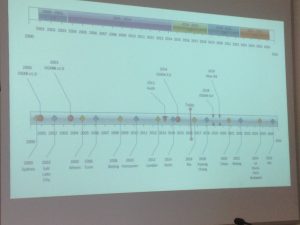
  • IMG_4785Christopher Payne’s @cjapayne excellent account of the Knowledge Management effort that is embedded in the Olympics.  It is the most visible of all Project KM programmes (see alongside) with great potential to act as a benchmark for all big cross border multinational projects. Imagine the expertise they have developed (with quite a small team) in transferring knowledge from London to Rio to Tokyo all in the gaze of the global public. I know Chris is keen to share his IMG_4787knowledge with the greater KM community so contact him or hear him speak.
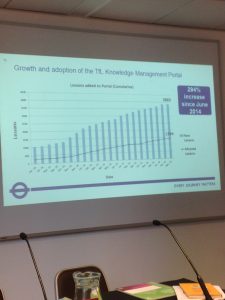
  • TfL’s approach outlined by @LemmerLutz to making great use of Lessons Learned and feeding improvements back into process.  The graph alongside illustrates the successful postings of lessons to their KM portal (up nearly 300% in 2 years).
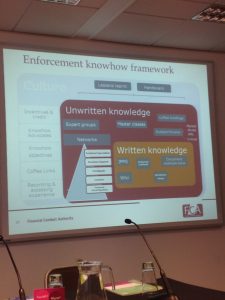
  • The broad acceptance that you can achieve a lot with a little.  The Financial Conduct Authority presentation being a great example of how to make effective use IMG_4790of people by using communities and having an easily understood framework. I noted though that poor search is a real barrier to adoption and that the lack of a technical underpinning a constraint.

  • Hearing from a couple of people how Random Coffee Sessions can be effective. The idea is simple: develop a list of people who are interested in having short coffee meetings with peers on a 1:1 basis and pair them up on a periodic basis.

What frustrated me

  • The continued reluctance to share thoughts / observations on Twitter, a stance at odds with the audience’s oft stated desire to ‘Work out Loud”.  How can you encourage others to do so if you don’t do it yourself?  I wrote more on this subject a year back coining this phrase: It was like throwing a dart into a vacuum.

What did I not hear I expected to?

  • Social Network Analysis: Despite a real focus on Communities Social Network Analysis was not discussed. Not knowing who people go to for answers or who knows what is a risk to many businesses if those key but often hidden people depart. To a large extent the risk from the sudden departure of the ‘Expert’ is diminishing with the rise of empowered and informed knowledge workers and processes that contain embedded knowledge.

And finally

My favourite quote (used in the content of maintaining focus):

Don’t be like a dog who sees a squirrel


Brexit, Bollywood and the need for ‘assisted’ search

As regular readers of this column will know, when in England I try to begin my day in Eastbourne with a coffee (a Decaf, Espresso is off the menu now) before walking back along the seafront to work in Meads Village where I live. I always take a notepad to capture the revelations that occasionally come to me.

Bollywood beckons

IMG_4727Today was a case in point. As I got to the seafront I was approached by an Indian man who looked lost.

His English was heavily accented and my command of Hindi is so poor that our conversation was a bit stilted.  He asked, “where is the fliming?'”  I replied, “what filming?” to which the response was, “The Bollywood Filming at the Tower” which I inferred to be the Wish Tower (a notable landmark with a view to the pier – see alongside) and showed him the way.

NB I didn’t hang around for a role as an extra since I am no longer supple enough to participate in the dance routines that often feature in Bollywood movies.

Brexit, Paramedics and the Patient Access System

IMG_4733My second strange encounter was to find two paramedics and an ambulance on the promenade by one of the thatched beach shelters which are used in good weather as overnight accommodation by those who have none.
I mention this since it became the talk of the promenade prompting the same sort of negative comment I heard at the previous night’s EU Brexit debate: “There’s too many people here, I can’t get a Doctor’s appointment when I call and yet those people get an ambulance and paramedics”.

Strangely enough this got the creative juices flowing –  a case of disruptive influences perhaps. Mulling over the (lack of) debate that took place at the EU Referendum event I attended the previous evening, same old non arguments about statistics that can be interpreted in multiple ways, it triggered a thought about the challenge of having too much information and knowledge and not knowing how to locate it or indeed what to do with it.

To explain. For reasons too many to go into I have become familiar with the National Health Service’s Patient Access System. It’s an extranet that enables a patient to communicate with clinicians, make appointments, renew prescriptions and review all results and examine the historical trends,  I can have a blood test one day and see the results online the following day. It works brilliantly yet only 30% of patients actively use it.

If I am overseas and need additional medication on my return to the UK I can organise it remotely. It allows me to manage any health issues and improves my understanding of diagnosis and treatment so that a visit to the doctor is much more effective for her and me. It’s a far cry from the promenader’s “…I can’t get an appointment” perhaps confirming that knowing where to find ‘stuff’ and how to interact with systems is beyond the ken of many.

It reinforces my view that stakeholder engagement is both essential and difficult. Few of us have the analytic mind or patience to dig beneath the covers. We live in a soundbite society where we are used to instant responses and expect technology to provide it.

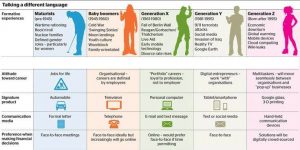
AgesIn the case of Patient Access I imagine engagement is a bigger challenge due to its wider range of potential users than in a business environment where focus is on Baby Boomer to Generation Z .
For more on this topic check out What’s in it for me: The challenge of sharing client knowledge and broadening relationships.)

Finding ‘stuff’

The Patient Access System is a great example of consolidating information and data yet is the not success is could be as many people don’t know about it, feel overwhelmed by it or can’t be bothered to try it.  These what’s in it for me issues show themselves in business too.

Try as we might technology makes it impossible to switch off from work (unless we switch off) though French legislation making it an offence to send emails to workers outside of the normal working ‘day’ might contradict that statement.  Yet we are increasingly time constrained and swamped by ‘stuff’ and email.

So what’s the answer? Assisted Search? Tagging? Automatic Indexing on the fly?

Recently two fellow Knowledge & Information Authors have opined on how to overcome the challenge of making it easier for people to find what they are looking for.

Nick Milton’s blog tackles the subject of Knowledge Bases and I was drawn to (and agree with) his assertion that you should

Structure your stored knowledge based on what people will be looking for, not based on who created it.

even though its not always possible to imagine all uses people will make of the knowledge base when they add content. I also concur that there is considerable value in structuring Knowledge Bases to support Communities of Practice or Thematic Areas. To read more: http://www.nickmilton.com/2016/05/how-to-structure-knowledge-to-be.html#ixzz49rCe0MOL

To an extent Nick’s blog post is recognition that search is not working: if it were then why would you need ‘assisted’ search in the form of a Knowledge Base.  I need to declare prior interest here as 20 years ago I was President of Verity’s European User Group (Verity was the granddady of search). Verity’s Topic Search used to create collections which assembled like minded content into meangful groupings.

Martin White’s cms search blog  http://www.cmswire.com/information-management/enterprise-search-is-bringing-me-down/ backs up the search is not working view and Martin notes:

If you can’t find information, then in effect it does not exist.

Your search application may return 85,340 results for a query, but if the most relevant information was not indexed, or your security permissions inadvertently prevented the information from being displayed — can you trust your search application?

And finally

In Lisboa at last month’s SocialNow event which among other things aims to shine a light on workplace collaboration tools much of the talk was about tagging of content so that it was more easily found.  The danger of relying on Tagging like Taxonomy is that one man’s tag is another man’s conundrum.

Perhaps this example best sums it up. I reluctantly became a Mac user in 2010. Having grown up on Windows infrastructure I was wedded to the idea of Explorer to manage my documents and files.  I was assured that Mac Search would solve all my problems and had no need of a filing structure or Knowledge Base. It doesn’t and though I would never go back I still use an Explorer like structure to augment search.

It seems Assisted Search is here to stay for the foreseeable future.

A book on the sunbed, KM Manager’s critical ‘ates and getting social in Lisboa

It’s been an interesting couple of weeks that began with a vacation in Cabo Verde on an island called Sal (Salt in English-which sort of gives away the terrain). Then a week in Lisboa at the annual SocialNow event, a unique gathering where social enterprise software vendors present their products to an invited evaluation panel representing the management of a fictituous company Cablinc.

a book on the sunbed

Cabo Verde was chosen as the vacation destination for two reasons: it is a former Portuguese colony and my wife (who is Portuguese) and I are trying to visit all of them to see how much of the culture and governance structures remain; and it seemed like a good place to wind down and catch up on book reading.

Without the necessity of a daily commute and the reading time a long journey creates I find the virtual world gets in the way of paperback reading though sitting under a sun umbrella reading a book on KM Strategy might not be everyone’s idea of relaxation on vacation!

Here’s a very abdriged review of my vacation reading list:

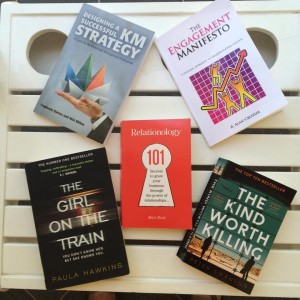
  • The Kind Worth Killing: A clever tale, well written with a twist that starts at an airport, the author keeps you Holiday Readingin constant anticipation and it kept my interest throughout.   Great for a 5 hour plane ride.
  • The Girl On The Train: Took a long time to get going (rather like the train system here) switching back and forth among characters.  Ending was well crafted if you have the patience to get there.
  • Relationology: Essentially a business book (101 tips) about managing relationships with stakeholders. Admired the discipline behind the networking approach and how the author has turned his theories into practice for the good of others but felt it devalued the human element of meeting people by making it a very structured process.  Did like suggestions about having groups of mailing lists and being upfront about why you are meeting/calling.
  • Engagement Manifesto: A book that triggered a lot of thought with good tips and approaches. Made the most notes (7 c’s of change, 5 elements of change and ‘The Five Monkeys’ experiment about resistance to change as its “the way things are done around here’).
  • Knowledge Management (KM) Strategy: The book sets out a good, structured and thorough approach and I liked the suggestion that organisations should give primary focus on critical knowledge and strategic knowledge areas when developing their strategy.  I felt though the chapter on KM Technology could have benefited from more visualisation of where the tools fit and what they look like (a picture being worth a thousand words).

KM Manager’s 4 critical ‘ates

While reading the Engagement Manifesto with its 4 of this and 7 of that my thoughts turned to engagement in a KM environment. I’ve been arguing for some time that facilitation is a core competence for all KM Managers. And I think there are 3 others. So my 4 critical ‘ates are:

  • Investigate: Are you putting a buring fire out / solving an immediate business need (operational KM) or is this driven by the vision from the top consisent with the organisation’s stated business direction (Strategic KM)?
  • Negotiate: Up front you need to agree what the scope of your role is and to be tough negotiating what success and hence measures will look like.
  • Facilitate: So much of what a KM Manager does involves facilitation and another sub ‘ate, Navigate. You will become the hub knowing who to go to to ask if you don’t know yourself. You have to facilitate connections, meetings, interactions, events and communities. It requires resilinace and a lot of social skills.
  • Communicate: Senior KM’er’s tell you to devote at least 30% of their time to communicating what you do and getting feedback – its not just about broadcasting it’s about collaborating. Have the KM Elevator pitch always with you. Let all your stakeholders know what you are doing and why.

Which leads me nicely onto Lisboa and the 5th edition of SocialNow.

getting Social in Lisboa

From left, Luis Suarez, Emanuele Quintarelli, Paul Corney, Ana Neves, Jaap Linssen and Marc Wright

5 vendors presented and they were interwoven with a couple of keynotes and presentation from Cablinc ‘consultants’ (see panel alongside) who focused on the business issues facing the organisation setting context for the vendor presentations. I was delighted that Eric Hunter was able to come over from San Diego to sit on the evaluation panel.

Screen Shot 2016-04-19 at 15.34.04

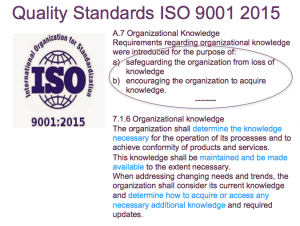
My topic was Knowledge Capture & Retention and ISO 2015. Perhaps surprisingly few in the room were aware of last year’s ISO update which for the first time included this on KM:

A fuller account of the proceedings and the twitter chat can be found at eventifer.

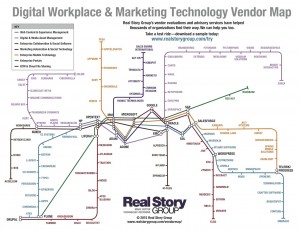
subway_Graphic_2015_1280pxI was really taken by the closing Keynote from Tony Byrne of The Realy Story Group who gave an illuminating talk on the landscape of digital workplace and social enterprise tools and apps. His Technology Vendors Map is well worth a look.
If this is a topic of interest I’d also point you to an excellent article from Dion HInchcliffe on Social Collaboration Tools.

As in 2015 Nooq won the ‘coolest tool’ category. Its a great visualisation tool to show what’s happening in an organisation and sits above enterprise applications.

and finally

This year for the first time there was a day of Masterclasses after the event. I was delighted to have had the opportunity to work alongside Luis Suarez (@elsua) who is a #noemail evangelist.

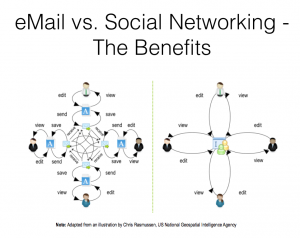
Screen Shot 2016-04-19 at 16.16.12Luis ran the morning and I ran the afternoon. His method and justification for lowering email usage are compelling and I loved this slide that shows how a social networking platform can be a lot more efficient than using email.

And now back in the UK I have a couple of week’s focusing on the next chapter of the book I am coauthoring with Patricia Eng before travelling back to the Mid East and Lisboa.